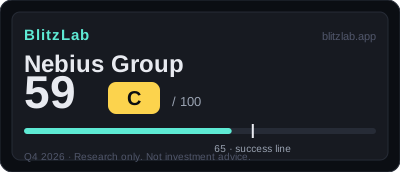
Nebius Group — Blitz Index 59 (C)
Prepaid blitz — customers fund the buildout. Highest of the neo-cloud trio.
Last re-scored: October 11, 2026.
Confidence: High · Nasdaq-100 · Category: ai-infra
Score breakdown
| Section | Score | Detail |
|---|---|---|
| A · Speed | 20 / 25 | Q2 2026 $582.3M (+454% YoY); AI cloud +514%; ARR $1.9B to $3.0B in one quarter |
| B · Moat | 36 / 60 | MSFT $19.4B + Meta $12B contracts; 170MW to 1GW to 5GW power pipeline |
| C · Creative destruction | 11 / 15 | Hyperscalers buying from neo-cloud — structural inversion; $40B+ backlog lock-in |
| D · BlitzFailing | −8 | Pro forma debt ~$13.5B (10x TTM); FY2026 capex $20-25B (7x guidance) |
Think we scored it wrong? Score it yourself →
Radar axes (0–100): Moat 60 · Speed 80 · Creative 73.
Watch item
Gates: G1 pass · G2 pass (estimated). Neo-cloud trio: NBIS 59 > IREN 56 > CRWV 53. 6 below threshold — first-ever score.
Strengths
- AI cloud +514% YoY (SEC); ARR $1.9B to $3.0B in a single quarter (+598% YoY)
- $40B+ backlog (~30x TTM) + $9B+ 2026 prepayments — demand visibility and funding solved together
- Adj. EBITDA margin 41% (Q2), AI cloud segment 50% — fastest margin turnaround of the trio
- Nvidia $2B investment + Reference Platform partner + Vera Rubin first validation
Concerns
- Customer concentration: MSFT + Meta are most of the $40B+ backlog — two decisions from disruption
- Pro forma debt ~$13.5B (10x TTM) + FY2026 capex $20-25B — sold contracts, still building
- -13% on August converts announcement — dilution sensitivity remains
- Meta $15B backstop is conditional — only $12B of the $27B headline is firm
Research notes
Thesis: a neocloud built on sold capacity
Nebius Group N.V. is, in the terms of this scoring, a neocloud: a company whose business is selling artificial-intelligence compute capacity, principally through large, long-dated contracts with customers that include the very hyperscalers it is often assumed to compete with. At the scoring date, T = 2026-10-11, Nebius earned a BlitzLab v1.0 total of 59 out of 100, grade C — six points below the 65-point threshold used in this model. The section totals are Speed 20 of 25, Moat 36 of 60, Creative Destruction 11 of 15, and Demerits of minus 8. Converted to the model's three radar axes, that is Speed 80.0, Moat 60.0, and Creative Destruction 73.3. There is no FLAG: the demerit total of 8 sits below the 15-point FLAG threshold.
This was a first scoring, with no blind-scoring history behind it. That matters for how the result should be read. The score is a snapshot of a company in the middle of a very fast transition, not a verdict on a long, stable record. Nebius traces its corporate history to Yandex N.V., which sold its Russian assets in 2024 and then changed its name and relisted as Nebius Group. The score file is explicit that the old Yandex-era results have nothing to do with the present business, and the scoring rests on the new company's filings and reporting, not on that legacy.
Both gates passed. Gate G1, which asks whether growth is sustained or a second growth curve is present, passed on confirmed figures: second-quarter 2026 revenue and, above all, the scale and composition of the AI cloud segment. Gate G2, which asks whether the ten-year ceiling of the new market is at least ten times current revenue — a bar of approximately $13.6 billion against trailing-twelve-month revenue of about $1.36 billion — passed on estimates. The score file is careful here: the order backlog alone is not treated as a ten-year ceiling, so G2 rests on industry estimates of AI infrastructure spending running into the hundreds of billions of dollars, with the backlog cited as supporting context rather than as proof on its own.
The central character of this company, as the score file presents it, is a reversal. Microsoft and Meta — the hyperscalers that might be expected to supply their own capacity — are buying capacity from Nebius. That single structural fact runs through almost every section of the score: it explains the growth, it explains the distribution score, it explains the creative-destruction score, and it also explains the largest risk, which is concentration. The thesis, in one sentence, is that Nebius is selling a future that is already largely contracted, and is building the physical capacity to deliver it with money that is, to an unusual degree, supplied in advance by its customers.
Speed: the fastest growth in the measured set, from a small base
Speed is Nebius's strongest axis, at 20 of 25, and the growth item within it, A1, scored 9 of 10. The figures behind that score are confirmed in SEC filings and they describe acceleration, not merely growth. Full-year 2025 revenue was $529.8 million, up 479 percent year over year. Trailing-twelve-month revenue at the scoring date was approximately $1,355 million, built quarter by quarter from $146.1 million in the third quarter of 2025, to $227.7 million in the fourth quarter, to $399.0 million in the first quarter of 2026, and to $582.3 million in the second quarter of 2026. Year-over-year growth was 684 percent in the first quarter of 2026 and 454 percent in the second. The AI cloud segment accounted for $574.9 million of the second quarter's $582.3 million — 98.7 percent of consolidated revenue — and grew 514 percent year over year.
Annualized recurring revenue, reported on a press-reported basis, rose from $1.9 billion at the end of March 2026 to $3.0 billion at the end of June, up 598 percent year over year. Full-year 2026 guidance, maintained at the scoring date, called for revenue of $3.0 to $3.4 billion and annualized recurring revenue of $7 to $9 billion. The score file withholds the tenth point on A1 for a specific reason: the base is still small — AI cloud revenue grew from $93.7 million to $574.9 million — and a full 10 would require demonstrated growth of more than 100 percent sustained even at an $8 billion annualized recurring revenue run rate. That condition is a useful discipline. It separates a company that is growing fast because it started small from a company that has proven it can keep growing fast at scale.
Capital velocity, A2, scored 4 of 5, and here the score file shows both faces of the same fact. Access to capital was, in its words, of the highest grade. Nvidia invested $2 billion in March 2026, taking a 9.3 percent stake disclosed in a Schedule 13G. Convertible notes followed: $4.34 billion in March 2026 and then $5.75 billion on 2026-08-24, confirmed in SEC filings. An at-the-market program raised approximately $2.8 billion through the end of June, a $775 million senior facility was added in July 2026, and customer prepayments of more than $9 billion were expected for 2026. Market capitalization was approximately $64 to $69 billion in September and October 2026. The other face is dilution. The August convertible announcement was accompanied by a 13 percent share-price fall, and the score file notes ongoing dilution, including the parallel exchange of an existing $800 million note and 15.8 million shares. Raising capital is both the engine and a cost, and the deductions section returns to that tension.
Hiring and productivity, A3, scored 3 of 5. Headcount was 1,543 employees on the basis of the annual report on Form 20-F, up 29.1 percent year over year, with a LinkedIn figure of approximately 1,700 people in October 2026, rising month by month, cited on a press-reported basis. Revenue per employee was approximately $0.88 million on trailing-twelve-month revenue divided by headcount — about one quarter of the approximately $3.5 million figure cited for CoreWeave. The score file is conservative here for a stated reason: in a GPU business, the bottleneck is power and capital rather than headcount, so the productivity ratio is informative but not decisive. Hiring is plainly in blitz mode; the score simply refuses to treat headcount growth alone as proof of operating leverage.
Share velocity, A4, scored 4 of 5. Nebius is described as the second-largest of the three neoclouds, behind CoreWeave, in a contest the score file calls a three-way race. Four AI cloud contracts of more than $1 billion each were signed in the second quarter of 2026, and the value of new customer contracts rose more than ninefold. The Microsoft contract of $19.4 billion and the Meta contract of $27 billion on a headline basis are the landmarks of this expansion. Pricing power is also evidenced, on a press-reported basis, by a 30 percent repricing of older GPUs, a 15 percent premium achieved at auction, and an on-demand price increase on 2026-10-01 that included a 21 percent rise for B300 capacity. The fifth point was withheld because no quantified market share figure was confirmed. The score therefore credits the direction and the contract evidence, but not a market-share claim that the record does not support.
Moat: capacity, contracts, and a software stack still being assembled
Moat is the weakest of the three positive axes in proportional terms — 36 of 60 — and that is where the most interesting judgment in this scoring lives. Nebius does not have, in the score file's plain language, a true network effect, because it is a capacity business. Its network-effects item, B1, scored 7 of 18. What it does have is a growing software layer wrapped around bare-metal rental: Token Factory, a managed inference offering; Tavily, an agentic search company acquired in February 2026; Eigen AI, cited at $643 million on a press-reported basis; the Clarifai team; and Inferize, acquired on 2026-10-01 and therefore included in this scoring. Alongside that sits a supply-side advantage that is not a network effect but functions somewhat like one: Nvidia Reference Platform Cloud Partner status, a 9.3 percent Nvidia stake, and priority access to next-generation chips, plus a preferred sovereign partnership with Palantir confirmed in an SEC filing dated 2026-09-08. The score is one point below CoreWeave's 8 on this item, for a stated reason: the revenue contribution of the software stack has not been disclosed in quantified form. The stack is expanding; its commercial weight is not yet proven in numbers.
Distribution scalability, B2, scored 12 of 18, and this is the highest single moat item. Operating capacity was 170 megawatts at year-end 2025, confirmed in the Form 20-F, with a target of 800 megawatts to 1 gigawatt connected by year-end 2026 and a contracted-power target of 5 gigawatts, raised from 2.5 gigawatts. The footprint spans Vineland, New Jersey — where the Microsoft contract is structured in nine tranches — together with Finland, the United Kingdom, Iceland, France, and Missouri. Execution evidence exists: the first Microsoft tranche was delivered on time in November 2025 and the second in February 2026, both confirmed in the Form 20-F. The discount is structural and is stated with unusual clarity in the score file: "the contracts are sold, and the buildings are being built." That is the same structural risk carried by CoreWeave, and it is why the score is one point below CoreWeave's 13 — Nebius is, on scale and demonstrated execution, one tier below.
Market size, B3, scored 10 of 12. The AI infrastructure market is estimated in the hundreds of billions of dollars on industry estimates, and the backlog of more than $40 billion stands alone at roughly three times the G2 bar of $13.6 billion. The Nvidia partnership adds a further marker: a target of deploying more than 5 gigawatts of Nvidia systems by 2030. The full 12 points were withheld pending demonstrated achievement of the $7 to $9 billion annualized recurring revenue guidance. As with A1, the pattern is consistent: the score credits the contracted future, but reserves its highest marks for a future that has actually arrived.
Gross margin, B4, scored 7 of 12, and the score file insists on showing its working. Excluding depreciation, the cost-of-revenue ratio of 23 percent implies a gross margin of approximately 77 percent, confirmed in SEC filings. Including depreciation and amortization of $259.7 million — 45 percent of revenue — the honest figure is approximately 32 percent. Adjusted EBITDA margin was 41 percent in the second quarter, with the AI cloud segment at 50 percent on a press-reported basis, and adjusted EBITDA swung from negative $64.9 million in full-year 2025 to positive $236.2 million in the second quarter of 2026. GAAP results, however, remained a net loss of $190.4 million in the quarter. The score is one point above CoreWeave's 6, reflecting the speed of the margin turnaround. The lesson of the two margin figures is worth carrying forward: in a business where the assets are GPUs that depreciate fast, a margin quoted before depreciation flatters the economics, and the score file's decision to print both numbers is part of what makes this scoring credible.
Creative destruction: the hyperscaler as customer
Creative destruction scored 11 of 15, the second-highest axis proportionally, and it is driven by the same reversal described in the thesis. The order being displaced, C1, scored 4 of 5. Neoclouds are displacing and supplementing the GPU supply of general-purpose hyperscalers in the AI workload domain, and the score file's formulation is precise: Microsoft and Meta are procuring Nebius capacity, which means the hyperscaler is buying from the neocloud rather than simply competing with it. AI cloud revenue was 98.7 percent of consolidated revenue in the second quarter of 2026, on a confirmed basis. The company is still small relative to the whole cloud market, but it has become core infrastructure for AI training and inference, and that is enough for 4 points.
Irreversible behavioral change, C2, scored 4 of 5 — the highest of the three neoclouds on this item. The basis is contractual lock-in of an unusually capital-heavy kind: a five-year Microsoft contract of $19.4 billion, and a Meta arrangement comprising $12 billion of confirmed value over five years plus a $15 billion backstop. Expected prepayments of more than $9 billion in 2026, with 70 percent of second-quarter contracts including prepayments on a press-reported basis, create a capital structure that is difficult to unwind. The score file notes that this is structurally stronger than CoreWeave's 3 on the same item, because of the investment-grade character of the customers and the scale and prepayment share of the contracts. One qualification must be preserved exactly as the score file states it: the Meta backstop is conditional — it applies if capacity cannot be sold to third parties — so within the $27 billion headline, the confirmed portion is $12 billion. Treating the headline as confirmed value would overstate the lock-in.
Cost-structure change, C3, scored 3 of 5. The claimed mechanism is lower unit compute cost from Nvidia priority allocation and purpose-designed data centers, together with the removal of an "idle GPU tax" through Token Factory and the Inferize acquisition, improving utilization and token economics. The score withholds more because the present evidence runs in the opposite direction on price: this is currently a price-increase phase, with B300 prices up 21 percent and older GPUs repriced up 30 percent. That is evidence of supplier-side pricing power in a shortage, not evidence of a collapsing cost structure, and no measured unit-cost figure has been disclosed. The distinction is important and the score file draws it cleanly: charging more because demand exceeds supply is not the same as making compute structurally cheaper.
Deductions and risks: large debt, light interest — for now
Total demerits are minus 8, composed of debt at minus 7, revenue quality at 0, governance at minus 1, and regulatory or social cost at 0. That composition is more informative than the total alone.
Debt, D1, scored minus 7 of a possible minus 10. Total debt was $8.55 billion at 30 June 2026, confirmed in SEC filings, and adding the August 2026 convertible notes of $5.75 billion and subtracting the $0.8 billion exchange gives a pro forma figure of approximately $13.5 billion on an estimated basis — roughly ten times trailing-twelve-month revenue, and a higher multiple than CoreWeave's 4.6 times. Lease liabilities of more than $1.51 billion are confirmed on top of that. Full-year 2026 capital expenditure guidance of $20 to $25 billion, on a press-reported basis, is approximately seven times revenue guidance. Those are the figures that justify a heavy deduction.
The offsetting factors, which are why the deduction is minus 7 rather than minus 8 for CoreWeave or worse, are equally specific. Interest expense of $119.1 million per quarter equals 0.5 times adjusted EBITDA, against 5 times for CoreWeave, on a confirmed basis. The debt is concentrated in convertible notes with low coupons — the August issue comprised 0.50 percent notes due 2030 and 4.50 percent notes due 2034 — and the structure is, in the score file's phrase, "built with customer money": cash of $8.04 billion and deferred revenue of $5.98 billion, both confirmed, plus expected prepayments of more than $9 billion on a press-reported basis, covering 50 to 60 percent of capital expenditure. The score file's summary of this position is worth quoting in substance: the debt is large, but the interest is light — for now. The "for now" is doing real work, because the interest burden depends on the adjusted EBITDA that the new capacity is supposed to generate, and that capacity is still being built.
Revenue quality, D2, scored 0: no restatement, auditor change, or audit-opinion issue was found in the disclosure record. One item is recorded and correctly not treated as misconduct: a $597.4 million revaluation gain on Toloka included in second-quarter 2025 net income, disclosed as non-recurring income. Governance, D3, scored minus 1 for a three-tier differential voting structure — Class A shares at €0.01, Class B at €0.10, and Class C at €0.09, confirmed in the Form 20-F and Form 6-K — with the founder Volozh's voting share unconfirmed. No insider-selling issue was confirmed. The deduction is light precisely because the concentration itself is unconfirmed; the structure exists, the degree does not, and the score refuses to invent it. Regulatory and social cost, D4, scored 0: no securities litigation or fines were confirmed in the disclosure record, while market concerns about valuation and customer concentration were recorded at press level only and not scored.
Beyond the scored deductions, the score file's "concerns" section names risks that the v1.0 model does not fully capture, and a faithful research body should carry them forward rather than bury them. Customer concentration is first: Microsoft and Meta account for most of the more-than-$40 billion backlog, so a problem in one contract is, in the score file's words, a problem for the whole company. The second is execution: the $20 to $25 billion capital program must be delivered while the contracts it serves are already sold. The third is dilution sensitivity, demonstrated by the 13 percent share-price fall on the August convertible announcement, with remaining at-the-market capacity of 12.3 million shares plus convertible conversion volumes still to come. The fourth is the conditional character of the Meta backstop, already noted. The fifth is the combination of a continuing GAAP loss of $190.4 million per quarter with a valuation note — a market capitalization of approximately $64 to $69 billion against trailing-twelve-month revenue of approximately $1.36 billion, implying a price-to-sales ratio of approximately 47 to 51 times, with a 52-week range of $73.52 to $299.86 — that the score file explicitly excludes from the business score, citing the lesson of an earlier test that the business score does not look at price. A second blitz failure, the score file warns, would land heavily at that starting point. That warning is a statement about fragility, not a forecast, and it should be read as such.
The blitzscaling fit analysis in the score file ties these threads into a single image. Nebius's primary levers are distribution — where distribution means power and data-center sites, with capacity rising from 170 megawatts toward 1 gigawatt and then a contracted-power target of 5 gigawatts — and capital. Its secondary lever is platform, the software stack being wrapped around rental. Its weak lever is network effects, a structural limit of a capacity business, where Nvidia priority allocation is a supply-chain advantage rather than a network effect. The judgment is that Nebius is the same species as CoreWeave — a "heavy-equipment blitz" — in a European-origin variant whose customers are Microsoft and Meta. The trade of speed against efficiency is made in a distinctive way: speed is bought with customer money, through prepayments, and time is bought with convertible notes carrying low coupons. The company is in the early acceleration phase of its first blitz, with a revenue run rate rising from $0.53 billion in full-year 2025 toward guidance of $3.2 billion for full-year 2026 and an annualized recurring revenue target of $8 billion by year-end, against a backlog described as "a future already sold." And the single largest risk, as the score file names it, is that two customers are effectively the company: the blitzscaling rules do not guarantee that demand lasts forever, and Nebius's demand rests, in practice, on two decisions.
What to watch
The next marker on the calendar is third-quarter 2026 earnings, scheduled for 2026-10-22, which fell after the scoring date and was therefore excluded from this score. No outcome is predicted here; the earnings release is noted only as the next point at which the figures in this draft can be checked against new disclosures. The items to check then, and in the quarters after, follow directly from the scoring.
First, the annualized recurring revenue path: whether the $7 to $9 billion full-year guidance range is being approached, and whether growth above 100 percent can be demonstrated at an $8 billion run rate, which is the condition the score file sets for a full A1 mark. Second, delivery: whether the build from 170 megawatts toward the 800-megawatt to 1-gigawatt year-end target stays on schedule, and whether further Microsoft tranches arrive on time as the first two did. Third, the funding mix: whether prepayments continue to cover 50 to 60 percent of capital expenditure, and whether the pro forma debt figure of approximately $13.5 billion grows faster or slower than the revenue that must service it. Fourth, the margin question in its honest form: whether the approximately 32 percent gross margin including depreciation widens, and whether adjusted EBITDA continues to cover interest at anything like the current 0.5-times ratio as the capital program scales. Fifth, the software stack: whether Token Factory, Tavily, Eigen AI, Clarifai, and Inferize begin to show a quantified revenue contribution, which is the missing evidence behind the B1 score of 7. And sixth, concentration: any change in the Microsoft or Meta arrangements, including the status of the conditional $15 billion Meta backstop, and any sign that the backlog's dependence on two customers is narrowing or widening.
Nebius at 59 is, in the end, a company that scores like a blitz in progress rather than a blitz completed. Its speed is exceptional and its contracted demand is extraordinary, but its moat is still a capacity position plus a software stack under construction, and its balance sheet is a bet that contracted demand will convert into delivered capacity on schedule. The score of 59/C records both halves of that sentence, and the quarters ahead will show which half grows heavier.
Head-to-head
Nebius Group vs CoreWeave — side-by-side scorecard comparison.
More AI Infra companies
Other AI Infra names on the Blitz Index, highest score first: NVIDIA (87/A), Arista Networks (73/B), Advanced Micro Devices (62/B).
Next earnings
Nov 12, 2026 · Before open · Confirmed
Coverage
As of October 2026 · Model v1.0 (frozen) · Confidence: High (listed, SEC filings) · Not investment advice — a scholar's assessment.
Embed this score
Copy the HTML below to show this score on your site. The badge links back to this page and updates automatically when the score changes.
Preview:
BlitzLab scores businesses against a scholar’s standard — not investment advice. No price targets, no buy/sell recommendations. Figures are from SEC filings (XBRL) as labeled in the source scorecard.