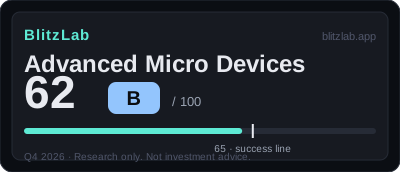
Advanced Micro Devices — Blitz Index 62 (B)
OpenAI and Meta each signed 6GW — demand visibility does not get better than this.
Last re-scored: November 3, 2026.
Confidence: High · S&P 500 · Nasdaq-100 · Category: ai-infra
Score breakdown
| Section | Score | Detail |
|---|---|---|
| A · Speed | 19 / 25 | Q2 2026 +50% YoY; Data Center +107%; $41.3B TTM base |
| B · Moat | 36 / 60 | 6GW multi-year contracts with OpenAI·Meta (SEC); Helios rack-scale at 9 sites |
| C · Creative destruction | 10 / 15 | System-company pivot: rack-scale AI from chips to turnkey |
| D · BlitzFailing | −3 | ~20% warrant dilution overhang; China 22.4% export-control exposure |
Think we scored it wrong? Score it yourself →
Radar axes (0–100): Moat 60 · Speed 76 · Creative 67.
Watch item
Gates: G1 ✓ · G2 ✓ (borderline, company TAM estimate). 3 points below the threshold — Q3 2026 rescore (B2 11→12, C2 3→4). The warrant structure converts customer lock-in into shareholder dilution.
Strengths
- Q3 2026: first Helios systems in use at Microsoft·Meta·OpenAI·Anthropic·OCI; MI450 ramp begun
- 6GW contracts each from OpenAI and Meta (SEC-confirmed)
- Net cash ~+$9.9B + $5B revolver undrawn
- GAAP GM 53.8% (Q2); FCF FY2025 $5.5B
Concerns
- Warrants could dilute ~20% (~320M shares) if fully vested
- AI accelerator share: NVIDIA 90%+ reality vs 6GW only now entering delivery
- China 22.4% of revenue — MI308 $800M reserve precedent
- ROCm trails CUDA — no software-ecosystem moat (B1 5)
Research notes
Thesis: a second blitz, already showing up in the accounts
Advanced Micro Devices enters this scoring period as a mature company in the middle of a second act, and the score of 62 out of 100, grade B, reflects exactly that position: strong enough to clear both gates of the BlitzLab model, fast enough on speed, and still short of the 65-point threshold by three points. The arithmetic is 19 points for speed, 36 for moat, 10 for creative destruction, and minus 3 in deductions, for a total of 19 + 36 + 10 − 3 = 62. There is no FLAG, because total deductions of 3 fall well below the 15-point FLAG threshold. The assessment was first dated 16 October 2026 on second-quarter 2026 results, disclosed in an 8-K on 4 August 2026 and a 10-Q on 5 August 2026, and was re-scored on 3 November 2026 when third-quarter 2026 results were published. In the third quarter, the first Helios rack-scale systems were in use at Microsoft, Meta, OpenAI, Anthropic, and Oracle Cloud Infrastructure, and the MI450 ramp began, so the contract stage that had held back the distribution and behaviour-change marks is partly resolved and delivery has begun to be demonstrated. That re-scoring moved distribution scalability (B2) from 11 to 12 and irreversible behaviour change (C2) from 3 to 4, lifting the total from 60 to 62.
The first blitz in AMD's recent history was the recovery of share in x86 server processors with EPYC, a campaign that ran roughly from 2017 to 2023. The second blitz, which began around 2024, is the move into artificial intelligence acceleration and rack-scale systems, built on Instinct accelerators alongside EPYC. What makes this scoring distinctive is that the second blitz is not a promise about a future market alone. By the second quarter of 2026, the Data Center segment accounted for 58.2 percent of total revenue, up from 22.5 percent in 2021. Data Center revenue grew from $3,694 million in 2021 to $16,635 million in 2025, a 4.5-fold increase over four years on figures confirmed in SEC filings. In the second quarter of 2026 alone, Data Center revenue reached $6,718 million, up 107 percent year on year. A company can announce an AI strategy without much difficulty; a company whose largest segment has become the data center, at that rate of growth, is demonstrating something else. The score treats AMD as a mature company undergoing a second growth curve, and both gates pass on that basis.
Gate 1, which asks whether growth continues or a second growth curve is present, passes on confirmed figures. Gate 2, which asks whether the ceiling of a new market over ten years is at least ten times current revenue, passes on the borderline, and the borderline character of that pass matters. Trailing twelve-month revenue at T was $41,305 million, so the bar implied by the model is about $413 billion. The adopted total addressable market range is the whole AI data center silicon market of more than $1 trillion by 2030, covering GPUs, CPUs, networking, and FPGAs, which matches the breadth of AMD's business across Instinct GPUs, EPYC CPUs, AI networking, FPGAs, and Helios rack-scale systems. That figure is a company estimate, presented by Lisa Su at AMD's analyst day in November 2025 and reported in the press, not an independently verified figure. The accelerator-only market estimate of $500 billion by 2028, also a company estimate, would on its own be only about 1.2 times the bar, while the broader $1 trillion figure is about 2.4 times the bar. The scoring therefore records Gate 2 as a borderline pass dependent on a company estimate, with the absence of independent verification noted as a risk rather than hidden behind the pass mark.
Speed: growth at a scale where growth is supposed to slow down
Speed contributes 19 of a possible 25 points, the strongest of the three positive axes when converted to a comparable scale, and growth itself is the single largest contributor. Growth, item A1, scores 9 of 10. Full-year 2025 revenue was $34,639 million, up 34 percent year on year on SEC-confirmed figures. The first quarter of 2026 grew 38 percent, and the second quarter reached $11,536 million, up 50 percent year on year and 13 percent quarter on quarter, again on SEC-confirmed figures. Trailing twelve-month revenue stood at $41,305 million, and guidance for the third quarter of 2026 was about $13.0 billion, up 41 percent year on year, also SEC-confirmed. The reason the item stops at 9 rather than 10 is instructive: the pure revenue contribution of the AI transition is not separately disclosed, so the scorer cannot isolate it cleanly even though the direction and magnitude of growth are confirmed.
The treatment of acquisition-driven growth is handled explicitly in the score file, and it strengthens rather than weakens the growth reading. ZT Systems, acquired in a transaction that closed in March 2025 for $4.4 billion, is described in the 10-Q as "not material" within Data Center, so the growth assessment is effectively an organic one. Xilinx, acquired in 2022, is already embedded in the base, with organic trends visible in the years that followed: revenue fell 3.9 percent in 2023 and rose 13.7 percent in 2024. At a revenue base above $41 billion, growth rates of 34 to 50 percent are, by the standard applied in the score file, of the highest order for a company of this size. The withheld tenth point is a discipline about disclosure, not a doubt about direction.
Capital velocity, item A2, scores 4 of 5. Access to capital is rated at the highest level in the score file, and the balance sheet explains why. Market capitalisation was about $918 billion as of 15 October 2026 on a press-reported basis. Net cash was about positive $9.9 billion on SEC-confirmed figures, supported by a $5.0 billion undrawn unsecured revolving facility, also SEC-confirmed, and a $14 billion share repurchase programme with $9.4 billion remaining, also SEC-confirmed. There was no dilutive fundraising of the kind that would weigh against this item. The warrants held by OpenAI and Meta, 160 million shares each at an exercise price of $0.01, are a potential dilution, but they were unvested as of 27 June 2026 on SEC-confirmed figures and are tied to milestones, so the score file treats the quality of capital access itself as high while recording the dilution question separately under governance.
Hiring and productivity, item A3, scores 3 of 5. Headcount was about 31,000 on figures confirmed in the 10-K, and revenue per employee works out to about $1.33 million per person on trailing twelve-month revenue divided by headcount, a calculated figure that the score file describes as elite-level productivity. Quarterly research and development spending was $2,528 million, or 21.9 percent of revenue, on SEC-confirmed figures, and the score file notes continued hiring of AI strategy personnel. The score is held at 3 rather than higher for a narrow reason: the year-on-year growth rate of headcount could not be confirmed, so the scorer chose the conservative mark. That restraint is characteristic of this scoring throughout, where an unconfirmed input produces a lower mark rather than an assumed one.
Share velocity, item A4, scores 3 of 5, and here the two fronts of AMD's business pull in different directions. In server CPUs, AMD's share is about 40 percent on a company claim reported in the press, and the direction of travel is expansion against Intel. In AI accelerators, the front on which blitzscaling is most directly contested, NVIDIA holds more than 90 percent on a press-reported basis, while AMD's stated ambition is a double-digit share over the next ten years, again a company claim reported in the press. What is confirmed in SEC filings is the shift in revenue mix: Data Center moved from 22.5 percent of revenue in 2021 to 58.2 percent in the second quarter of 2026. The conversion of CPU and accelerator positions into share is therefore under way, but numerical proof of AI accelerator share does not yet exist in the evidence reviewed, and the score reflects that gap at 3 rather than rewarding the ambition.
Moat: customers as distribution, and the limits of that moat
Moat contributes 36 of a possible 60 points, and its composition tells the story of AMD's competitive position more precisely than the subtotal alone. The weakest moat item is also the most structurally revealing. Network effects, item B1, score 5 of 18. The score file is explicit that there is no true network effect here, as a matter of the structure of the business: AMD sells semiconductors. What exists in place of a network effect is contractual lock-in. OpenAI and Meta each hold warrants for 160 million shares alongside multi-year contracts for 6 gigawatts each, confirmed in SEC filings, but those warrants were unvested as of 27 June 2026. The ROCm software ecosystem, which would be the natural candidate for an ecosystem effect, trails CUDA, and the score file records that its standing is not quantitatively confirmed. The mark sits at the bottom of the 5 to 9 anchor band for weak data or ecosystem effects, below the comparable company Broadcom at 7, where a lock-in effect had been demonstrated in practice. AMD's moat, in other words, is not built on users attracting users. It is built on customers embedding AMD into their infrastructure plans.
Distribution scalability, item B2, scores 12 of 18, the highest moat item, and it is where that customer-embedding strategy pays off most clearly. In this business, the large demand partner is the distribution channel. OpenAI and Meta each have multi-year, multi-generation supply arrangements for 6 gigawatts, with the first gigawatt of MI450 supply beginning in the second half of 2026, all confirmed in SEC filings. Helios rack-scale turnkey systems are supplied to a named set of customers that includes Anthropic, Cirrascale, HUMAIN, Microsoft, OpenAI, Oracle, Tensorwave, and Vultr, on company announcements confirmed in SEC filings, and Oracle's public AI supercluster is also noted on a press-reported basis. A chief financial officer comment referring to tens of billions of dollars of revenue appears in an SEC 8-K. There is no viral or platform-based distribution of the kind a consumer product might enjoy, but within enterprise design-win distribution, the score file rates this as the highest grade, two points above Broadcom at 9 for general channels. The withheld points have a clear reason: 6 gigawatts was at the contract stage, before revenue recognition. Third-quarter 2026 results, published 3 November 2026, partly resolve that premise: the first Helios systems are in use at Microsoft, Meta, OpenAI, Anthropic, and Oracle Cloud Infrastructure, and the MI450 ramp has begun, so the mark moves from 11 to 12, with full conversion into recognised sales still to be demonstrated.
Market size, item B3, scores 10 of 12, following directly from the Gate 2 analysis. The market is large and AMD participates across multiple axes, with Instinct GPUs, EPYC CPUs, networking, and FPGAs all addressing the AI data center silicon market. The full mark is reserved until AI accelerator share is numerically demonstrated, which is the same evidence gap that limits share velocity. The score file is consistent on this point: size is credited, dominance within the largest part of that market is not yet credited.
Gross margin, item B4, scores 9 of 12. GAAP gross margin in the second quarter of 2026 was 53.8 percent, with non-GAAP gross margin at 56 percent, both SEC-confirmed, against 39.8 percent in the prior-year period, a comparison that reflects both the disappearance of the MI308 charge and a richer Data Center mix. Full-year gross margins were stable across 2023 to 2025 at 50.0 percent, 49.3 percent, and 49.5 percent. Operating margin in the second quarter was 17.3 percent, SEC-confirmed. Free cash flow was $5,519 million in full-year 2025 and $4,124 million in the first half of 2026, both SEC-confirmed, and the Data Center segment's operating margin was 21.7 percent in full-year 2025, SEC-confirmed. The structural burden sits in the All Other category at negative $4,007 million, including $2,254 million of amortisation of acquired intangible assets. The mark is one point below Broadcom at 10, whose gross margin was 69 percent, a comparison the score file makes explicitly. Profitability accompanies growth here rather than being sacrificed for it, but the margin structure still carries the cost of past acquisitions.
Taken together, the moat section describes a company whose defensibility rests on design wins and system-level supply rather than on a self-reinforcing user network. That is a coherent moat for an enterprise semiconductor business, and it is also a moat whose strength will be tested by delivery: contracts lock customers in only as long as the products arrive on the roadmap that was promised.
Creative destruction: replacing one order, challenging another
Creative destruction contributes 10 of a possible 15 points, split across three items that again divide along the two-front structure of the business. The order being replaced, item C1, scores 4 of 5. In CPUs, EPYC is replacing the x86 server CPU order, with share of about 40 percent on a company claim reported in the press, and the scale and demonstration of that replacement are substantial. In AI accelerators, the challenge to NVIDIA's order, with more than 90 percent share on a press-reported basis, is under way but still early. The combined assessment lands between the anchors: 5 would require a clear and large-scale replacement, 3 would describe replacement under way but limited in scope, and the score file places AMD between them at 4. The distinction matters because it refuses to let success on one front stand in for success on the other.
Irreversible behaviour change, item C2, scores 4 of 5. OpenAI and Meta have embedded AMD from the design stage of their infrastructure roadmaps, through multi-generation 6-gigawatt contracts and purchase-milestone-linked warrants. A hyperscaler that designs its architecture around a supplier's roadmap does not reverse that decision casually, and the score file recognises the structural difficulty of unwinding such an arrangement. The mark was held at 3 rather than higher because, as of 27 June 2026, the warrants were unvested and volumes had not yet been delivered: that was the contract stage, not yet the delivered stage. Third-quarter 2026 results, published 3 November 2026, add evidence of actual Helios delivery and use, so the behaviour change moves from under way to demonstrated in part and the mark moves from 3 to 4; a full 5 is reserved because the number of vested warrants is still unconfirmed. The comparison drawn in the score file is with a company where delivery plus prepayments had been demonstrated, which scored 4. AMD's behaviour change is therefore recorded as under way rather than completed, and the difference between a signed roadmap and a shipped system is preserved in the number.
Cost structure change, item C3, scores 2 of 5, the lowest creative destruction item, and the reason is the absence of third-party verification. Helios rack-scale represents an attempt to shift from selling chips to selling turnkey rack units, with a company claim of leadership on a dollars-per-inference-token basis, on company announcements confirmed in SEC filings. No third-party verified measurement of unit cost per token has been disclosed, so the claim remains at the assertion stage and the score stays at 2. This is the same discipline seen elsewhere in the scoring: a company claim is recorded as a company claim, and a cost breakthrough is credited only when it can be measured by someone other than the claimant. The rack-scale transition may yet prove to be the most consequential change in how AMD sells, but at T it is a strategic shift announced, not a cost collapse demonstrated.
Deductions and risks: a clean balance sheet with two live exposures
Deductions total minus 3, which is why no FLAG is raised, but the three deductions that do exist point at the risks most worth watching, and the two items scored at zero are as informative as the deductions themselves. Debt, item D1, scores 0, the best possible mark. Total debt principal was $3,250 million, or 0.08 times trailing twelve-month revenue, on SEC-confirmed figures. Cash was $5,086 million and short-term investments were $8,025 million, totalling $13,111 million, with net cash of about positive $9.9 billion on an estimated basis. Quarterly interest was $37 million against operating profit of $1,990 million, an interest coverage ratio above 50 times on an estimated basis. A guarantee on Xilinx notes exists, but covenant compliance is SEC-confirmed and no trigger is present. This is the financial foundation of the "blitz on earned money" reading in the score file: the speed described above is funded by cash generated and customer contracts, not by borrowing, and the debt item records that fact with a clean zero.
Revenue quality, item D2, also scores 0. There was no revenue restatement and no audit opinion issue, with EY as auditor, on SEC-confirmed figures. The segment reorganisation in the first quarter of 2025 was a presentation change with retrospective adjustment, not an accounting irregularity. The MI308 charge of $800 million in the second quarter of 2025 and the reversal of about $360 million in the fourth quarter, the latter on a press-reported basis, were disclosed one-off items and are not treated as triggers. A zero here does not mean the business is free of volatility; it means the volatility that occurred was disclosed through the proper channels rather than surfacing as a quality failure.
Governance, item D3, scores minus 1, and the deduction is entirely about the warrants. The governance structure itself is clean: a single class of common stock with no differential voting rights, confirmed in the DEF 14A and 10-K, and Lisa Su serving as both chief executive and chair since February 2022 on a press-reported basis. Institutional holders Vanguard at 8.8 percent and BlackRock at 7.7 percent are confirmed in the DEF 14A. The deduction reflects the other side of the customer lock-in strategy: if the OpenAI and Meta warrants vest in full, about 320 million shares, or about 20 percent, of dilution is possible. The warrants are currently unvested, so the dilution is potential rather than realised, and the deduction is correspondingly small at minus 1. But the structure deserves attention precisely because it is the price of the moat: the same instruments that bind two of the world's largest AI infrastructure buyers to AMD's roadmap would, if fully earned, transfer a substantial ownership stake to those customers.
Regulation and social cost, item D4, scores minus 2, the largest single deduction, and it rests on a realised event plus a live exposure. MI308 export controls for China, imposed through a Bureau of Industry and Security licence requirement in April 2025, produced the $800 million charge in the second quarter of 2025, confirmed in an SEC 8-K. Revenue from China including Hong Kong was $7,751 million in full-year 2025, or 22.4 percent of revenue, on SEC-confirmed figures, so any renewed tightening of controls would strike directly at a large revenue base rather than at a peripheral one. Dependence on third-party foundries, including TSMC, is recorded in the 10-K risk factors, and the 10-K also notes Intel's market position and the NVIDIA-Intel alliance announced in September 2025. The realised charge plus the scale of the China exposure together justify minus 2, and this item, more than any other deduction, connects a past cost to a continuing vulnerability.
Two further risks sit outside the deduction items but belong in any honest account of this score. The first is the software ecosystem: ROCm trails CUDA, and no network effect has formed around it, which is why B1 scores only 5. Hardware design wins can be lost if the software layer that developers actually use remains anchored elsewhere, and the score file does not assume that problem away. The second is manufacturing dependence: as a fabless company, AMD depends on foundry partners for yield and supply, so a production shortfall would land on the same delivery commitments that underpin the distribution score. These are not scored deductions beyond what is already captured, but they shape how the scored items should be read together.
What to watch: contracts becoming revenue
The path from 62 to the 65-point threshold is unusually legible in this scoring, because the score file identifies the items where the missing points could be earned, and all of them are observable within the next two to four quarters. The first is B1, where vesting of the OpenAI and Meta warrants would convert contractual lock-in from a promise into a demonstrated fact. The second is B4, where a rising Data Center mix could lift gross margin further from the second-quarter level of 53.8 percent on a GAAP basis. The third is C2, where continued recognition of 6-gigawatt contract revenue would move behaviour change from 4 toward a full 5; the first step, from 3 to 4, was taken in the third quarter, when Helios systems entered use. None of these requires a new strategy, a new market, or a new product line. All of them require the existing strategy to convert into shipments, recognised revenue, and vested milestones.
The central watch item, and the score file names it as the single largest blitzscaling risk, is delivery against the MI450 ramp. The first gigawatt of MI450 supply under the OpenAI and Meta arrangements began in the third quarter of 2026, with the first Helios systems in use at Microsoft, Meta, OpenAI, Anthropic, and Oracle Cloud Infrastructure, and the contracts are multi-generation by design. A single quarter of ramp delay would not merely defer revenue; it would put pressure on the customers' infrastructure roadmaps and on the warrant milestones tied to purchases. The score file puts the point sharply: the contracts have been sold, and delivery has only just begun. Demand visibility is, on the evidence reviewed, close to complete, which means that any failure on the supply side, whether in ramp, yield, or foundry capacity, would transmit directly into the score rather than being cushioned by demand uncertainty. That asymmetry is the defining tension of AMD at 62 points: a demand story that is unusually well documented, paired with a delivery story that is still to be proven.
The product roadmap provides the frame for watching that delivery. The accelerator sequence runs from MI300 through MI350 and MI400 to MI450 on an eighteen-month cycle, alongside the sixth-generation EPYC Venice processor, and the score file treats this product cadence as the secondary lever that pulls distribution forward: products attract the design wins, and design wins then pull the roadmap. Observers should therefore watch not only headline revenue but the composition of that revenue, whether Data Center continues to rise as a share of the total from 58.2 percent, whether gross margin moves with that mix, and whether the named Helios customers progress from announced supply to deployed systems. The third-quarter 2026 guidance of about $13.0 billion, up 41 percent year on year, sets the near-term bar for that conversion, and the third-quarter 2026 results, published 3 November 2026, are the first evidence that the contract stage is giving way to the delivery stage: the first Helios systems are in use at Microsoft, Meta, OpenAI, Anthropic, and Oracle Cloud Infrastructure, and the MI450 ramp has begun.
For context only, and not reflected in the business score, the score file records market capitalisation of about $918 billion as of 15 October 2026 on a press-reported basis, a price-to-sales ratio of about 22 times trailing twelve-month revenue, and a 52-week share price range of $188.22 to $658.52, with an all-time high of $658 reached on 6 October 2026. The BlitzLab model deliberately does not look at price when scoring the business, a lesson the score file attributes to earlier testing, so these figures are noted here as market context and play no part in the 62-point total. The score stands on filings, contracts, margins, and cash flow, and it will move when those move: upward if warrants vest, margins expand with the Data Center mix, and 6-gigawatt volumes are recognised as revenue, and downward if the MI450 ramp slips, export controls tighten against the 22.4 percent China exposure, or the customer warrants' potential dilution of about 20 percent begins to materialise. At 62 out of 100, grade B, AMD is scored as a mature company executing a second blitz whose demand side is documented and whose delivery side is now the whole question.
More AI Infra companies
Other AI Infra names on the Blitz Index, highest score first: NVIDIA (87/A), Arista Networks (73/B), Astera Labs (61/B).
Next earnings
Q4 2026 · Expected
Coverage
Advanced Micro Devices, Inc. · Q3 2026 reported Nov 3, 2026 · Score 62 · Grade B
Embed this score
Copy the HTML below to show this score on your site. The badge links back to this page and updates automatically when the score changes.
Preview:
BlitzLab scores businesses against a scholar’s standard — not investment advice. No price targets, no buy/sell recommendations. Figures are from SEC filings (XBRL) as labeled in the source scorecard.