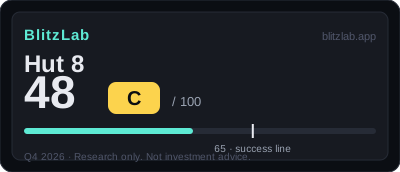
Hut 8 — Blitz Index 48 (C)
949MW of contracted AI capacity — the contracts are signed, the buildings are being built.
Last re-scored: October 15, 2026.
Confidence: High · Category: ai-infra
Score breakdown
| Section | Score | Detail |
|---|---|---|
| A · Speed | 19 / 25 | Q2 2026 revenue +81% YoY (SEC); 949MW contracted; $7.5B project financing raised in one quarter |
| B · Moat | 32 / 60 | 949MW · $26.6B base-term take-or-pay 15-year; 100% investment-grade tenants; Google backstop |
| C · Creative destruction | 8 / 15 | Bitcoin mining → AI power-infrastructure second curve; contract-proven, delivery pending |
| D · BlitzFailing | −11 | D1 −8: $7.64B long-term debt = 26× TTM (contract-collateralized); CEO dual role at ABTC |
Think we scored it wrong? Score it yourself →
Radar axes (0–100): Moat 53 · Speed 76 · Creative 53.
Watch item
Gates: G1 ✓ (second curve, contracted demand) · G2 ✓ estimated (bar ≈ $3.2B, colocation TAM clears it). 17 points below the threshold — first score. Delivery starting Q2 2027 is the whole thesis.
Strengths
- 949MW · $26.6B base-term contracted (8-K)
- BBB- project financing $7.5B secured
- $1.75B+ avg annual NOI at full delivery
- 8,660MW development pipeline
Concerns
- $51.2M quarterly interest vs $10.4M adj. EBITDA
- Pre-delivery = 100% execution risk
- CEO related-party exposure (ABTC)
- Thin cash firewall for the build
Research notes
Thesis: a signed blitz, waiting for buildings
Hut 8 Corp. (NASDAQ: HUT) scores 48 out of 100, grade C, on BlitzLab v1.0, seventeen points below the 65-point line. The arithmetic is exact and worth stating at the outset, because the shape of the score explains the company better than the total alone: speed 19 out of 25, moat 32 out of 60, creative destruction 8 out of 15, and deductions of 11 points. Added together, 19 plus 32 plus 8 minus 11 equals 48. There is no FLAG marker, because deductions of 11 sit below the 15-point FLAG threshold. The score is a first scoring, not a rescore, and its as-of date, T, is October 15, 2026. The latest results available at T were second-quarter 2026 results, published on August 4, 2026. Third-quarter 2026 results, expected in November, had not been published at T and are excluded from the score; they appear in this body only as a future marker, with no anticipated outcome attached.
The central story of the score file can be put in one sentence borrowed from the file itself: the contracts are sold, and the buildings are being built. Hut 8 has signed 949 megawatts of artificial intelligence data centre capacity under long-term contracts with a base-term contract value of approximately $26.6 billion, and it has not yet delivered that capacity. Delivery is not expected until the second quarter of 2027. The company's trailing twelve-month revenue at T was approximately $317.9 million. The ratio of signed base-term contract value to trailing revenue is therefore about 84 times, which the score file describes as the highest level among the companies it measures. That single ratio is the whole analytical problem of Hut 8. If the contracts convert into revenue on schedule, the company standing at T is a much larger business in embryo. If delivery slips, the same ratio describes a promise whose cost is already being paid in interest, quarter by quarter, before any of the contracted income arrives.
The score file's three key drivers make that problem precise. The first is the extreme form of the signed-but-not-delivered position just described: $26.6 billion of base-term contract value against approximately $318 million of trailing twelve-month revenue, with all of the expected net operating income still in the future, because delivery is not due until the second quarter of 2027. The score, in the file's own framing, is therefore in large part a credit assessment of a signed future rather than a measurement of a delivered present. The second key driver is a qualitative distinction inside the debt that funds that future. Long-term debt of $7.64 billion on a book basis is, by multiple alone, extreme, at about 26 times trailing twelve-month revenue. But the file argues that the quality of that debt differs from the debt-market-dependent borrowing of a peer such as CoreWeave, which carries the same deduction of negative 8 on this item. Hut 8's borrowing is contract-backed project financing, secured against take-or-pay contracts with investment-grade tenants and a Google backstop, with a maturity in 2042 and therefore no near-term refinancing cliff. The third key driver is the clock that runs against that distinction. Quarterly interest expense of $51.2 million is about five times quarterly adjusted EBITDA of $10.4 million. On current cash generation, the company cannot cover its interest bill from operating earnings, so a delay in delivery does not merely postpone growth; it converts directly into leverage pressure while the interest clock keeps running. An undrawn revolving facility of $1.07 billion from JPMorgan, confirmed in September 2026, is described in the file as a firewall, with the qualification that the firewall is thin relative to the scale of the obligations behind it.
The gate verdicts frame the same story from the model's entry conditions. Gate 1, which asks whether a second growth curve exists, passes on confirmed evidence: the transition from bitcoin mining to artificial intelligence power infrastructure is demonstrated by signed contracts, not merely announced as an intention. Gate 2, which asks whether the ten-year ceiling of the new market is at least ten times current revenue, passes as an estimate. The bar is approximately $3.2 billion, ten times trailing revenue, and the estimated global data centre colocation market of $104 billion in 2025 rising to $204 billion in 2030, on a MarketsandMarkets estimate, is more than 30 times that bar. The file is careful to add that the $26.6 billion contract backlog alone, at about eight times the bar, is not itself the basis for the pass, because contract value is not the same thing as a ten-year market ceiling; the pass rests on the market estimate. That distinction matters, and this body preserves it exactly. Hut 8 passes both gates, and then scores 48. The gates establish that a second curve and a large enough market exist. The score measures how far, and at what cost and risk, the company has travelled into them.
Speed: growth that is real, capital that is fast, and a base that is still small
Speed scores 19 out of 25, or 76.0 on the radar conversion, and it is the strongest section in percentage terms. Its four items are growth 7 out of 10, capital velocity 4 out of 5, hiring and productivity 4 out of 5, and share velocity 4 out of 5. The section describes a company moving quickly in every dimension the model measures, but from a base that is still small relative to the contracts it has signed.
Growth, at 7 out of 10, rests on confirmed filing evidence. Second-quarter 2026 revenue was $74.9 million, up 81 percent year over year, confirmed by the Form 10-Q filed on August 4, 2026. Full-year 2025 revenue was $235.1 million, up 45 percent, confirmed by the Form 10-K filed on February 25, 2026. Trailing twelve-month revenue of approximately $317.9 million is an estimate derived from those filings. The score withholds three points for reasons the file states plainly, and this body preserves them without softening. The growth rate, however strong, sits a tier below the rate cited for comparison, Nebius at positive 454 percent. The base is small, so a high percentage is easier to achieve than it would be from a larger base. No guidance has been disclosed, so there is no management-stated forward revenue figure against which to test the trajectory. And the revenue still contains the volatility of the bitcoin mining legacy, which the company is in the process of leaving behind but had not fully left at T. Growth of 81 percent in a quarter is therefore scored as good, not as maximal, because the model asks not only how fast revenue grew but how large, how guided, and how clean that growth is.
Capital velocity, at 4 out of 5, is the item where Hut 8 looks most like a blitz company in the classical sense: a company converting a credible story into funding at speed. In a single quarter, the company raised $7.5 billion of project financing, confirmed in the Form 10-Q, Note 9, at an investment-grade rating of BBB-, with a maturity in 2042. In September 2026, it added an undrawn revolving facility of $1.07 billion from JPMorgan, confirmed by a Form 8-K dated September 28, 2026. Raising investment-grade project financing of that size in one quarter is, on the file's judgement, top-tier evidence of capital access. The score withholds the fifth point for a reason that cuts against the headline size of the raise. The financing is entirely debt, and its coupon of 6.13 to 6.19 percent is expensive. It is not equity-type capital, and it carries the interest burden discussed in the deductions section below. Capital velocity, in other words, is scored highly for access and speed, and discounted for cost and form. A company that can borrow $7.5 billion at investment grade in a quarter has demonstrated that lenders believe its contracts. A company that pays more than 6 percent for that belief has also demonstrated what that belief costs.
Hiring and productivity, at 4 out of 5, rests on a small headcount and a high revenue-per-employee figure. The company employed 248 people, confirmed by the Form 10-K. Revenue per employee of approximately $1.28 million, on trailing twelve-month revenue, is an estimate calculated from that headcount, and the file notes that it is 1.45 times the comparable figure for Nebius, at $0.88 million per person. The file's interpretation is that, allowing for the character of a power infrastructure business, in which revenue is generated by megawatts and contracts rather than by large sales or engineering teams, this is high productivity from a lean organisation. The score withholds the fifth point because demonstrated hiring speed is limited in the evidence reviewed: the file records the headcount and the productivity arithmetic, but not a hiring trajectory that would justify the top mark. A lean organisation is an advantage for a company whose product is contracted capacity, and it is also a fact that deserves a qualification. Two hundred and forty-eight people cannot themselves build 949 megawatts of data centre capacity; the delivery of that capacity depends on construction partners, contractors, and tenants' own build programmes, which is one reason the execution risk discussed below cannot be read off the headcount alone.
Share velocity, at 4 out of 5, rests on the contracts themselves. The 949 megawatts are contracted on triple-net, take-or-pay terms, with investment-grade tenants accounting for 100 percent of the contracted base and a Google backstop behind the base term. In the language of the blitzscaling model, this is a land grab in the market that matters most for artificial intelligence infrastructure: not users, not downloads, but power interconnection, the physical permission to run computing at scale. The score file treats the signed capacity as demonstrated evidence of that land grab. The score withholds the fifth point because no quantified market share figure is confirmed in the file. Hut 8 has demonstrably won a large amount of contracted capacity, but the filings reviewed do not provide a market share number that would allow the score to be completed at the top mark. That is an honest limitation, and it connects to the gate discussion above: the market is estimated to be large, and Hut 8's contracted position within it is large in absolute terms, but its share of that market is not a disclosed, measured figure at T.
Moat: contracted capacity as a moat, without a network effect
Moat scores 32 out of 60, or 53.3 on the radar conversion, and its four items are network effects 4 out of 18, distribution scalability 12 out of 18, market size 10 out of 12, and gross margin 6 out of 12. The shape of that split is the analytical core of the Hut 8 case. The company has something difficult to replicate in the form of contracted power capacity with strong tenants, in a market large enough to matter, but it has no classical network effect, and its operating margin, which is the scorecard's proxy for pricing power, is weak even though its gross margin looks strong. Each of those points needs to be taken separately, because the moat section is where a careless reading of Hut 8 goes most wrong.
Network effects, at 4 out of 18, are the weakest moat item, and the score file is explicit about why the item cannot score higher: there is no true network effect. A network effect in the scorecard's sense means that each additional user or customer makes the product more valuable to every other user. Hut 8's business does not work that way. It sells power and capacity, and one tenant's megawatts do not make another tenant's megawatts more valuable. What the company does have is a contractual lock-in that can resemble a network effect from a distance but is not one. Fifteen-year take-or-pay leases, with a 3 percent annual escalator, create switching costs of a contractual kind: a tenant that has committed to fifteen years of payments does not leave lightly. The score file also notes the existence of Highrise AI, a graphics processing unit as a service business held as a 100 percent subsidiary, which could in principle develop network or platform characteristics. But the file records that no revenue contribution from Highrise AI has been disclosed that would demonstrate such an effect, so it cannot lift the score at T. The score of 4 therefore rewards the contractual lock-in for what it is, and refuses to credit it as something it is not. That discipline matters, because it prevents the strongest feature of the contracts, their duration and their tenant quality, from being double-counted as both distribution and network effect.
Distribution scalability, at 12 out of 18, is the strongest moat item, and it is built entirely from the two contracts. River Bend contributes 245 megawatts at $7.0 billion over a fifteen-year term. Beacon Point contributes 704 megawatts at $19.6 billion over a fifteen-year term. Together they are 949 megawatts and $26.6 billion of base-term contract value, confirmed by Forms 8-K with Exhibit 99.1 company announcements (the score file cites announcements dated July 20, 2026, and December 17, 2025). The contracts carry a 3 percent annual escalator, investment-grade tenants, and a Google backstop on the base term. The expected average annual net operating income from the contracted portfolio is stated in the company announcement as more than $1.75 billion. That figure is an expectation attached to contracts that have not yet been delivered, and this body records it as such, not as realised income. The discount applied to the distribution score follows directly from that timing. The file's phrase is that the contracts are sold and the buildings are being built, and that delivery is not due until the second quarter of 2027, so there is no demonstrated execution at T. The file notes that Nebius carries the same structural risk, which is why the comparison is instructive rather than exculpatory: both companies have sold capacity ahead of delivery, and both are therefore scored with a discount for execution risk that has not yet been retired. A distribution score of 12 describes contracted distribution that is large, high-quality, and long-dated, but not yet proven by delivery. The file also records a development pipeline of 8,660 megawatts, which is the source of possible future contract conversion. That pipeline figure is a statement of opportunity, not of contracted revenue, and the score does not treat it as contracted. Its relevance is as a future observation point, discussed in the final section, not as evidence at T.
Market size, at 10 out of 12, is the item where the Gate 2 judgement is converted into a score. The estimated global data centre colocation market of $104 billion in 2025 rising to $204 billion in 2030, on a MarketsandMarkets estimate, passes the gate by a wide margin, as described above. The score withholds the top two points for the reason the file states: the top mark would require demonstrated conversion of contracts into revenue. A market can be large, and a company can hold contracts within it, without yet having shown that the contracts become recognised revenue at the expected rate. The score of 10 therefore describes a market that is large enough to support a much larger company, with the proof of conversion still outstanding. It is worth noting what the market size score does not claim. It does not claim that Hut 8 will capture any particular share of the $204 billion market, and it does not treat the $26.6 billion contract backlog as a market share figure. The backlog is a company-level fact. The market estimate is an industry-level estimate from a third party. The score holds those two kinds of evidence apart, and this body does the same.
Gross margin, at 6 out of 12, is the moat item where the Hut 8 story becomes genuinely two-sided, and it requires careful reading, because two margin figures in the file point in opposite directions. Gross margin in the second quarter was approximately 64 percent, excluding depreciation and amortisation, confirmed by the Form 10-Q. Adjusted EBITDA margin in the same quarter was 14 percent, or $10.4 million on revenue of $74.9 million, also confirmed. The file presents both figures without reconciling them into a single margin, and this body follows that treatment: they measure different things. Gross margin excluding depreciation and amortisation describes the profitability of revenue before the heavy capital costs of a power infrastructure business are charged. Adjusted EBITDA margin describes operating earnings after the operating costs that remain, and it is, in the file's own phrase, honestly weak. The score of 6 reflects the honest figure rather than the flattering one. A company whose gross margin is 64 percent but whose adjusted EBITDA margin is 14 percent is a company whose operating costs, or whose legacy business mix, absorb most of the gross profit before it reaches operating earnings. The file adds a further qualification that belongs in this item. Reported results on a generally accepted accounting principles basis showed a net loss of negative $94.6 million in the quarter, including unrealised losses on digital assets of negative $138.6 million. That loss is dominated by a non-cash revaluation of digital asset holdings, not by the operating performance of the power business, and the file treats it as a disclosed structural characteristic of the company's reported earnings rather than as evidence of operating failure. But it also means that a reader who looks only at the reported net loss, or only at the 64 percent gross margin, will misunderstand the company in opposite directions. The honest summary is the pair of figures together: a high gross margin on the current revenue mix, a low operating margin on the same revenue, and a reported loss driven substantially by digital asset revaluation.
Creative destruction: a landlord in a transformation, not yet its author
Creative destruction scores 8 out of 15, or 53.3 on the radar conversion, from three items: replacing the existing order 3 out of 5, irreversible behaviour change 3 out of 5, and cost-structure change 2 out of 5. The section's message is consistent across all three items, and it is the most conceptually interesting part of the Hut 8 score. The company is participating in a genuine transformation, the conversion of mining power infrastructure into artificial intelligence data centre infrastructure, but its role in that transformation is that of a landlord rather than that of the tenant who drives the new order.
Replacing the existing order, at 3 out of 5, describes the conversion itself. Hut 8's legacy business was bitcoin mining, which uses power infrastructure to produce digital assets. Its new business is to lease power infrastructure to tenants who use it to run artificial intelligence computing. The corporate form of that conversion is the separation of the mining segment into American Bitcoin, known as ABTC, as a separately listed entity, leaving the main company as a power infrastructure platform. That separation is confirmed in the filings, and it is the structural evidence that the second growth curve identified in Gate 1 is not merely a new product line but a redefinition of what the company is. The score stops at 3 for the reason the file gives, and the reason is worth stating plainly because it limits how the transformation should be described. The agent of the replacement is the tenant, named in the file as including companies such as Fluidstack, not Hut 8 itself. Hut 8 provides the power, the site, and the building. The tenant provides the computing that displaces the old order. A landlord in a transformation scores differently from the author of the transformation, and the file scores Hut 8 accordingly: the replacement is real and in progress, but its scope, as far as Hut 8's own agency is concerned, is limited to providing the infrastructure on which others build the new order.
Irreversible behaviour change, at 3 out of 5, describes the lock-in that the fifteen-year contracts create. A fifteen-year take-or-pay commitment, with a 3 percent annual escalator, from an investment-grade tenant, is a structural commitment that is difficult to reverse. Once a tenant has built its computing deployment around a particular site's power, cooling, and interconnection, moving that deployment is costly and disruptive, and the contract makes exit expensive even before the physical costs are counted. That is a genuine form of irreversibility, and the score credits it. The score stops at 3 for a timing reason that mirrors the distribution discount. Delivery is not due until the second quarter of 2027, so the irreversibility at T exists at the contract stage, not yet at the operational stage. The file notes that Nebius scores a step higher on this item because it has demonstrated delivery, whereas Hut 8 has demonstrated signature. The distinction is the difference between a tenant that has committed on paper and a tenant that has committed in operating fact, with equipment installed and workloads running. Hut 8's lock-in is therefore scored as contracted rather than demonstrated, a direction rather than a completed fact.
Cost-structure change, at 2 out of 5, is the lowest item in the section, and the gap between direction and proof is widest here. The company asserts a power-first model, in which securing power interconnection before building computing capacity changes the economics of data centre development. That assertion is recorded in the Form 10-K's discussion of key factors, on a press-reported basis in the file's classification. The score stops at 2 because no measured unit cost figure has been disclosed that would demonstrate a cost-structure collapse: no cost per unit of computing, and no cost per megawatt of build, on a measured basis, is published in the evidence reviewed. A model that claims to change costs, without publishing the unit costs that would prove the change, is scored as an assertion rather than a demonstration. The creative destruction section as a whole therefore reads as a company participating in a real transformation, providing the physical substrate for it, with contractual lock-in that is strong on paper and unproven in operation, and with a cost claim that has not yet been measured. That is a fair reading of a company whose new business has been sold but not yet delivered, and it leaves substantial room for the section to rise if delivery demonstrates the lock-in and the cost advantage in operating fact.
Deductions and risks: debt that is extreme in size and distinctive in form
Deductions total 11 points: debt negative 8 out of a possible negative 10, revenue quality 0, governance negative 2 out of a possible negative 5, and regulatory and social costs negative 1 out of a possible negative 5. That is a substantial load, though below the FLAG threshold, and it is dominated by a single item. The business subtotal before deductions is 59, which is itself below the 65-point line, so the deductions are not the sole reason Hut 8 misses the line; the business sections are. But the deductions describe the risk that will decide whether the business sections rise or fall, and the debt item deserves the careful attention the score file gives it.
Debt, at negative 8, is the largest deduction, and its composition is more interesting than its size alone. Long-term debt was $7.64 billion on a book basis, with principal of $7.74 billion, confirmed by the Form 10-Q, Note 9. That book figure is approximately 26 times trailing twelve-month revenue of approximately $317.9 million. Quarterly interest expense was $51.2 million, against quarterly adjusted EBITDA of $10.4 million, a ratio of about five times. On current cash generation, the company cannot cover its interest bill from operating earnings, and the file states that conclusion directly. The score file's judgement is that this extreme multiple does not earn the maximum deduction of negative 10, for three offsetting reasons, each of which this body preserves exactly. First, the debt is contract-backed: it is secured against take-or-pay contracts with investment-grade tenants and a Google backstop, which is a different risk from borrowing that depends on continued access to debt markets for refinancing. Second, the maturity is 2042, so there is no refinancing cliff in the near term; the debt does not need to be repaid or refinanced before the contracted income is expected to arrive. Third, liquidity at T consisted of cash of $233.6 million plus the undrawn $1.07 billion revolving facility from JPMorgan confirmed in September 2026, which together provide a buffer, though the file's own qualification is that the buffer is thin relative to the scale of the obligations. The comparison the file draws is with CoreWeave, which carries the same deduction of negative 8 but for a different reason: CoreWeave's borrowing is described as debt-market-dependent, whereas Hut 8's is contract-backed. The same score therefore conceals a qualitative difference that the file records as a candidate for future model refinement, under the heading of distinguishing contract-backed project financing from debt-market-dependent borrowing. A reader should hold both sides of the debt item together, as the file does, without smoothing them into a single judgement. The multiple is extreme. The form is distinctive. The interest coverage on current earnings is inadequate. The maturity is long. All four statements are true at T, and the score of negative 8 is the file's attempt to weigh them together.
Revenue quality, at 0, is the only deduction item with no deduction, and the file's reason is a clean record. There has been no revenue restatement, no auditor change, and no audit opinion issue, with KPMG as auditor from 2025, confirmed by the Form 10-K and Form 10-Q. The volatility of reported earnings from digital asset revaluation, including the negative $138.6 million unrealised loss in the second quarter, is treated as a disclosed structural characteristic of the company's reported results, not as a revenue quality failure. A reader should therefore not read the reported net loss of negative $94.6 million as a qualification of the revenue figure of $74.9 million, which is confirmed by the filing. The revenue quality score of 0 is a positive finding in a scorecard where most companies carry some deduction, and it means that the growth and margin figures discussed above can be taken as reported, with the qualifications about estimates and press-reported items that the file itself attaches, rather than as figures under accounting doubt.
Governance, at negative 2, describes a related-party structure created by the mining separation. The chief executive officer, Asher Genoot, serves concurrently as Executive Chairman of ABTC, and the chief strategy officer serves concurrently as chief executive officer of ABTC. Genoot and Ho, through a limited liability company, purchased ABTC Class B shares at $1.40, in a profit-share form of related-party interest disclosed in the Form 10-K's related-party note, confirmed on a filing basis. Hut 8 itself has a single class of common stock, which limits the governance discount that a dual-class structure at the parent would otherwise imply. The deduction of 2 reflects the specific conflict the file identifies: senior leadership of Hut 8 holds a distinct economic interest in the separated mining entity, in a form that gives them a profit share in ABTC that is not identical to the interest of Hut 8 shareholders as such. That is not an allegation of misconduct, and the file does not present it as one. It is a structural observation about incentives across two listed entities that were recently one business, and the score marks the distance between a clean single-company governance structure and the structure that exists at T.
Regulatory and social costs, at negative 1, complete the deduction picture with one substantially resolved matter and one outstanding condition. The substantially resolved matter is a securities class action, settled for $2.4 million, with preliminary approval in July 2026 and a final hearing scheduled for November 6, which is after T. The file also records a shareholder derivative suit as having reached a settlement in principle. The file's characterisation, which this body preserves, is that these matters are effectively on the path to closure. This body attaches no outcome to the November 6 hearing, which had not occurred at T, and records it only as a future marker. The outstanding condition is a grid matter recorded on a press-reported basis: a conditional Base Load designation from ERCOT, with grid review still in progress. That designation is described in the file as a precondition for contracts, which is why it belongs in the risk section even though it has not produced a realised cost at T. A conditional grid designation is not a failed contract, but it is a reminder that contracted capacity depends on physical permissions that are not entirely within the company's control. The deduction of 1 reflects a disclosed-risk level, with one matter near closure and one condition still outstanding, rather than an incurred regulatory cost.
What to watch: delivery, conversion, and the interest clock
The score file identifies a single direction for the score, and it translates directly into what a reader should watch in future filings. The direction is delivery. The file's formulation is that the score's direction is only one thing: the delivery schedule for the 949 megawatts, expected from the second quarter of 2027, and the speed at which the $26.6 billion of contracts converts into recognised revenue. A delay of one quarter in delivery is identified as the trigger that would shake the contract-backed premise of the debt item. Conversely, the commencement of Phase 1 delivery, together with a normalisation of the adjusted EBITDA margin from 14 percent toward 30 percent or above, is identified as the combination that would lift the discounts applied to the distribution and gross margin items. Those are the file's own thresholds, recorded here as observation points, not as predictions. This body attaches no anticipated outcome to any of them.
The first test is therefore the delivery schedule itself. Future filings should be read for the timing of Phase 1 delivery against the second-quarter 2027 expectation, for any change in that expectation, and for the reason given if it changes. A delivery that begins on schedule retires the central discount in the score: the contracts cease to be promises and become operating assets. A delivery that slips extends the period during which interest is paid before contracted income arrives, and the file is explicit that the interest burden is the mechanism by which a slip becomes a leverage problem. Quarterly interest of $51.2 million against quarterly adjusted EBITDA of $10.4 million means that each quarter of delay adds interest without adding the contracted income that the debt was raised to fund. The undrawn $1.07 billion revolving facility and cash of $233.6 million define the buffer against that mechanism, and future filings should be read for the size of that buffer as well as for the delivery date: whether the revolver remains undrawn, whether cash is maintained, and whether financing conditions change before delivery.
The second test is the conversion of contracts into recognised revenue and margin. The expected average annual net operating income of more than $1.75 billion is an expectation attached to the contracted portfolio, not a realised figure. Future filings should be read for the first recognised revenue from River Bend and Beacon Point, for the rate at which that revenue ramps, and for the margin on that revenue. The gross margin item, currently 6 out of 12, rests on the tension between a 64 percent gross margin excluding depreciation and amortisation and a 14 percent adjusted EBITDA margin on current revenue. The contracted business, if it delivers the expected net operating income, should change that tension, because contracted data centre revenue carries a different cost structure from the current mix. If the margin normalises toward the 30 percent range the file identifies, the gross margin discount has a path to lift. If recognised revenue arrives but the operating margin remains near current levels, the file's investment reading of the contracts as a high-quality moat will need to be re-examined. The disclosure that would settle the cost question most directly is the one the file identifies as missing: measured unit costs, whether cost per unit of computing or cost per megawatt of build, that would demonstrate the power-first model's claimed cost advantage. Until that disclosure appears, the cost-structure item, currently 2 out of 5, has no path to rise on evidence rather than assertion.
The third test is the pipeline and the quarterly reporting cycle that surrounds it. Third-quarter 2026 results, expected in November and excluded from this score because they had not been published at T, are the first judgement point after T, and the file identifies the conversion speed of the 8,660 megawatt development pipeline into new contracts as the observation point in that report. This body attaches no anticipated outcome to that marker; the judgement will come from the reported pipeline conversion, if any, not from expectations formed in advance. The same discipline applies to the November 6 final hearing on the $2.4 million securities settlement, recorded above as a future marker with no outcome attached, and to the ERCOT conditional Base Load designation, whose grid review was still in progress at T. Each of those items will produce a fact in a future filing or announcement, and each fact will either confirm or qualify the risk assessment recorded here. None of them changes the score at T.
The honest summary is the score itself, with its shape preserved. Speed that is proven in growth and capital access, from a base that is still small. A moat that is contracted, high-quality, and long-dated, without a network effect and without yet demonstrated delivery. Creative destruction that is real as a transformation of the company's identity, limited as a matter of agency to the role of landlord, and unmeasured as a cost claim. Deductions that are dominated by debt that is extreme in size, distinctive in form, and inadequately covered by current earnings. And a total of 48, grade C, seventeen points below the line, waiting on a single event to decide whether the signed future becomes a delivered present: the delivery of 949 megawatts, expected from the second quarter of 2027, against an interest bill that does not wait.
More AI Infra companies
Other AI Infra names on the Blitz Index, highest score first: NVIDIA (87/A), Arista Networks (73/B), Advanced Micro Devices (62/B).
Next earnings
Q4 2026 · Expected
Coverage
Hut 8 Corp. · Q3 2026 due Nov 4, 2026 (BMO) · Score 48 · Grade C
Embed this score
Copy the HTML below to show this score on your site. The badge links back to this page and updates automatically when the score changes.
Preview:
BlitzLab scores businesses against a scholar’s standard — not investment advice. No price targets, no buy/sell recommendations. Figures are from SEC filings (XBRL) as labeled in the source scorecard.