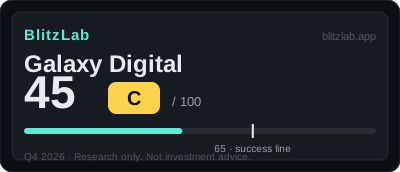
Galaxy Digital — Blitz Index 45 (C)
One site delivered on time — one tenant, one bet.
Last re-scored: October 27, 2026.
Confidence: High · Category: ai-infra
Score breakdown
| Section | Score | Detail |
|---|---|---|
| A · Speed | 17 / 25 | Helios Phase I first full quarter: DC adj. GP $79M, EBITDA $69M (Q2: $20M/$11M) |
| B · Moat | 33 / 60 | 526MW · 15-year CoreWeave lease ($10.4B minimum); single-tenant concentration |
| C · Creative destruction | 8 / 15 | Mining campus → AI data-center conversion; Helios anchored the second curve |
| D · BlitzFailing | −13 | D1: 9.875% $3.5B + $5.8B near-term obligations; founder 49.2% voting; LUNA $120M settlement |
Think we scored it wrong? Score it yourself →
Radar axes (0–100): Moat 55 · Speed 68 · Creative 53.
Watch item
Gates: G1 ✓ (data-center second curve, first lease revenue) · G2 ✓ estimated. 20 points below the threshold — first score. D −13 sits two points above the blitzfailing watch line.
Strengths
- Phase I on-time delivery
- $1B+/yr lease revenue visibility
- 90%+ lease EBITDA margins
- ERCOT 1.6GW approved
Concerns
- Single-tenant CoreWeave concentration
- High-coupon debt stack
- Founder control 49.2%
- Ontario litigation pending
Research notes
Thesis: the landlord's blitz
Galaxy Digital Inc. (NASDAQ: GLXY) scores 45 out of 100, grade C, under the BlitzLab v1.0 model: Speed 17 out of 25, Moat 33 out of 60, Creative Destruction 8 out of 15, and Demerits of minus 13. The total sits 20 points below the 65-point threshold, and the deductions sit just 2 points above the minus-15 line at which the model places a company under FLAG watch. Neither gap is an accident of rounding. Both describe the same company from opposite sides: a second growth curve that has just produced its first revenue quarter, carried by a balance sheet and a customer structure that leave almost no room for error.
The first thing to understand about Galaxy is that its headline revenue number does not describe its business. Consolidated GAAP revenue of roughly $57.4 billion on a trailing-twelve-month basis is mostly principal trading gross-up, the accounting reflection of trading on its own account rather than the economic substance of what the company earns. The score file is explicit that this figure is not real revenue in any sense useful for judging scale, and the company itself supplements its disclosure with a non-GAAP measure, adjusted gross profit, to show the underlying economics. On that basis, consolidated adjusted gross profit was $43 million in the second quarter of 2026. The scoring therefore evaluates scale, growth, and margin on an adjusted basis, and it treats the data-center business, Helios, as the blitzscaling business under examination, with the digital-assets business as the established first curve that keeps generating activity around it.
That framing matters because it changes what counts as evidence. Galaxy's first curve, digital assets, still shows product-market fit: 1,741 trading counterparties in the second quarter of 2026, up 3 percent quarter on quarter. But the second curve is where the score is won or lost. Data Centers passed its first real test in the second quarter of 2026, when it recorded its first revenue quarter, delivered Phase I of Helios on schedule, and turned adjusted EBITDA positive for the segment. The gate verdicts reflect that sequence. Gate 1, the second growth curve, passes on confirmed evidence: data-center adjusted gross profit of $20 million and adjusted EBITDA of positive $11 million in the second quarter of 2026, with Phase I capacity of 133 megawatts delivered on time. Gate 2, the ten-year market ceiling, passes on an estimate, and only for the data-center business: the bar is set at approximately $1.0 billion, derived from annualized data-center revenue of roughly $104 million multiplied by ten, and the artificial-intelligence data-center market is estimated at $933.8 billion by 2030, roughly 900 times that bar. On a consolidated GAAP basis, the file states plainly, the bar cannot be computed at all because of the trading gross-up. The pass is therefore narrow, conditional, and honestly labelled: a data-center pass, not a whole-company pass.
The score file's own summary of the company is a single sentence that the rest of this profile keeps returning to: one tenant is, in effect, the company. The 526 megawatts contracted through 2028, the minimum $10.4 billion Phase II commitment, and the 15-year lease all run to a single counterparty, CoreWeave. The contracted 15-year lease total of approximately $15 billion is press-reported, and the average annual rental revenue outlook of more than $1 billion is likewise press-reported, but the concentration itself is confirmed in the company's filings. That concentration is the thread that runs through the moat, the risks, and the watch items alike.
Speed: a first quarter that is genuinely explosive and genuinely thin
Speed scores 17 out of 25, the strongest of the three radar axes at 68.0 on a 100-point conversion, and the composition of that score tells the story precisely. Growth, item A1, scores 8 out of 10. The data-center business grew from $3.1 million of GAAP revenue in the first quarter of 2026 to $26.0 million in the second quarter, with adjusted gross profit rising from $3 million to $20 million and adjusted EBITDA swinging from negative $0.9 million to positive $11 million. Those are confirmed figures from the company's second-quarter filing and earnings release, and the rate of change is, on its face, explosive. The reason the item stops at 8 rather than higher is stated in the file with equal clarity: this is a single first revenue quarter, off a tiny base. One quarter proves that revenue recognition has begun; it does not yet prove a repeatable run rate. The press-reported expectation of a full Phase I quarter of roughly $80 million per quarter from the third quarter of 2026 onward is noted in the file as a forward marker, not as a result, and the third-quarter 2026 results themselves were not yet published as of the scoring date of October 15, 2026, and are excluded from this assessment entirely.
Capital velocity, item A2, scores 3 out of 5. The scale of fundraising is large: $3.507 billion of 9.875 percent senior secured notes due 2031, issued on July 28, 2026 and confirmed in a filing, earmarked for Helios Phase II funding, together with a $460 million private placement and a $500 million at-the-market program. The score is held back by price. A 9.875 percent coupon is expensive money, and the file benchmarks it directly against a peer: it is about 1.6 times the 6.1 percent investment-grade coupon achieved by HUT. The contrast is the point. Galaxy raised the money it needed to build, but it paid a credit price that reflects how the market judges its risk, and that price becomes a recurring cost against every future quarter of lease income.
Hiring and productivity, item A3, scores 2 out of 5. Headcount stands above 700 employees, confirmed in the annual report, and annualized adjusted gross profit per employee is calculated at approximately $0.24 million per person. The file sets that figure beside two peers on the same basis: approximately $0.88 million per person at NBIS and approximately $1.28 million at HUT. Galaxy's figure is far lower, and no evidence of hiring velocity was available to the scorers. The item is labelled a mix of confirmed and estimated inputs, and the honest reading is that the company is still staffed like a trading and financial-services firm while its growth story is a construction and leasing business. Whether the productivity ratio improves as data-center revenue scales is one of the quieter questions beneath the headline score.
Share velocity, item A4, scores 4 out of 5, the strongest speed item after growth. The evidence is physical and confirmed: 526 megawatts contracted through 2028, approval for more than 1.6 gigawatts from ERCOT, campus potential of 3.5 gigawatts, and a pipeline of more than 5.7 gigawatts. This is the land-grab made concrete, megawatts secured and permitted rather than merely discussed. The single point withheld reflects a measurement limit rather than a doubt: no quantified market share figure was confirmed, so the maximum score was reserved. In blitzscaling terms, the company has seized the ground; it has not yet been measured against the whole field.
Moat: power and contracts in place of network effects
Moat scores 33 out of 60, or 55.0 on the radar conversion, and its internal shape is more revealing than the total. The moat here is not a network. It is scarce power, contracted capacity, and a lease structure that converts construction into long-dated cash flow, discounted by the fact that the entire structure leans on one tenant.
Network effects, item B1, score just 5 out of 18, and the file does not soften the reason: the data-center business has no network effect at all, because it is a wholesale lease to a single tenant. What lifts the item above zero sits on the other side of the company. The trading business brings 1,741 counterparties, a staking validator presence, GK8 custody, and tokenization partnerships, which together create data and ecosystem effects that are real but weak. The mix of confirmed and press-reported evidence supports a modest score, and the gap between 5 and 18 is a structural statement. No matter how well Helios performs, a landlord collecting rent from one tenant does not get more valuable with each additional user in the way a network business does. That ceiling is permanent unless the business itself changes shape.
Distribution scalability, item B2, scores 11 out of 18, the largest single moat contribution. The 15-year CoreWeave lease, signed in April 2025 and confirmed in the annual report, is the distribution channel: a decade and a half of contracted demand, with Phase I's 133 megawatts delivered on time in the second quarter of 2026 as execution evidence that the company can actually hand over what it promised. Phase II carries a minimum commitment of $10.4 billion with annual escalations of 3 to 5 percent, partly press-reported, which gives the revenue stream a contractual growth path rather than a hope. The discount is the concentration. The file explicitly scores Galaxy one step below NBIS on this item because NBIS has two investment-grade tenants while Galaxy has one. Distribution that depends entirely on a single counterparty is scalable in volume but fragile in structure, and the score reflects both halves of that sentence.
Market size, item B3, scores 10 out of 12 on an estimate. The artificial-intelligence data-center market is estimated at $933.8 billion by 2030, sourced to a ResearchAndMarkets estimate, and the gate test passes on the data-center business alone. The two points withheld are a discipline device: the maximum score waits for Phase II delivery evidence. A market can be enormous without being capturable, and the file refuses to award full marks for a market the company has only begun to serve.
Gross profit, item B4, scores 7 out of 12. Data-center adjusted gross profit margin was approximately 77 percent in the second quarter of 2026, calculated as $20 million of adjusted gross profit on $26 million of revenue, confirmed in the earnings release, and the data-center project's adjusted EBITDA margin is projected above 90 percent on a press-reported basis. GAAP gross margin cannot be computed because of the trading gross-up structure, so the adjusted basis is the real one, and the file says so directly. The reservation, again, is time: the evidence is one quarter plus an outlook. A 77 percent margin on a first quarter is a promising shape; a 90 percent-plus margin sustained across full quarters at scale would be a different claim, and it has not yet been made with reported numbers.
Taken together, the moat is a physical and contractual moat. ERCOT approval for more than 1.6 gigawatts, campus potential of 3.5 gigawatts, and a pipeline beyond 5.7 gigawatts describe power and land that cannot be conjured quickly by a competitor. The lease converts that scarcity into contracted revenue. What the moat lacks is any self-reinforcing dynamic: no network that strengthens as it grows, no second tenant to diversify the rent roll, and only one quarter of margin evidence. That is why 33 out of 60 feels like a fair resting place rather than a harsh one.
Creative destruction: a conversion, not yet a revolution
Creative destruction scores 8 out of 15, or 53.3 on the radar conversion, and its three items describe a genuine transformation with a limited blast radius. The order being displaced, item C1, scores 3 out of 5. Helios itself is the evidence: a mining campus acquired for $65 million, converted to artificial-intelligence and high-performance computing use, with an $87.3 million writedown of mining equipment confirmed in the annual report. The writedown is both a funeral and an admission price, the old era's assets written off as the new era's site is prepared. Alongside it, tokenization partnerships with Superstate, BNY, and State Street represent an ongoing displacement of traditional financial rails, in progress rather than complete. The file's reservation is precise: Galaxy is more a beneficiary of this transition than its direct driver, and the scope remains limited. It is converting its own site and participating in tokenization, not overturning the order single-handedly.
Irreversible behavior change, item C2, scores 3 out of 5. The 15-year lease, the minimum $10.4 billion commitment, annual escalations of 3 to 5 percent, and ERCOT approval for more than 1.6 gigawatts of scarce power together constitute a long-dated capital commitment that is difficult to unwind. A tenant does not sign a fifteen-year lease on a gigawatt-scale campus casually, and a landlord does not secure that power and build that capacity without committing itself in return. The discount, once more, is concentration: the irreversibility of the demand structure is tied to a single tenant's credit. If the tenant's standing changes, the durability of the commitment is tested in exactly the place where it is thinnest.
Cost-structure change, item C3, scores 2 out of 5. The shift from mining to fixed rental income is a real change in cost structure, anchored by the confirmed $87.3 million mining-equipment writedown. But the file records a missing piece that keeps the score low: no company-published measured figure for the collapse in unit compute cost, in dollars per megawatt or dollars per flop, was disclosed. The direction of the cost change is visible; its magnitude is not measured in the record. The item is labelled confirmed for the writedown and unconfirmed for the unit-cost evidence, and the score follows the evidence rather than the narrative.
The overall picture is of a company that has executed a conversion of its own assets and is participating in a larger displacement of financial infrastructure, without yet demonstrating that it drives that displacement. That is a respectable position for a first scoring, and it is also a long way from the creative-destruction scores of companies that define a new order outright.
Deductions and risks: thirteen points, three heavy items, no margin for a bad quarter
Demerits total minus 13, and the distribution matters more than the total. Debt, item D1, accounts for minus 7 out of a possible minus 10. Total debt was $8.12 billion as of June 30, 2026, confirmed in the quarterly filing. Contractual obligations were $8.91 billion, of which $5.79 billion falls due within one year, including $3.73 billion of loans that follow a rollover practice, and data-center construction commitments add $1.49 billion due within one year. The $3.507 billion of 9.875 percent notes due 2031, issued for Helios Phase II, sits on top of that near-term wall. The offsetting structure is real and is stated carefully in the file: the data-center lease carries a minimum of $10.4 billion in contracted value as collateral for the build, and once Phase II is delivered, in the second quarter of 2027, lease EBITDA of approximately $620 million per year on an estimate is structured to cover annual interest of approximately $346 million per year. Cash plus stablecoins of $2.46 billion serve as a firewall for the transition period. The risk is the interval between now and that delivery: the obligations are near-term, the covering cash flow is not yet flowing, and the trading book's leverage is mixed into the same balance sheet alongside the high-coupon debt. The file's judgment is that the structure works if delivery happens on schedule, and that the "if" is doing a great deal of work.
Revenue quality, item D2, scores 0, the only clean item in the deductions section. There is no history of auditor change, adverse audit opinion, or restatement: KPMG has served as auditor since 2021 without interruption. The GAAP gross-up is treated as a structural characteristic of the business, disclosed and supplemented with non-GAAP measures, rather than as a quality problem. That distinction is important. The score file refuses to punish Galaxy for an accounting shape it discloses, while still refusing to let that shape inflate its scale measures. Both decisions are consistent, and both show the model working as designed.
Governance, item D3, scores minus 3 out of minus 5. The company has a dual-class share structure, and founder Novogratz controls approximately 49.2 percent of voting power, confirmed in the annual report. Key-person risk is explicitly named as a risk factor in the company's own filings. In the $460 million private placement, executives disposed of 3.75 million shares. The chief accounting officer resigned effective September 30, 2026, with the file recording that the departure was not attributed to discord and that succession was internal. None of these facts alone is disqualifying, and the file does not present them as such. Together, they describe concentrated control in one founder's hands, with the governance risks that concentration always carries, and the score reflects that concentration rather than any allegation of misconduct.
Regulatory and social cost, item D4, scores minus 3 out of minus 5. The LUNA settlement with New York prosecutors cost $120 million, payable over four years, with a provision of $113.8 million confirmed in the quarterly filing. That is a substantial realized regulatory cost, not a hypothetical one. An Ontario class action remains pending, with an uncertain outcome, and the company remains exposed to digital-asset regulation across the SEC, the CFTC, FinCEN, and the New York BitLicense regime. The file's framing is that the LUNA matter is residue with a price tag already attached, while the Ontario litigation and the broader regulatory exposure are live. Either could add to the deductions, and the arithmetic of the watch threshold makes that prospect concrete: a further 2 points of deductions would carry the company to the minus-15 FLAG line.
The score file also notes, for context only and not as part of the score, a share price of $22.15 as of October 6, 2026 and a market capitalization of approximately $8.7 billion on an estimate. GAAP price-to-sales is meaningless for this company because of the gross-up, and the business score deliberately does not look at price. Those figures are recorded here for completeness and are not inputs to any judgment in this profile.
What to watch: two questions that decide the next four quarters
The direction in the score file is "watch," with the watch items named as single-tenant exposure and the minus-13 deduction total. The next four quarters, in the file's own terms, turn on whether the data-center margin story can carry the weight of the deductions, and the file names its triggers on both sides.
On the upside, three triggers are listed. The first is Phase II delivery in the second quarter of 2027. The second is demonstration of the projected 90 percent-plus lease EBITDA margin with reported figures rather than outlooks. The third is tenant diversification through new site contracts, which would directly address the concentration that discounts the distribution score and shadows the creative-destruction score. The nearer-term marker is the full Phase I quarter from the third quarter of 2026 onward, press-reported at roughly $80 million per quarter: it is a marker to observe when reported, not an outcome assumed here, since third-quarter 2026 results were not published as of the scoring date and are excluded from this assessment.
On the downside, the triggers are equally specific. An adverse development in the Ontario litigation or additional regulatory costs could push the deductions item higher, and with only 2 points of headroom to the FLAG threshold, the path from watch to FLAG is short. The deeper downside risk, named as the single largest risk from a blitzscaling perspective, is the tenant itself. The file records CoreWeave's own deduction total at minus 13 on leverage, and observes that if that pressure becomes real, Galaxy's $10.4 billion contract stands on the other side of the same shock. The file calls this a "kindred risk": two companies, one lease, one shock. Without tenant diversification, the file states plainly, there is no hedge for this risk within the company's own structure.
Three open model questions are recorded in the score file as candidates for a future model version, with the model itself unchanged. The first is a quantitative anchor for customer concentration, covering the single-tenant 100 percent case at Galaxy and the two-customer case at NBIS, applied through the deductions where backlog concentration exceeds a set level. The second is a formal rule for scale measures at companies whose GAAP revenue is distorted by trading gross-up, making the adjusted-basis approach used here explicit. The third is a rule for linking a tenant's credit standing to the landlord's scores where a single-tenant structure applies. Galaxy is, in the file's words, the representative case of a blind spot the current model does not directly capture: customer concentration. Readers should understand the 45 accordingly. It is the score the frozen model produces, and the file itself flags the dimension the model misses.
The company's history, as recorded in the file, is short in its current form: a first scoring, with no blind assessment, following a Delaware conversion and Nasdaq listing in May 2025 after a prior TSX listing. That brevity is part of the story. Galaxy is not a company with a decade of reported data-center quarters to judge. It is a company with one reported data-center quarter, one on-time delivery, one tenant, and a very large contracted future. The score of 45 out of 100, grade C, captures that balance: real execution, real contracted demand, real margins in their first showing, set against expensive debt, concentrated control, realized regulatory cost, and a customer structure in which a single name carries the entire second growth curve. The next reported quarters will show whether the first quarter was the start of a run rate or simply a good first quarter, and whether the contracted future converts into diversified, reported cash flow before the near-term obligations come due.
More AI Infra companies
Other AI Infra names on the Blitz Index, highest score first: NVIDIA (87/A), Arista Networks (73/B), Advanced Micro Devices (62/B).
Next earnings
Q4 2026 · Expected
Coverage
Galaxy Digital Inc. · Q3 2026 reported Oct 27, 2026 (BMO) · Score 45 · Grade C
Embed this score
Copy the HTML below to show this score on your site. The badge links back to this page and updates automatically when the score changes.
Preview:
BlitzLab scores businesses against a scholar’s standard — not investment advice. No price targets, no buy/sell recommendations. Figures are from SEC filings (XBRL) as labeled in the source scorecard.