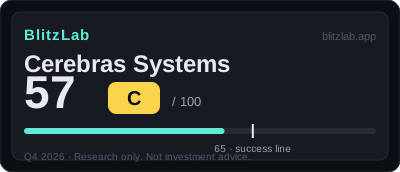
Cerebras Systems — Blitz Index 57 (C)
The inference challenger to NVDA — demand proven, delivery pending.
Last re-scored: October 11, 2026.
Confidence: Medium · Category: ai-infra
Score breakdown
| Section | Score | Detail |
|---|---|---|
| A · Speed | 18 / 25 | FY2025 $510M (+76%); H1 2026 +84%; cloud +281% YoY; RPO $25.4B |
| B · Moat | 32 / 60 | Wafer-scale architecture; OpenAI co-design; AWS Bedrock pipeline; no CUDA-grade ecosystem |
| C · Creative destruction | 10 / 15 | Wafer-scale challenges the GPU order in inference; disaggregated inference fragmentation |
| D · BlitzFailing | −3 | Dual-class entrenchment (-2); 86% UAE concentration is export-control exposure (-1) |
Think we scored it wrong? Score it yourself →
Radar axes (0–100): Moat 53 · Speed 72 · Creative 67.
Watch item
Gates: G1 pass · G2 pass (estimated). IPO 2026-05-14. 8 below threshold — first-ever score.
Strengths
- Four straight years of high growth: $24.6M (2022) to $510M (2025); H1 2026 +84%
- OpenAI $20B+ MRA (750MW, 3-5yr) + RPO $25.4B (~37x annual revenue)
- AWS Bedrock (2027-Q1) + AMD disaggregated inference (2026-Q4) — global distribution pipeline
- $8.6B cash + $850M revolver — IPO war chest, no debt burden
Concerns
- Extreme concentration: 86% of FY2025 from 2 UAE related parties; top 3 = 76% in Q2 2026
- Capacity constrained: reverse-leasing systems from customers; Q3 guidance flat QoQ
- OpenAI MRA exclusivity limits sales to certain competitors
- Dual-class (Class B 20 votes); insiders hold ~50.8% voting power
Research notes
Score: 57/C. Speed (A) 18/25, Moat (B) 32/60, Creative destruction (C) 10/15, Demerits (D) −3. Total: 18 + 32 + 10 − 3 = 57. Eight points short of the 65 threshold. No FLAG: demerits of 3 are below the 15-point FLAG trigger. This is a research assessment under BlitzLab v1.0 (frozen), not investment advice. Figures are as of T = 11 October 2026; the latest quarter included is Q2 2026, announced 12 August 2026, and Q3 2026 results, expected around November 2026, are excluded because they fall after T.
1. Current position: demand proven, delivery being proven
Cerebras Systems, Inc. (NASDAQ: CBRS) is an early-stage public company in the BlitzLab sense: it listed on 14 May 2026, only five months before the scoring date, and its trailing twelve-month revenue is estimated at about $0.68 billion. The score file's confidence is medium-high, because it rests on direct SEC EDGAR sources — the S-1, the 424B4 prospectus, the 10-Q, and 8-K filings — while warning that the listed history is short and that headcount, market share, and unit economics are unconfirmed or press-reported rather than measured from filings.
What the filings do establish is a four-year run of rapid growth. Revenue rose from $24.6 million in 2022 to $78.7 million in 2023, $290.3 million in 2024, and $510.0 million in 2025, a 76% increase in that last year. The first half of 2026 added $373.5 million, up 84% year on year. Within that, the first quarter of 2026 reached $193.4 million, up 94%, and the second quarter reached $180.1 million on a GAAP basis, up 74%, or $209.9 million on the company's "core" basis, up 103%. Cloud revenue grew 281% year on year on a GAAP basis and 287% on a core basis. Those are the numbers behind the growth score of 8 out of 10 — strong, but deliberately one step below the 9 awarded to a faster-growing peer, because the forward guidance tells a different story about the near term.
The company raised its full-year 2026 guidance to core revenue of $880–890 million, yet its third-quarter guidance of core revenue of $214–216 million implies only about 2–3% growth quarter on quarter against the second quarter. The score file reads that flattening not as a demand signal but as a capacity signal: orders are not the constraint; the ability to build and deliver systems is. That distinction runs through the whole assessment. Both gates pass — growth is sustained, and the new market's ten-year ceiling clears the bar — but the score of 57/C is best understood as the score of a blitz in its first act, where the question has moved from whether anyone wants the product to whether the company can deliver it at the scale it has promised.
The clearest expression of that promised scale is the order book. Remaining performance obligations (RPO) stand at $25.4 billion, roughly 37 times annualised trailing revenue. The gate test for a new market requires a ten-year ceiling of at least ten times current revenue, a bar of about $6.8 billion on trailing revenue of about $0.68 billion; RPO alone is about 3.7 times that bar. The score file's verdict on the company's stage is therefore precise: demand is proven, delivery is being proven, and the conversion of that $25.4 billion backlog into recognised revenue across 2027 and 2028 is the real test. The score file draws an explicit parallel to Tesla in 2017, just before its "production hell" period — a company whose demand was no longer in doubt and whose manufacturing execution was about to become the whole story.
2. Speed: fast growth, well-funded, but throttled by capacity
Speed is Cerebras's strongest axis on a rescaled basis, at 72.0 out of 100, and the subscores show why it is strong without being maximal. Growth earns 8 of 10, capital velocity 4 of 5, hiring and productivity 3 of 5, and share velocity 3 of 5, for 18 of 25.
Capital velocity is the most clear-cut of the four. The initial public offering was priced at $185 per share, with 30 million shares raising $5.55 billion, and the full exercise of the greenshoe took the total to 34.5 million shares and $6.4 billion gross, as announced by the company. The first day opened at $350 and closed at $311.07, up 68.1%, reported as the largest United States technology IPO of 2026 with more than 20 times oversubscription. Cash, restricted cash, and short-term investments together total $8.6 billion, with an $850 million revolving facility undrawn. That is, in the score file's phrase, top-tier blitz ammunition. The offset is also recorded: just before T, the share price was $164.17, about 11.3% below the offering price, which limits the room for a further equity raise on attractive terms — although, with cash at that level, no immediate raise is needed. The valuation note attached to the score file makes the same point from the other side: an estimated market capitalisation of about $37 billion, roughly 54 times trailing revenue, and a price about 47% below the first-day close, describe a market adjusting its expectations. Under BlitzLab's method the business score does not look at price, so none of that enters the 57; it is context, not scoring input.
Hiring and productivity earn only 3 of 5, and the reason is evidential rather than operational. The SEC filings do not confirm a headcount figure, so the score file relies on a press-reported range of roughly 525 to 900 people, drawn from sources spanning about 525 to a range of 800–900, with a professional-network range of 501–1,000. Dividing estimated trailing revenue by that press-reported range gives revenue per employee of roughly $0.8–1.3 million, below a hardware-and-cloud peer's reported level, and the score file awards a conservative 3 precisely because the underlying headcount is unconfirmed. The gap is flagged as a measurement gap, not as evidence of weak productivity.
Share velocity also earns 3 of 5, capped for the same reason: no confirmed market-share figure exists. Cerebras is described as the leading challenger in inference-specialised architecture, while the category's dominant player remains NVIDIA, on the strength of its CUDA software ecosystem, its hyperscaler relationships, and its manufacturing scale. What supports the 3, rather than a lower score, is a pipeline of distribution and co-design agreements that could convert challenger status into share: a 750-megawatt multi-year agreement with OpenAI, placement on Amazon Web Services' Bedrock platform scheduled for the first quarter of 2027, and a disaggregated-inference product with AMD scheduled for production in the fourth quarter of 2026. Until share itself is measured, the score file treats 3 as the ceiling for this item.
3. Moat: contracts and architecture, not network effects
Moat is the weakest axis on a rescaled basis, at 53.3 out of 100, and the score file is unusually candid about why. Cerebras earns 32 of 60: network effects 6 of 18, distribution scalability 10 of 18, market size 10 of 12, and gross margin 6 of 12. The pattern is that of a company whose defences are contractual and architectural rather than ecological.
There is, in the score file's direct judgement, no genuine network effect here. This is a capacity business, and it has no developer ecosystem comparable to CUDA. What it has instead is depth of lock-in with a small number of customers. The S-1 confirms a "next-generation model co-design" relationship with OpenAI, which is a technical lock-in of a different kind: joint design work is hard to unwind and hard for a rival to replicate quickly. Alongside it sits a contractual lock-in, in the form of the 750-megawatt, three-to-five-year OpenAI agreement and the substantial portion of the $25.4 billion RPO attributed to it. The score file places network effects at the bottom of its 5–9 band, at 6, because that lock-in is concentrated in effectively a single customer — in contrast to a peer whose breadth spans most leading AI laboratories — and because the OpenAI agreement's exclusivity provisions restrict sales to certain competitors. Depth without breadth is the precise character of this moat.
Distribution scalability, at 10 of 18, is where the delivery story becomes concrete. Data-centre capacity of 600 megawatts is secured for operation and delivery-contracted volumes by the end of 2027, with a gigawatt-scale pipeline beyond that. A multi-year partnership with AWS, signed in March 2026, leads to Bedrock placement in the first quarter of 2027, which the score file treats as a global distribution channel rather than a single-customer win. The AMD disaggregated-inference product enters production in the fourth quarter of 2026. On the supply side, manufacturing is being scaled tenfold across Flex, Sanmina, and Rocket EMS, TSMC wafer supply is secured, and the architecture's avoidance of high-bandwidth memory, CoWoS packaging, and 3-nanometre processes is presented by the company as a supply-chain advantage, since it sidesteps the bottlenecks constraining rivals. The discount from a higher score comes from execution in 2026 itself: capacity has been so short that the company has been leasing back systems from its own existing customers, and chief executive Andrew Feldman is quoted as describing a temporary pressure on core cloud margins as a result. The score file's judgement is that delivery execution, more than any other single factor, will decide the direction of this score.
Market size earns 10 of 12 on an estimated, externally sourced figure: the AI inference market is put at $251 billion in 2025, rising to $672 billion in 2029, a 28% compound annual growth rate, according to Bloomberg Intelligence as cited in the S-1. That clears the second gate comfortably, and trailing revenue of about $0.68 billion is only about 0.27% of the 2025 market. The full 12 is withheld on a stated principle applied consistently across companies: a company earns the maximum only when its financial statements demonstrate a meaningful share of that market, which Cerebras has not yet done.
Gross margin earns 6 of 12, and here the score file insists on a distinction that matters for reading every Cerebras margin figure. GAAP gross margin moved from 12% in 2022 to 33% in 2023, 42% in 2024, and 39% in 2025, then to 44.6% in the first quarter of 2026 — but the second quarter of 2026 shows GAAP gross margin of only 14.2% against a core margin of 41%, an improvement of 940 basis points year on year on the core basis, with full-year 2026 core guidance of 41–43%. The gap between GAAP and core reflects items including warrant amortisation, stock-based compensation, and data-centre pass-through costs, and the score file notes that the footnotes require checking before the core figure is treated as the whole story. Unit economics are improving, but the company remains loss-making on both bases: a GAAP operating margin of negative 265% and a core operating margin of negative 16%. Reported fiscal 2025 net income of $237.8 million includes a one-off gain of $363.3 million; on a non-GAAP basis the company recorded a net loss of $75.7 million. None of that is scored as an accounting demerit, as discussed below, but it is the reason a margin story that looks strong on the core basis earns only a middle score.
4. Creative destruction: a real architectural challenge, still at inception
Creative destruction earns 10 of 15: replacing the existing order 4 of 5, irreversible behaviour change 3 of 5, and cost-structure change 3 of 5, for a rescaled 66.7. The shape of these scores — the highest subscore for the challenge itself, lower scores for the behavioural and cost consequences — matches a disruption that has begun but has not yet remade its market.
The challenge to the existing order is architectural. Cerebras's wafer-scale architecture takes on the GPU order at the AI inference stage, and the score file highlights a specific mechanism: disaggregated inference, in which different stages of the inference pipeline run on specialised silicon — AMD handling prefill with Cerebras handling decode, and Trainium combined with Cerebras on Bedrock — described as "inference fragmentation," the decomposition of the inference pipeline into stage-specialised hardware. That is a genuine structural claim, not merely a faster chip: it proposes that inference need not run on a single general-purpose accelerator. The score stops at 4 rather than 5 because scale is still small; trailing revenue of about $0.68 billion is minimal beside NVIDIA, so replacement is at the inception stage.
Behaviour change earns 3 of 5. The company's proposition, in its own phrase, is that "speed changes what AI can do" — that sufficiently fast inference makes agentic AI practical in ways slower inference does not. The score file cites Cerebras as a launch partner for GPT-5.6 Sol at 750 tokens per second, and notes the structural lock-in of the three-to-five-year OpenAI agreement and the $25.4 billion backlog. Its named customers span applied AI and enterprise software — Cognition, Lovable, Block, Figma, AlphaSense, GSK, and CrowdStrike for inline security — which shows the technology reaching real workloads. The discount reflects that the move to high-speed inference is an industry-wide structural shift, shared with rivals such as Groq and SambaNova, and that no mass standard has yet emerged. Cerebras is riding a wave it did not create alone.
Cost-structure change also earns 3 of 5, and this is the section where labelling discipline matters most. Every speed and cost figure here is a company claim, without independent measurement disclosed in the score file. The company claims that its CS-3 system is up to 21 times faster than NVIDIA's DGX B200 at roughly a third of the cost and power, that the CS-4 system announced in August 2026 is up to 30 times faster, and the S-1 claims 15 times faster on open-source model benchmarks, with that benchmark caveat attached. The avoidance of high-bandwidth memory, CoWoS, and 3-nanometre processes is again presented by the company as a cost advantage. But no independent measurement of cost per token — the unit-cost collapse that would prove a cost-structure change — has been disclosed. The score file's conservative 3 is the direct result of its "claims versus measurement" principle: an architectural speed advantage, recorded in the S-1 as a wafer-scale engine of 900,000 cores and 58 times the DGX B200 on the cited comparison, is treated as a real architectural fact, while the multiples of 15, 21, and 30 times are treated as company claims awaiting independent verification. If independent measurement arrives, the score file notes, there is room for upward revision; until then, the claim and the proof are kept apart.
5. Deductions and risks: no accounting trigger, but concentration is the story
Demerits total only −3, which is why there is no FLAG, but the composition of that −3, and the risks recorded alongside the zero scores, deserve more attention than the small total suggests. Debt earns 0 of −10, revenue quality 0 of −10, governance −2 of −5, and regulation and social cost −1 of −5.
Debt carries no trigger. Borrowings are $918.2 million, including a $1.0 billion secured note from OpenAI dated January 2026, together with lease liabilities of $568.8 million; total debt of $2,473 million is 21% of total assets. Cash of $8.6 billion and the undrawn $850 million revolver mean there is no interest burden in the ordinary sense — the second quarter recorded other income of positive $27 million. The watch item attached to this clean score is the commitment stack behind it: $25.4 billion of delivery obligations, a 600-megawatt build-out, and a tenfold manufacturing scale-up, with first-half capital expenditure already above $548 million. A company can be unlevered on its balance sheet and still be heavily committed on its order book, and the score file keeps those two facts side by side.
Revenue quality also earns 0, because there is no restatement, auditor change, audit-opinion issue, or accounting-fraud allegation in the disclosure history. Three structural discount factors are nevertheless recorded in full, and they qualify any reading of the growth story. First, the fiscal 2025 profit is flattered by the one-off gain described above. Second, the GAAP-versus-core margin gap is wide and requires footnote verification. Third, and most consequential, is customer concentration. In fiscal 2025, two related parties accounted for 86% of revenue: MBZUAI at 62% and G42 at 24%. In the second quarter of 2026, the top three customers accounted for 76% of revenue, and on an accounts-receivable basis, a customer identified only as Customer B accounted for 57%. The score file is explicit that concentration is recorded as a concern item rather than scored as an accounting demerit, on the same basis as a peer with 67% single-customer concentration that also scored 0 here — but it also lists the quantification of a concentration anchor as its first candidate for a future model revision, precisely because cases as extreme as 86% from two related parties strain the current treatment. A reader who stops at "D2 = 0" and misses the 86% has missed the risk.
Governance earns −2, the largest single demerit. The dual-class structure gives Class B shares 20 votes per share, and officers, directors, and holders of more than 5%, together with their affiliates, hold 38.1% of the equity but about 50.8% of the voting power — in the prospectus's own words, Class B holders "will have the ability to control the outcome." There is also a classified board, and chief executive Andrew Feldman holds about 5.4%. Multiple Form 144 filings in September 2026 are noted, with their subjects and scale unconfirmed. The score file is careful to add that there is no fraud or embezzlement issue; the deduction is for structural entrenchment of founder control, not for misconduct.
Regulation and social cost earn −1, again with no incident behind the deduction: no securities class action, fine, or judgement as of T. The exposure is structural and follows directly from the concentration figures. With 86% of fiscal 2025 revenue coming from two UAE-related customers, the company is exposed to any change in United States export-control policy toward the Middle East for AI chips. Nothing has happened; the −1 records the shape of the exposure, not an event. A further historical note is recorded without a scored consequence: the company withdrew an S-1 in 2024 before relisting in 2026, with the reason unconfirmed.
6. The blitzscaling lens: a one-front blitz, and what to watch
Read through the blitzscaling lens, Cerebras is a deep-technology and partnership blitzer, not a network-effects blitzer. Its main levers are a tenfold architectural bet — wafer-scale computing — and partnerships that borrow distribution: OpenAI for demand and co-design, AWS for global reach, AMD for a disaggregated product. A secondary lever is speed itself as marketing: figures such as 750 tokens per second attract customers as earned attention, and the company was named to Fast Company's "Next Big Things in Tech" list in 2026. The weak lever is the developer ecosystem, where there is no counterpart to CUDA, and the closest substitute for ecosystem lock-in is the OpenAI co-design relationship.
The speed-versus-efficiency trade-off has been made in the textbook blitz direction, with one interesting exception. The $6.4 billion IPO proceeds are being committed to capacity before demand is fully converted — 600 megawatts secured, manufacturing scaled tenfold — which is "efficiency later" in its classic form. The present paradox, that demand exceeds supply to the point of leasing back systems from customers at the cost of margin, is itself a blitz choice: buying speed with money. The exception is on the supply-chain side, where avoiding high-bandwidth memory, CoWoS, and 3-nanometre processes is an efficiency-minded design decision that sidesteps rivals' bottlenecks. A speed-obsessed blitzer that is unusually careful about supply-chain efficiency is a distinctive combination, and it is one of the reasons the distribution score stays at 10 despite the capacity shortfall.
The score file's single largest risk deserves to be stated plainly, because it is also the investment in the company's own terms. The OpenAI agreement is both the fuel and the risk: it is the engine of growth and the majority of the backlog, and simultaneously a single point of failure. If the 750-megawatt delivery commitment is missed, the consequences compound — contract breach, reputational damage, and evaporation of backlog. If it is met, dependence deepens, because the agreement's exclusivity provisions close doors to other large technology customers. Blitzscaling theory asks for options on several fronts; Cerebras, in the score file's phrase, is a one-front blitz, with no second front of comparable scale.
What to watch, then, follows directly from the scores rather than from any external checklist. First, delivery: whether the 600-megawatt build-out and the tenfold manufacturing ramp convert backlog into recognised revenue, and whether the third-quarter guidance pattern — growth flattening to 2–3% quarter on quarter — proves to be a capacity artefact that clears, or a ceiling that persists. The next quarterly report, expected around November 2026 and excluded from this score, is the first test. Second, concentration: whether the share of the top customers, and of OpenAI within the backlog, broadens through the AWS Bedrock launch in the first quarter of 2027 and the AMD product's production in the fourth quarter of 2026, or whether new growth only deepens the existing dependence. Third, measurement: whether independent benchmarks verify the claimed speed and cost multiples, which would bear directly on the conservative scores for network effects and cost structure. Fourth, the balance sheet commitments: whether capital expenditure, already above $548 million in the first half, stays funded from the $8.6 billion cash pile without strain as the delivery obligations come due. And fifth, governance and policy: whether the dual-class control structure and the UAE-related export-control exposure, both currently recorded as structural items without incidents, remain merely structural. A score of 57/C, eight points below the threshold, is not a verdict that this blitz fails; it is a photograph of a company whose demand has been proven and whose delivery, breadth, and independent verification have not yet caught up.
More AI Infra companies
Other AI Infra names on the Blitz Index, highest score first: NVIDIA (87/A), Arista Networks (73/B), Advanced Micro Devices (62/B).
Next earnings
Nov 12, 2026 · After close · Confirmed
Coverage
As of October 2026 · Model v1.0 (frozen) · Confidence: Medium (listed, SEC filings) · Not investment advice — a scholar's assessment.
Embed this score
Copy the HTML below to show this score on your site. The badge links back to this page and updates automatically when the score changes.
Preview:
BlitzLab scores businesses against a scholar’s standard — not investment advice. No price targets, no buy/sell recommendations. Figures are from SEC filings (XBRL) as labeled in the source scorecard.