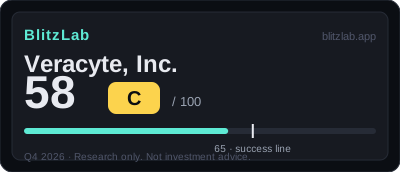
Veracyte, Inc. — Blitz Index 58 (C)
Veracyte scores 58 — a profitable cancer-diagnostics business (70.1% gross margin, operating profit) whose second curve is still proving its speed.
Last re-scored: October 25, 2026.
Confidence: High · Category: frontier
Score breakdown
| Section | Score | Detail |
|---|---|---|
| A · Speed | 16 / 25 | Revenue +23.5% (FY2024) → +16.0% (FY2025, $517.1M) → Q2 2026 +15%; testing +19% in Q2; Decipher volume +27% (FY2025) |
| B · Moat | 34 / 60 | Evidence flywheel (800,000+ patients, 100+ prostate papers) → NCCN Level 1 + full Medicare coverage for Decipher prostate; 70.1% FY2025 gross margin, operating margin +11.2% |
| C · Creative destruction | 12 / 15 | PSA/Gleason-only risk stratification replaced by Decipher 22-gene classification; Afirma avoiding unnecessary thyroid surgery; TrueMRD blood-based recurrence monitoring entering |
| D · BlitzFailing | −4 | Payer concentration (Medicare+UHC 47%); Q2 ASP includes $4.5M prior-period collections true-up; patent suit as plaintiff (Sonic Healthcare, jury trial 2027-Q1); DEF 14A governance unverified (recorded gap) |
Think we scored it wrong? Score it yourself →
Radar axes (0–100): Moat 56.7 · Speed 64 · Creative 80.
Watch item
Gates: G1 ✓ · G2 ✓ (borderline, estimate — combined ceiling ~$10B+ ≈ 1.7x the $5.93B bar, resting on two new products). 7 points below the threshold — first score.
Strengths
- Revenue +16.0% (FY2025) → testing +19% (Q2 2026) — double digits held on a $0.56B base (SEC)
- Decipher +27% (FY2025) → +20% (Q2); volume ~102,000 cases (FY2025) → ~29,700 in the quarter — the core engine sustaining
- GM 70.1% → 72.2% + operating margin +15.8% (H1 2026) + FCF TTM ~$166M — margin and cash generation in the proven zone
- FY2026 guidance raised ($590–596M, Q2) — management confidence quantified (press)
- TrueMRD MolDX coverage + launch (May/Jun 2026) · Prosigna U.S. launch — two second curves proving at once
- NCCN Level 1 + full Medicare coverage — guideline and reimbursement as an institutional moat
- Effectively debt-free + $485.2M cash + SBC 8.4% — a light balance sheet and dilution load
Concerns
- Growth decelerating (+23.5% → +16.0% → Q2 +15%) — Decipher also slowing (+27% → +20%)
- Prosigna Medicare coverage not secured — breast axis unproven; 100+ institutions contacted, conversion to revenue unconfirmed
- Payer concentration (Medicare+UHC 47%) — one payer policy change disrupts distribution
- TrueMRD revenue contribution undisclosed — MIBC single-indication volume unproven; full MRD TAM cannot be read straight into the ceiling (G2 borderline basis)
- Patent suit as plaintiff (Sonic Healthcare, jury trial 2027-Q1) — cost and management distraction risk
- FDA LDT enforcement-discretion risk + Haifa operations geopolitical exposure (press)
- DEF 14A governance unverified — direct review required at rescore (recorded gap)
Research notes
Veracyte, Inc. (NASDAQ: VCYT) is a cancer genomics diagnostics company whose business rests on five testing axes: Decipher Prostate, Decipher Bladder, Afirma for thyroid, Prosigna for breast, and TrueMRD for minimal residual disease monitoring. Scored as of 25 October 2026 (T), on the basis of second-quarter 2026 results announced on 30 July 2026, the company earns 58 out of 100 under the BlitzLab v1.0 model — 16 for Speed, 34 for Moat, 12 for Creative Destruction, and minus 4 in deductions — placing it in grade C, seven points below the 65-point threshold. The score describes a company that has already proved it can make money from diagnostics, and that now faces a narrower question: whether two newly launched products can re-accelerate growth that is decelerating from a profitable base.
Thesis: profit first, then the second curve
Most blitzscaling stories run in the opposite order from Veracyte's. The familiar pattern is a company that buys growth with losses and hopes margins arrive later. Veracyte, by the evidence in its filings, arrived at margins first and is only now spending the proceeds on a second growth curve. Revenue rose from $361.1 million in fiscal 2023 to $445.8 million in fiscal 2024, an increase of 23.5%, and then to $517.1 million in fiscal 2025, up 16.0%. The first half of 2026 continued the pattern at a smaller scale: $139.1 million in the first quarter, up 21% year on year, and $150.3 million in the second quarter, up 15%. Testing revenue, the core of the business, grew faster than total revenue in each of those periods — up 18% in fiscal 2025 to $493.2 million, then up 26% in the first quarter and 19% in the second quarter, on a press-reported basis. The direction is consistent, but so is the deceleration: total growth has stepped down from 23.5% to 16.0% to 15% in the most recent quarter.
What makes that deceleration interesting rather than merely disappointing is what accompanied it. Operating income moved from a loss of $85.8 million to a profit of $57.8 million in fiscal 2025, and reached $45.6 million in the first half of 2026. Net income was $66.4 million in fiscal 2025 and $54.2 million in the first half of 2026, all on an SEC-confirmed basis. Gross margin climbed from 63.6% to 66.9% and then to 70.1% in fiscal 2025, reaching 72.7% in the first quarter of 2026 and 72.2% in the second. Testing gross margin on a non-GAAP basis was 76% in the second quarter, as reported in the company's earnings release. Operating margin reached 11.2% in fiscal 2025 and 15.8% in the first half of 2026; net margin on a trailing-twelve-month basis was 20.4%, adjusted EBITDA was 29.2% in the second quarter, and trailing free cash flow was approximately $166 million on a derived basis. In the scoring group's terms, this is the rare completed profit-and-loss statement: a diagnostics company that is not waiting for profitability to validate its model, but funding its next act from profits already earned.
The second act arrived in the second quarter of 2026, when two products reached the market at once. Prosigna, a breast cancer recurrence-risk test, launched in the United States during the quarter. TrueMRD, a whole-genome minimal residual disease test, secured Medicare coverage through the MolDX program on 15 May 2026, according to a company announcement, and launched commercially on 1 June 2026. Both events fall before T and therefore count as demonstrated evidence, not plans. The gates of the BlitzLab model reflect that distinction. Gate G1, which asks whether growth is sustained or a second curve is demonstrated, passes on confirmed evidence: the revenue record, the completed turn to profitability, and the two launches. Gate G2, which asks whether the ten-year market ceiling is at least ten times current revenue, passes only narrowly, and the reasons for that narrowness run through the rest of this assessment.
Speed: a durable engine, running slower
The Speed section scores 16 out of 25, and its four items tell a single story from different angles: the engine works, but it is no longer accelerating.
Growth itself, item A1 at 6 out of 10, is the binding constraint. The headline figures are respectable for a company with trailing-twelve-month revenue of $561.9 million, yet the scoring deliberately caps the item because deceleration is visible in both total revenue and the largest product. Decipher, the prostate test, grew 27% in fiscal 2025, then 30% in the first quarter of 2026, then 20% in the second quarter, on a press-reported basis. Afirma, the thyroid test, grew 9% in fiscal 2025, then 21% and 18% in the first two quarters of 2026. Testing revenue overall outpaced total revenue, which is a healthy sign, but the comparison the score file draws is instructive: Natera, scored in the same program at 52/C, grew 36% to 38% in the comparable frame, a full tier faster. Veracyte's guidance for fiscal 2026, raised at the second quarter to $590–596 million on a press-reported basis, implies continued double-digit growth, but it does not imply a return to the low-twenty-percent rates of 2024. The score of 6, not higher, is the arithmetic of that gap.
Capital speed, item A2 at 3 out of 5, measures something subtler than access to money: it measures demonstrated speed in raising and deploying it. By access alone, Veracyte would score at the top. Cash plus short-term investments stood at $485.2 million, operating cash flow was $136.3 million in fiscal 2025 and $81.0 million in the first half of 2026, and the balance sheet is effectively debt-free, as discussed below. But the item scores speed, not comfort, and a self-funding company by definition has little recent large-scale fundraising to demonstrate. The score file applies the same standard used for Natera and draws the same distinction: a company in a self-funding phase is not penalized for lacking capital, but neither is it credited with fundraising velocity it has not shown. Market capitalization of approximately $3.7–3.85 billion, on a press-reported basis, is also far smaller than Natera's $56.7 billion, which means the depth of the funding market available to it is structurally different. The score of 3 records that distinction without mistaking it for weakness.
Hiring and productivity, item A3 at 3 out of 5, rests on a small workforce doing a large amount of revenue. The company employed 755 people on a press-reported basis, which implies revenue per employee of approximately $744,000 on a trailing-twelve-month calculation — in the same range as Nebius at $0.88 million and a tier above Natera at $376,000. Two operational facts support the score. First, the Afirma v2 platform transition was completed in 2025, giving the company a lever for launching new tests on an existing platform rather than rebuilding one each time. Second, first-quarter 2026 operating income rose 680% year on year on a press-reported basis, a vivid demonstration of operating leverage: revenue growth falling mostly to the bottom line. The discount reflects the other side of that same quarter, in which research and development spending rose 53% year on year on a press-reported basis. The company has entered an investment cycle, and productivity gains are still in the process of being proved in margin rather than already proved at their peak. A score of 3 holds both halves of that sentence.
Share-expansion speed, item A4 at 4 out of 5, is the strongest of the four Speed items, and it is where the company's most quotable piece of evidence sits. Decipher test volume grew 27% in fiscal 2025 to approximately 102,000 tests, then 24% in the first quarter and 17% in the second quarter, on a press-reported basis. Afirma volume grew 11%, then 12%, then 10% across the same three periods — steadier, slower, and still double-digit. The decisive evidence, however, is a statement by the chief executive officer on the first-quarter earnings call, as reported in press coverage, that Decipher has penetrated only about one-third of its addressable prostate cancer patients, leaving two-thirds who have not yet benefited from the test. If that characterization is right, the remaining market is not a hypothesis to be discovered but a measured gap to be closed. The score stops at 4 rather than 5 only because a quantified market share figure has not been publicly disclosed; the same standard was applied to Natera. Volume growth plus a stated penetration gap is strong evidence of expanding share, but it is not the same as a published share statistic.
Moat: evidence as distribution
The Moat section scores 34 out of 60, and its logic is specific to diagnostics. In most industries, distribution means stores, salespeople, or a platform. In diagnostics, distribution means clinical guidelines and payer coverage: a test that physicians are told to use, and that insurers will pay for, has a channel that a competitor cannot replicate by spending more on sales. Veracyte's moat is built from that mechanism, and its strength and its fragility come from the same source.
Network effects, item B1 at 7 out of 18, are scored honestly as absent in the classical sense. There is no user-to-user network here. What exists instead is an evidence flywheel, and the score file documents it in unusual detail. Rising test volume has produced a dataset covering more than 800,000 patients, on a press-reported basis, which has supported more than 100 published clinical papers on prostate cancer and more than 100 papers from the company's GRID research platform. That body of evidence, the company claims, earned Decipher inclusion in the National Comprehensive Cancer Network guidelines at Level 1 evidence status, and guideline inclusion in turn supported Medicare coverage across the full prostate range, which in turn supported volume and pricing — normalized average selling price rose 3% in the second quarter. The score of 7, equal to Natera's, places this in the middle of the anchor range for evidence-based lock-in: weaker than a patient-level lock-in of the kind a tumor-informed residual disease test creates for an individual patient, but comparable as an institutional lock-in, because a guideline endorsement is difficult for a competitor to displace without replicating the evidence base behind it.
Distribution scalability, item B2 at 9 out of 18, is the highest Moat item, and it describes the same mechanism from the commercial side. The distribution system is a direct sales organization plus payer coverage, and the coverage facts are the substance. Decipher holds Medicare coverage across the full prostate range, from localized to metastatic disease, and the company claims it is the only gene-expression test with that breadth. TrueMRD added MolDX coverage for muscle-invasive bladder cancer in May 2026. Prosigna, by contrast, was in contact with more than 100 breast cancer institutions at the time of the second-quarter call, on a press-reported basis, but was still in discussions with Medicare — the one axis where coverage had not yet been demonstrated. The discount to the score is structural and is shared with Natera: Medicare plus UnitedHealthcare account for 47% of revenue on a press-reported basis, so payer decisions are not merely a commercial variable but the gate through which distribution itself passes. A score of 9, at the top of its anchor range, credits a distribution system that has been extended twice over, while recording that its gatekeeper concentration is the price of that extension.
Market size, item B3 at 8 out of 12, is where the G2 gate's narrowness becomes a scored item. The gate's bar is set at approximately $5.93 billion, ten times the midpoint of fiscal 2026 guidance of about $593 million; the score file notes that using trailing-twelve-month revenue would set a lower bar of $5.62 billion, and deliberately adopts the stricter guidance-based figure. Against that bar, the core market alone falls short. The global prostate molecular diagnostics market was $1.54 billion in 2023 and is forecast at $2.57 billion by 2030, a compound annual growth rate of 6.5%, according to WiseGuy data cited on a press-reported basis — only 43% of the bar. A broader definition of the prostate diagnostics market, including PSA testing and imaging, was $5.02 billion in 2025 and is forecast at $9.19 billion by 2030, a 12.9% compound rate, according to TBRC data cited on a press-reported basis, but that definition is wider than Veracyte's directly addressable market and serves only as a reference ceiling. What changes the arithmetic is the residual disease market that TrueMRD has entered: Natera's annual report cites a United States total addressable market of approximately $24 billion for residual disease monitoring, a company claim, and third-party forecasts for the global liquid biopsy market in 2035 range from $19.9 billion to $36.8 billion, as cited in the Natera scoring. Veracyte's first indication is a single one — muscle-invasive bladder cancer — so the full residual disease market cannot be claimed directly, but the platform is structured to expand across cancers, according to company statements on the second-quarter call. Summing the prostate molecular market, the thyroid market served by Afirma, the breast recurrence-risk market served by Prosigna, which the company describes as hundreds of thousands of early hormone-receptor-positive breast cancer patients, bladder residual disease, and international expansion produces an estimated combined ceiling above $10 billion, about 1.7 times the bar — the same headroom band as Natera's 1.6 times. The score of 8 reflects that the ceiling clears the bar only in aggregate, and only if the two new products prove themselves. A deliberately excluded upside — the full pan-cancer opportunity for whole-genome residual disease testing, which could be described in tens of billions of dollars — was left out of the calculation precisely because only one commercial indication exists, the same discipline applied when early cancer screening was excluded from Natera's ceiling.
Gross margin, item B4 at 10 out of 12, is the highest single item in the entire score, and it is the item where Veracyte most clearly separates from its closest comparator. The margin progression is confirmed in filings: 63.6% to 66.9% to 70.1% in fiscal 2025, then above 72% in both quarters of 2026. The decisive difference from Natera, which scored 9 with a gross margin of 64.7%, is what happens below the gross margin line. Natera remained operating-loss-making; Veracyte converted its gross margin into an operating margin of 11.2% in fiscal 2025 and 15.8% in the first half of 2026, a trailing net margin of 20.4%, and the free cash flow noted above. The score stops at 10 rather than 12 because the top of the scale requires gross margin sustained above 75% on a GAAP basis plus demonstrated margin contribution from Prosigna and TrueMRD, neither of which has yet been shown. The 10 therefore reads as a statement about the present — the margin proof is complete for the existing business — with the conditions for the final two points stated in advance.
Creative destruction: replacing judgment with measurement
The Creative Destruction section scores 12 out of 15, the highest of the three sections on a percentage basis, and it captures the sense in which Veracyte's tests are not merely better diagnostics but replacements for a way of deciding.
Item C1, the order being replaced, scores 4 out of 5. The old order is treatment decisions made from PSA levels and Gleason grade alone — empirical risk classification, in the score file's phrase — supplemented by surgical habits that genomic information can now challenge. Decipher's 22-gene classifier quantifies metastatic risk and thereby informs decisions to intensify or de-escalate treatment. Afirma helps patients avoid unnecessary thyroid surgery. TrueMRD introduces blood-based recurrence monitoring where imaging and follow-up visits previously carried the burden. The targets being replaced — empirical classification, unnecessary procedures, imaging-based tracking — are large and clearly identified. The score stops one point below the top because the replacement is, at this stage, a mixture of substitution and supplementation: genomic classifiers sit alongside existing diagnostics in many workflows rather than displacing them entirely, unlike a one-time curative paradigm that would score the full 5.
Item C2, irreversible behavioral change, also scores 4 out of 5. The mechanism is again institutional. Guideline inclusion plus full-range Medicare coverage has moved Decipher results into the clinical workflow, where they determine the choice between active surveillance and treatment, and the intensity of treatment chosen. That is a structural lock-in in progress: once a test result routinely determines a treatment path, removing the test means returning to less informed decisions, which neither physicians nor payers have an incentive to do. The accumulation of coverage for Prosigna and TrueMRD, including TrueMRD's MolDX coverage in May 2026, is presented in the score file as repetition of the same trajectory on new axes. The score stops at 4 because the change, while structural within clinical practice, has not reached the level of mass behavioral change that would score 5 — it is a change in how medicine is practiced, not yet in how the public behaves.
Item C3, cost-structure change, scores 4 out of 5 on the strength of a measured proxy. Gross margin improved by 8.6 percentage points, from 63.6% to 72.2%, over roughly three and a half years, which the score file treats as a measured proxy for falling per-test cost, driven by the Afirma v2 platform transition, volume scale, and average selling price improvement of 3% on a normalized basis. Beyond the company's own costs, the genomic classification pathway changes the cost structure of the diagnostic journey itself: avoiding an unnecessary thyroid surgery or a round of repeated imaging is a larger saving than any single test's price. The score stops at 4 because a per-test unit cost in dollars has not been publicly disclosed, so the cost decline is demonstrated through margin rather than measured directly — the same standard applied to Natera and Tempus.
Deductions and risks: light, concentrated, and mostly structural
Total deductions are minus 4, among the lightest in the scoring group, and the composition matters more than the total. No single deduction is large; the risk profile is instead a small number of structural exposures, each of which maps to a strength described above.
Debt, item D1 at minus 1 out of a possible minus 10, is barely a debt item at all. Total debt was $98.0 million against equity of $1,388.4 million, with cash and short-term investments of $485.2 million and sustained positive operating and free cash flow, all confirmed in filings. The deduction's real substance is dilution: stock-based compensation was $43.6 million in fiscal 2025, equal to 8.4% of revenue — about half of Natera's 15.4%, which drew a deduction of minus 3. A press-reported observation of a 19% equity overhang, combined with no confirmed share-repurchase offset, is the basis for the light deduction. The company pays its people partly in stock, as growth companies do, but the burden is light by the standards of its peer group.
Revenue quality, item D2 at minus 1, records a small blemish of a specific kind. There have been no revenue restatements, auditor changes, or audit-opinion issues. The deduction arises because second-quarter 2026 average selling price included $4.5 million of prior-period collections — a true-up of reimbursement estimates, of the same structure as an item that drew minus 2 for Natera, but smaller in scale, at roughly 3% of testing average selling price. It is a reminder that in a business where payers reimburse after the fact, revenue always contains an element of estimation, and that element occasionally revises itself. Separately, a $6.7 million one-time loss from winding down Veracyte SAS, the biopharma services unit, in the third quarter of 2025 was treated as a non-recurring cleanup rather than a deduction — and, more importantly, as evidence of strategic focus, since it left testing at more than 95% of revenue.
Governance, item D3 at 0, is the score file's most explicit gap rather than a clean pass. The definitive proxy statement dated 22 April 2026 was not directly reviewed, so dual-class share structure, founder ownership, and related-party transactions could not be confirmed. Review sources identified no governance issues, so the item was processed as no-trigger, but the score file records the verification gap and makes direct review of the proxy a precondition for the next rescoring. A zero here therefore means "nothing found, but not fully verified," which is a weaker statement than Natera's zero, where a single-class structure was confirmed. Readers should weight it accordingly.
Regulatory and social cost, item D4 at minus 2 out of a possible minus 5, collects three distinct exposures. The first is patent litigation in which Veracyte is the plaintiff: in May 2025 the company sued Sonic Healthcare over its ThyroSeq v3 test, alleging infringement of Afirma patents, with a jury trial expected in the first quarter of 2027 on a press-reported basis. Because Veracyte is the plaintiff rather than the defendant, the exposure is litigation cost and management distraction, not damages — a deliberate contrast with Natera's minus 5, which reflected a jury verdict against it. The second exposure is the payer concentration already discussed: Medicare plus UnitedHealthcare at 47% of revenue means a single payer's policy change — a coverage narrowing, a price reduction, or tightened prior authorization — transmits directly into volume and price. The third is regulatory: the Food and Drug Administration's 2024 final rule on laboratory-developed tests was vacated by a federal court on 31 March 2025, but discretionary enforcement risk remains, and the company's Haifa operations, associated with its C2i acquisition, carry geopolitical exposure, both on a press-reported basis. None of these has produced a verdict or a fine; together they justify a moderate deduction for a business whose risks are concentrated in the rules that govern its market.
The BlitzLab fit analysis in the score file names the single largest risk in one sentence: payer coverage is the company. That formulation is worth pausing on, because it unifies the moat and the risk sections. The same Medicare coverage that constitutes Veracyte's distribution is also its single point of failure. A coverage decision is not one risk among many for this business; it is the channel through which every other risk must travel. The progress of Prosigna's Medicare discussions is therefore the first signal of the direction of that risk, and the score file treats it as such.
What to watch: the two launches and the gate's conditions
The score file's forward markers are unusually precise, because the company's own calendar supplies them. Third-quarter 2026 results were scheduled for 4 November 2026, after T, and are therefore excluded from this scoring; they are the first verification point for the central question of this assessment, namely whether Prosigna and TrueMRD can return testing growth to the twenty-percent range. The gate's review triggers are stated in the same terms: a refusal or delay in Prosigna's Medicare coverage, a failure of TrueMRD volume to demonstrate itself, or Decipher growth falling below 10% would each require the G2 verdict to be revisited. Those are not predictions; they are the conditions under which the current judgment would need to change, and they give the next scoring a falsifiable structure.
Three other markers deserve attention for the same reason. First, the margin conditions for the final two points of B4: gross margin sustained above 75% on a GAAP basis, and demonstrated margin contribution from the two new products. Second, the governance gap: direct review of the April 2026 proxy statement before the next rescoring, without which the D3 zero remains unverified. Third, the patent trial expected in the first quarter of 2027, which will convert a cost-and-distraction risk into an observed outcome, in one direction or the other.
Stepping back, the shape of the 58 is legible. A company with a proven margin structure, a guideline-backed distribution system, and a credible second curve scores 34 on Moat and 12 on Creative Destruction — strong, though not exceptional. It scores only 16 on Speed, because its growth is decelerating and its capital velocity is unproven in a self-funding phase. And it loses only 4 points to deductions, because its balance sheet is clean, its dilution is light, and its litigation runs in the favorable direction. The seven-point gap to 65 is therefore not a story of hidden damage; it is a story of a single missing ingredient, which is faster growth. If Prosigna's coverage and TrueMRD's volume supply that ingredient, the arithmetic of the model has room to move. If they do not, the company remains what the current score describes: a profitable, well-defended diagnostics business whose blitz, for now, is on pause.
More Frontier companies
Other Frontier names on the Blitz Index, highest score first: Rocket Lab (62/B), Tesla (62/B), Illumina, Inc. (61/B).
Next earnings
Q4 2026 · Expected
Coverage
Veracyte, Inc. · Q3 2026 due Nov 4, 2026 (AMC) · Score 58 · Grade C
Embed this score
Copy the HTML below to show this score on your site. The badge links back to this page and updates automatically when the score changes.
Preview:
BlitzLab scores businesses against a scholar’s standard — not investment advice. No price targets, no buy/sell recommendations. Figures are from SEC filings (XBRL) as labeled in the source scorecard.