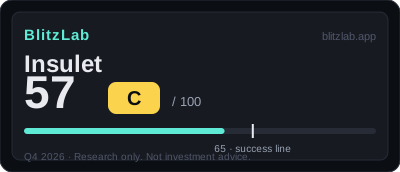
Insulet — Blitz Index 57 (C)
Growth re-accelerated to +30.7% with gross margin at 71.6% — a margin-proven blitz whose ceiling is set by a switching-cost moat, not a network.
Last re-scored: October 21, 2026.
Confidence: High · Category: frontier
Score breakdown
| Section | Score | Detail |
|---|---|---|
| A · Speed | 16 / 25 | Revenue +22.1% → +30.7% — a rare re-acceleration at device scale; international +44.1% now contributes over half the growth |
| B · Moat | 35 / 60 | Prescriber ecosystem and pharmacy-channel lock-in with high switching costs — but no network effect; B1 caps in the switching-cost band (7) |
| C · Creative destruction | 11 / 15 | The tubeless patch displaced tubed pumps and daily injections; Omnipod 5 + sensor integration rewired the daily routine |
| D · BlitzFailing | −5 | Debt stack after the 2025 convertible buyback ($949.2M incl. leases) and a first guidance cut — modest, disclosed, in the file |
Think we scored it wrong? Score it yourself →
Radar axes (0–100): Moat 58.3 · Speed 64 · Creative 73.3.
Watch item
Gates: G1 ✓ · G2 ✓ (estimate, borderline). Bar ≈ $27.1B (FY2025 revenue × 10) vs a ~15M-patient addressable population (company estimate) with pump penetration still low outside US Type 1.
Strengths
- FY2025 pairs +30.7% growth with gross margin +180bp to 71.6% and operating income +53% — the atlas's true signature: acceleration and margin expansion together
- International Omnipod +44.1% — the second engine is geographic
- Operating cash flow $569.3M — the blitz funds itself
- Omnipod 5 with CGM integration deepens daily-use lock-in
Concerns
- First guidance cut (Aug 2026): US Omnipod growth 20–22% → 17–19% — Type 2 expansion is slower to learn than modeled
- Patient counts and new starts are not in the SEC filings — adoption can only be inferred from revenue
- CEO/CFO transition year; Q2 2026 GAAP operating margin dipped 250bp on one-off severance
- The moat is switching costs, not network effects — the B bucket caps the total below the line
Research notes
Insulet Corporation, founded in 2000, is a single-business company built around one platform: the tubeless, wearable insulin pump Omnipod. Its Drug Delivery business, which supplies Pods for Amgen's Neulasta Onpro, has shrunk to 1.3% of revenue. Everything that matters about Insulet, therefore, is a question about Omnipod: how many people with diabetes adopt a pump, how quickly, through which channel, and at what margin. That concentration is both the clarity of the story and its central risk.
As of the scoring date of 20 October 2026 — hereafter T — Insulet's BlitzLab v1.0 score is 57 out of 100, grade C. The composition matters more than the total. Speed (A) is 16 out of 25: A1 Growth 7, A2 Capital velocity 3, A3 Hiring and productivity 3, A4 Share velocity 3. Moat (B) is 35 out of 60: B1 Network effect 7, B2 Distribution scalability 10, B3 Market size 8, B4 Gross margin 10. Creative destruction (C) is 11 out of 15: C1 Order displaced 4, C2 Irreversible behaviour change 4, C3 Cost-structure change 3. Deductions (D) total −5: D1 Debt −2, D2 Revenue quality −1, D3 Governance 0, D4 Regulatory and social cost −2. The total is therefore 16 + 35 + 11 − 5 = 57, eight points below the 65-point threshold. There is no FLAG, because total deductions of 5 are below the 15-point FLAG threshold. Insulet is classified as MATURE. The latest results available at T were second-quarter 2026 results, reported on 5 August 2026; third-quarter 2026 results, scheduled for before the market open on 4 November 2026 according to the company's announcement, were not yet released at T and are treated here only as a future marker, with no anticipated outcome attached.
Thesis: the harvest body and the second blitz
The score file's summary phrase for Insulet is precise: a proven body, an unproven expansion. The body is the type 1 diabetes business, sold largely through endocrinologists and a pharmacy channel, generating revenue of $2,708.1 million in fiscal 2025, operating income of $473.8 million at a 17.5% margin, and operating cash flow of $569.3 million. The expansion is type 2 diabetes, opened by a United States Food and Drug Administration approval in August 2024 that made Omnipod 5 the first automated insulin delivery pump with a type 2 indication, and now being pursued through primary care physicians — a different prescriber, a different workflow, and, as the evidence at T already shows, a slower learning curve than management first expected.
Both gates pass, but the second only narrowly and with an explicit warning attached. Gate 1, sustained growth or a second growth curve, passes on confirmed figures: revenue rose from $1,697.1 million in fiscal 2023 to $2,071.6 million in fiscal 2024, an increase of 22.1%, and then to $2,708.1 million in fiscal 2025, an increase of 30.7%, or 29.5% on a constant-currency basis. That reacceleration at a scale above $2.7 billion is unusual for a large medical-device company, and it arrived together with margin expansion and cash generation rather than at their expense. The second curve has a real shape, not merely a label: Omnipod 5's type 2 indication, granted in August 2024, plus launches in 19 countries.
Gate 2, a ten-year new-market ceiling at least ten times current revenue, passes as an estimate, on the boundary, and the score file is careful about why. The bar is set from confirmed fiscal 2025 revenue: ten times $2,708.1 million is approximately $27.1 billion. On a trailing-twelve-month basis covering the third quarter of 2025 through the second quarter of 2026, revenue was $3,053.4 million, which would imply a bar of about $30.5 billion, but the score file adopts the confirmed annual figure as the canonical bar. The addressable patient pool, on the company's own estimate as stated in its annual report, is about 15 million people in the countries it serves: about 6 million with type 1 diabetes, about 6 million with type 2 diabetes who require insulin, and about 3 million in the United States with type 2 diabetes on basal insulin only. Pump penetration is only about 40% for type 1 diabetes in the United States and about 25% internationally, according to the company's estimate, and much lower for type 2 diabetes. Penetration alone, therefore, offers an arithmetic path to multiples of current revenue. What cannot be verified is the speed of that path, because revenue per patient per year is not disclosed, so the penetration rate that would be required to reach the bar cannot be calculated with certainty, and prices and reimbursement structures differ by country, so the 15 million patients cannot be converted into dollars at a single price. The gate question for Insulet is therefore not whether the market is too small. It is a penetration-speed question: how fast type 2 adoption actually happens. The first downward revision to guidance, in August 2026, already arrived as an early warning on exactly that speed. The re-examination triggers recorded in the score file are further downward revisions to United States Omnipod growth, stagnation in type 2 new-start indicators, and stagnation in pump penetration.
Speed: reacceleration, then the first deceleration
Growth, A1 at 7 out of 10, is the most two-sided item in the score. Fiscal 2025 revenue of $2,708.1 million, up 30.7%, breaks down into United States Omnipod revenue of $1,919.8 million, up 27.2%, and international revenue of $754.3 million, up 44.1%, or 39.3% on a constant-currency basis. The first half of 2026 continued that strength in aggregate — revenue up 28.3%, with the first quarter at $761.7 million, up 33.9%, and the second quarter at $801.7 million, up 23.5% — but the composition of the second quarter is where the deceleration first becomes measurable: United States growth of 20.1% and international growth of 35.5%. The guidance revision announced on 5 August 2026 points in the same direction. United States Omnipod growth guidance for fiscal 2026 was lowered from 20–22% to 17–19%, and total revenue growth guidance was lowered from 21–23% to 20–22% on a constant-currency basis. The score file records this as the first year in which guidance was revised downward rather than upward, and management attributed the change, in the score file's account, to what it was learning from the type 2 expansion. That is a business event, and it is scored as one, in A1 and in Gate 1, rather than treated as an accounting-quality issue. It is also worth stating plainly what the deceleration does not yet show: total guidance remains in the range of around 20% growth, and first-half growth of 28.3% means sustained growth itself is not in question. What is in question is the slope of the second curve.
Two structural limits on the speed evidence should be kept in view throughout this profile. First, the company does not disclose absolute numbers for customer counts, new starts, conversion rates, or retention rates in its Securities and Exchange Commission filings, so the quality of product-market fit can only be verified indirectly, through revenue and margin. That limit is reflected in A1 and A4. Second, the comparison points in the score file place Insulet's 7 in context: it sits below a peer that maintained growth in the high-30% range while raising guidance, and at the same level as a much larger company growing 33.7% from a $13.3 billion base. In other words, 7 recognises genuine reacceleration without rewarding it as though the deceleration had not happened.
Capital velocity, A2 at 3 out of 5, describes a company that has demonstrated access to capital but whose recent capital flows run in the opposite direction from fundraising: toward tidying and returning. Access itself is evidenced by a $450 million issue of 6.5% senior unsecured notes in March 2025, maturing in 2033, and by the refinancing of a Term Loan B in August 2024, maturing in 2031. The subsequent direction of travel is clean-up. In 2025 the company repurchased convertible notes with $419.9 million of principal for $541.5 million in cash and retired them, as part of total 2025 repayments of $1,052.2 million, and share repurchases accelerated from $59.6 million in fiscal 2025 to $300.0 million in the first half of 2026, while the diluted share count fell from 73.9 million to 71.9 million and then to 69.8 million. The score applies the yardstick for a mature, self-funding company rather than that for a company still proving it can raise money. The share price context, on a press-reported basis, is a narrower market window: $141.96 on 19 October 2026, down 60% from a 52-week high of $354.88 and down 50.1% year to date, with a market capitalisation of about $9.8 billion on a press-reported basis. That price history is not part of the business score, and it is recorded here only as context, labelled as press-reported, not as a judgement on value.
Hiring and productivity, A3 at 3 out of 5, captures a deliberate bet placed ahead of demand. Headcount was about 5,400 at 31 December 2025, on a confirmed Securities and Exchange Commission basis, an increase of 38% from the prior year, centred on commercial and customer-experience organisations, with 60% of employees in the United States and operations in 18 countries. Revenue per employee, a derived estimate, was about $502,000, down from an estimated roughly $659,000 the year before: hiring at 38% outran revenue growth of 30.7%. Selling, general and administrative expense rose from $917.2 million to $1,165.0 million, up 27.0%, including an increase of $37.1 million in advertising spending described in the score file as investment in creating type 2 demand. That increase was below the rate of revenue growth, so it is not the kind of cost reversal seen in peers where research and administrative spending sharply outran revenue. The judgement embedded in the 3 is therefore conditional: hiring is a lead investment in future demand, and whether productivity recovers is something type 2 penetration still has to prove.
Share velocity, A4 at 3 out of 5, is scored lower than the revenue figures alone might suggest, for a reason that is entirely about evidence. The stock of unpenetrated demand is large, on the company's estimate — type 1 pump use of about 40% in the United States and about 25% internationally, and much lower for type 2 — but the speed of penetration cannot be measured in hard numbers, because new customer starts, conversion, and retention are not disclosed; the score file marks them unconfirmed. The indirect evidence is strong: international revenue up 44.1% in fiscal 2025 and 35.5% in the second quarter of 2026, Omnipod 5 launched in 19 countries, and a type 2 indication granted in August 2024 that opened a new patient pool. What is missing is a verifiable change in share against competitors such as Tandem and Medtronic that can be stated numerically, and the score therefore sits one point below a peer that could evidence its share gain in volume terms. A reader who wants a single sentence on A4 should carry this one: the opportunity is large and the direction is favourable, but the velocity itself is inferred, not counted.
Moat: switching costs and a pharmacy channel, not a network effect
The moat section, B at 35 out of 60, is where Insulet's ceiling is set, and the score file is unusually explicit about why. The headline for the whole profile can be stated as follows: Insulet's score is held down not by risk, but by the kind of moat it has. A moat built on switching costs and a prescriber ecosystem has a structural upper bound in this scoring model that a classic network effect does not, and the 8 points Insulet lacks against the 65-point threshold would have to come from the moat, not from speed alone.
Network effect, B1 at 7 out of 18, is scored in the 5–9 anchor band for data and ecosystem effects, and the score file insists on naming what the item really is here. It is not a classic network effect. More users do not directly raise the value of the product for other users, and no direct monetisation of data itself, such as data sales, is disclosed. What does exist is a bundle of switching costs and ecosystem friction that grows stickier as the installed base grows. A Pod is a consumable replaced after a maximum of three days, so adoption creates a repeating purchase. Patients invest in training and adaptation. Reimbursement eligibility through insurance and pharmacy channels creates a structural hurdle to leaving. Clinicians develop prescribing habits and embed Omnipod in their clinical workflows. And Omnipod 5's built-in automated insulin delivery algorithm integrates with both major continuous glucose monitoring camps — Dexcom G6 and G7 and Abbott FreeStyle Libre 2 Plus, varying by market, with Libre 3 integration in development and a data-platform partnership with Glooko — so that a larger installed base reduces friction in the prescribing ecosystem even though it does not create two-sided marketplace liquidity. That indirect effect is real, and it is why the score is not in the 1–4 band for community or brand alone, but it is also why it stops at 7: the 10–14 band for two-sided market liquidity does not apply, and the score sits at the same level as a peer whose data flywheel connects only indirectly to reimbursement decisions.
Distribution scalability, B2 at 10 out of 18, is the strongest moat item after margin, and it rests on a single design decision: the pharmacy channel. In the United States, sales flow through wholesalers into a pharmacy benefit channel on a pay-as-you-go basis. The patient makes no upfront device investment, and the insurer bears less upfront risk, so the distribution design itself removes the barrier to starting a prescription. That includes negotiation for Medicare Part D coverage, and it represents a shift away from the durable medical equipment channel convention for medical devices. The repeatability of that distribution is evidenced by international growth: revenue up 44.1% in fiscal 2025 and 35.5% in the second quarter of 2026, with expansion to 19 launch countries translating directly into revenue. Three discounts keep the score at the lower end of the 10–14 large-distribution-partner band. Selling, general and administrative expense is 43% of revenue, at $1,165.0 million, which marks a sales-dependent structure. About 86% of all sales pass through intermediaries. And type 2 diabetes is prescribed disproportionately in primary care, so the existing endocrinologist-centred sales organisation has to be extended into a new channel — and the guidance revision is, in the score file's reading, the first invoice for that learning cost. Repeatability in the new channel is not yet proven, so the score stops at 10.
Market size, B3 at 8 out of 12, follows Gate 2 with a conservative adjustment. The addressable patient pool of about 15 million people, on the company's estimate, and the penetration headroom described above would place Insulet among the top of the scored group on headroom alone. The discount has two parts. Because revenue per patient is not disclosed, the market cannot be converted into dollars with certainty, and the scoring model's conservative principle for estimated items — start one band lower — is applied. And because the realisation of that ceiling depends on a single variable, the speed of type 2 penetration, the score is held below a peer that could state its dollar market as 5.5 times its gate bar. The 8 is therefore a statement about verification as much as about size: a very large pool, imprecisely priced.
Gross margin, B4 at 10 out of 12, is the strongest single item in the profile, and it requires a structural warning before it is admired. Gross margin rose from 68.3% to 69.8% and then to 71.6% in fiscal 2025, an expansion of 180 basis points attributed in the score file to manufacturing and supply-chain efficiency, average selling price increases, and volume effects. Gross profit was $1,939.9 million. Operating margin rose from 13.0% to 14.9% and then to 17.5%, and operating cash flow was $569.3 million. In the second quarter of 2026, gross margin was 70.2% on a derived basis, adjusted operating margin was 19.3%, up 140 basis points, and adjusted earnings per share were $1.66, up 41.5%. The warning is that this 71.6% is not software-like high margin. A Pod is a manufactured consumable hardware product replaced every three days: revenue repeats like a subscription, but cost of revenue always contains physical manufacturing and supply-chain cost, and reimbursement prices and average selling price pressure reach margin directly. It should not be read on the same yardstick as software businesses with gross margins in the 85–90% range and scores of 11 or 12. On the correct yardstick — a hardware business achieving 30.7% growth and margin expansion at the same time — the score file calls the combination a rare signature in the scored group, and scores it one point above a peer with a 64.7% gross margin that remained loss-making at the operating level. That is the right way to understand the 10: exceptional for what it is, not comparable to what it is not.
Creative destruction: displacing tubes and injections, and the pharmacy convention
Creative destruction, C at 11 out of 15, is Insulet's highest axis in percentage terms, and it is the section where the product story is clearest. The order displaced, C1 at 4 out of 5, is specific: tubed pumps and multiple daily injections. The tubeless, disposable Pod — with a hidden needle, waterproofing, and up to three days of continuous infusion — created a category that removed the psychological barrier of a pump, and the August 2024 type 2 indication widened the displacement to patients who had never used a pump at all. A second displacement runs in parallel, in distribution: the convention that a medical device belongs in the durable medical equipment channel is being replaced by a pharmacy benefit channel. The reason the score stops at 4 rather than 5 is scale of completion. In type 2 diabetes, multiple daily injections remain the dominant delivery method, and tubed competitors coexist. Displacement is under way; it is not yet complete at market scale, and the score file reserves 5 for the kind of total replacement associated with the highest-scoring platform cases.
Irreversible behaviour change, C2 at 4 out of 5, is scored at the level of the adopter rather than of society as a whole, and the evidence is behavioural, not rhetorical. For a patient, automated insulin delivery linked to continuous glucose monitoring makes 24-hour wear — including sleep, exercise, and showering — part of daily life, and the three-day Pod replacement cycle and pharmacy-channel refills become embedded in life's rhythm, so that returning to multiple daily injections would be a clinical and behavioural step backward. For clinicians, prescribing and training workflows are reorganised around Omnipod. The institutional evidence is cumulative: Food and Drug Administration indications expanded from type 1 diabetes in 2022 to type 2 diabetes in 2024, and the reimbursement channel has become established. Again the score stops at 4 for a stated reason: the behaviour change of the new pool — type 2 patients and primary care physicians — is still in its early formation, and the guidance revision is itself evidence of that. A score of 5 is reserved for society-wide irreversibility of the kind associated with a general-purpose platform, and Insulet, however deep its effect on its adopters, does not claim that.
Cost-structure change, C3 at 3 out of 5, separates two layers that are often confused. The layer where change is proven is the payment structure: the pharmacy channel's pay-as-you-go model removes the patient's upfront device purchase cost and the insurer's upfront risk, converting the cost of starting a pump from a durable-medical-equipment-style capital expenditure into a consumable-style operating expenditure. The layer where change is gradual is manufacturing: gross margin improved by 3.3 percentage points over two years, from 68.3% to 71.6%, which is measured evidence of economies of scale, but dollar unit cost for a Pod is not disclosed, and international average selling prices are actually rising, so there is no evidence of a collapse in unit cost. The score therefore sits below peers whose margin improvements were in the range of 19 to 22 percentage points. The distinction is worth preserving, because it prevents a common misreading of this profile: Insulet changed how a pump is paid for more decisively than it changed how cheaply a pump is made.
Deductions and risks: a light deduction load, honestly stated
Deductions total only −5, which is strikingly light for a medical-device company in this scored group, and the score file is explicit that this lightness is a finding, not an oversight. Debt, D1 at −2 out of a possible −10, starts from a light leverage position: total debt of $949.2 million including leases at 31 December 2025, comprising a Term Loan B maturing in 2031 with covenants, $450 million of 6.5% senior notes maturing in 2033, and a revolving facility. That is 0.35 times revenue. Interest expense of $59.4 million against operating income of $473.8 million implies coverage of about 8 times, and operating cash flow was $569.3 million. The deduction is not about leverage itself. It has two specific roots: cash of $534.9 million at 30 June 2026, down from $716.1 million at year-end as share repurchases reduced it, was smaller than total debt, leaving a net debt position; and the 2025 convertible-note clean-up, in which $419.9 million of principal was repurchased for $541.5 million, realised a repayment loss of $123.9 million, so the cost of tidying the capital structure is visible in the accounts. Two offsetting facts are recorded and prevent a larger deduction: stock-based compensation was restrained at $62.7 million, or 2.3% of revenue, and the share count is falling through repurchases, so no dilution deduction is applied.
Revenue quality, D2 at −1, is the most carefully bounded deduction in the profile, and its boundary is instructive. There are no revenue restatements, no auditor changes, and no audit-opinion issues: no accounting-quality trigger exists. The guidance revision itself is not double-counted here, because it is already reflected as a business event in A1 and Gate 1, following the precedent that a guidance revision is a business event, not an accounting-quality issue. The small −1 rests on a cluster affecting confidence in execution: the fiscal 2026 guidance revision in August 2026, a chief executive officer and chief financial officer change, and two executive-change filings in September 2026, all falling in the same year, so that a discount on the new management team's forward statements persists until the next guidance delivery. A secondary factor is the shrinking Drug Delivery segment: revenue fell from $38.9 million to $34.1 million, down 12.3%, with $9.1 million in the first half of 2026, a segment dependent on a single partner, Amgen. That is a concentration fact, not an accounting allegation, and the score treats it as such.
Governance, D3 at 0, records an absence of structural triggers. Insulet has a single share class, with no dual-class voting rights and no founder control. Holders above 5%, on the basis of the proxy statement, are Capital Research at 11.1%, FMR at 9.0%, and BlackRock at 8.7%, with the caveat that each figure rests on a filing as of a different reference date — an institutional, dispersed structure. Chief executive officer Ashley McEvoy is a professional manager who succeeded Jim Hollingshead on his retirement. The management change itself is reflected in D2 as an execution-confidence matter and is deliberately not double-counted here.
Regulatory and social cost, D4 at −2, is scored on structural exposure, not on events, because at T there were no confirmed fines, litigation judgements, or sanctions. The exposure is threefold, all recorded as standing items in the annual report's risk section: dependence on insurance reimbursement negotiations, including the pharmacy channel and Medicare Part D, so that a change in reimbursement terms is a change in distribution terms; dependence on the timetable for additional Food and Drug Administration approvals, including Libre 3 integration, a full closed loop for type 2 diabetes, and Omnipod 6; and exposure to the OECD Pillar Two global minimum tax. Competition and concentration factors are recorded as concerns but are not double-counted in this item: competition from Medtronic Diabetes, which is planned for spin-off, Tandem, and Beta Bionics; dependence on the two continuous glucose monitoring companies, Dexcom and Abbott; concentration in distribution, with the top two distributors accounting for about 53% of fiscal 2025 revenue; and the long-term effect of GLP-1 medicines on insulin demand, which the score file marks as unverified — neither the company nor the market yet has an answer. That unverified label should be preserved by any reader summarising this profile: it is an open question, not a finding in either direction.
The wider risk list in the score file deserves a final, plain restatement, because it shows what could still move the score. Selling, general and administrative expense at 43% of revenue, combined with 38% headcount growth, means the type 2 demand-creation investment becomes fixed cost if penetration does not follow. The Drug Delivery segment is shrinking and single-partner dependent. Competition is intensifying, including from the multiple-daily-injection and smart-pen camp as well as from other pump makers. And the valuation context, on a press-reported basis — a share price down 60% from its 52-week high — records that the market, at T, appeared to be pricing the type 2 delay as structural rather than temporary. The business score does not follow the share price, and this profile does not either; the observation is included only because the score file includes it, labelled as press-reported, as a statement about market perception at T.
What to watch: one variable, several checkpoints
If there is a single sentence to carry from this profile, it is the score file's own identification of the maximum risk: penetration speed is the company. The ceiling in Gate 2, the trajectory in A1, the score in B3, and the payback on 38% hiring growth all depend on one variable — how fast type 2 penetration actually happens. The patient pool of about 15 million people, on the company's estimate, is not in doubt as arithmetic. What is unproven is how quickly primary care prescribing habits, the slowest behaviour change in this story, can be moved.
The checkpoints that would test that variable are already defined by the score file, and they should be watched in that order. First, whether United States Omnipod growth is revised down again, or stabilises within the lowered 17–19% guidance range for fiscal 2026. Second, whether the type 2 new-start indicators — to the extent they become visible through revenue and segment disclosure, since absolute customer numbers are not disclosed — show stagnation or renewed acceleration. Third, whether pump penetration, on the company's own estimates, moves from about 40% in the United States and about 25% internationally for type 1 diabetes, and from a much lower base for type 2 diabetes. Fourth, whether the pipeline advances on its stated items: the EVOLUTION 3 feasibility study for a full closed loop in type 2 diabetes, Omnipod 6, and Libre 3 integration, each dependent on further regulatory clearance. Fifth, whether the next guidance delivery restores the execution confidence discounted in D2, given the chief executive officer and chief financial officer change and the September 2026 executive-change filings. And sixth, as a future marker only, the third-quarter 2026 results scheduled for 4 November 2026, which were not available at T and whose outcome is not anticipated here.
Insulet at 57 is therefore best read as a profile with a high floor and a moat-limited ceiling. The floor is set by a manufacturing business that grew revenue 30.7% in fiscal 2025 while expanding gross margin to 71.6%, converting that growth into a 17.5% operating margin and $569.3 million of operating cash flow, on a balance sheet with 0.35 times revenue in debt, restrained stock-based compensation, a single share class, and no accounting-quality trigger. The ceiling is set by a moat that is real but of a bounded kind: switching costs and a prescriber ecosystem, scored at 7, in a pharmacy distribution system scored at 10, serving a very large but imprecisely priced patient pool scored at 8. The next two to four quarters, in the score file's own framing, will decide the direction of A1 and B3 together. Until type 2 penetration proves its speed, Insulet remains what the score says it is: a proven body, still proving its expansion.
More Frontier companies
Other Frontier names on the Blitz Index, highest score first: Rocket Lab (62/B), Tesla (62/B), Illumina, Inc. (61/B).
Next earnings
Q4 2026 · Expected
Coverage
Insulet Corporation · Q3 2026 due Nov 4, 2026 (BMO, confirmed) · Score 57 · Grade C
Embed this score
Copy the HTML below to show this score on your site. The badge links back to this page and updates automatically when the score changes.
Preview:
BlitzLab scores businesses against a scholar’s standard — not investment advice. No price targets, no buy/sell recommendations. Figures are from SEC filings (XBRL) as labeled in the source scorecard.