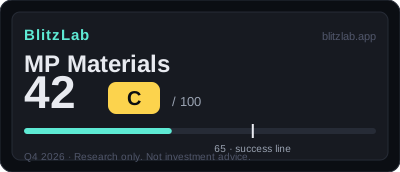
MP Materials — Blitz Index 42 (C)
DoD contracts carry the P&L. Standalone revenue is the real gate.
Last re-scored: November 5, 2026.
Confidence: High · Category: power
Score breakdown
| Section | Score | Detail |
|---|---|---|
| A · Speed | 15 / 25 | NdPr oxide output 2,599 MT (+101% YoY, record); revenue ramping on the DoD contract stack — commercial independence unproven |
| B · Moat | 25 / 60 | Only scaled non-China NdPr option + 10-year DoW PPA; the moat is contracts and uniqueness, not cost — a price taker |
| C · Creative destruction | 10 / 15 | Onshoring the rare-earth chain — the destruction is geopolitical, not commercial |
| D · BlitzFailing | −8 | Materials EBITDA turned by the $51M PPA, not operations; OCF −$155.8M (FY2025); dilution overhang 77M+ shares |
Think we scored it wrong? Score it yourself →
Radar axes (0–100): Moat 42 · Speed 60 · Creative 67.
Watch item
Gates: G1 ✓ · G2 ✓ (borderline — self-defined ceiling). 2035 contract expiry is the true gate.
Strengths
- NdPr oxide 2,599 MT (+101% YoY) — refining ramp proven
- Apple $500M partnership (2027 shipments) + GM magnet precursor contract
- DoW 10-year PPA + offtake (~$140M EBITDA/yr guarantee) — a decade of visibility
- $1.45B cash + $275M revolver
Concerns
- Segment profit is PPA-driven — no PPA, 2024 Materials EBITDA was −$14.1M
- OCF −$155.8M (FY2025) + $500–600M 2026 capex guidance
- China export-control pause expires 2026-11-10 — price shock risk
- PPA upside cap (30% of excess to DoW)
Research notes
Score: 42/100, Grade C — A Speed 15/25, B Moat 25/60, C Creative destruction 10/15, D Demerits −8. As-of date (T): 2026-10-18. Model: BlitzLab v1.0 (frozen 2026-10-10). This is a scholar's assessment for education and research purposes only, not investment advice.
1. Current position: a state-backed first blitz, still in ramp-up
MP Materials Corp. (NYSE: MP) scores 42/100, Grade C, on its first BlitzLab scoring, dated 2026-10-18. The arithmetic is 15 + 25 + 10 − 8 = 42, which sits 23 points below the 65-point threshold for a blitzscaling success call under the frozen v1.0 model. There is no FLAG: total demerits of 8 fall short of the 15-point FLAG trigger. The shape of the score matters more than the total. Creative destruction is the strongest axis at 66.7 on a 100-point conversion (10/15), speed sits in the middle at 60.0 (15/25), and moat is the weakest at 41.7 (25/60). In other words, MP is destroying an old order faster than it has yet built a defensible, self-sustaining position inside the new one. That ordering — destruction first, moat still to be proven — is the through-line of this note.
The company the score file describes is, in classification, a growth company with trailing-twelve-month revenue of approximately $305 million and a market capitalisation of approximately $7.1 billion as of 2026-10-16. Its operating story is a structural conversion, not a single quarter of growth. Product revenue was $253.4 million in fiscal 2023, fell to $203.9 million in fiscal 2024, and recovered to $224.4 million in fiscal 2025, a figure that includes $51.0 million of price-support (PPA) income. In the first half of 2026, product revenue reached $199.1 million, including $59.9 million of PPA income, up 68% year on year on a product-revenue basis. The second quarter of 2026 alone was $108.5 million, up 89% year on year. The score file is explicit that the ramp is concentrated in the most recent two quarters, and that revenue on a fiscal 2023 to 2025 view was roughly flat to down — down about 20% and then up about 10% — rather than a smooth multi-year climb. Any reading of MP as a steadily compounding grower would therefore misdescribe the evidence. What has compounded, visibly and quickly, is the mix inside revenue, and that mix shift is the company's central claim to a second growth curve.
That mix shift runs from concentrate to separated products and then toward magnets. Concentrate revenue was $252.5 million in 2023, or 99.6% of the total, then $42.0 million in 2025, then zero in the first half of 2026. Neodymium-praseodymium (NdPr) oxide and metal revenue moved in the opposite direction: $0.7 million in 2023, $115.1 million in 2025, and $165.6 million in the first half of 2026 alone. NdPr oxide production reached 2,599 metric tons, up 101% year on year and a record. Rare-earth oxide in concentrate also reached a record. Magnet precursor revenue, which was zero, reached $66.9 million, and NdFeB magnet manufacturing began in December 2025. The score file treats this as a demonstrated second growth curve, and Gate G1 — sustained growth or a second growth curve — passes on confirmed evidence. The gate verdict as a whole is a pass on both gates, with G2 flagged as borderline, a qualification that returns throughout this note and should not be stripped away in summary.
The July 2025 break with China is the hinge on which the conversion turns. MP stopped selling concentrate to China in July 2025, after the transaction with the U.S. Department of Defense (since September 2025 styled the Department of War, 'DoW'), and the score file records that the halt was a condition of that transaction. The Shenghe offtake, the prior channel into China, expired in January 2026 and was not renewed. A company that stops selling its dominant product into its dominant market and rebuilds around refining and magnets is not merely diversifying a product line. It is, in the score file's phrase, destroying its own old business. Whether that destruction pays is a separate question from whether it happened, and the score keeps those questions apart: creative destruction scores 10/15, while moat and margin quality score far lower.
2. Speed: a fast ramp inside a narrow window
Speed scores 15/25, composed of growth at 7/10, capital velocity at 3/5, hiring and productivity at 2/5, and share velocity at 3/5. The growth subscore of 7 reflects the tension described above: a genuine, record-setting ramp in separated products, set against a three-year product-revenue path that is essentially flat. The score file credits the conversion as organic rather than acquisition-driven, which matters for a blitzscaling assessment: the growth was built by converting the company's own output, not by purchasing revenue. But it withholds a higher growth score because the ramp is concentrated in the recent two quarters. Two quarters are evidence; they are not yet a track record.
Capital velocity, at 3/5, captures a company that can raise money quickly and at scale, but pays for that speed. In July 2025 MP issued 13.59 million shares at $55, for net proceeds of $724.2 million on confirmed SEC evidence, lifting cash to $1.45 billion by June 2026. Alongside that, the DoW package added $400 million of preferred stock (with a $150 million Samarium loan, a $550 million package in total), alongside a separate $275 million revolving facility. That is fast, large-scale capital formation, and it is the financial counterpart of the operating ramp: the refining and magnet plants were funded before the commercial magnet revenue that must eventually repay them. The other side of the same subscore is dilution and market-price pressure. The $55 offering price compares with a price of $40.17 as of the score file's reporting date, a decline of 27% on a press-reported basis, and the 2026 capital expenditure guidance of $500–600 million, stated after government support, shows how much cash the build still absorbs. Speed bought with dilution is still speed, but the score correctly refuses to treat it as costless.
Hiring and productivity, at 2/5, is the most industrial of the speed subscores, and the lowest. Headcount was 998 full-time-equivalent employees, up 24% year on year, with revenue per employee of approximately $225,000 — a mining-and-manufacturing productivity profile, not a software one. The score file notes a plan for approximately 1,500 employees at full operation of the 10X facility, and treats hiring as a leading indicator of growth in this kind of business: people are hired before the tonnes they will produce. That framing is important. In a software blitz, hiring often lags product-market fit; in a heavy-industrial ramp, hiring leads it, and the wage and training bill arrives before the output does. A score of 2 does not say the hiring is wrong. It says that, on the evidence available at T, headcount growth has not yet translated into the productivity that would mark a high-velocity operation.
Share velocity, at 3/5, rests on position rather than on a measured market share, and the score file is candid about that limit. MP is described in its 10-K as the largest producer in the Western Hemisphere and the only scaled rare-earth producer in North America — a self-description, recorded as such, not an independently measured share figure. A quantified market share is recorded as unconfirmed in the score file. What supports the 3 is the combination of record NdPr oxide production, record rare-earth oxide in concentrate, and the status of being, in the score file's words, effectively the only listed option for a non-China supply chain. That is a meaningful positional fact, but it is not the same as a measured share gain against named competitors, and the subscore reflects the gap.
3. Moat: uniqueness plus a government contract, not a cost advantage
Moat scores 25/60, the weakest axis, and its composition explains why. Network effects score 6/18, distribution scalability 8/18, market size 7/12, and gross margin quality 4/12. The single most important sentence in the score file for understanding this company is that the substance of its moat is (1) its position as the only scaled producer in the United States and (2) a ten-year DoW price-and-volume guarantee contract — and that it is not a cost advantage. Everything in this section should be read under that sentence. To describe MP's moat as a low-cost position would be to contradict the score file's own evidence.
The network-effects subscore of 6/18 makes the point in scoring form. The score file places MP in the "data and ecosystem effects, 5–9" anchor range, but the mechanism here is not a classic network effect in which each additional user makes the product better for every other user. The mechanism is a government-contract franchise, explicitly compared in the score file to the pattern seen at KTOS: a durable position created by a government relationship and a contracted demand base, rather than by a self-reinforcing user network. The 10-K language quoted in the score file is essential context. Concentrate is not listed on a major commodity market, and demand comes from a small number of China-based refiners. In a market structured that way, price formation sits elsewhere, and MP's position, however unique, does not by itself confer pricing power.
That brings the analysis to the price-taker structure, which the score file states plainly and which this note preserves without softening. China determines the price in this market, and MP is a price taker. The score file does not present this as a temporary inconvenience or as a risk that clever management has already solved. It presents it as the market structure: a small number of China-based refiners on the demand side, a price set by the Chinese market, and a producer outside China that must accept that price for its commercial output. The government price support described below does not change that structure; it bridges it for ten years. Conflating the bridge with the structure — describing MP as though the PPA made it a price maker — would be the central analytical error this note must avoid.
Distribution scalability, at 8/18, is the strongest moat subscore, and it is entirely contract-shaped. The DoW 10X offtake runs for ten years, with an annual EBITDA guarantee of $140 million and quarterly prepayment of 25%. The PPA runs for ten years with a price floor of $110 per kilogram. Apple has a $500 million partnership, with shipments beginning in 2027 and a $200 million prepayment, and GM magnet precursor contracts carry a remaining $83.1 million to be delivered in 2026 through the first half of 2027. Taken together, those contracts give MP something rare for an industrial ramp: a decade of visible, contracted demand and a price floor under its core separated product. The reason the subscore stops at 8 is stated just as clearly in the score file: the PPA and offtake are limited to ten years, the Apple scale and timing are forward-looking, and standalone commercial viability after the contracts end is unproven. Distribution that is contracted for a decade is real distribution, but distribution that expires is not yet a permanent channel.
Market size, at 7/12, carries the same qualification into the gate analysis. Gate G2 asks whether the ten-year ceiling of the new market is at least ten times current revenue, a bar of approximately $3.05 billion against trailing revenue of approximately $305 million. The score file passes G2, but on an estimated and borderline basis, and only after narrowing the market definition in a disciplined way. The wedge was declared before scoring, following the BMNR precedent: non-China NdPr refining plus NdFeB magnets in the United States and allied supply chains. The score file explicitly rejects using the entire rare-earth mining market as the addressable market, on the grounds that such a definition would make passage trivial and therefore meaningless. On an economic-value basis, the comparison is instead: global rare-earth oxide of approximately 252 kilotons, of which NdPr is a "significant majority" by value on the 10-K's citation of Adamas, translating at $100 per kilogram into billions of dollars, plus a NdFeB magnet market that is larger still, for a wedge of approximately $30–50 billion. The bar of $3.05 billion is therefore roughly 6–10% of the wedge. That arithmetic passes, but the score file immediately adds the constraint that planned physical capacity alone falls short: midstream designed NdPr oxide capacity of approximately 6,075 metric tons corresponds to approximately $0.6 billion, and magnet capacity of 10,000 metric tons per year to approximately $0.8 billion. Reaching the bar on planned capacity alone does not work. Price increases, heavy rare earths, recycling, and the Maaden joint venture contribution would all need to contribute, and the market-size subscore of 7, with the full 12 reserved for the point at which post-contract standalone revenue is demonstrated, records exactly that conditionality. Reaching the bar also implies a ten-year compound annual growth rate of approximately 26%, a demanding pace that the score file states rather than assumes away.
Gross margin quality, at 3/12, is where the price-taker structure and the government bridge meet in the financial statements. On a product-revenue basis, gross margin was 63.4% in 2023, collapsed to 5.5% in 2024, and recovered to 14.1% in 2025 — a path that tracks the NdPr price cycle almost exactly. Including PPA income, the 2025 margin is 30.0%. The Materials segment's adjusted EBITDA of $16.8 million in the relevant period is mostly PPA income of $51 million, and without PPA, segment EBITDA in 2024 was negative $14.1 million. Operating cash flow for fiscal 2025 was negative $155.8 million, reflecting PPA receivables and inventory absorption. In a falling-price period, inventory net-realisable-value charges also appear — $21.5 million in 2024. The score file's judgement is blunt and should be preserved: the quality of earnings is dependent on price and on contract, and the substance of profitability in the ramp phase is a price-floor contract rather than a demonstrated standalone cost advantage. A reader who looked only at the 30.0% PPA-inclusive margin and concluded that MP had achieved a structurally high-margin business would be misreading the score file in the precise way the 3/12 subscore warns against.
4. Creative destruction: destroying its own old business, on purpose
Creative destruction scores 10/15, composed of the order being replaced at 4/5, irreversible behaviour change at 4/5, and cost-structure change at 2/5. This is the axis on which MP looks most like a blitzscaler, and it is also the axis where the evidence is most concrete, because destruction here is measured in revenue lines going to zero rather than in strategy language.
The order being replaced, at 4/5, is the China-centred refining and magnet chain. The score file puts the concentration figures plainly: approximately 90% of refining in China, and 94% of magnets in China, with Mountain Pass on the refining side and the Independence and 10X facilities on the magnet side as the replacement pole. The DoW transaction's stated purpose, as recorded in the score file, is to reduce foreign dependency. The structural driver behind that purpose is China's export-control regime: a licensing system introduced in April 2025, with a grace period then scheduled to expire on 2026-11-10. The score file treats that expiry as a live variable, not as background. Whether the controls tighten, loosen, or are extended changes both the urgency of a non-China chain and the price environment in which MP sells, and the note records the date as a watch item rather than as a resolved fact.
Irreversible behaviour change, at 4/5, is the strongest form of evidence a destruction claim can carry: the old business is not being kept alive as a hedge while the new one is tried. Concentrate sales to China stopped in July 2025 as a condition of the DoW transaction. The Shenghe offtake expired in January 2026 and was not renewed. Concentrate revenue went from $252.5 million to zero in the first half of 2026. NdPr revenue went from $0.7 million to $115.1 million and then $165.6 million in a half year. Magnet precursor revenue went from zero to $66.9 million, and NdFeB magnet manufacturing began in December 2025. The score file's phrase for this pattern — that MP is in the process of destroying its own old business — is quantitative, not rhetorical. A company can announce a pivot; MP has extinguished the revenue line that defined it. The irreversibility point deserves emphasis because it cuts both ways. It is evidence of commitment, and it is also evidence of exposure: there is no longer a concentrate business to fall back on if the refining and magnet ramp stalls.
Cost-structure change, at 2/5, is where the destruction story is still a claim rather than a demonstration. The 10-K asserts that unit costs for separated products are falling on a ramp effect. The score file records that assertion and then withholds a higher score, because a standalone cost advantage is unproven: refining is still ramping, and magnets have only just begun. The economics of destruction — producing the replacement at a cost structure that makes the old order uncompetitive on its own merits — remain at the assertion stage. That restraint is the difference between a 10/15 creative-destruction score and a higher one, and it connects directly to the moat discussion: MP has replaced the geography and the ownership of the chain faster than it has proven a cost structure that would survive without a price floor.
5. Deductions and risks: leverage, earnings quality, governance, and the cap on the upside
Demerits total −8, composed of debt at −4/−10, revenue quality at −3/−10, governance at −1/−5, and regulatory and social cost at 0/−5. The total is below the FLAG threshold, but the composition is informative, and the largest deduction is the one most directly tied to the blitz itself: the balance sheet that funds it.
Debt, at −4, starts from a position that looks comfortable in isolation and less comfortable once the full claim stack is laid out. Debt principal was $1,012.8 million, comprising $862.8 million of 2030 convertible notes and a $150 million Samarium loan, against cash of $1.45 billion — a net-cash position on that narrow comparison. The 2026 convertible notes matured on April 1, 2026 and were converted upon maturity and settled in full ($67.5 million cash plus 337,741 shares); no 2026 notes remained outstanding at T. The score file then adds the qualifications that produce the deduction. The Series A preferred stock carries a cumulative dividend of 7.0%, approximately $28 million a year in cash obligation — not debt in form, but a fixed cash burden in substance, and the score file treats it as such. The dilution overhang is large: shares outstanding moved from 177.4 million to 178.1 million, with a further potential 24.5 million from DoW, 39.7 million from 2030 convertible notes, and 13.6 million from the 2025 offering. Operating cash flow for fiscal 2025 was negative $155.8 million, and 2026 capital expenditure guidance is $500–600 million. The revolving facility carries a covenant requiring either EBITDA of $400 million or cash of $500 million maintained until the second quarter of 2027. None of those items individually imperils the company given the cash balance and the revolver, but together they describe a company whose blitz is funded by a layered stack of claims — converts, preferred dividends, and a potential share count far above today's — rather than by operating cash flow. That is a fair description of a state-backed blitz, and it is also a fair reason for a −4.
Revenue quality, at −3, is the scoring counterpart of the PPA discussion in the moat section, and the score file frames the PPA with a precision this note preserves. The PPA is government price support: a ten-year contract under which the government guarantees a price floor of $110 per kilogram for NdPr, and the resulting income is, in the score file's characterisation, transfer-like in nature — income that arises from a government price guarantee rather than from commercial demand at a market price. In 2025, most of the segment's earnings were PPA income of $51 million. The score file also notes that no material weakness in internal control over financial reporting was mentioned, and that the auditor is KPMG — a clean governance signal on the accounting side that sits alongside the quality concern, and the two should not be conflated. The concern is not that the numbers are unreliable. It is that their composition is policy-dependent. The score file adds that the price collapses of 2023 and 2024 hit cash flow and liquidity directly, in the 10-K's own words, which is the historical proof of the dependence: when the price fell, before the PPA existed in this form, the damage was immediate. The scheduled expiry of the China export-control grace period on 2026-11-10 is recorded as a further source of abrupt change in price and demand. A revenue-quality deduction of −3, rather than a larger one, reflects that the PPA is a disclosed, contracted, ten-year arrangement, not an undisclosed one-off — but a decade-long dependence on a price floor is still dependence.
Governance, at −1, is the smallest deduction and the most narrowly sourced. A CEO-related entity aircraft lease cost $0.5 million per year as of November 2024. A special performance share award for Litinsky in October 2025 carried a $15 million target linked to 10X and magnet goals. Voting concentration could not be confirmed from the DEF 14A at scoring time and is recorded as unconfirmed, requiring a check rather than an assumption. The score file does not build a governance case out of these items, and neither does this note. They are recorded as watch items: a related-party lease and a large goal-linked award in a company where government contracts and construction milestones dominate the value-creation story deserve disclosure and monitoring, not exaggeration.
Regulatory and social cost, at 0, records two items without scoring them, and the distinction matters. First, market-price volatility is noted but not scored: a beta of 2.12 and a 52-week range of $37.81 to $100.25, with a fall from the $100.25 high to $40.17 on a press-reported basis, sit in the valuation domain, which the BlitzLab model deliberately does not score. The business score does not look at price, following the lesson the site records from its ARK test, and this note follows the same rule: the share-price path is context, not a scoring input. Second, the PPA's upside cap is recorded as a cross-item with the margin and revenue-quality sections: 30% of any excess above the price floor goes to DoW. That cap is the mirror image of the floor. The floor protects the downside for ten years; the cap shares the upside. A reader who celebrates the floor without noting the cap, or who treats the PPA as though MP kept all of a price spike, would misunderstand the contract. The cap does not earn a separate deduction here because its effect is already captured in the margin and quality discussion, but it belongs in any honest summary of the government support: support that is capped is not the same as support that is unlimited.
6. Blitzscaling lens: a government-led blitz, and what it can and cannot prove
The score file's blitzscaling-fit analysis classifies MP as a business-to-government order blitz — a KTOS- and AVAV-like wave, in a raw-materials form. The main growth lever is capital plus government demand: the DoW $550 million package together with the $724 million offering, with contracts functioning as the distribution channel. The secondary lever is vertical integration from mining through refining to magnets, described as the first fully integrated chain in the United States, which is a structural differentiator. The weak lever is pricing power: in a market where China sets the price, pricing power is an exposure, not a lever. That three-part classification is more useful than any single label, because it predicts where MP will look strong and where it will look fragile. It will look strong wherever contracts, capital, and construction matter. It will look fragile wherever market price, standalone cost, and post-contract demand matter. The score's shape — high creative destruction, middling speed, low moat — is exactly that prediction, expressed in numbers.
The speed-versus-efficiency trade-off, in the score file's telling, was paid for in three currencies. First, advance investment: large-scale capital expenditure on Independence and 10X ahead of the customer contracts from Apple and GM and the government contracts that underwrite them. Second, dilution: 13.6 million shares from the offering plus a potential 24.5 million from DoW, with the state taken on as a capital partner rather than a conventional shareholder base alone. Third, margin left to price: rather than defending margin through a proven cost advantage, MP defends it through a price-floor contract — surviving by structure, in the score file's phrase, rather than by efficiency. That is a coherent blitz posture, but it inverts the usual blitzscaling story in one respect. In a software blitz, speed buys a network that then defends itself. Here, speed buys plants whose defence, for the next decade, is a contract. The question the next decade must answer is whether the plants, once built and ramped, defend themselves at market prices.
On the score file's staging, MP is in the early part of the first blitz's production ramp-up phase: record NdPr oxide output, magnet manufacturing just begun, Apple shipments from 2027, and a path from approximately $300 million of revenue toward $3 billion that is at its entrance rather than its middle. The score file's label for this configuration is a "state-led blitz" — demand, price, and capital all underwritten by government contract. The label is descriptive, not celebratory. A state-led blitz can build a supply chain that a purely commercial blitz could not finance, and it can also create a company whose commercial test is deferred rather than passed. The deferral is the point. Ten years of contracted demand is a long bridge, and bridges are valuable, but a bridge is not a destination, and the score file's maximum-risk statement says so directly: the whole question is whether MP is a company that earns money at commercial prices when the ten-year contracts end.
7. What to watch
The score file names its re-examination triggers explicitly, and this note adopts them as the watch list, because they are the conditions under which the current score would change rather than merely fluctuate. First, standalone profitability after the contracts end: the central trigger is whether MP demonstrates independent revenue and profitability at commercial prices around the 2035 contract-expiry horizon, and the evidence for that will accumulate long before 2035 in the form of commercial magnet volumes. Second, the NdPr price path: because margin tracks the price cycle and the PPA floor is fixed at $110 per kilogram with 30% of the excess going to DoW, the price determines both how much protection the floor provides and how much upside MP retains. Third, commercial magnet volumes from Apple and GM: Apple shipments beginning in 2027 and the remaining $83.1 million of GM precursor deliveries in 2026 through the first half of 2027 are the first observable commercial demand beyond the government contracts, and their scale and timing are forward-looking items to be confirmed in filings rather than assumed.
Three nearer-term items belong on the same list. The China export-control grace period was scheduled to expire on 2026-11-10, and any change in that regime can move price and demand abruptly; it is the most immediate external variable in the score file. The third-quarter 2026 results, which were not yet released as of T and are therefore excluded from this score, will be the first test of whether the first-half ramp — $199.1 million of product revenue, record NdPr output, and magnet manufacturing begun — extended into the second half. And the 10X ramp itself, toward 7,000 metric tons per year by 2028, is the physical test of the distribution story: contracted demand is only as good as the tonnes that can be produced to meet it, and the hiring path toward approximately 1,500 employees at full 10X operation is the human counterpart of that test.
One-line risk: MP has built the non-China chain's bridge — a decade of contracted demand and a price floor — but it has not yet proven it can stand on the other side at market prices, and everything in the 42/C score, from the 3/12 margin quality to the borderline G2 pass, is a measure of that unproven crossing.
More Power & Energy companies
Other Power & Energy names on the Blitz Index, highest score first: Solaris Energy Infrastructure (59/C), Bloom Energy (58/C), Forgent Power Solutions (50/C).
Next earnings
Q4 2026 · Expected
Coverage
MP Materials Corp. · Q3 2026 due Nov 5, 2026 (AMC, confirmed) · Score 42 · Grade C
Embed this score
Copy the HTML below to show this score on your site. The badge links back to this page and updates automatically when the score changes.
Preview:
BlitzLab scores businesses against a scholar’s standard — not investment advice. No price targets, no buy/sell recommendations. Figures are from SEC filings (XBRL) as labeled in the source scorecard.