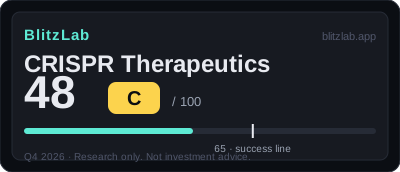
CRISPR Therapeutics — Blitz Index 48 (C)
CASGEVY is approved and ramping — but product revenue is $0.
Last re-scored: October 18, 2026.
Confidence: High · Category: frontier
Score breakdown
| Section | Score | Detail |
|---|---|---|
| A · Speed | 14 / 25 | CASGEVY quarterly revenue $76M (+78% QoQ, +151% YoY) — accelerating commercial ramp; but all company revenue is milestones and grants |
| B · Moat | 24 / 60 | World's first CRISPR therapy — category-definer position; 39-country approvals; in vivo pipeline entering clinic |
| C · Creative destruction | 12 / 15 | Chronic dosing → one-time cure — the paradigm shift is the score's backbone |
| D · BlitzFailing | −2 | 100% Vertex dependence for manufacturing and commercialization; $0 own product revenue — collaboration-expense net −$213.5M/year |
Think we scored it wrong? Score it yourself →
Radar axes (0–100): Moat 40 · Speed 56 · Creative 80.
Watch item
Gates: G1 ✓ (borderline) · G2 ✓ (declared basis). 17 points below the threshold — the science is historic; the business isn't yet.
Strengths
- CASGEVY quarterly revenue $76M (+78% QoQ, +151% YoY) — accelerating ramp
- 39-country approvals + FDA label to age 2+ + German reimbursement — access widening
- In vivo pipeline entering clinic (CTX310 in NEJM, CTX340/460 Phase 1)
- $2.36B cash, ~6-year runway — time is ample
Concerns
- $0 own product revenue — collaboration-expense net −$213.5M/year while commercializing
- 100% Vertex dependence — manufacturing and commercialization led by the partner
- CRISPR IP landscape highly dynamic — patent litigation risk
- $2.2M upfront per patient vs lifetime payer benefit — adoption bottleneck
Research notes
Thesis
CRISPR Therapeutics is best understood as two stories running at different speeds inside one company. The first story is scientific and historical, and it is already complete in one decisive respect: the company co-developed and co-commercializes CASGEVY, the world's first CRISPR therapy to reach patients. That therapy has regulatory approval in 39 countries, a label in the United States that was expanded in July 2026 to children aged two and older, and a commercial ramp that, at the level of the joint venture with Vertex Pharmaceuticals, is accelerating. The second story is financial and organisational, and it is still in its early chapters. On CRISPR Therapeutics' own income statement, there is no product revenue line for CASGEVY at all. The company's share of the economics arrives instead through a net collaboration line, and in fiscal year 2025 that line was still deeply negative, because the company's share of commercialisation costs exceeded its share of the profits. The tension between those two stories is the whole of the investment-research question here, and it is also the reason the BlitzLab score lands where it does: 48 out of 100, grade C.
The score is built from four sections. Speed, section A, is 14 out of 25. Moat, section B, is 24 out of 60. Creative destruction, section C, is 12 out of 15. Deductions, section D, are minus 2. The arithmetic is 14 plus 24 plus 12 minus 2, which equals 48. That total sits 17 points below the 65-point threshold used in the BlitzLab model, so the company is recorded as below that threshold. There is no FLAG, because the deduction total of 2 is well below the 15-point FLAG boundary. The item scores are as follows: A1 growth 4 out of 10, A2 capital velocity 4 out of 5, A3 hiring and productivity 2 out of 5, A4 share velocity 4 out of 5; B1 network effects 6 out of 18, B2 distribution scalability 7 out of 18, B3 market size 8 out of 12, B4 gross margin 3 out of 12; C1 order displaced 5 out of 5, C2 irreversible behaviour change 4 out of 5, C3 cost-structure change 3 out of 5; D1 debt minus 2 out of minus 10, D2 revenue quality 0, D3 governance 0, and D4 regulatory and social cost 0. The as-of date for the scoring, T, is 18 October 2026. The most recent results available at T were the second-quarter 2026 Form 10-Q, filed on 3 August 2026. Third-quarter 2026 results had not been released as of T and are therefore excluded from this assessment, appearing below only as a future reporting marker, with no anticipated outcome attached.
CRISPR Therapeutics was founded in 2013. Its scientific foundation is connected to Emmanuelle Charpentier, who shared the 2020 Nobel Prize in Chemistry. That lineage matters for the research narrative, but the scoring does not reward lineage for its own sake. It rewards what has been built, what is selling, what is defensible, and what replaces an existing order. On those tests, the company presents an unusual profile: the highest possible mark for the order it displaces, a strong mark for the size of the markets it is aiming at, and much weaker marks for the speed and defensibility that are visible in its own reported numbers. Understanding why that profile is not a contradiction is the purpose of this account.
The gate questions: a borderline pass, twice over
Before any item score is assigned, the BlitzLab model asks two gate questions. The first, G1, asks whether growth is continuing or a second growth curve is present. The second, G2, asks whether the ten-year ceiling of the new market is at least ten times current revenue. CRISPR Therapeutics passes both, but both passes are recorded as borderline, and the reasoning behind that caution is worth setting out in full, because it shapes everything that follows.
The G1 difficulty is straightforward. CRISPR Therapeutics' own income statement contains no CASGEVY product revenue line. Its fiscal year 2025 revenue was $3.5 million, and the score file records that all of it was grants, with collaboration revenue of $0. The company's trailing-twelve-month revenue is described in the score file as approximately $15 million, consisting of milestones and grants, not product sales. A reader who looked only at that statement would see a research company, not a commercial one. The gate verdict nevertheless passes the company, and the reason is that the commercial reality sits one level up, at the joint venture with Vertex. Vertex reports CASGEVY revenue, and on a press-reported, Vertex-reported basis, that revenue rose from $14.2 million in the first quarter of 2025 to $76 million in the second quarter of 2026, an increase of 78 percent quarter on quarter and 151 percent year on year. In 2025, 64 patients received infusions. More than 75 authorised treatment centres had been activated. The eligible patient population in approved countries is described as more than 60,000. CRISPR Therapeutics takes 40 percent of the net profit or loss under the sharing arrangement. The gate reasoning therefore treats the combination of an approved product, paying patients, an accelerating revenue ramp at the joint-venture level, and a 40 percent economic share as qualitatively different from a company with no approved product and no commercial revenue at all. The score file draws the comparison explicitly with a company that failed this gate because it had no commercial revenue, no certification, and no quantified backlog. CRISPR Therapeutics, by contrast, has certification, patients, and a ramp.
That pass is conditional, and the conditions are stated rather than left implicit. The score file names three review triggers for G1: the moment the collaboration expense, net line turns positive; the start of a company-recognised revenue line, for example from zugo-cel or another wholly owned programme; and two consecutive quarters in which CASGEVY quarterly revenue stalls or declines. Until one of the first two arrives, the gate pass remains a judgement about a product that is commercialising through a partner, not a fact visible in the company's own top line. That distinction is not a footnote. It is the central structural fact of the company, and it recurs in the moat, speed, and risk sections below.
The G2 pass follows a similar logic, and it too depends on a declared basis of measurement. If the test were applied mechanically to the company's own revenue of approximately $15 million, the bar would be roughly $150 million, but the score file argues that such a bar is distorted, because that $15 million is milestone residue rather than product economics. Following a precedent used for another company in the same situation, the gate therefore applies a product-economics basis: the ten-year ceiling of the economics attributable to CRISPR Therapeutics, meaning its 40 percent share of CASGEVY net profit or loss plus the commercialisation potential of its pipeline. On that basis, the candidates include CASGEVY itself, with more than 60,000 eligible patients multiplied by a $2.2 million patient price, which the file notes as a theoretical $132 billion before any assumption about penetration, together with Vertex's 2026 guidance for CASGEVY and JOURNAVX combined of approximately $500 million, and the option value of zugo-cel in autoimmune disease, in vivo cardiovascular programmes, and a small interfering RNA programme. The file concludes that a ten-year ceiling above $1.5 billion is plausible, which would clear any reasonable bar between $150 million and $1 billion. The pass is again recorded as borderline, because most of that ceiling still depends on pipeline options rather than demonstrated commercialisation. Only CASGEVY has been demonstrated. The rest is possibility, and the scoring treats possibility and proof differently throughout.
Speed: a product that is accelerating, a company statement that is not
Section A, speed, totals 14 out of 25, and the split between its four items tells the story more precisely than the total alone. A1, growth, is 4 out of 10. A2, capital velocity, is 4 out of 5. A3, hiring and productivity, is 2 out of 5. A4, share velocity, is 4 out of 5.
Start with A1, because it contains the most important measurement problem in the whole file. The company's own revenue history, as recorded from Securities and Exchange Commission filings and checked against inline XBRL data, runs from $915.0 million in fiscal year 2021, which included a $900 million upfront payment from Vertex, down to $3.5 million in fiscal year 2025, all of it grants. A growth rate computed from that series would be meaningless, because the 2021 figure was a milestone event, not a recurring commercial base. The second quarter of 2026 illustrates the same point from the other direction: of $10.18 million in company revenue in that quarter, $10 million was a new licence upfront payment, described in the file as one-off. The score therefore does not pretend that the company's own statement shows growth. It awards 4 points conservatively, on the basis that the commercial speed is real at the joint-venture level, with CASGEVY quarterly revenue rising from $14.2 million to $76 million and infusions accelerating in 2025, even though no trace of that growth appears in the company's own profit and loss account. The 4 is a compromise between two true statements: the product is ramping, and the company's statement is not.
A2, capital velocity, is the strongest item in the speed section, at 4 out of 5, and it is also the most firmly grounded in filings. In March 2026, the company raised $600 million through convertible notes, maturing in 2031, carrying a coupon of 1.7308 percent and a conversion price of $76.56. The file records this as the company's first-ever borrowing. Earlier, an at-the-market equity programme from 2021, sized at $600 million, had been fully sold, and a 2025 at-the-market programme had $557.2 million remaining. Cash plus securities stood at $2,364 million as of 30 June 2026. Against an annual burn rate of approximately $385 million, the file calculates a runway of about six years. The judgement is that access to capital is good. The company is not scrambling for funding, and the runway gives its pipeline time to produce clinical readouts. Capital velocity here means the ability to keep funding the work, not the speed at which revenue is growing, and on that narrower test the company scores well.
A3, hiring and productivity, is 2 out of 5, and it is the weakest item in the section. The company reported 407 full-time employees at the end of 2023, a figure confirmed in filings. The fiscal year 2025 management discussion and analysis explicitly refers to decreased headcount, meaning the company has been reducing staff rather than hiring in the rapid, blitz-like pattern the model rewards. The score file does not give a current headcount figure, and this account does not invent one. What can be said is that the direction is contraction, not expansion, and the score reflects that. A company can be scientifically ambitious while shrinking its workforce, for example by focusing its pipeline, but the model scores hiring speed as its own signal, and on that signal CRISPR Therapeutics is not blitzing.
A4, share velocity, is 4 out of 5. The reasoning is qualitative rather than numerical, because a share figure measured in patients cannot yet be computed in the way a software market share can. CASGEVY is the world's first CRISPR therapy, which makes the company the category definer for gene-editing therapy. It holds approval in 39 countries, and the United States label was expanded in July 2026 to patients aged two and older. The file is explicit that share cannot be quantified on a patient basis at this early stage, but that the first-mover platform position is clear, and the score reflects position rather than a measured percentage. That is a generous reading, and the file presents it as such, but it is consistent with the model's treatment of category creation: being first to approval in a new therapeutic modality is itself a form of share velocity, even before the denominator is large enough to measure precisely.
Taken together, section A describes a company whose product is moving faster than its organisation. The capital is in place, the category position is established, and the joint-venture revenue is accelerating, but the company's own revenue line is flat at a negligible level, and its headcount is falling. A reader who wants a single sentence for this section could use the score file's own framing: the product is blitzing, the profit and loss account is still at the starting line.
Moat: a platform with leverage, not a network
Section B, moat, totals 24 out of 60, the lowest proportional section in the score, and that low proportion is important. A company can have a historic scientific achievement and still score modestly on moat, because the model asks not whether the science is impressive, but whether the advantage compounds, distributes, addresses a large market, and converts into margin. On those four tests, the company scores 6, 7, 8, and 3 respectively.
B1, network effects, is 6 out of 18. The asset here is the CRISPR/Cas9 platform, and the file describes its leverage accurately: once the platform exists, it can be reused as new indications are added, moving from ex vivo approaches, in which cells are edited outside the body, to in vivo approaches, in which editing happens inside the body, and onward to small interfering RNA work. The company also owns its own good manufacturing practice facility in Framingham, covering the process end to end, and its technology traces to Nobel Prize-winning foundational work. Those are real platform advantages. What they are not, the file is careful to say, is a pure network effect. There is no self-reinforcing loop in which each additional user makes the product more valuable to every other user in the way a marketplace or a social platform exhibits. The score therefore sits in the anchor range described in the file as platform leverage, the range of 5 to 9 for data or ecosystem effects, rather than in the higher ranges reserved for genuine network effects. Two further qualifications keep the score in the lower half of that range. The intellectual property landscape for CRISPR is described in the company's own annual report risk factors as highly dynamic, with third-party patent litigation risk, and the company faces direct competition in vivo from Intellia and others. A platform that can be reused is valuable; a platform whose ownership is contested and whose rivals are building parallel platforms is less defensible than the word platform alone might suggest.
B2, distribution scalability, is 7 out of 18. Commercialisation worldwide is led by Vertex, so distribution is partner-led. That is a deliberate choice, and the file treats it as both a strength and a structural bottleneck. On the strength side, the partnership is repeatable in the sense that Vertex already operates the authorised treatment centre network, and the company has additional collaborations, including with Lilly on zugo-cel combination work and with Sirius on the joint development of CTX611. On the bottleneck side, the therapy itself is delivered through authorised treatment centres, a process that runs from cell collection through conditioning chemotherapy to infusion over a period of months, and the patient price of $2.2 million must be paid upfront, while the benefit accrues over a lifetime. That mismatch between an upfront payment and a lifetime benefit is described in the file as a payer mismatch, and it constrains adoption regardless of how good the distribution partner is. Partner-led distribution can therefore scale, but it cannot remove the structural friction of the therapy itself, and the score of 7 reflects a distribution system that is workable and repeatable but not frictionless.
B3, market size, is 8 out of 12, the strongest moat item, and it follows directly from the G2 reasoning. The ten-year ceiling is assessed on the combination of CASGEVY, zugo-cel, in vivo cardiovascular programmes, and the small interfering RNA programme, and on that combined basis it clears the bar. The file withholds the full 12 points, and the reason is explicit: the full score would require commercial proof from zugo-cel or from one of the in vivo programmes, and at present only CASGEVY has been demonstrated. Market size in this model is therefore not a forecast of what could theoretically be sold. It is a scored judgement about a ceiling that is partly proven and partly optional, and the 8 records that balance. The theoretical arithmetic is worth stating plainly, because it shows how large the gap between theory and proof remains. More than 60,000 eligible patients multiplied by $2.2 million gives a theoretical figure above $130 billion, but the file notes that penetration must be assumed to be low, and no penetration assumption is converted into a scored market size. The 8 is a judgement, not a multiplication.
B4, gross margin, is 3 out of 12, and it is the item where the gap between theory and realisation is widest. Gross margin is recorded as not applicable, because product revenue is $0 and there is no cost of goods sold on the company's own statement. The unit economics in theory look strong: a United States list price of $2.2 million per patient, with CRISPR Therapeutics taking 40 percent of net profit or loss, implies a high theoretical margin. The realised position is the opposite: the collaboration expense, net line was minus $213.5 million per year in fiscal year 2025, meaning the company's share of costs exceeded its share of profit. The file applies an anchor principle that estimated items are scored one band lower, and awards 3. The lesson of B4 is general, and it applies beyond this company. A high price does not equal a high margin until the sharing arrangement, the manufacturing cost, and the commercialisation cost have all been paid. At T, they had not been, on a net basis, for CRISPR Therapeutics.
The moat section as a whole therefore reads as a platform with genuine reuse value, a partner-led distribution system with a structural bottleneck, a large addressable ceiling that is mostly still optional, and no realised margin. That is a moat in formation, not a moat in full operation, and the total of 24 out of 60 records that status without exaggerating it in either direction.
Creative destruction: the strongest section, and why it is not enough on its own
Section C, creative destruction, totals 12 out of 15, the highest proportional section in the score, and it is the section that most justifies attention to this company. C1, the order displaced, is 5 out of 5, the maximum. C2, irreversible behaviour change, is 4 out of 5. C3, cost-structure change, is 3 out of 5.
C1 earns its maximum because the displacement is paradigm-level, not incremental. A one-time gene-editing treatment intended to be curative replaces chronic, lifelong management: repeated blood transfusions and drugs such as hydroxyurea for sickle cell disease and transfusion-dependent beta thalassemia, and, by extension in the pipeline, chronic lipid-lowering drugs and PCSK9 inhibitors for cardiovascular indications. The therapy does not improve the existing regimen by a percentage. It proposes to end the regimen. The file also notes the historic position: the world's first CRISPR therapy. A maximum score here is not a claim that every eligible patient will switch, or that switching is easy. It is a claim about the clarity and scale of what is being displaced, and on that test the case is as clear as the model allows.
C2, at 4 out of 5, measures whether behaviour is actually changing, not merely whether it could. The evidence cited is the sequence of approvals from December 2023 through the July 2026 expansion to age two and older, the 39-country footprint, and the commercial ramp of 78 percent quarter on quarter in the second quarter of 2026 on a Vertex-reported basis. The pipeline adds a second layer of behaviour change in progress: in vivo clinical entry, with CTX310 in Phase 1b, whose results were published in the New England Journal of Medicine, and CTX340 and CTX460 both starting Phase 1, together with zugo-cel receiving Regenerative Medicine Advanced Therapy designation and CTX211 entering Phase 1. The file withholds the fifth point, reserving it for long-term follow-up demonstrating durable cure. That reservation is important. A therapy that edits genes must prove not only that it works in the short term, but that the benefit lasts and that the safety profile holds over years. Until that long-term tracking exists, behaviour change is described as in progress, not complete, and the score of 4 records that distinction.
C3, at 3 out of 5, addresses cost structure. A single $2.2 million administration, set against a lifetime of chronic treatment costs, has the potential to change the total cost structure over the long term. The score is held at 3 because the realisation of that change depends on payer acceptance, and payer acceptance is precisely where the upfront-versus-lifetime mismatch bites. A health system that must pay $2.2 million now for a benefit spread over decades faces a budgeting problem even if the lifetime arithmetic favours the one-time treatment. The file, citing press-based reporting and analysis for this item, therefore treats the cost-structure change as possible but not yet realised, contingent on payers accepting the model. The distinction between a cost that is lower in total and a cost that is easier to pay is the whole of C3, and the company has proven the first half of that distinction more than the second.
Section C is the reason the total reaches 48 rather than falling much lower. Without the 12 points here, the company would sit in the high 30s. With them, it sits in the middle of grade C. That is also the limit of what creative destruction alone can do in this model. A paradigm can be displaced in principle while the business that displaces it is still loss-making at the net collaboration line, still dependent on a partner for distribution, and still waiting for its pipeline to prove itself. The model is designed to hold both truths at once, and this company is a test of whether the reader can do the same.
Deductions and risks: light on debt, heavy on concentration
Section D totals minus 2, which is light by the model's standards, and each item deserves separate attention, because a low deduction total does not mean a low-risk company. It means that the specific risks the model deducts for are, at T, either modest or classified elsewhere.
D1, debt, is minus 2 out of minus 10. Total debt was $904.2 million as of 30 June 2026, set against cash plus securities of $2,364 million, so the debt itself is described in the file as light relative to cash. The March 2026 convertible notes of $600 million are the largest component, and they are the company's first borrowing. The other side of the item is dilution, not default risk. The 2021 at-the-market programme was fully sold, amounting to 8.0 million shares, the 2025 programme had $557.2 million remaining, and the convertible notes could convert into a maximum of 11.36 million shares. Those are channels through which existing shareholders' ownership could be diluted, even if the debt itself is comfortably covered. The score of minus 2 therefore records a balance sheet that is not strained, with a dilution channel that remains open.
D2, revenue quality, is 0. The first-quarter 2026 Form 10-Q reported disclosure controls as effective, and no material weakness was mentioned. Intellectual property litigation risk and long-term safety uncertainty appear in the risk factors as background, but the file records them as not triggering a deduction under this item. That is a classification decision, not a dismissal. Those risks are real, but they are recorded in the concerns section rather than as a revenue-quality deduction, because no accounting or disclosure failure has been identified.
D3, governance, is 0. The file notes a sale by the chief executive officer, Kulkarni, of 4,098 shares on 14 October, described on a press-reported basis, citing a Form 4, as for tax withholding purposes, amounting to only a 1.55 percent reduction in the holding. No unusual governance issue is identified in the annual report. A small, explained sale for tax withholding is not treated as a governance signal, and the score reflects that.
D4, regulatory and social cost, is 0. No securities litigation or penalty is recorded. The file does, however, record a structural risk under the concerns heading rather than under D4: complete dependence on Vertex for manufacturing and commercialisation of CASGEVY. That dependence is a business risk, not a regulatory fine, so it does not score under D4, but it is the single most important risk in the whole assessment, and it is addressed directly below. Competition is also recorded as background, including Lyfgenia, whose price is given in the file as $3.1 million, and Intellia in the in vivo field. The absence of a D4 deduction should therefore not be read as an absence of risk. It should be read as an absence of the specific kind of cost this item measures.
Beyond the scored deductions, the file lists five further concerns that belong in any honest account. First, the company's own product revenue is $0, and the collaboration expense, net line is minus $213.5 million per year, because commercialisation costs are still being shared. Second, Vertex dependence is total for the only commercial asset: manufacturing, commercialisation, pricing, and payer negotiation are all led by the partner. Third, the CRISPR intellectual property landscape is described as highly dynamic, with patent litigation risk. Fourth, the $2.2 million upfront payment versus lifetime benefit creates a payer mismatch that acts as an adoption bottleneck. Fifth, the long-term safety of gene therapy, including durability and side effects, remains uncertain, and the share price has shown high sensitivity to clinical events, with a 52-week range given in the valuation note as $44.12 to $75.06 and a beta of 1.93. The valuation note itself, which records a market capitalisation of approximately $4.99 billion as of 16 October 2026, is explicitly not reflected in the score, because the BlitzLab model scores the business, not the price, following a lesson recorded from an earlier test. The price is mentioned here only as context for volatility, not as a scored input.
Blitzscaling fit: a proxy blitz
The score file offers a summary judgement that is worth quoting in substance, because it captures the company's strategic shape better than any single item score. CRISPR Therapeutics is described as a platform and partnership blitzer. Its main levers are the CRISPR/Cas9 platform and Vertex-led distribution. Its supporting lever is capital, with $2.36 billion in cash and securities plus at-the-market capacity and convertible notes to fund the pipeline. Its weak levers are network effects and speed, in the sense that speed must be measured at the product level rather than at the company-statement level. The verdict is that the product's destructive power is first-class, while the business's speed is still warming up.
The trade-off the company has made is also stated clearly. It has handed speed to a partner. By leaving manufacturing and commercialisation to Vertex and taking only 40 percent of the economics, it has avoided building a large commercial organisation of its own, but it has also handed over control of the destiny of its only commercial asset. It has bought time with cash: a runway of about six years is time to wait for pipeline clinical results. And it has not lived on milestones: fiscal year 2025 revenue of $3.5 million, all grants, shows a structure that no longer depends on milestone windfalls of the kind seen in 2021, when a $900 million upfront payment dominated the statement.
The file places the company at a specific stage: the warm-up to the first act of blitzscaling, in commercialisation's early phase. The CASGEVY ramp has begun, but the net contribution to CRISPR Therapeutics' own profit and loss account is still negative. The next act depends on zugo-cel and the in vivo programmes. The file's phrase for this stage is a proxy blitz: the product is blitzing, but the company's income statement is still at the starting line, and the signal that the first act has ended will be the collaboration net line turning positive. That framing is useful because it prevents two opposite misreadings. The first misreading would be to call the company a failure because its own revenue is negligible. The second would be to call it a proven commercial success because a partner's revenue line is accelerating. Both misreadings ignore the structure. The structure is the story.
The file names a single maximum risk from a blitzscaling perspective, and it is worth giving it its own emphasis: the steering wheel is held by Vertex. Manufacturing, commercialisation, pricing, and payer negotiation for CASGEVY are all partner-led. CRISPR Therapeutics holds 40 percent of the economics and the option value of its pipeline, but the fate of its only commercial asset rests in another company's hands. A partnership can be the best distribution system available and the largest single point of failure at the same time. That duality is not resolved by the score, and it should not be resolved by the reader either. It is the condition under which the company must be monitored.
What to watch
The future markers below are drawn strictly from the score file's own triggers and pipeline status as of T. No outcome is anticipated for any of them, and no date is asserted beyond what the file states. Third-quarter 2026 results had not been released as of T, so their eventual release is a reporting marker only. What matters is what the release will allow a reader to check, not what it is expected to show.
First, the collaboration expense, net line. The file names its turn to positive as a G1 review trigger, and the blitzscaling assessment names the same turn as the signal that the first act has ended. Until that line turns, the company's commercial story remains a joint-venture story with a negative net contribution at the company level. When it turns, if it turns, the structure of the assessment changes, because the company's own statement will for the first time show a net commercial contribution from CASGEVY.
Second, the start of a company-recognised revenue line. The file names zugo-cel as an example. That programme, an autoimmune CAR-T therapy, holds Regenerative Medicine Advanced Therapy designation, and its progress is therefore a second G1 trigger as well as a candidate for the commercial proof that B3 withholds its full score for. A revenue line that the company recognises itself, distinct from a shared net line, would change the measurement basis for growth from joint-venture revenue to company revenue, and that change would be visible in A1 before it was visible anywhere else.
Third, the CASGEVY ramp itself, on a Vertex-reported, press-based basis. The file names two consecutive quarters of stall or decline as a G1 review trigger. The ramp from $14.2 million to $76 million, with 78 percent quarter-on-quarter growth in the second quarter of 2026, sets a high base, and the question for monitoring is continuation, not celebration of a single quarter. The authorised treatment centre count, given as more than 75 activated, and the infusion count, given as 64 in 2025, are the operational counterparts to the revenue line, because a therapy delivered through centres over months cannot ramp on price alone. Access expansion already recorded at T, including 39-country approval, the July 2026 label expansion to age two and older, and German reimbursement in May 2026, forms the background against which future centre and infusion figures should be read.
Fourth, the pipeline's clinical progression, in the order the file presents it. CTX310, in Phase 1b with results published in the New England Journal of Medicine; CTX340 and CTX460, both starting Phase 1; CTX211, in Phase 1; zugo-cel, with its advanced therapy designation; and CTX611, a small interfering RNA programme in Phase 2 under joint development with Sirius. The file's scoring logic makes the stakes of this progression explicit: B3 withholds its full score until zugo-cel or one of the in vivo programmes demonstrates commercialisation, and G2's ceiling depends mostly on these options. Clinical progression alone does not satisfy those tests. Commercial demonstration does. The distinction between a programme entering a trial and a programme reaching patients should be maintained in any future update.
Fifth, the balance sheet and dilution channels. Cash plus securities of $2,364 million and a runway of about six years at an annual burn rate of approximately $385 million mean that funding pressure is not the near-term constraint, but the remaining $557.2 million under the 2025 at-the-market programme and the maximum 11.36 million shares into which the convertible notes could convert are the channels to monitor if further capital is raised. Total debt of $904.2 million as of 30 June 2026, against that cash position, is the baseline for any future comparison.
Sixth, the two background risks that the scored items classify elsewhere: the highly dynamic CRISPR intellectual property landscape, with third-party patent litigation risk, and the long-term safety and durability question for gene therapy, which C2 reserves its fifth point for. Neither is a scored deduction at T, and neither should be treated as resolved because it is unscored. They are the kind of risks that appear in risk-factor disclosure before they appear in numbers, and the score file records them in that place.
CRISPR Therapeutics, at 48 out of 100 and grade C, is therefore not a company that the model dismisses, and not a company that it endorses as a proven blitzscaler. It is a company whose destructive idea has been proven in the regulatory sense, whose product is selling through a partner at an accelerating rate on a Vertex-reported basis, whose platform can be reused across indications, and whose own financial statement still shows a research company sharing costs rather than banking product profit. The score holds those facts together without forcing them into a single judgement, and any future revision should be judged by whether it does the same: whether it updates the collaboration line, the company revenue line, the centre and infusion counts, and the pipeline's commercial proof, and whether it leaves the theoretical ceiling clearly labelled as theoretical until a second programme proves it in the market.
More Frontier companies
Other Frontier names on the Blitz Index, highest score first: Rocket Lab (62/B), Tesla (62/B), Illumina, Inc. (61/B).
Next earnings
Q4 2026 · Expected
Coverage
CRISPR Therapeutics AG · Q3 2026 reported Nov 2, 2026 · Score 48 · Grade C
Embed this score
Copy the HTML below to show this score on your site. The badge links back to this page and updates automatically when the score changes.
Preview:
BlitzLab scores businesses against a scholar’s standard — not investment advice. No price targets, no buy/sell recommendations. Figures are from SEC filings (XBRL) as labeled in the source scorecard.