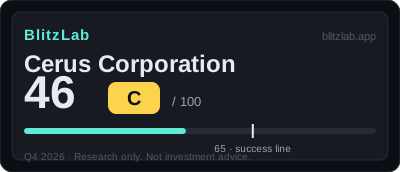
Cerus Corporation — Blitz Index 46 (C)
Cerus scores 46 — the same 46 as its draft, now confirmed by Q3 results, with a positive Phase 3 for red cells that the score does not yet count.
Last re-scored: November 2, 2026.
Confidence: Medium · Category: frontier
Score breakdown
| Section | Score | Detail |
|---|---|---|
| A · Speed | 15 / 25 | Nine-month product revenue of $168.8M (+14%), Q3 $57.7M (+10%), FY guidance of $229–231M reaffirmed — but Q3 decelerated from +16% in the first half |
| B · Moat | 28 / 60 | INTERCEPT pathogen reduction as the standard in blood centres, with IFC kits accelerating (+44% in Q3) — but a single-product franchise with a 52.4% product margin |
| C · Creative destruction | 8 / 15 | Pathogen-reduced blood displacing untreated components — real but slow, and the red-cell second curve is not yet in the score (FDA unreviewed, CE Mark late 2027) |
| D · BlitzFailing | −5 | Cash of $57.1M and a tenth straight quarter of positive adjusted EBITDA (D1 −2); government-contract revenue down 16% (D2 −1); both regulatory milestones pushed back (D4 −2) |
Think we scored it wrong? Score it yourself →
Radar axes (0–100): Moat 46.7 · Speed 60.0 · Creative 53.3.
Watch item
Gates: G1 ✓ (confirmed — product growth sustained: nine months +14%, Q3 +10%, plus a second curve in the RedeS Phase 3) · G2 ✓ (estimated — the pathogen-reduction market clears the bar on the blood-safety definition). 19 points below the 65-point threshold — a Q3 2026 rescore of the unpublished draft (46/C → 46/C, Q2-based estimates confirmed by Q3 results). No FLAG: deductions of only 5. Watch: the RedeS final report, the CE Mark timeline (late 2027), and whether INT200's US PMA path clears its extra data step.
Strengths
- Results re-confirmed: nine-month product revenue of $168.8M (+14%), Q3 $57.7M (+10%), FY guidance of $229–231M reaffirmed
- RedeS Phase 3 positive: primary efficacy non-inferiority met (p=0.004), safety endpoint met — the clinical precondition for the red-cell second curve
- Financial health: cash of $57.1M, Q3 operating cash flow of +$3.0M, adjusted EBITDA positive for a tenth straight quarter ($5.7M)
- IFC accelerating: Q3 $5.6M (+44% YoY), US IFC kit conversion continuing
- Geographic spread: North America +12%, EMEA +5% despite headwinds
Concerns
- Both regulatory milestones pushed back: the red-cell CE Mark to late 2027, the INT200 US PMA to an extra data-collection step
- Growth decelerating: Q3 +10% versus +16% in the first half, net loss widening ($0.55M versus $0.02M) on higher SG&A
- Product gross margin down year on year (53.4% → 52.4%) on inflation, FX and IFC production costs
- Government-contract revenue −16% (old BARDA and FDA contracts ended) — total revenue up only 6%
- The FDA has not yet reviewed the RedeS final report — the US approval path and timing are undetermined
Research notes
Thesis: the same score, on better evidence
Cerus enters the BlitzLab record with a rescore of 46 out of 100, grade C, built from Speed 15 out of 25, Moat 28 out of 60, Creative Destruction 8 out of 15, and deductions of 5. The total sits 19 points below the 65-point line, and the shape of the score is the story: speed converts to 60.0 and creative destruction to 53.3, while the moat converts to 46.7. This is the pathogen-reduction company — product revenue of about $226.6 million trailing — whose score did not move from its unpublished draft (46/C → 46/C) because the third quarter confirmed the draft rather than changing it: nine-month product revenue up 14%, guidance reaffirmed, adjusted EBITDA positive for a tenth straight quarter. What did change is the quality of the evidence, from second-quarter estimates to third-quarter results — and the arrival of a positive Phase 3 for red cells, which the score deliberately does not yet count.
What the business does
Cerus Corporation, based in Concord, California, makes the INTERCEPT Blood System — technology that reduces pathogens in donated blood. Its approved products treat platelets and plasma; red blood cells are in development, and the company also sells INTERCEPT Fibrinogen Complex, or IFC. The business model is a consumable one: blood centres buy kits that are reordered every collection cycle, so each installed customer generates a recurring stream. About 800,000 kit doses were sold in the third quarter of 2026. Product revenue was $57.7 million in that quarter, and $168.8 million in the first nine months of 2026. A second, smaller revenue line — government contract revenue of $6.3 million in the quarter — is research funding from contracts such as the former BARDA and FDA agreements, and it is falling, down 16% year on year as those contracts end or shrink, which is why the scoring measures the product line rather than the total.
The installed base is what makes the revenue defensible. INTERCEPT is the only system reported to hold both FDA approval and a CE Mark for platelets and plasma, and once a blood centre has validated the workflow, switching means revalidation, retraining and recertification — costs the centre would rather not pay twice. Penetration of pathogen-reduced platelets in the United States is in the mid-60% range and still rising. Geographically, North American product revenue was $39.1 million in the third quarter, up 12%, and Europe, the Middle East and Africa was $17.6 million, up 5% despite Russian geopolitical headwinds and currency drag. IFC, the newer kit, contributed $5.6 million in the quarter, up 44% from $3.9 million a year earlier, and the shift to IFC kits happens inside existing blood-centre contracts, which is the cheapest kind of expansion. The company employed 268 people at the end of 2025, and product revenue per employee is about $846,000 on that stale denominator. Cash was $57.1 million at the end of the third quarter, up $0.8 million from the second quarter, with a MidCap facility of up to $110 million behind it.
Why the score is what it is
Speed scores 15 out of 25. The A1 growth item holds at 5 out of 10: product revenue grew 14% in the first nine months and 10% in the third quarter, against 14% in fiscal 2025, and fiscal 2026 guidance of $229–231 million, implying 11–12% growth, was reaffirmed — neither raised nor cut. The 5 reflects the deceleration: the third quarter's 10% is slower than the first half's 16%, and at a $227 million scale, mid-teens growth is steady rather than fast. IFC growing 44% is an accelerant, but it is only about 10% of the total. Capital speed scores 3 out of 5: third-quarter operating cash flow was positive at $3.0 million and adjusted EBITDA of $5.7 million marked a tenth consecutive positive quarter, so the company sustains itself — but there is no demonstrated large, cheap capital raise for a blitz. Hiring and productivity score 3 out of 5, with the 2026 headcount undisclosed and operating costs rising at a similar pace to revenue — the net loss widened to $0.55 million from $0.02 million a year earlier on higher selling, general and administrative spending. Share speed scores 4 out of 5, the best item on the axis: North America up 12%, INT200 illuminator placements continuing in Europe, and the IFC kit shift embedded in existing contracts — though no direct market-share percentage is disclosed.
The moat, at 28 out of 60, is flat across all four items at 7 points each. Network effects score 7 out of 18: the validated blood-centre workflow plus regulatory validation creates genuine switching costs, and the INT200 illuminator and IFC kit ecosystem extends the installed base — but centres do not gain value from other centres joining, so it is not two-sided liquidity. Distribution scores 7 out of 18: a direct and distributor footprint worldwide, with blood-centre contracts pre-selling the kit stream, but procurement is slow and concentrated, and the INT200 US premarket approval has slipped from unconfirmed to delayed, needing an extra data step after preliminary feedback from the FDA. Market size scores 7 out of 12: the pathogen-reduction market extrapolates to about $4.4–5.1 billion by 2036, roughly twice the bar of $2.27 billion, but the low vendor path sits at about the bar itself, the vertical is a single one — blood safety — and Terumo and Macopharma compete in it. Gross margin scores 7 out of 12: product gross margin was 52.4% in the third quarter, up from 51.4% in the second quarter but down from 53.4% a year earlier, with product gross profit of $30.3 million up 8% — a solid level whose trajectory is still downwards on inflation, currency and IFC production costs, and the company is not yet at operating profit. Creative destruction scores 8 out of 15: INTERCEPT replaces bacterial culture testing, gamma irradiation and CMV serology testing inside transfusion safety, and pathogen-reduced components are becoming the standard of care, but it is a workflow replacement within one vertical rather than an industry-wide order, and the kit adds per-unit cost that is only partly offset by avoided testing, irradiation and inventory waste — which is why the cost-structure item scores just 2.
The risks — and the red-cell question
Deductions total 5 points, and the largest single item is regulatory timing. The D4 deduction of 2 points reflects two milestones that both slipped after the draft scoring: the red-blood-cell CE Mark, now expected only in late 2027 after the French regulator ANSM raised questions and the full RedeS clinical study report was added to the submission, and the INT200 US premarket approval, which needs incremental data gathering after preliminary FDA feedback. The RedeS Phase 3 topline itself, reported on 2 November 2026, was positive: the primary efficacy endpoint was met on non-inferiority — adjusted haemoglobin increment 1.996 versus 2.050 grams per decilitre, a difference of minus 0.054 with a 95% confidence interval of minus 0.210 to 0.103 and p=0.004 against a margin of minus 0.32 — and the safety endpoint was met, with no significant difference in treatment-emergent adverse events, 3.4% versus 2.5%, p=0.634. Low-titre transient INTERCEPT-specific antibodies appeared in 2.2% of patients versus none in the control arm, with no haemolysis or clinical impact. But the FDA has not yet reviewed the final study report, secondary endpoints have not been reported, and the red-cell market is deliberately excluded from the gate's market ceiling because the product is unapproved — the positive result is a second curve's clinical premise, not yet a commercial one. Debt takes 2 points: the third-quarter debt split is unconfirmed, with the second-quarter figure of $76.8 million of total debt and about $20.5 million of net debt the latest confirmed, though the MidCap refinancing is cutting interest costs. Revenue quality takes 1 point for the shrinking government contract line, and governance takes none — no dual-class, founder or sponsor control issue was found, and chief executive Jayaraman, in place since 1 July 2026, is described as running smoothly, though major shareholders are unconfirmed.
What would change the score
This score is unusual in that it did not move from its unpublished draft — 46 out of 100, grade C, before and after — because the third quarter confirmed the draft rather than changing it. What moves it next is almost entirely regulatory. The red-cell CE Mark process, the full clinical study report expected in the first half of 2027, the secondary endpoints, and the FDA's review of the final report are the sequence that decides whether red cells enter the gate's market ceiling, the market-size item and the creative-destruction items — the largest single lever in the file. The INT200 premarket approval data step is the second. On the commercial side, delivery of fiscal 2026 guidance of $229–231 million in product revenue and $23–25 million for IFC, a return of product gross margin above 53%, and IFC growth holding above 40% would all support the growth and margin items. The risk is the mirror image: if the two regulatory milestones slip further, the second blitz opens in 2028 or later, and the first act — platelet and plasma growth of 10 to 14% — has to carry the score alone.
The gates: both pass — the second curve is a regulatory decision away
Gate 1, two pieces of product-market-fit evidence for a growth company, passes on a confirmed basis. Product revenue grew 14% in nine months and 10% in the third quarter, and the second curve — red-cell pathogen reduction — met its Phase 3 primary efficacy endpoint for non-inferiority (p=0.004) with its safety endpoint met. Gate 2, a ten-year market ceiling at least ten times current revenue, passes as an estimate on the blood-safety definition. But the second curve is not in the score: the FDA has not reviewed the final report, the CE Mark is expected only in late 2027, and the INT200 US PMA needs an extra data step — both milestones slipped from the draft's timeline. The fourth quarter of 2026 has not been reported at T, and its reporting date is unconfirmed — it is not a company-confirmed date and must not be presented as one — and no outcome is anticipated here. That is the balance of the record at T: a steady compounder, re-confirmed by its quarter, whose largest lever is a regulatory decision in 2027.
More Frontier companies
Other Frontier names on the Blitz Index, highest score first: Rocket Lab (62/B), Tesla (62/B), Illumina, Inc. (61/B).
Next earnings
Q4 2026 · Expected
Coverage
Cerus Corporation · Next earnings unconfirmed at scoring · Score 46 · Grade C
Embed this score
Copy the HTML below to show this score on your site. The badge links back to this page and updates automatically when the score changes.
Preview:
BlitzLab scores businesses against a scholar’s standard — not investment advice. No price targets, no buy/sell recommendations. Figures are from SEC filings (XBRL) as labeled in the source scorecard.