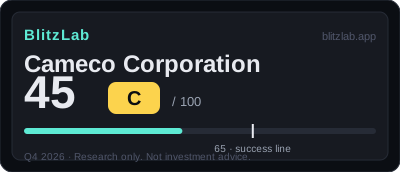
Cameco Corporation — Blitz Index 45 (C)
Cameco scores 45 — the uranium supplier with ~230M lbs under long-term contract and a Westinghouse stake, held back by flat 2026 deliveries, a 25.5% margin, and a gate pass that hangs on the market definition.
Last re-scored: October 30, 2026.
Confidence: Medium · Category: power
Score breakdown
| Section | Score | Detail |
|---|---|---|
| A · Speed | 16 / 25 | FY2023–FY2025 revenue CAGR of ~16% (FY2024 +21%, FY2025 +11%) — but 2026 is flat by design: nine months 0% growth and Q3 +1% on deliberate delivery discipline |
| B · Moat | 24 / 60 | Long-term contracts (~230M lbs uranium, ~83M kgU fuel services) plus a 49% Westinghouse stake — but commodity pricing power is limited (B1 5) and the margin is thin (B4 5) |
| C · Creative destruction | 10 / 15 | Nuclear power displacing fossil baseload as the reactor renaissance builds — a real displacement, paced by reactor construction rather than by Cameco |
| D · BlitzFailing | −5 | Nearly net debt-free (D1 −1); the Inkai joint venture's Kazakhstan exposure (D2 −2); the CRA transfer-pricing dispute running since 2007 (D4 −2) |
Think we scored it wrong? Score it yourself →
Radar axes (0–100): Moat 40.0 · Speed 64.0 · Creative 66.7.
Watch item
Gates: G1 ✓ (estimated — growth sustained: multi-year CAGR of ~16% plus a second curve in Westinghouse AP1000) · G2 ✓ (estimated — uranium alone is 0.9–1.0× the bar; adding fuel services reaches 1.2–1.3×). 20 points below the 65-point threshold — first score. No FLAG: deductions of only 5. Watch: the long-term uranium price (below US$80/lb the G2 pass wobbles), delivery guidance, and the CRA dispute.
Strengths
- Multi-year growth: FY2023–FY2025 revenue CAGR of ~16%, FY2024 +21%, FY2025 +11%
- Contract book: ~230M lbs of uranium plus ~83M kgU of fuel services under long-term contract
- Westinghouse 49%: Q3 equity-adjusted EBITDA of US$143M, an AP1000 pipeline of up to 91 units, a US government strategic partnership
- Effectively net debt-free: net debt of ~CAD 137M against cash of CAD 859.8M
- A growing market: WNA sees uranium demand at 107,000 tU by 2040 (reference case), with unmet demand widening
Concerns
- 2026 revenue is flat: nine months 0% growth, Q3 +1%, delivery guidance cut (33.0M → 29.5–30.5M lbs)
- Margins falling: TTM gross margin of 25.5%, Q3 19.7% (from 27.6% a year ago)
- Thin G2 headroom: uranium alone matches the bar — the pass is sensitive to the long-term price
- CRA transfer-pricing dispute in progress (tax years 2007–2019, cash and collateral tied up) (D4 −2)
- Inkai joint-venture exposure in Kazakhstan (D2 −2), and a commodity business with limited pricing power (B1 5)
Research notes
Thesis: seven years of contracts, priced by the commodity
Cameco enters the BlitzLab record with a first scoring of 45 out of 100, grade C, built from Speed 16 out of 25, Moat 24 out of 60, Creative Destruction 10 out of 15, and deductions of 5. The total sits 20 points below the 65-point line, and the shape of the score is the story: creative destruction converts to 66.7 and speed to 64.0, while the moat converts to only 40.0. This is the uranium supplier — trailing-twelve-month revenue of about CAD 3,479 million, roughly US$2.5 billion — that holds about 230 million pounds of uranium under long-term contract plus 83 million kgU of fuel services, and owns 49% of Westinghouse, whose AP1000 pipeline runs to as many as 91 units. The 2026 flatline is deliberate: deliveries were trimmed by contract discipline, not by missing demand, in a market where unmet demand is widening.
What the business does
Cameco Corporation is a Canadian company listed on the New York Stock Exchange, reporting under IFRS in Canadian dollars, and it is the world's largest listed uranium producer. It mines uranium — principally at the tier-one Cigar Lake and McArthur River operations — and provides fuel services, conversion and fabrication, to nuclear utilities around the world. About 85% of revenue comes from uranium sales and about 15% from fuel services; enrichment is not its business and is excluded from the market definition. It also owns 49% of Westinghouse, the nuclear reactor and services company, accounted for by the equity method, which means Westinghouse's revenue is not consolidated into Cameco's — its contribution arrives as a share of earnings, US$143 million of adjusted EBITDA in the third quarter of 2026, up from US$124 million a year earlier.
The commercial model is contracts, not spot sales. Cameco holds about 230 million pounds of uranium under long-term contract — roughly 28 million pounds a year of deliveries on average over the next five years, against 33.0 million pounds delivered in 2025, or about seven years of coverage — plus about 83 million kilograms of uranium in fuel-services contracts. That contracted book is the foundation of the revenue line, and it is also the reason the 2026 numbers look flat: deliveries were deliberately trimmed, with 2026 guidance of 29.5–30.5 million pounds against 33.0 million in 2025, as a matter of contracting discipline rather than missing demand. Production in 2025 was 21.0 million pounds on Cameco's share, down 10% year on year on the mine plan, while revenue still rose 11% on higher prices. Trailing revenue is about CAD 3,479 million, roughly US$2.5 billion at the 1.40 exchange rate used in the file, and the company employed 3,082 people at the end of 2025 — about CAD 1.13 million of revenue per employee. Net earnings in the first nine months of 2026 were CAD 199 million, down from CAD 391 million a year earlier.
Why the score is what it is
Speed scores 16 out of 25. The A1 growth item scores 5 out of 10: the multi-year record is strong — revenue rose from CAD 2,588 million in fiscal 2023 to CAD 3,136 million in fiscal 2024, up 21.2%, and to CAD 3,482 million in fiscal 2025, up 11.0%, a compound rate of about 16% — but 2026 has stopped, with nine-month revenue flat at CAD 2,278 million and the third quarter up just 1% to CAD 619 million. The 5 credits the record and the contracted book while marking the flat year for what it is. Capital speed scores 4 out of 5: nine-month adjusted EBITDA was CAD 1.2 billion including the Westinghouse share, cash was CAD 859.8 million against long-term debt of CAD 997.0 million — net debt of only about CAD 137 million, roughly 4% of trailing revenue — and the company pays a dividend while holding its Westinghouse stake without an equity raise. The one caveat is that nine-month operating cash flow was not directly confirmed in the reviewed sources. Hiring and productivity score 3 out of 5: output fell on the mine plan and the change in headcount against 2024 is unconfirmed, so no hiring blitz or productivity leverage can be evidenced. Share speed scores 4 out of 5: as the largest listed producer with a growing long-term book, Cameco is the verified, reliable supplier filling a widening gap — UxC data shows about 589 million pounds contracted over the last five years against about 815 million pounds of reactor consumption, so uncovered requirements are growing — but no direct market-share figure is disclosed, and the position against Kazatomprom is unconfirmed.
The moat, at 24 out of 60, is the weak axis, and the gross margin is the main reason. Network effects score 5 out of 18: there is no true network effect, but there is a lock-in of a different kind — nuclear fuel is bound by licensing, quality certification and long-term contracts that make switching hard, and the tier-one ore bodies are structurally scarce. That is the bottom of the data-and-ecosystem band, because uranium is a homogeneous commodity with limited pricing power. Distribution scores 7 out of 18, the best moat item: multi-year contracts with utilities worldwide are a repeatable lever, with fuel-services contracts layered on top, though distribution depends on sales and negotiation and delivery timing swings sharply by quarter — third-quarter gross profit fell 28% year on year on that timing. Market size scores 7 out of 12: the nuclear fuel cycle — uranium plus conversion plus fabrication — extrapolates to about US$30–33 billion by 2036, only 1.2 to 1.3 times the bar of about US$24.9 billion, and uranium alone is 0.9 to 1.0 times the bar, so the pass has almost no slack and depends on the long-term uranium price holding at US$90–100 a pound. Gross margin scores 5 out of 12: 27.9% in fiscal 2025, about 25.5% trailing, and 19.7% in the third quarter, down from 27.6% a year earlier — a miner's margin that swings with mine costs, delivery mix and the uranium price, with no joint signature of acceleration plus margin expansion. Creative destruction is the strongest axis at 10 out of 15: coal and gas baseload generation is giving way to nuclear as a low-carbon, 24-hour baseload source, and AI data-centre power demand is accelerating that renaissance — though Cameco is the beneficiary of the shift rather than its instigator, since nuclear is a revival of an existing energy source rather than a new disruptor, and the shift is a slow, policy-dependent, ten-year decision cycle rather than a consumer behaviour change.
The risks
Deductions total 5 points, and the two largest are a tax dispute and a geopolitical exposure. The D4 regulatory deduction of 2 points reflects the Canada Revenue Agency transfer-pricing dispute, covering tax years 2007 to 2019: court rulings have gone partly in Cameco's favour for some years, later years remain unresolved, and cash and security are tied up — an adverse ruling could mean a material tax burden. The same item also carries the Kazakhstan political risk on the Inkai joint venture, in which Cameco holds 40%. The D2 revenue-quality deduction of 2 points covers that Inkai exposure as well — the joint venture's EBITDA sits inside the uranium segment — plus a one-off of about US$170 million of Westinghouse revenue related to the Czech Dukovany project in the second quarter of 2025, and the quarter-to-quarter volatility of delivery timing. Debt takes only 1 point: the balance sheet is close to net-debt-free, but mine decommissioning and reclamation provisions sit on it in unquantified amounts, and the Westinghouse stake's debt is not consolidated, so it is a separate risk rather than a visible one. Governance takes none — no dual-class, founder or private-equity control issue was found, and the structure is single-class common stock under standard Canadian governance, though major shareholders are unconfirmed. The gate itself carries a warning the file states plainly: if the long-term uranium price falls below US$80 a pound, even the uranium-plus-fuel-services total falls short of the bar, and the pass wobbles.
What would change the score
The levers are the uranium price, the reactor pipeline and the tax dispute. A long-term price holding at US$90–100 a pound preserves the gate's thin pass; a fall below US$80 a pound undermines it. On the second curve, the Westinghouse AP1000 pipeline of up to 91 reactors — up to 105 gigawatts — and the strategic partnership with Brookfield and the US government announced in 2026 are the test of whether new reactor deployment becomes a second axis rather than a minority stake, alongside fuel-services contracting at conversion prices described as record highs. A resolution of the Canada Revenue Agency dispute in Cameco's favour would remove the largest single deduction and release tied-up cash and security. And the margin needs to recover: a gross margin back above the fiscal 2025 level of 27.9% would be the first evidence that the nuclear renaissance is converting into Cameco's profitability rather than only into its contracted book.
The gates: both pass — the second by a hair, on the definition
Gate 1, sustained growth or a second growth curve for a mature company, passes as an estimate. Multi-year revenue grew at about 16% a year from fiscal 2023 to fiscal 2025, and the second curve is the Westinghouse stake and its AP1000 pipeline. Gate 2, a ten-year market ceiling at least ten times current revenue, also passes as an estimate — and the file is candid that the pass depends on the definition: uranium alone is 0.9–1.0 times the bar, and only by adding fuel services does it reach 1.2–1.3 times. If the long-term uranium price falls below US$80 a pound, the pass wobbles. The fourth quarter of 2026 has not been reported at T, and its reporting date is unconfirmed — it is not a company-confirmed date and must not be presented as one — and no outcome is anticipated here. That is the balance of the record at T: a verified supplier in a renaissance market, a margin that is a miner's margin, and a score whose ceiling is set by the commodity price.
More Power & Energy companies
Other Power & Energy names on the Blitz Index, highest score first: Solaris Energy Infrastructure (59/C), Bloom Energy (58/C), Forgent Power Solutions (50/C).
Next earnings
Q4 2026 · Expected
Coverage
Cameco Corporation · Next earnings unconfirmed at scoring · Score 45 · Grade C
Embed this score
Copy the HTML below to show this score on your site. The badge links back to this page and updates automatically when the score changes.
Preview:
BlitzLab scores businesses against a scholar’s standard — not investment advice. No price targets, no buy/sell recommendations. Figures are from SEC filings (XBRL) as labeled in the source scorecard.