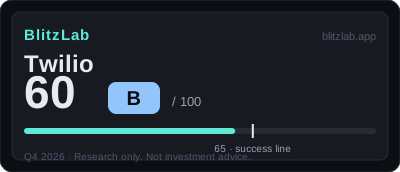
Twilio — Blitz Index 60 (B)
Speed is back — organic +17% and DBNER 116% — but a ~49% gross-margin ceiling caps the moat.
Last re-scored: October 20, 2026.
Confidence: High · Category: platforms
Score breakdown
| Section | Score | Detail |
|---|---|---|
| A · Speed | 17 / 25 | Organic growth re-accelerated +12% → +17% over three quarters; DBNER 116%; ~$1.0M revenue per employee |
| B · Moat | 34 / 60 | Usage-based distribution is broad, but carrier pass-through structurally caps gross margin at ~49% |
| C · Creative destruction | 10 / 15 | The API standard that replaced legacy telecom plumbing; the AI layer is still narrative and Segment unproven |
| D · BlitzFailing | −1 | Activist overhang and a founder-CEO exit in the record; the balance sheet itself is net cash |
Think we scored it wrong? Score it yourself →
Radar axes (0–100): Moat 56.7 · Speed 68 · Creative 66.7.
Watch item
Gates: G1 ✓ · G2 ✓ (estimate). Bar ≈ $55.7B (TTM revenue × 10) vs company TAM of $158B by 2028; CPaaS-only third-party estimates are thinner.
Strengths
- Organic re-acceleration (+12% → +17%) driven by existing customers — DBNER 116% is quality growth
- Profitability turn completed: operating income −$876.5M (2023) → +$157.8M (2025); FCF $945.4M at a 19% margin
- Revenue per employee ~$1.0M (TTM) — growing while shrinking headcount
- Net cash $2.66B and $1.2B of cumulative buybacks cut the share count 16.5% (2023–2025)
Concerns
- Q3 2026 guidance of organic +11–12% — the re-acceleration's first slowdown signal is already printed
- Gross margin sliding 51.1% → 48.9% → 48% as A2P pass-through expands
- Reported (+22%) vs organic (+17%) gap of $71.1M pass-through needs constant care in reading growth
- Segment: no separate revenue disclosed, cross-sell reportedly difficult, sale demands refused
Research notes
Thesis: speed has returned; the moat has not yet deepened
Twilio enters the BlitzLab record as a first-time score, and the first thing the record establishes is a change of direction. This is a mature company, with trailing-twelve-month revenue of about $5.57 billion at the scoring date of 20 October 2026, that spent two years slowing down and has now spent several quarters speeding up again. Annual revenue growth fell from 34.6 percent in fiscal 2022 to 8.6 percent in fiscal 2023 and 7.3 percent in fiscal 2024, then recovered to 13.7 percent in fiscal 2025. That sequence alone would be a familiar turnaround story. What makes it more interesting, and what the score tries to capture, is the quality of the recovery: it is being driven less by new logos alone than by existing customers spending more, and it is being delivered by a smaller workforce than the company had at the end of 2025.
The total score is 60 out of 100, grade B, built from Speed 17 out of 25, Moat 34 out of 60, Creative Destruction 10 out of 15, and deductions of 1. Five points short of the 65-point threshold, Twilio is best read as a company in the confirmation phase of a second act rather than a company that has already completed one. The speed section is, by the score file's own comparison, the strongest among the mature software companies it cites — ahead of the 13 points each recorded for CRM, NOW and ADBE, and ahead of HUBS at 15. The moat section is where the score stalls. A gross margin near 49 percent, a developer moat that is real but shallow compared with multi-product lock-in, and an artificial-intelligence story that has not yet produced a disclosed revenue figure together cap the total, however encouraging the growth trajectory looks.
Both gates pass, but they pass in different registers, and the difference matters. Gate 1, sustained growth or a second growth curve, passes on confirmed figures: the re-acceleration of organic growth and the rise in dollar-based net expansion are documented in filings. Gate 2, a ten-year market ceiling at least ten times current revenue, passes only as an estimate. The bar is about $55.7 billion, ten times trailing revenue of $5,572.3 million, calculated from four confirmed quarters spanning the third quarter of 2025 through the second quarter of 2026 and cross-checked against EDGAR company-concept data. The company's stated total addressable market of $158 billion for 2028, cited from its January 2025 Investor Day and its fiscal 2025 annual report as press-reported, is about 2.8 times that bar. Narrowed to communications plus data alone, the figure is still $119 billion. Third-party estimates for the standalone CPaaS market are thinner, at $72.7 billion by 2033 from Persistence Market Research and $85.6 billion by 2033 from Verified Market Research, both press-reported, or only 1.3 to 1.5 times the bar. The score file is explicit that the company does not state a quantified market size in the body of its 10-K, so the gate verdict rests on the company's stated figure plus third-party estimates and is labelled an estimate rather than a confirmed pass. That honesty sets the tone for everything that follows: where Twilio's evidence is filed and measurable, the draft says so; where it is claimed, estimated or reported in the press, it says that too.
Speed: a genuine re-acceleration, measured with its discount applied
The growth subscore, A1 at 6 out of 10, is the clearest example of the score file separating a real recovery from a flattering headline. Organic growth accelerated from 13 percent in the third quarter of 2025 to 12 percent in the fourth quarter, then to 16 percent in the first quarter of 2026 and 17 percent in the second quarter of 2026, all confirmed in filings. Dollar-based net expansion rate, the measure of how much existing customers expand, moved from 108 percent in fiscal 2025 to 114 percent in the first quarter of 2026 and 116 percent in the second quarter. Fiscal 2026 guidance was raised on 6 August 2026, to reported growth of 18 to 18.5 percent and organic growth of 13 to 13.5 percent. Those are the facts behind the word re-acceleration.
Two discounts keep the subscore at 6 rather than higher, and both deserve emphasis because they recur throughout the assessment. First, reported growth in the second quarter of 2026 was 22 percent, but $71.1 million of it was A2P fee pass-through, confirmed in the 10-Q management discussion, in which revenue equals cost and gross profit is unaffected. Real growth, on the score file's reading, is the organic 17 percent, not the reported 22 percent. Second, guidance for the third quarter of 2026 points to organic growth of 11 to 12 percent, a deceleration from the second quarter's pace, and full-year organic guidance remains at 13 to 13.5 percent. The re-acceleration is therefore real, but the score treats its peak as possibly already passed, and holds A1 at the same 6 points given to NOW and HUBS. That is a deliberately unsentimental judgement: three quarters of acceleration earn credit, but a guided slowdown in the very next quarter prevents the score from extrapolating the trend.
Capital speed, A2 at 3 out of 5, tells a quieter story of discipline replacing expansion. Twilio no longer needs to raise capital to grow; it returns it. A $2.0 billion repurchase programme approved in January 2025, expiring 31 December 2027, saw $854.6 million repurchased in fiscal 2025 and a cumulative total of about $1.2 billion, leaving $826 million remaining at 30 June 2026. Cash plus short-term investments stood at $2.66 billion, a net-cash position. Acquisitions are now small: the Stytch acquisition cost $104.1 million in cash in November 2025, a minor sum beside the multi-billion-dollar deals of the earlier blitz era. The market capitalisation of about $44.5 billion is labelled an estimate in the score file, derived from Form 4 sale prices of $289.68 to $296.34 on 30 September 2026 multiplied by 153.6 million shares outstanding, and on that estimated basis the test of whether market value doubled in twelve months cannot be judged. The subscore therefore rests on the pace of return alone, matching CRM at 3 points, rather than on any claim about valuation momentum.
Hiring and productivity, A3 at 4 out of 5, is where Twilio's turnaround looks most distinctive. Headcount fell from 5,587 employees at the end of 2025 to 5,558 in the first quarter of 2026 and 5,492 in the second quarter, while revenue grew at a rate above 20 percent on a reported basis. Revenue per employee reached about $907,000 in fiscal 2025 and about $1.01 million on a trailing basis, calculated as $5,572.3 million divided by 5,492 employees, reaching the $1 million benchmark the model uses. The score file contrasts this with HUBS at roughly $353,000 and NOW at roughly $508,000, a gap it calls stark. The fifth point is withheld for a precise reason: this is productivity achieved by reduction rather than by hiring at speed, and on the fiscal 2025 measure alone the figure sat below the benchmark. The distinction is worth keeping in mind. Twilio is not blitzing by adding people faster than anyone else; it is growing while employing fewer people, which is a different kind of operational achievement, and the score credits it as such without pretending it is the same thing.
Share velocity, A4 at 4 out of 5, completes the speed picture. Active customer accounts rose from 325,000 in 2024 to 402,000 in 2025, an increase of 24 percent in one year, confirmed in filings, across more than 180 countries. The expansion rate of 116 percent is treated as evidence that share is deepening within the existing base, not merely widening at the edges. Two limits keep the subscore below the maximum: no quantified market share figure is confirmed, the category-leader positioning remains a company claim, and cross-selling from the Segment acquisition is described in reporting as facing difficulties, which discounts the expansion into adjacent territory. The pattern is consistent across the speed section. Every claim that can be counted is counted, and every claim that cannot is discounted rather than assumed.
Moat: distribution that works, a moat that stays shallow, and a margin ceiling
If speed is Twilio's argument for attention, the moat section is its argument for patience. At 34 out of 60, it is the largest section and the binding constraint on the total, and its internal shape explains why. Distribution scores well, market size scores well, and the other two components pull the section down.
Network effects, B1 at 7 out of 18, are assessed with unusual frankness: Twilio has no classical network effect. Its defensive strength is instead a combination of developer adoption, counted in the millions of developers, the switching costs of embedded API integrations, carrier coverage and deliverability at scale, and the combination of Segment customer-data-platform data with communications, the last of which is a company claim. That places the company in the middle of the model's 5-to-9 band for data and ecosystem effects. It sits one point below HUBS at 8, because it lacks a quantified equivalent of the multi-product lock-in the score file cites for HUBS, and because application programming interfaces are standardised, making multi-homing and substitution by rival CPaaS providers or hyperscalers relatively easier. The offsetting evidence is the expansion rate of 116 percent itself: customers are not merely staying, they are spending more, which is treated as working evidence that the moat, shallow as it is, functions.
Distribution scalability, B2 at 11 out of 18, is the strongest moat component and the closest thing Twilio has to a classic blitz lever. The model is self-serve APIs plus usage-based pricing, so that when a developer embeds Twilio, usage itself becomes distribution, alongside an enterprise go-to-market motion confirmed in the 10-K. The land-and-expand evidence is measured rather than asserted: dollar-based net expansion rose from 103 percent in 2023 to 108 percent in 2025 and 116 percent in the second quarter of 2026. That trajectory lands in the lower end of the model's 10-to-14 band. It sits one point below DDOG at 12, whose net retention is described as in the low 120 percent range, because Twilio's expansion, while strengthening, has not yet reached that trajectory, and because Segment integration and cross-selling are reported, on the basis of independent analyst commentary, to have encountered difficulties. The June 2026 SIGNAL platform rebuild is noted as an attempt to redesign distribution for the artificial-intelligence era, a statement of intent whose commercial result is not yet in the numbers.
Market size, B3 at 10 out of 12, mirrors the gate verdict. The company's stated $158 billion market for 2028, press-reported, is about 2.8 times the $55.7 billion bar, and even the narrower communications-plus-data subset of $119 billion clears it comfortably. The discount is dependence: the score leans heavily on a company estimate, since the 10-K itself states no quantified market size, and standalone third-party CPaaS estimates of $72.7 billion to $85.6 billion by 2033 cover the bar by only 1.3 to 1.5 times. A large part of the claimed ceiling therefore comes from defining the market more broadly, as a customer-engagement platform spanning CPaaS, contact-centre-as-a-service and customer-data-platform territory plus conversational artificial intelligence, rather than from the original messaging and voice market alone. The score gives the same 10 points as DDOG, while making clear that the breadth of the definition is doing much of the work.
Gross margin, B4 at 6 out of 12, is the structural weakness that the score file identifies as decisive. GAAP gross margin moved from 49.2 percent in fiscal 2023 to 51.1 percent in fiscal 2024, then down to 48.9 percent in fiscal 2025 and 48 percent in the second quarter of 2026, with a non-GAAP figure of 51 percent for that quarter. That sits structurally below the 60 percent software benchmark the model uses, and far below the 80-percent-plus margins of the comparison software companies, which score 10 to 11 points on this item. The cause is the business model itself: carrier network costs are passed through, so that A2P fee increases raise both revenue and cost, leaving gross profit in dollars unaffected while pressing the margin percentage down, a mechanism confirmed in the 10-Q. Gross profit in dollars did grow, from $2,043.9 million to $2,478.7 million, and a free-cash-flow margin of 19 percent in fiscal 2025 plus improving non-GAAP operating margin support the downside, but the downward trajectory from 51.1 percent to 48 percent blocks a higher score. This single item accounts for most of the gap between Twilio and its higher-scoring peers, and unlike a growth rate or a hiring plan, it cannot be fixed in a quarter. It is built into how the company makes money.
Creative destruction: the first wave is done; the second is unproven
The creative-destruction section, 10 out of 15, describes a company whose original disruption is largely complete and whose next disruption is still a claim. The first displacement, C1 at 3 out of 5, was the replacement of building carrier integrations in-house with a programmable API. That wave is substantially finished. The second displacement now in progress, on the company's account, is the replacement of legacy contact centres and manual outreach with artificial-intelligence-agent-based conversational engagement, presented as infrastructure for customer engagement in the artificial-intelligence era. The score holds this at 3, the anchor for displacement in progress but limited in scope, because the artificial-intelligence products — AI Assistants, ConversationRelay and CustomerAI — have no disclosed revenue contribution, and the terms for those products do not appear in the 10-K at all, a non-disclosure the score file records as confirmed. A disruption that cannot yet be counted cannot yet be scored higher, however plausible its description.
Irreversible behaviour change, C2 at 4 out of 5, is the strongest creative-destruction component, and it rests on the first wave rather than the second. Building communications through a rented API has become the default way developers work, and 402,000 active accounts embedded across more than 180 countries represent a position from which a return to building everything in-house is, in the score file's phrase, effectively absent. The score draws an explicit parallel with ADBE's completed subscription transition, also scored at 4, as the same kind of finished behaviour change. The fifth point, reserved for smartphone-level irreversibility, is withheld because switching to a substitute remains possible, and because the newer behaviour change around artificial-intelligence agents is still forming, with no measured evidence to include in this score. The judgement is balanced: credit for a transformation that is done, restraint about one that is not.
Cost-structure change, C3 at 3 out of 5, follows the same logic. The historical evidence is clear: Twilio replaced the capital, headcount and regulatory burden of building carrier connectivity in-house with usage-based pricing. The current, still-forming change — artificial-intelligence orchestration collapsing contact-centre labour costs — has no company-measured figures behind it, and the A2P pass-through actually pushes customer costs upward rather than down. The Stytch acquisition, at $104.1 million, is read as an attempt to secure an agent-identity layer, a cost and trust layer for the next phase, but an attempt is not yet a result. The score matches CRM at 3, a company with its own demonstrated cost change behind it, and no more.
Deductions and risks: a clean balance sheet with two watch items
Deductions total just 1 point, and no FLAG is triggered, since the threshold is 15 points of deductions. That cleanliness is itself informative, but the score file is careful to record observations that do not attract deductions, and those observations are where the risk discussion properly lives.
Debt, D1 at zero, is unambiguous. Borrowings are $1.0 billion, comprising $500 million of 2029 notes at 3.625 percent and $500 million of 2031 notes at 3.875 percent, carried at $993.2 million in the second quarter of 2026, or 0.18 times trailing revenue, against cash plus short-term securities of $2.66 billion: a net-cash position, confirmed. Stock-based compensation of $600.4 million equals 11.9 percent of revenue, on a falling trajectory from 16.3 percent to 13.8 percent to 11.9 percent, and repurchases have more than offset it, with shares outstanding falling from 183.3 million in 2023 to 153.0 million in 2025. The observation recorded alongside, without deduction, concerns the Syniverse equity investment: a carrying value down from $301.6 million at the end of 2025 to $250.5 million in the second quarter of 2026, after a fiscal 2025 equity-method loss of $101.2 million plus an impairment of $80.6 million. The score file treats this as a question about the quality of capital allocation rather than a debt problem, and that framing is the right one. The balance sheet is not the risk; the judgement behind one investment is.
Revenue quality, D2 at zero, is also clean on the facts that matter. There is no revenue restatement and no audit issue, confirmed, and the score file credits transparency rather than penalising the pass-through: the definition of organic growth is stated in earnings releases, and the $71.1 million A2P pass-through is voluntarily disclosed in management discussion. The observation here concerns earnings quality rather than revenue quality. Second-quarter 2026 GAAP diluted earnings per share of $6.68 included $5.91 from the release of a deferred-tax-asset valuation allowance, a non-cash item, against non-GAAP earnings per share of $1.47. That is a disclosed one-off, treated in the same spirit as the strategic-investment gains noted for CRM, but it means the headline profit figure should not be read as a run-rate. The underlying profitability turn is real — GAAP operating income moved from negative $876.5 million in 2023 to positive $157.8 million in 2025, the first annual GAAP profit was $33.8 million, free cash flow reached $945.4 million at a 19 percent margin, and fiscal 2026 free-cash-flow guidance was set at $1.135 billion to $1.155 billion — yet the second-quarter headline flatters the pace, and the score file says so plainly.
Governance, D3 at minus 1, is the only deduction, and it reflects a history rather than a current scandal. On the positive side, Twilio has a single share class, the Class B shares having been automatically converted and extinguished on 28 June 2023, leaving one share with one vote, confirmed, with no founder control and with officers and directors holding under 1 percent. On the risk side, activist intervention has a documented history: pressure from Legion Partners from 2023, together with Anson Funds and Sachem Head, press-reported, preceded the departure of founder chief executive Jeff Lawson in January 2024, also press-reported, and Sachem Head partner Andy Stafman joined the board by agreement in April 2024, confirmed. A governance history that runs as far as a chief executive change is recorded as mild instability, hence minus 1. Insider selling, including chief executive sales under a 10b5-1 plan of about $10 million as reported and chief financial officer sales for tax withholding on restricted stock units in Form 4 filings, is assessed as within the ordinary range and not reflected in the score.
Regulatory and social cost, D4 at zero, is clean on the current record. The second-quarter 2026 10-Q reports no material litigation, only ordinary-course matters, confirmed, and while telecommunications, privacy and data regulation remain standing risk factors in the 10-K, there is no record of fines or sanctions. The March 2024 operating review decision to reject an activist demand to divest Segment is recorded as a strategy judgement, dealt with in the governance context rather than as a regulatory cost. The risk section of the 10-K is not empty, but an unmaterialised risk is not a deduction, and the score does not manufacture one.
What to watch: the five points, and where they could come from
Twilio's path to the 65-point threshold runs through the moat and creative-destruction sections, not through speed. Speed at 17 is already the highest among the mature peers the score file cites, so there is little headroom left there, and the guided deceleration in organic growth argues against expecting more from that section in the near term. The five missing points are instead distributed across the structural items: the margin ceiling in B4, which cannot improve quickly given the pass-through model; the depth of switching costs in B1, which would need Segment's data combination to be demonstrated rather than claimed; and the quantification of artificial-intelligence revenue in C1, which would need a disclosed figure where today there is none.
The immediate test is the one the score file already names. Third-quarter 2026 earnings, confirmed for 29 October 2026 after market close and therefore after this score's as-of date, are the next marker for whether the guided organic growth of 11 to 12 percent materialises and whether the re-acceleration sustains, pauses or resumes. This draft records that date only as a marker and makes no prediction about its outcome, since the results fall outside the score's evidence window. Beyond that single quarter, the items to follow are the trajectory of gross margin as pass-through volumes move, any separate disclosure of Segment revenue or cross-selling evidence, any quantification of artificial-intelligence product revenue, the carrying value and further results of the Syniverse investment, and the continued presence of activist holders, with Anson noted as still holding. Each of these maps to a specific line in the score, which is what makes them useful as watch items rather than general anxieties.
The overall picture is therefore a precise one. Twilio has executed the hard part of a turnaround — returning to growth, converting to profitability on a GAAP operating basis, generating free cash flow at a 19 percent margin, and doing so with fewer employees and a shrinking share count — while leaving the harder part of a blitzscaling story undone: converting usage growth into a deep, high-margin moat. The score file's own summary phrase captures it: speed has returned, and the moat is the assignment. Until Segment's data layer or the artificial-intelligence product line produces a measurable, high-margin revenue stream, Twilio remains a fast current running over a shallow bed — impressive in motion, and still five points from the threshold that would mark it as something more.
More Platforms companies
Other Platforms names on the Blitz Index, highest score first: Alphabet (83/A), Meta (78/B), Airbnb (76/B).
Next earnings
Q4 2026 · Expected
Coverage
Twilio Inc. · Q3 2026 earnings Oct 29, 2026 (AMC, confirmed) · Score 60 · Grade B
Embed this score
Copy the HTML below to show this score on your site. The badge links back to this page and updates automatically when the score changes.
Preview:
BlitzLab scores businesses against a scholar’s standard — not investment advice. No price targets, no buy/sell recommendations. Figures are from SEC filings (XBRL) as labeled in the source scorecard.