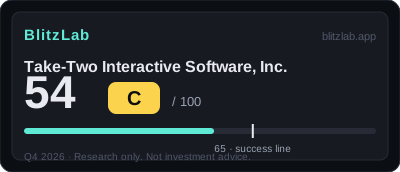
Take-Two Interactive Software, Inc. — Blitz Index 54 (C)
Take-Two scores 54 — a proven catalog (recurrent spending 78% of bookings) waiting on one conversion: GTA VI Online must repeat what GTA Online did for GTA V.
Last re-scored: October 24, 2026.
Confidence: High · Category: platforms
Score breakdown
| Section | Score | Detail |
|---|---|---|
| A · Speed | 16 / 25 | FY2026 bookings $6.72B (+19%) and GAAP revenue $6,656.4M (+18.2%) — but Q1 FY2027 bookings fell −3% YoY into the pre-launch trough |
| B · Moat | 38 / 60 | Recurrent consumer spending 78% of FY2026 bookings (84% in Q1 FY2027); GTA Online still monetizing a 2013 title; digital 97% of revenue |
| C · Creative destruction | 9 / 15 | GTA V monetizing 13 years on via GTA Online and GTA+; GTA VI $79.99 pricing breaks the $70 console standard — post-launch evidence still missing |
| D · BlitzFailing | −9 | GAAP losses persist (−$298.2M FY2026); FY2027 guidance explicitly GTA VI-driven; two GTA VI delays (~13-month slip) |
Think we scored it wrong? Score it yourself →
Radar axes (0–100): Moat 63.3 · Speed 64 · Creative 60.
Watch item
Gates: G1 ✓ · G2 ✓ (borderline — bar ≈ $66.6B vs ~$189–200B global games market; reaching the bar implies ~33–35% share, stated openly). 11 points below the threshold — first score.
Strengths
- FY2026 bookings +19% broad-based across all three labels — growth was not a single title
- Recurrent spending 78% of FY2026 bookings (84% in Q1 FY2027) — the installed base carries the P&L between hits
- GTA V monetizing 13 years on via GTA Online + GTA+ — the catalog, not just new releases, monetizes
- Digital 97–99% of revenue; mobile 50% / console 39% / PC 11% — diversified across every platform segment
- NBA 2K26 >12M units (+9% vs 2K25), DAU +15% — an annual franchise behaving like a live service
- Net debt only ~$693M (<1× EBITDA); FY2026 OCF $624.3M — self-funding into the launch
Concerns
- Q1 FY2027 bookings −3% YoY and GAAP losses persist (−$298.2M FY2026, −$34.1M Q1 FY2027); EBITDA margin only ~11.4%
- FY2027 guidance (+20%) explicitly driven by an unlaunched title; Rockstar ~37% of guided bookings
- Two GTA VI delays (~13-month slip from Fall 2025); console-only launch with no PC date announced
- Development budget and pre-order volume undisclosed — the two numbers most relevant to launch economics are both Unconfirmed
- Hit costs inflating: capitalized unreleased development $2,149.7M; software development costs & royalties +161.6% YoY
- G2 attainable-share gap: the bar implies ~33–35% of the entire global games market
Research notes
Thesis: a proven catalog, an unproven next conversion
Take-Two Interactive Software, founded in 1993 and based in New York, is best understood not as a single hit factory but as a portfolio of persistent game worlds. Its three labels divide the work in a way that matters for the whole score. Rockstar Games makes Grand Theft Auto and Red Dead Redemption. 2K makes NBA 2K, WWE 2K, Borderlands, and Civilization. Zynga, acquired in 2022, makes the mobile portfolio. Together they produced fiscal 2026 GAAP revenue of $6,656.4 million, up 18.2 percent, and Net Bookings of $6.72 billion, up 19 percent from $5.65 billion. That breadth is the first thing to hold in mind, because the score that follows is not a story about one title carrying a quarter. In fiscal 2026, according to the chief executive as recorded in the score file, every label exceeded its initial expectations.
The second thing to hold in mind is timing. The scoring date, called T in the score file, is 2026-10-24. The latest reported quarter at T is the first quarter of fiscal 2027, the quarter ended 2026-06-30 and reported on 2026-08-07. Grand Theft Auto VI, the product on which the next fiscal year's guidance depends, was still unlaunched at T, with a launch date of 2026-11-19. That makes the official score of 54 out of 100, grade C, a trough score in a precise sense: the moat is measured on evidence that already exists, while the largest forward claim has no launch data behind it yet. The score is 11 points below the 65-point threshold, and it carries no FLAG, because total demerits of 9 points are below the 15-point FLAG line. The breakdown is Speed 16 out of 25, Moat 38 out of 60, Creative Destruction 9 out of 15, and Demerits minus 9, which sum to 54.
The thesis, in the score file's own compressed phrase, is "proven catalog, unproven next conversion." Fiscal 2026 was a breadth year. The first quarter of fiscal 2027 and the guided second quarter are a pre-launch trough, openly guided as such. What happens after 2026-11-19 will determine whether the next conversion — Grand Theft Auto VI Online turning launch buyers into recurring spenders, as Grand Theft Auto Online did for Grand Theft Auto V — becomes a second durable layer or remains a launch spike. At T, that conversion has zero data. The draft that follows therefore treats the launch strictly as a future marker, not as an outcome, and it treats the guided fiscal 2027 bookings figure of $8.0 billion to $8.2 billion, about 20 percent growth, as guidance, not as a reported result.
Speed: growth that is broad, cash that is self-generated, and a pipeline that is expensive to run
Growth, scored 7 out of 10, is the strongest part of the Speed section, and its strength comes from composition as much as from size. Fiscal 2026 bookings growth of 19 percent and GAAP revenue growth of 18.2 percent were broad-based across all three labels, spanning NBA 2K, the Grand Theft Auto catalog, Zynga mobile, Borderlands 4, and Civilization VII. The calculated revenue compound annual growth rate from fiscal 2024 to fiscal 2026 is about 11.5 percent. The engine underneath that growth is recurrent consumer spending, which grew 17 percent in fiscal 2026 to reach 78 percent of bookings, and then rose to 84 percent of bookings in the first quarter of fiscal 2027. That sequence matters because it changes what growth means here. A company whose bookings are dominated by recurrent spending is not waiting for the next launch week to have a quarter; it is monetizing an installed base between launches. The score file is explicit that this is why the growth engine is described as recurring rather than launch-week units.
The offset is equally plain. First-quarter fiscal 2027 bookings fell 3 percent year on year, to $1,385.9 million, even though that figure beat guidance of $1.32 billion to $1.37 billion, and GAAP revenue still rose 2.0 percent. The score file reads that dip as a pre-launch seasonal trough rather than a loss of demand, and the guidance beat supports that reading, but the scoring rule applied here is strict: fiscal 2027 guidance growth of about 20 percent, driven by an unlaunched title, supports the growth score without lifting it. A higher growth score would require bookings re-acceleration in a reported quarter, not a guided one. That discipline is worth noticing, because it is what keeps a pre-launch score honest. Guidance can describe a hinge; only reported bookings can prove that the hinge has turned.
Capital speed, scored 4 out of 5, is judged for a mature company on generated cash flow rather than on fundraising velocity. Fiscal 2026 operating cash flow was $624.3 million, above the initial forecast of about $450 million, and calculated free cash flow was about $461.5 million, operating cash flow less property, plant, and equipment spending of $162.8 million. Net debt was only about $693 million. There were no buybacks in the fourth quarter of fiscal 2026 despite a 21.7 million-share authorization, of which 10.0 million shares remained. The picture is one of capital that is available rather than blitzed: the company funded its pipeline from its own cash flow, without distress issuance, and it did not spend the quarter buying back stock either. The offsets are seasonal and structural at once. First-quarter fiscal 2027 operating cash flow was negative $168.8 million, seasonally, against negative $44.7 million in the prior-year quarter. Capital expenditure is guided up to about $290 million, from about $200 million. Stock-based compensation was $305.3 million in fiscal 2026. None of those figures overturns the self-funding verdict, but together they explain why capital speed is 4 rather than 5. The money is there; it is also being consumed by a pipeline whose costs are rising, a theme that returns in the deductions section.
Hiring and productivity, scored 2 out of 5, is the weakest Speed item, and the score file is candid about why. Take-Two employed 12,909 full-time employees at 2026-03-31, of whom 9,998, or 77 percent, worked in development studios. Calculated revenue per employee in fiscal 2026 was about $516,000, roughly one-quarter of the comparable bookings-per-head figure of about $2.21 million cited for Roblox in its own scoring. Research and development spending was $1,074.6 million, or 16.1 percent of revenue, and selling and marketing spending was $1,770.8 million, or 26.6 percent of revenue. No hiring-growth series was present in the scoring pack, and hiring is not observed here as a blitz lever. Headcount, in this reading, is the cost of maintaining a hit pipeline, not a lever that scales revenue by itself. A studio organization that large can produce worlds of extraordinary depth, but it cannot be scaled up and down like a sales team, and every additional title in development adds people before it adds bookings. That structural fact caps the score, and it also explains why the company's growth has to come from monetizing what its studios have already built rather than from adding heads at a faster rate.
Share speed, scored 3 out of 5, reflects franchise momentum that is real but not quantified as market-share movement. The Grand Theft Auto franchise has sold in more than 465 million units. Grand Theft Auto V alone is cited at more than 225 million units in the 10-K and more than 230 million on the first-quarter call, the latter figure press-based. Red Dead Redemption 2 has sold more than 85 million units. NBA 2K26 had sold more than 12 million units by August, up 9 percent against NBA 2K25, with daily active users up 15 percent, both figures press-based. Geographic reach in the first quarter of fiscal 2027 was 60 percent United States revenue and 40 percent international. Backward concentration is moderate: Grand Theft Auto products accounted for 12.4 percent of fiscal 2026 revenue, so share is broad rather than spiking on a single catalog line. A higher score would require a quantified share gain, and the score file does not claim one. Momentum without a measured share gain is worth 3 points, not 4, and that restraint is consistent with the rest of the file.
Moat: the live-services flywheel, fully digital distribution, and a market ceiling stated with its weakness attached
Network effects, scored 10 out of 18, are the most interesting judgment in the Moat section, because the score file both praises the flywheel and refuses to call it something it is not. Recurrent consumer spending at 78 percent of fiscal 2026 bookings and 84 percent in the first quarter of fiscal 2027 means the installed base, not launch-week sales, carries the profit-and-loss statement between hits. Grand Theft Auto Online still monetizes a title first released in 2013, thirteen years on, and remains a top contributor, with series recurrent spending up 3 percent in the first quarter of fiscal 2027 on the call. A subscription layer, Grand Theft Auto Plus, is described on the fourth-quarter call, press-based, as growing significantly year on year, though no subscriber count is disclosed. NBA 2K annual recurrent spending grew by more than 30 percent in fiscal 2026, on the call, and the Zynga mobile portfolio adds a diversified daily-play base. The score file calls this the strongest evidenced live-services flywheel in the scored set outside pure platforms, and the evidence supports that phrasing: few catalogs in the set can point to a thirteen-year-old title still funding the present.
The discount is equally important. This is an engagement flywheel, not a cross-side network effect of the marketplace kind, in which each additional user directly increases value for users on the other side. Friends, crews, and creator content deepen engagement, but Sony and Microsoft remain gatekeepers: console revenue was 39.0 percent of fiscal 2026 revenue, and the 10-K carries a risk factor on licensor approval. The undisclosed Grand Theft Auto Plus subscriber count caps the score below 12. A flywheel that depends on platform holders for approval and economics, and whose subscription scale cannot be counted from public disclosure, cannot score like a platform that owns its own network outright. Ten points is therefore a measured verdict: exceptional persistence, bounded by dependence.
Distribution scalability, scored 13 out of 18, is the highest Moat item, and it is the least debatable. Distribution is already fully digital and global. Digital online revenue was 97.0 percent of fiscal 2026 revenue, and in the first quarter of fiscal 2027 digital revenue was 98 percent of GAAP revenue and 99 percent of Net Bookings. All three platform segments operate at scale: mobile 50.1 percent, console 39.0 percent, and personal computer and other 10.9 percent of fiscal 2026 revenue. A long-term Xbox Publisher License Agreement with Microsoft was entered into on 2026-09-28, reported in an 8-K on 2026-09-30 with terms undisclosed, securing Xbox terms into the Grand Theft Auto VI window. The discounts are real but do not undo the verdict. Grand Theft Auto VI is console-only at launch, with no personal computer date announced, which temporarily narrows distribution. Platform holders remain gatekeepers on approval and economics. Proven at scale, however, the distribution system scores above a company still building its distribution, and the score file makes that comparison explicitly against Nebius. Digital distribution at 97 to 99 percent is not a promise; it is the mix the company already reports.
Market size, scored 8 out of 12, is where the score file is at its most self-aware, and the reasoning deserves to be followed in full because it also determines the second gate. The gate question is whether the ten-year market ceiling is at least ten times current revenue. Adopted revenue is fiscal 2026 GAAP revenue of $6,656.4 million, confirmed by the Securities and Exchange Commission filing, which sets the bar at about $66.6 billion; on a trailing-twelve-month basis the bar would be about $66.9 billion, with the same conclusion. The market boundary adopted is global consumer games spending across mobile, console, and personal computer. That definition matters because Take-Two already earns revenue in all three segments, so the objection that a company cannot count markets it does not serve does not apply here. Newzoo's September 2025 outlook, a press-based third-party estimate, put global games revenue at about $188.8 billion for 2025, and the score file uses a range of about $189 billion to $200 billion, making the market about 2.8 to 3.0 times the bar. On market-size arithmetic alone, the gate passes.
The recorded weakness, stated openly rather than hidden, is that reaching the bar would imply about 33 to 35 percent share of the entire global games market. No publisher holds anything near that today; Take-Two itself is about 3.3 percent, and the largest publisher is roughly a tenth of the market. The score file notes that the Roblox scoring recorded the identical weakness and still passed on the same arithmetic, and that consistency across the games vertical requires the same treatment here. The gate therefore passes on arithmetic, while the market-size item score of 8, not 10 to 12, is where the attainable-share skepticism is priced. A score of 10 or more would require Grand Theft Auto VI Online to evidence a durable new revenue layer. That division of labor — gate passes, item score stays skeptical — is the honest way to handle a ceiling that is arithmetically large and practically distant at the same time.
Gross margin, scored 7 out of 12, continues the pattern of a solid result with a thinner honest margin underneath. Gross margin in fiscal 2026 was 57.2 percent, up from 54.3 percent in fiscal 2025 and 41.9 percent in fiscal 2024, the earlier year depressed by impairments, and it was 57.5 percent in the first quarter of fiscal 2027. That is a solid content margin, below software-platform levels of 70 percent and above. The honest margin is thinner: calculated earnings before interest, taxes, depreciation, and amortization margin was only about 11.4 percent, $760.6 million divided by $6,656.4 million, after selling and marketing spending at 26.6 percent of revenue and an amortization wedge of about $725.6 million in acquired-intangible amortization in the fiscal 2026 management reconciliation, and $160.5 million in the first quarter of fiscal 2027. The improving trajectory supports 7 points; persistent GAAP losses block more. A content margin in the high fifties, filtered through marketing intensity and amortization, becomes an operating margin in the low teens, and the score reflects both layers rather than celebrating the first and ignoring the second.
Creative destruction: pricing power tested, behavior change demonstrated, cost structure moving the wrong way
Order being replaced, scored 3 out of 5, is a thesis stated but not yet evidenced at T, and the score file does not pretend otherwise. The central question is whether Grand Theft Auto VI Online turns a once-a-decade launch into a persistent platform, as Grand Theft Auto Online did for Grand Theft Auto V, or remains a launch spike. Two real breaks support 3 points. First, Grand Theft Auto VI pricing at $79.99 for the Standard edition and $99.99 for the Ultimate edition breaks the $70 console standard that Take-Two itself set at the start of this generation, according to press reports of the Rockstar announcement on 2026-06-24. That is a pricing-power test for the whole market for large-budget console titles: if buyers accept the higher standard tier, every large publisher's price umbrella moves. Second, Zynga's acquisition in 2022 already replaced the company's console-only identity once, since mobile is now 50 percent of revenue, though the console-only Grand Theft Auto VI launch temporarily reverses that mix. A score of 4 would require post-launch evidence, and at T there is none to cite. The pricing break is real; the platform break is still a question.
Irreversible behavior change, scored 4 out of 5, is the strongest Creative Destruction item because its evidence is demonstrated rather than promised. Grand Theft Auto V is still a top-two contributor thirteen years after launch, through Grand Theft Auto Online recurrent spending and Grand Theft Auto Plus. NBA 2K behaves as an annual live service, with recurrent spending growth above 30 percent in fiscal 2026 and, for NBA 2K26, daily active users up 15 percent and units up 9 percent. Zynga titles occupied six of the top eleven first-quarter fiscal 2027 contributors, plus Color Block Jam, which diversifies daily mobile play away from console hit timing. Players, in other words, already behave differently from the old buy-a-disc-and-wait-for-a-sequel pattern: they return daily to worlds that keep charging, updating, and expanding. One point is held back for a precise reason: the behavior of the Grand Theft Auto VI era, meaning Grand Theft Auto VI Online retention, has no data at T. Demonstrated change in the old worlds earns 4 points; the new world's behavior cannot be scored until it exists.
Cost-structure change, scored 2 out of 5, runs in the opposite direction, and the score file is blunt about it. Digital distribution at 97 to 99 percent already collapsed physical distribution costs, but that shift is old news, already present in the mix, not a new break. The current cost direction runs the other way. Capitalized software development for all unreleased titles was $2,149.7 million at 2026-03-31. Software development costs and royalties were $439.8 million in fiscal 2026, up 161.6 percent year on year. Stock-based compensation was $305.3 million. Hit costs are inflating, not collapsing, and no unit-cost collapse is evidenced. Two points therefore reflect a company whose distribution revolution is complete and whose production costs are rising at the same time. That combination — cheap distribution, expensive creation — is the central cost tension of the modern large-budget games business, and Take-Two exhibits it in its purest form.
Deductions and risks: light debt, noisy earnings, a contractual governance quirk, and a twice-delayed launch
Debt, scored minus 2 out of a possible minus 10, is light but not zero. At 2026-06-30, cash of $1,364.9 million plus short-term investments of $461.7 million gave $1,826.6 million of liquidity, against total debt of $2,519.7 million, for calculated net debt of about $693 million, under one times fiscal 2026 earnings before interest, taxes, depreciation, and amortization of $760.6 million. The maturity wall has been termed out: notes due in 2025 were repaid in April 2025, and notes due in 2026 were repaid in March 2026. The offsets keep the deduction from disappearing entirely. An amount of $629.9 million now sits in short-term debt. Capital expenditure is guided to about $290 million. Deferred revenue was seasonally drawn down, from $1,189.6 million to $1,014.5 million. A balance sheet that can fund a launch from its own cash flow, while carrying a short-term debt balance and a rising capital budget into that launch, earns a small deduction rather than a clean pass, and that feels proportionate.
Earnings quality, scored minus 4, is a deduction for noise and concentration, not for misconduct. The score file is explicit that there was no restatement, auditor change, or adverse opinion. The gap is nonetheless large and persistent: a GAAP net loss of $298.2 million in fiscal 2026 against positive earnings before interest, taxes, depreciation, and amortization of $760.6 million, a gap explained by disclosed non-cash items including acquired-intangible amortization, stock-based compensation, and impairments, but large all the same. The first quarter of fiscal 2027 added a $43.4 million impairment for cancelling an unannounced third-party title, and stock-based compensation more than doubled year on year in the quarter, to $86.0 million from $40.7 million. The tax provision was $100.4 million despite a pre-tax loss, reflecting valuation allowances, for an effective rate of negative 50.8 percent. The second half of the deduction is forward concentration: fiscal 2027 guidance growth of about 20 percent in bookings is explicitly driven by Grand Theft Auto VI, and Rockstar accounts for about 37 percent of guided bookings on the call, press-based, so a launch shortfall would hit the fiscal year and the company's stated expectation of sustaining the new scale at the same time. Recent guidance beats in the fourth quarter of fiscal 2026 and the first quarter of fiscal 2027 keep the deduction at minus 4 rather than deeper. Noise plus concentration, disclosed and partly mitigated, is the fair summary.
Governance, scored minus 1 out of a possible minus 5, is clean on the dimension that matters most in this model. Take-Two has a single class of common stock, with no dual-class or super-voting structure in the 10-K or the 2026 proxy statement. The largest holders are institutions: Vanguard 7.02 percent, BlackRock 6.81 percent, State Street 6.43 percent, the Saudi PIF 6.10 percent, and JPMorgan 4.98 percent. The single point of deduction is for a contractual key-person structure: chief executive Zelnick and president Slatoff serve through a management agreement with ZMC, successor by assignment from ZelnickMedia, rather than through direct employment, with a dedicated board committee overseeing the arrangement. Insider ownership is below 1 percent each, with Zelnick holding 1,382,568 shares and Slatoff holding 1,126,165 shares. A charter amendment on 2026-09-17 limiting officer liability is recorded in the score file as a governance note, not scored. The governance picture is therefore straightforward: no control-enhancing share structure, a concentrated institutional register, and one unusual contractual arrangement that costs a single point.
Regulatory and social cost, scored minus 2 out of a possible minus 5, is driven by a demonstrated delay history rather than by any lawsuit, fine, or sanction, none of which is scored here. The Grand Theft Auto VI date moved from a Fall 2025 original window to 2026-05-26, a first delay announced on 2025-05-02, and then to 2026-11-19, a second delay announced on 2025-11-06, a slip of about thirteen months. Bloomberg reporting on 2026-10-14, press-based, relayed that both delays were driven by scope and polish and were relayed by Rockstar's publishing head. The date has been reaffirmed twice, in May and August 2026, and pre-orders and pre-load are set, which bounds the deduction at minus 2. Disclosure gaps ride along with the deduction: no personal computer date has been announced, and both the development budget and the pre-order volume are Unconfirmed, with the budget undisclosed by the company and therefore not cited as a figure here. Other risks noted in the 10-K — platform approval, the console cycle, mobile acquisition costs, artificial intelligence, tariffs, and security — are noted, not separately scored. The company's stated doctrine on delays, in the chief executive's line recorded in the score file, is that delays are painful but never regretted in retrospect, and the Grand Theft Auto V precedent of thirteen years of monetization is offered as the receipt for that doctrine. Whether that doctrine holds for the sixth installment is, again, a post-T question.
What to watch: the conversion, the trough, and the ceiling
Three markers, all dated in the score file, organize what a rescore would need to see. The first is the second-quarter fiscal 2027 results, due 2026-11-09, which fall after T and are therefore recorded here only as a next event. That quarter is a pre-launch quarter, and the score file is explicit that the rescore trigger is not that earnings release but the conversion evidence in the quarters after the launch. The second marker is the launch itself, on 2026-11-19, also after T and recorded here only as a schedule marker. The question it opens, without any anticipated outcome stated here, is whether Grand Theft Auto VI Online establishes a recurring revenue base within its first year, as Grand Theft Auto Online did for its predecessor. If it does, the Creative Destruction axis and the growth item both have a reported basis for re-rating. If it launches as a spike without a persistent layer, the fiscal 2027 claim of sustaining the new level of scale, and the durability premise behind the gate, would both need revisiting. The third marker is the gate's own rescore trigger: if a stricter attainable-share standard is adopted in a future model version, the gate verdict itself must be revisited, not retroactively reversed on this file.
Beyond those markers, the watch list follows directly from the deductions. Recurrent consumer spending as a share of bookings is the single most informative series to track, because it is the bridge between a launch and a platform: fiscal 2026 at 78 percent and the first quarter of fiscal 2027 at 84 percent set the pre-launch baseline. The guided second-quarter fiscal 2027 GAAP net loss of $157 million to $140 million, with earnings before interest, taxes, depreciation, and amortization near zero, sets the trough baseline against which the post-launch quarters will be read. Capitalized development for unreleased titles, software development costs and royalties, and stock-based compensation are the cost series to watch, because they determine whether hit costs keep inflating faster than the recurrent base grows. And the share arithmetic behind the gate — a $66.6 billion bar against a global market of about $189 billion to $200 billion, requiring about 33 to 35 percent share — is the ceiling against which any claim about long-run scale should be measured, rather than against launch-week enthusiasm alone.
Take-Two at 54 out of 100, grade C, is therefore not a verdict on whether its games are good, and it is not a verdict on a share price, which the score file records only as press-based context: a close of $203.69 on 2026-10-23 and a market capitalization of about $38.1 billion. The score judges the business against a scholar's criteria, and on those criteria the company presents a proven catalog monetized through recurrent spending, a fully digital and globally diversified distribution system, and a pricing break that the whole large-budget market will observe, set against a paused Speed section, inflating hit costs, persistent GAAP losses, and a forward story that rests on one unreleased product. That is a coherent C: strong enough in what can already be counted, restrained precisely where counting must wait for evidence that does not yet exist.
More Platforms companies
Other Platforms names on the Blitz Index, highest score first: Alphabet (83/A), Meta (78/B), Airbnb (76/B).
Next earnings
Nov 9, 2026 · Confirmed
Coverage
Take-Two Interactive Software, Inc. · Q2 FY2027 due Nov 9, 2026 · Score 54 · Grade C
Embed this score
Copy the HTML below to show this score on your site. The badge links back to this page and updates automatically when the score changes.
Preview:
BlitzLab scores businesses against a scholar’s standard — not investment advice. No price targets, no buy/sell recommendations. Figures are from SEC filings (XBRL) as labeled in the source scorecard.