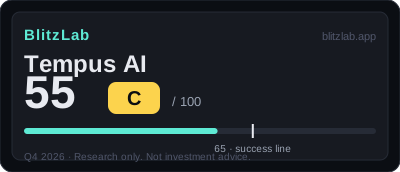
Tempus AI — Blitz Index 55 (C)
A+B+C = 69 clears the 65 line on its own — then D −14 drags it to 55. Organic diagnostics +31.2%, gross margin up 22.1pp in four years.
Last re-scored: October 17, 2026.
Confidence: High · Category: platforms
Score breakdown
| Section | Score | Detail |
|---|---|---|
| A · Speed | 18 / 25 | FY2025 +83.4% headline, but 62.7% of the increase is Ambry — organic diagnostics still +31.2% |
| B · Moat | 39 / 60 | Data flywheel: 8.6M de-identified records; 19 of the top 20 pharma as customers; $1.1B+ remaining TCV |
| C · Creative destruction | 12 / 15 | Intelligent Diagnostics replacing single-analyte tests; just-in-time trial network built on real-time data |
| D · BlitzFailing | −14 | Lefkofsky 57.9% vote + CEO-chair; related-party revenue surge; debt-to-equity 4.3x |
Think we scored it wrong? Score it yourself →
Radar axes (0–100): Moat 65 · Speed 72 · Creative 80.
Watch item
Gates: G1 ✓ · G2 ✓. 10 points below the threshold — first score. One point below the FLAG watch line: the data blitz faces its monetization test.
Strengths
- FY2026 revenue guidance $1.595–1.605B (~+25%) and adjusted EBITDA guidance ~+$65M
- Gross margin 40.6% to 62.7% in four years — the best margin trajectory measured
- 19 of the top 20 pharma as customers, $1.1B+ remaining TCV — data business demand visibility
- 87% physician 12-month retention on 55%+ oncologist penetration
Concerns
- Lefkofsky: 57.9% voting power + CEO-chair plus $35M mutual payment structure with co-founded Pathos
- Related-party revenue $4.5M to $65.3M in one year — the biggest question mark on revenue quality
- Collection rates of 50–55% — half of tests start as receivables
- Trials revenue down three straight years; debt-to-equity 4.3x plus a $500M ATM overhang
Research notes
Q3 2026 update
Q3 2026 update (company release, Nov 2, 2026; quarter ended September 30, 2026): total revenue $411.5M (+23% YoY, vs $334.2M) — Diagnostics $303.5M (+20%), led by oncology volume growth of 32%, with hereditary revenue growth of 3%; Data & Applications $108.1M (+33%), Insights +29%; MRD volume ~12,000 tests, up 300%. Gross profit $266.7M (+27%), gross margin 64.8% (vs 62.8%); GAAP loss from operations $(56.9)M (vs $(61.0)M); GAAP net loss $(14.9)M (vs $(80.0)M), GAAP diluted EPS $(0.08) (vs $(0.46)); non-GAAP net income $13.4M (vs $(19.6)M), non-GAAP EPS $0.07 (vs $(0.11)); Adjusted EBITDA $25.6M (6.2% margin, vs $1.5M). Cash and marketable securities $854.4M at quarter end. One-time/non-operating GAAP items (labelled, not operating performance): net loss included $50.8M of stock-based compensation expense and related employer payroll taxes and $42.8M in unrealized gains on marketable securities. Data licensing: October BMS collaboration licenses oncology data and models for up to $137.5M over five years, bringing total data licensing bookings to more than $550M year to date; multi-year Merck and Moderna collaboration on individualized neoantigen therapy; Personalis acquisition cleared regulatory review, shareholder meeting planned for November 30, 2026; two FDA 510(k) clearances (ECG-PH and ECG-MR). Guidance from the same release (forward-looking): FY2026 revenue $1.60–$1.605B (~+25% YoY), Adjusted EBITDA ~$65M. Score 55/C unchanged — this is a quarterly update note, not a rescore. Source: Tempus press release, https://investors.tempus.com/files/doc_financials/2026/q3/Tempus-Reports-Third-Quarter-2026_vF_11-2-26.pdf (also filed as 8-K Ex-99.1, Nov 2, 2026, https://www.sec.gov/Archives/edgar/data/1717115/000119312526442619/tem-ex99_1.htm)
Thesis: a data flywheel that works, inside a structure that charges for it
Tempus AI is a precision-medicine company built on a simple loop: run a diagnostic test, collect the de-identified clinical and molecular data that the test generates, use that data to make the next test more precise and the resulting dataset more valuable to drug developers, and then use the resulting demand to order more tests. The score file calls this a dual-engine structure — diagnostics as the engine of cash flow, data as the engine of margin — and the numbers at T (2026-10-17) support that description. Revenue grew from $188 million in fiscal 2020 to $1,271.8 million in fiscal 2025, a 6.8-fold increase over five years, or a compound annual growth rate of about 46%, on figures confirmed in SEC filings. Gross margin rose from 40.6% in 2022 to 62.7% in 2025. Adjusted EBITDA moved from negative $238.8 million in 2022 to a positive $8.0 million in the second quarter of 2026, with fiscal 2026 guidance of roughly positive $65 million.
That is the business case, and it is strong enough on its own to clear the BlitzLab threshold: the business score alone — speed plus moat plus creative destruction, before deductions — is 69, above the 65 line. The official score is 55, grade C, because deductions of 14 points pull it back down. Debt, revenue quality, and governance each cost 4 points, and regulatory exposure costs 2 more. The deductions total sits exactly one point below the 15-point threshold at which BlitzLab would flag the company for monitoring. Tempus is therefore best read as two stories in one document: a data flywheel that has been demonstrated in practice, and a corporate structure — concentrated voting control, acquisition-driven dilution, related-party revenue, and a payer-dependent collection model — that determines how much of the flywheel's value accrues to ordinary shareholders. The question the score poses is not whether the flywheel turns. It does. The question is who captures what it produces.
Tempus went public in June 2024, and this is its first BlitzLab scoring, with no blinded predecessor. The most recent results available at T are the second quarter of 2026, reported on July 30, 2026. Third-quarter 2026 results, expected in early November, fall after T and are excluded from this assessment; they appear below only as a future marker.
Speed: organic growth in the low thirties, hidden inside a headline of 83 percent
The headline growth figure is the first thing a reader meets, and the score file's first act of discipline is to take it apart. Fiscal 2025 revenue of $1,271.8 million was up 83.4% year over year, a figure confirmed in SEC filings. But $362.7 million of the $578.4 million increase — 62.7% of it — came from Ambry, the hereditary-testing business Tempus acquired, as disclosed separately in the 10-K. Under the model's acquisition-growth separation rule, that acquired contribution is excluded from the growth assessment. What remains is still substantial: Diagnostics grew 31.2% organically, from $451.7 million to $592.7 million, and Insights grew 38.0%. Growth continued into 2026, with first-quarter revenue up 36.1% and second-quarter revenue up 21.6%, both including Ambry, and fiscal 2026 revenue guidance of $1.595 billion to $1.605 billion, roughly 25% growth. Growth (A1) scores 8 of 10 — high, but with the 9 withheld precisely because two-thirds of the headline growth rate was acquired rather than organic.
Capital velocity (A2, 4 of 5) tells a similar story of unusual access paired with a continuing cost. Tempus raised $382.0 million net in its June 2024 initial public offering, then $725.7 million net from a $750 million 0.75% convertible note issue in July 2025, then $441.9 million net from a $460 million 0% convertible note issue in May 2026, the latter accompanied by capped-call transactions. In two years the company raised more than $1.55 billion in equity-type financing — access to capital at the top of the range. The other side of that access is an overhang: a $500 million at-the-market equity facility, and acquisition consideration paid in stock, including 4.84 million shares for Ambry and 1.26 million shares for Paige. The dilution is real and continuing, and it is charged under deductions rather than here.
Hiring and productivity (A3, 2 of 5) is the weakest speed item, and the reason is instructive about the model's evidentiary discipline. Total headcount is not disclosed in the 10-K; the figure of approximately 3,000 employees comes from AltIndex reporting and is unconfirmed. Revenue per employee of roughly $0.42 million per person therefore rests on an unconfirmed denominator and is labeled an estimate. With no demonstrated hiring velocity and no confirmed headcount, the model applies its anchor principle — an estimated item scores one band lower — and holds the item at 2. This is not a claim that Tempus hires slowly; it is a statement that the public record does not demonstrate hiring speed, and the score refuses to invent it.
Share-of-market velocity (A4, 4 of 5) is where speed becomes penetration. More than 55% of oncologists in the United States are connected to Tempus, a figure confirmed in the 10-K, with a 12-month physician retention rate of 87% among physicians ordering more than five tests. The company reports roughly 700 direct data connections, coverage of roughly 5,000 hospitals, and relationships with more than 65% of academic medical centers. A quantified market share is not disclosed, which is why the fifth point is withheld — but as a penetration indicator, the picture is strong: the distribution network is already built, and it retains its users.
Moat: the flywheel is demonstrated, and the data stays even when the customer leaves
Network effects (B1, 9 of 18) is the conceptual center of the Tempus case, and the score file treats it with unusual care. The flywheel is not asserted; it is traced through observable links. More tests generate more de-identified data; more data improves test precision and raises the value of the dataset to pharmaceutical customers; that value draws in more physicians and more pharmaceutical buyers; and those buyers order more tests. The data stock itself is disclosed and confirmed in the 10-K: more than 8.6 million de-identified patient records, 1.4 billion documents, and more than 450 petabytes in the cloud. Crucially, the structure contains a lock-in mechanism that survives churn: under the company's contracts, Tempus retains rights to de-identified data it has acquired even after a contract expires or is terminated. A customer can leave; the data does not leave with them. The score places this in the 5–9 anchor band for data and ecosystem effects — the top of that band — noting that the effect is two-sided, physicians on one side and pharmaceutical companies on the other, and that it connects to revenue, with Insights at $257.7 million and up 38%. Entry into the 10-point band is withheld under the model's conservative principle. The flywheel is real, but the score demands more before calling it a top-tier network effect.
Distribution scalability (B2, 12 of 18) is the strongest moat item, and its strength lies partly in a negative that is rare enough to be noteworthy. Nineteen of the twenty largest listed pharmaceutical companies by 2024 revenue do business with Tempus, a figure confirmed in SEC filings. Remaining total contract value exceeds $1.1 billion, including roughly $300 million of opt-in value. Specific commitments anchor the pipeline: GSK has committed to at least $180 million of spending through about 2027, AstraZeneca has a $35 million joint development arrangement, and a Recursion data license extended in September 2026 carries three years of fixed fees of $42 million. And the 10-K states, confirmed in its notes, that no single customer accounted for a significant portion of revenue in 2023, 2024, or 2025. For a company of this size selling to concentrated pharmaceutical buyers, the absence of customer concentration is an exceptional strength. Distribution is high-cost direct selling rather than viral, but it is repeatable and it expands, and combined with 55%-plus physician penetration it earns a place in the 10–14 anchor band.
Market size (B3, 10 of 12) passes the gate test with room to spare. The gate requires a ten-year market ceiling at least ten times current revenue, a bar of about $12.7 billion against fiscal 2025 revenue of $1,271.8 million — or about $16 billion against 2026 guidance of $1.6 billion. The company's diagnostic testing addressable market estimate, from its S-1, exceeds $70 billion across oncology and neuropsychiatry, about 5.5 times the bar, with the data business — clinical trials at $50 billion, biomarkers at $51 billion, and real-world evidence at $18 billion — as a separate option. The two points withheld reflect a labeling discipline the score file repeats throughout: the addressable market is a company estimate, and the 10-K's own risk section warns that such estimates may be wrong. The full 12 points await a market estimate confirmed on an evidentiary basis rather than a company estimate.
Gross margin (B4, 8 of 12) records one of the best margin trajectories among the companies measured. Gross margin moved from 40.6% in 2022 to 53.8%, then 55.0%, then 62.7% in 2025, all confirmed in SEC filings. The mix explains the level: the Data and applications business earns a 72.2% gross margin, on $316.4 million of revenue less $87.8 million of cost, while Diagnostics earns 59.6%. The one-step reduction, by the same logic applied to another loss-making company in the model's history, reflects that the operating loss is still $75.9 million in the second quarter of 2026. Margin expansion is demonstrated; self-sustaining profitability is not yet.
Creative destruction: replacing the single-analyte test and the trial that could not be run before
Creative destruction scores 12 of 15, the highest of the three axes in percentage terms — 80 on the 100-point radar conversion, against 72 for speed and 65 for moat. The disruption thesis (C1, 4 of 5) is that Intelligent Diagnostics — next-generation sequencing combined with clinical data and generative AI — replaces the single-analyte test as the unit of diagnosis. The Trials product extends the same logic to clinical research: a just-in-time trial network built on real-time data, which the 10-K describes, in its own words, as an attempt that was effectively impossible before Tempus. The targets being displaced are named and large: Guardant, Caris, and Myriad in testing, IQVIA and Flatiron in data and trial infrastructure. The fifth point is withheld because the displacement is of a workflow rather than of an entire order, as in the model's most complete disruption cases. Tempus changes how oncology diagnosis and trial recruitment are done; it does not yet replace the order itself.
Irreversible behavioral change (C2, 4 of 5) follows from the same loop that powers the moat, now read as a habit. The prescription-to-data loop runs from test order to data pipeline to pharmaceutical purchase to improved precision, and the data-rights clause means the loop's product survives any single customer's departure. The quantitative markers are the 87% twelve-month physician retention rate, the 19-of-20 pharmaceutical relationships, and remaining total contract value above $1.1 billion. This is not a society-wide behavioral shift of the smartphone kind, and the score does not pretend otherwise; within the oncology clinical workflow, however, the structure is difficult to reverse, and that is what the 4 records.
Cost-structure change (C3, 4 of 5) is measured rather than asserted. The 22.1-percentage-point gross margin improvement over four years, from 40.6% to 62.7%, is the observable trace of fixed-cost leverage. Adjusted EBITDA moved from negative $238.8 million in 2022 to negative $7.4 million in 2025 and toward guidance of roughly positive $65 million — a 97% reduction in losses across a period in which revenue roughly quadrupled, all confirmed in SEC filings. The fifth point is withheld because a dollar-denominated unit-cost collapse, cost per test, is not disclosed. The leverage is visible in the aggregate; it is not yet proven per unit.
Deductions and risks: the price of the structure
Debt (D1, negative 4 of 10) begins with a stark ratio. Total debt of $1,921.0 million at June 30, 2026, confirmed in SEC filings, stands against equity of $444.9 million — a debt-to-equity ratio of about 4.3 times — alongside an accumulated deficit of negative $2,395.9 million. The composition softens the picture somewhat: $750 million of 0.75% notes due 2030 and $460 million of 0% notes due 2032, both accompanied by capped calls and therefore equity-like, plus a $187.9 million Google convertible promissory note. The high-interest bank borrowing is gone: the Ares term loan of more than $206 million and the $100 million revolver were repaid in full in the first half of 2026, leaving a zero balance at June 30 — a genuine qualitative improvement in the capital structure. Cash of $599.6 million plus marketable securities of $150.2 million provide a buffer. The deduction is lighter than for companies carrying heavier debt loads, but 4.3 times equity plus the $500 million at-the-market overhang keeps it at negative 4.
Revenue quality (D2, negative 4 of 10) collects five separate concerns, and together they form the most consequential risk section in the file. First, stock-based compensation was $124.7 million in fiscal 2025, or 9.8% of revenue, and $106.8 million in the first half of 2026 — a core add-back in adjusted EBITDA, though the fiscal 2024 figure of $534.1 million was a one-time effect of restricted stock units vesting at the IPO. Second, collection rates are low: for the 2023–2024 cohorts, oncology next-generation sequencing tests collected at 55% and hereditary tests at 50%, meaning roughly half of tests begin as uncollected receivables. Third, the Trials product has declined for three consecutive years, from $45.6 million to $42.4 million to $38.5 million — the only declining product group in the data business. Fourth, related-party revenue jumped from $4.5 million in 2024 to $65.3 million in 2025, a 14.5-fold increase in one year, including AstraZeneca business routed through Pathos, a company co-founded by Tempus's founder; this connects directly to the governance deduction below. Fifth, the second quarter's first GAAP profit, positive $5.6 million, depended on $60.7 million of unrealized gains on marketable securities, while the operating loss was negative $75.9 million — a profit that is not self-generated from operations. There are no restatements, auditor changes, or audit-opinion issues, and the auditor is EY; the concerns are about the quality of the earnings, not their integrity.
Governance (D3, negative 4 of 5) is the heaviest single governance charge in the model's recent history, and the facts behind it are unusually clean-cut. Class B shares carry 30 votes each, and all 5,043,789 Class B shares are held by founder Eric Lefkofsky, confirmed in the DEF 14A filed April 7, 2026. Combined with 37.26 million Class A shares, or 21.4%, that delivers 57.9% of the voting power — absolute control. Lefkofsky is simultaneously chief executive officer, founder, and board chair. The related-party cluster completes the picture: a $35 million reciprocal payment structure with Pathos AI, which Lefkofsky co-founded, in connection with the AstraZeneca business, plus a provision for payment in Pathos preferred shares. The model applies the same logic it applied to another founder-controlled company at a similar voting level, with the related-party cluster as the aggravating factor. Blitzscaling theory celebrates founder speed; it does not celebrate the removal of checks on the direction of that speed, and the 14.5-fold jump in related-party revenue in a single year is the first warning light produced by this structure.
Regulatory and social cost (D4, negative 2 of 5) is structural rather than event-driven. Most revenue depends on third-party payer reimbursement, so a reduction in reimbursement rates or coverage would strike directly. The company is regulated as a medical-device maker by the FDA for products including Arterys and Paige, faces changing regulation of laboratory-developed tests and algorithm-based diagnostics, and operates as a HIPAA covered entity — meaning its de-identified-data commercialization, the premise of the data business, depends on a privacy regime that could tighten. Violations of the Stark, anti-kickback, and False Claims Act regimes could lead to exclusion from Medicare and Medicaid. Against that exposure stands a clean disclosed record: no securities class action or penalty was disclosed within the confirmed scope. The deduction is therefore 2, not more — exposure without an event.
Two further facts from the score file belong in any honest account of the risks, even though they are not scored items. Operating cash flow was still negative $80.8 million in the first half of 2026, and free cash flow was negative $245 million in fiscal 2025: profit on the income statement and cash generation are different problems, and Tempus has not yet solved the second. And insider sales of 1.28 million shares for $80.4 million over three months, on a press-reported basis, are recorded in the file's concerns. Neither fact changes the score; both belong in the reader's judgment.
What to watch: the monetization test, and the governance tripwire
The score file's own framing is that Tempus is in the late first act of blitzscaling — the transition from proving that something sells to proving that something keeps. Revenue guidance of $1.595 billion to $1.605 billion for fiscal 2026, with adjusted EBITDA guidance of roughly positive $65 million, sets the test for the year: whether the guided profitability materializes, and whether it arrives as operating profit rather than as valuation gains on securities. The related-party revenue line is the second test: whether the $65.3 million of 2025 grows, stabilizes, or retreats, and whether the Pathos-linked AstraZeneca structure produces further reciprocal flows. The third test is Trials, the only declining product group: whether three years of decline reverse, or whether the data business's growth concentrates further in the parts that are already working.
The governance tripwire is arithmetic, and the file states it plainly. Deductions of 14 sit one point below the 15-point monitoring threshold. Any single deduction item worsening — a further deterioration in revenue quality, an increase in leverage, a new governance event — would move Tempus into the monitored category. The pending Personalis acquisition, valued at $1.5 billion in all-stock consideration and unclosed at T, is the most visible candidate for such a move: closing would add further dilution on top of the Ambry and Paige share issuance and the at-the-market facility. Its closing, like the third-quarter 2026 results expected in early November, is a future marker only; no outcome is anticipated here.
The final picture is the one the score file's key drivers state most compactly. Strip out the acquisition, and organic growth in the low-to-high thirties with a margin trajectory among the best measured is a genuine blitzscaling business. Add back the structure — 57.9% voting control in one person's hands, a 14.5-fold jump in related-party revenue, collection rates near 50%, debt at 4.3 times equity — and the business score of 69 becomes an official score of 55. Tempus is a company whose flywheel has been demonstrated and whose monetization is now being tested, under a governance structure that leaves the test's direction in very few hands. That tension, more than any single number, is what the next quarters will resolve.
More Platforms companies
Other Platforms names on the Blitz Index, highest score first: Alphabet (83/A), Meta (78/B), Airbnb (76/B).
Next earnings
Q4 2026 · Expected
Coverage
Tempus AI, Inc. · Q3 2026 reported Nov 2, 2026 (BMO) · Score 55 · Grade C
Embed this score
Copy the HTML below to show this score on your site. The badge links back to this page and updates automatically when the score changes.
Preview:
BlitzLab scores businesses against a scholar’s standard — not investment advice. No price targets, no buy/sell recommendations. Figures are from SEC filings (XBRL) as labeled in the source scorecard.