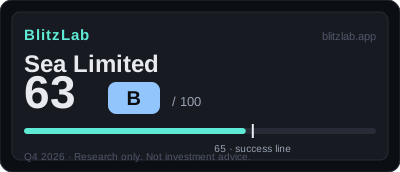
Sea Limited — Blitz Index 63 (B)
Shrinking Garena dependence while Shopee defends against TikTok Shop.
Last re-scored: October 18, 2026.
Confidence: High · Category: platforms
Score breakdown
| Section | Score | Detail |
|---|---|---|
| A · Speed | 16 / 25 | FY2025 revenue $22.94B (+36.4%); Q2 2026 +48.1% — accelerating at $20B+ scale; Shopee GMV +28.4%, take rate 11.4%→12.8% |
| B · Moat | 42 / 60 | Shopee ~53% SE-Asia GMV share (6 markets #1); Monee $11.1B loan book at 1.0% NPL — the embedded-credit flywheel |
| C · Creative destruction | 11 / 15 | Mobile-commerce standard in Southeast Asia; the disruptor now being disrupted by TikTok Shop (Thailand reversal) |
| D · BlitzFailing | −6 | Forrest Li 57.6% voting control (Class B 15:1); India Free Fire ban precedent — geopolitical exposure |
Think we scored it wrong? Score it yourself →
Radar axes (0–100): Moat 70 · Speed 64 · Creative 73.3.
Watch item
Gates: G1 ✓ · G2 ✓ (borderline — 3-segment TAM required). 2 points below the line — MELI's past, SE's present.
Strengths
- Q2 2026 revenue +48.1% — highest in 4 years at $20B+ scale (SEC)
- take rate 11.4%→12.8% — volume and price rising together
- Shopee + Monee adjusted EBITDA turned positive — the profitability blitz, proven
- Monee loan book $11.1B (+62.5%) at 1.0% NPL — credit quality holding
Concerns
- TikTok Shop counterattack — Thailand reversal, 2× growth across SE Asia
- Single-segment e-commerce TAM falls short of the G2 bar — the 3-segment sum is the premise
- Forrest Li 57.6% voting control on minority economics
- $18.96B debt + expanding loan book — cyclical vulnerability
Research notes
1. Current Position
Sea Limited is, in the terms of this scoring model, a company caught between two descriptions at once. Its revenue scale looks mature, while its growth rate still looks like that of a company in an earlier phase. The score file classifies Sea as moving from growth toward mature, citing fiscal 2025 revenue of $22.94 billion and a market capitalisation of roughly $57–58 billion, alongside a founding year of 2009 and an initial public offering in 2017. That tension — a mature-sized business still expanding at a growth-stage pace — runs through almost every part of the assessment that follows, and it helps explain both the strength of the score and the reason it stops short of the threshold that matters most in this model.
The headline result is a Blitz Index of 63 out of 100, grade B, on the BlitzLab v1.0 model frozen on 2026-10-10. The arithmetic is straightforward and worth stating plainly, because the whole body that follows is an unpacking of these four numbers. Speed contributes 16 points out of a possible 25. Moat contributes 42 out of 60. Creative destruction contributes 11 out of 15. Deductions subtract 6 points. Sixteen plus forty-two plus eleven minus six equals sixty-three. Converted to the three-axis radar used by the model, moat stands at 70.0 out of 100, speed at 64.0, and creative destruction at 73.3. No FLAG is attached to this score, because the deduction total of 6 sits well below the FLAG threshold of 15. The practical consequence is narrow but important: at 63, Sea falls two points short of the 65-point line that separates the grades in this system, and the score file records the outcome as a miss rather than a pass on that threshold, despite an otherwise passing set of gates.
Both gates were passed, though the second only narrowly. Gate G1 asks whether growth is continuing or a second growth curve is demonstrable, and the file records a confirmed pass. Annual revenue rose from $13.06 billion in fiscal 2023 to $16.82 billion in fiscal 2024, an increase of 28.7 percent, and then to $22.94 billion in fiscal 2025, an increase of 36.4 percent, all confirmed in the company's annual filing on Form 20-F. The quarterly sequence then accelerated further rather than fading: revenue grew 46.6 percent in the first quarter of 2026 and 48.1 percent in the second quarter of 2026, both confirmed in quarterly filings. The score file treats this as acceleration at a scale above $20 billion, not merely growth at a small base, and that distinction matters for how the rest of the score should be read.
Gate G2 asks whether the ten-year ceiling of the new market is at least ten times current revenue, and here the file records a borderline pass, explicitly labelled as estimated. Estimated fiscal 2026 revenue of roughly $31–32 billion, built from first-half actual revenue of $14.89 billion plus consensus estimates, implies a bar of roughly $310–320 billion. The file's case for clearing that bar rests on adding three segments together: Southeast Asian e-commerce, estimated at roughly $230 billion for 2026 on a McKinsey figure cited on a press-reported basis, with a growth trajectory toward hundreds of billions of dollars by 2036; Latin American e-commerce, where Shopee's Brazilian business is lifting the region's share of revenue; Southeast Asian digital lending, where Monee's loan balance is still at an early stage relative to an underbanked market; and global mobile gaming through Garena, anchored by Free Fire's daily active user count above 100 million. The file is candid about the fragility of this construction. Southeast Asian e-commerce alone, at roughly $230 billion, falls short of a bar of roughly $315 billion. The pass therefore depends on the three-segment combination, on continued share gains, and on expansion in Brazil and in global gaming. The comparison the file draws is with MercadoLibre, whose pass rested on a similarly combined commerce, payments, credit, and advertising market, but Sea's version is recorded as carrying more assumptions and thinner coverage above the bar, and therefore as a borderline pass rather than a comfortable one.
One further piece of framing belongs at the outset. Sea files as a foreign private issuer on Form 20-F, with a December fiscal year end, and the score file's confidence rating is high, resting on direct review of the 20-F and 6-K texts on SEC EDGAR together with inline XBRL data. The segment formerly called SeaMoney is now presented as Monee, a naming change the file dates to a 6-K filing from 2025-11-12. The latest confirmed financial statements as of the scoring date are the second-quarter 2026 results in a 6-K exhibit filed on 2026-08-11, covering the quarter ended 2026-06-30. Third-quarter 2026 results had not been released as of T, and nothing from that quarter appears in this draft. Aggregate sites expected those results on 2026-11-10, before market open, but the score file notes that no official company notice of that date had been given.
2. Moat
The moat section is the largest part of the score, contributing 42 of the 60 available points, and it is also the section where Sea's structure is most distinctive. Sea is not a single business with a single network effect. It is three businesses whose interactions are supposed to reinforce one another: Shopee, an e-commerce marketplace; Monee, a financial services arm built inside that marketplace's ecosystem; and Garena, a games business whose social dimension feeds traffic and attention into the wider group. The score file's judgment is that this three-part structure is real but not yet as deep as the closest comparator in the model, and the individual item scores trace that judgment precisely.
Network effects, item B1, score 13 out of 18. The core evidence is the multi-sided character of the group. Shopee brings together sellers, buyers, and an advertising auction. Garena adds a games-based social layer. Monee adds a credit-data loop embedded inside the Shopee ecosystem, where transaction and behavioural data from commerce can inform lending, and lending in turn can support further commerce. The quantitative signature the file highlights is the gap between two growth rates: core marketplace revenue of $4.3 billion, up 65.6 percent year on year, against gross merchandise volume growth of 28.4 percent. When the revenue a marketplace earns from its core activity grows more than twice as fast as the volume passing through it, something structural is happening to monetisation, and the file attributes that gap to the advertising auction's leverage on the take rate. The discount from a higher score comes from the level of that take rate itself. At 12.8 percent, Shopee's take rate is roughly half of MercadoLibre's 25.7 percent, and the file treats that as evidence that the current depth of the moat is thinner, even though the remaining headroom is itself a source of future movement. One point below MercadoLibre's 14 on this item is the file's way of encoding that comparison.
Distribution scalability, item B2, scores 11 out of 18. The positive case is geographic and segmental expansion in progress: Latin America, where the revenue share has risen from 16.8 percent to 24.1 percent, and Monee's move beyond Shopee itself. Distribution here is not only a matter of reaching new countries; it is also a matter of extending a financial product from inside one platform to customers outside it. The offsetting cost is the expense of defending that distribution through logistics. The file points to value-added services revenue falling 9.0 percent and to a rising shipping-subsidy net-off, describing the internalisation of logistics as a defensive cost that eats into the quality of distribution even as its reach grows. The score sits one point below the 12 awarded to both MercadoLibre and Datadog on this item, a placement that reflects expansion that is genuinely under way but already expensive to sustain.
Market size, item B3, scores 9 out of 12, and it inherits the same borderline character as the G2 gate. The reasoning is the same three-segment combination, and the same caveat applies: no single segment clears the bar on its own. The file places Sea in the same band as MercadoLibre at 8, Coinbase at 9, and Zscaler at 9, and it is explicit about what would be needed for a full score — resolution of the competitive pressure from TikTok Shop and demonstrated share in Latin America. Until those conditions are met, the market-size score remains a statement about potential breadth rather than demonstrated dominance of a single large market.
Gross margin, item B4, scores 9 out of 12. The gross margin itself expanded from 42.9 percent in fiscal 2024 to 44.7 percent in fiscal 2025, and the file traces the source of that profitability to Garena, whose adjusted EBITDA relative to bookings sits in a range of roughly 56 to 62 percent. The longer arc is striking: group adjusted EBITDA moved from negative $878.1 million in fiscal 2022 to positive $3,437.1 million in fiscal 2025, which the file reads as the margin proof of the restructuring period. The discount reflects the same logistics pressure seen in B2 — expanding shipping subsidies at Shopee pressing down on margin from below, even as the group-level margin rises. The moat as a whole, then, is a story of a structure that works and is widening, but whose most profitable engine is still games, whose most scalable engine is still subsidised, and whose monetisation rate still has a long way to run before it matches the deepest marketplace comparators.
3. Speed
Speed contributes 16 out of 25, and its internal pattern is uneven in a revealing way. One item is close to the maximum, one is middling, one is strong, and one is zero. That shape tells a story about a company that is growing very fast in its markets while no longer behaving like a company in the earliest, most capital-hungry phase of blitzscaling.
Growth, item A1, scores 9 out of 10. The fiscal-year revenue sequence already described — $13.06 billion, $16.82 billion, $22.94 billion — is the foundation, and the quarterly acceleration to 48.1 percent in the second quarter of 2026 is what lifts the item close to the top of its range. Two further details complete the picture. Shopee's gross merchandise volume reached $38.3 billion, up 28.4 percent, while the take rate rose from 11.4 percent to 12.8 percent on the file's own calculation, meaning volume and price per unit of volume rose together. Monee's loan balance reached $11.1 billion, up 62.5 percent year on year, and Garena's bookings rose 15.5 percent, which the file reads as a revival of the games business. The company's confirmed guidance adds a forward anchor that the file treats as part of the evidence: gross merchandise volume growth of roughly 25 percent, together with adjusted EBITDA at or above the absolute level of 2025. The single point withheld is also stated plainly. A full score would require demonstrated maintenance of growth above 50 percent, and Sea, at 48.1 percent in the most recent confirmed quarter, had not yet shown that.
Capital speed, item A2, scores 3 out of 5. The evidence here points in the opposite direction from the growth item. Sea is returning capital rather than raising it at scale: a $1 billion share repurchase programme, within which 4.7 million shares were repurchased for $416.8 million in the second quarter of 2026, a pace the file describes as accelerating, and convertible notes reduced from $1.48 billion to $1.05 billion through repayment and repurchase. No new mega-financing is recorded. The file's interpretation is that this is a capital-discipline phase, not a blitz-style expansion phase, and the middling score reflects that the financial machinery is being used to consolidate rather than to fund a new land grab.
Hiring and productivity, item A3, scores 0 out of 5, and this is the score that most sharply limits the speed total. Headcount rose from 62,700 in 2023 to 80,700 in 2024 and then to 102,700 in 2025, an increase of 64 percent over two years, while revenue per employee sits at roughly $223,000. The composition of that workforce explains the judgment: 77,600 employees sit in general operations, a category the file associates with logistics and operational intensity. The file draws the same line it drew for MercadoLibre, where revenue per employee of roughly $418,000 also produced a zero on this item, treating logistics-heavy structures as subject to a structural ceiling on this measure regardless of how fast revenue grows. The point is not that hiring is slow — it is very fast — but that the model rewards revenue per head, and a business built on operating its own logistics cannot clear that bar in the way a software business can.
Share velocity, item A4, scores 4 out of 5. Shopee's share of Southeast Asian platform gross merchandise volume is estimated at roughly 53 percent on a press-reported basis from Momentum Works, with first place in all six major markets in the region. The Latin American revenue share rising from 16.8 percent to 24.1 percent adds a second front to the same story. The discount is the warning light the file returns to repeatedly: in the second quarter of 2026, TikTok Shop overtook Shopee in Thailand for the first time on an estimated, press-reported basis, with 48 percent against Shopee's 45 percent, according to Cube Tradewinds estimates. A company can lead a region overall and still be losing the most contested market within it, and the file treats that single reversal as enough to keep the item below its maximum.
4. Creative Destruction
Creative destruction contributes 11 out of 15, and its three items describe a company that displaced an old order, changed behaviour in a lasting way, and altered cost structures, while now facing the possibility of being displaced in turn. That symmetry — the displacer becoming the displaced — is the intellectual centre of this section, and the score file refuses to let either half of it go.
The order being replaced, item C1, scores 4 out of 5. Shopee is presented as the largest beneficiary of the shift from offline to mobile commerce in Southeast Asia, built on a mobile-first approach and localised payments, while Monee extends the same logic to digital credit for underbanked customers, with a loan balance of $11.1 billion. The target being replaced is clear and large: traditional retail on one side, and traditional banking access on the other. The point withheld is the reversal already described. TikTok Shop is attacking Shopee with a social-commerce model, and the Thai reversal is treated as evidence that the displacer is itself under attack. A full score is therefore held back, not because the original displacement is in doubt, but because its durability is now contested.
Irreversible behaviour change, item C2, also scores 4 out of 5. The file's case rests on three habits that are difficult to unwind: Shopee as the standard for mobile commerce in Southeast Asia, SPayLater-style digital credit becoming part of everyday spending, and Free Fire's social gaming culture, with daily active users above 100 million. These are behaviours embedded in daily life rather than one-off transactions, and that embeddedness is what the item is designed to reward. The same reservation applies as in C1. A second migration, toward social commerce, is already under way, which means the behaviours Sea established are durable but not immune to being superseded by a newer set of habits built on content and commerce combined.
Cost-structure change, item C3, scores 3 out of 5. The mechanism here is the advertising auction's effect on the take rate, rising from 11.4 percent to 12.8 percent, which changes how sellers acquire customers: a larger share of the value of a transaction is captured through the platform's auction rather than through sellers' own marketing. The internalisation of logistics is also cited as lowering unit costs. The reason the score stops at 3 is evidential rather than conceptual. The file notes that measured figures for a collapse in per-unit cost have not been disclosed, so the item is scored on the demonstrated take-rate mechanism and on analysis, rather than on a fully measured cost collapse. The section as a whole therefore describes genuine creative destruction whose second act — whether Sea can defend the order it created — is unresolved.
5. Deductions & Risks
Deductions total only 6 points, which is why no FLAG attaches to this score, but the composition of those 6 points matters more than their size. Three of the four deduction items carry a charge, and each points at a different kind of risk: balance-sheet and credit exposure, revenue quality and regulatory precedent, and governance concentration.
Debt, item D1, is charged 2 points out of a possible 10. Total debt stood at $18.96 billion at the end of June 2026, a large absolute figure that the file nevertheless describes as manageable against assets of $29.4 billion. The balance-sheet position behind that judgment is a net-cash stance: cash of $3.53 billion plus short-term investments of $5.57 billion, with convertible notes of $1.05 billion being repaid. The risk that justifies the deduction sits inside the lending book rather than in the headline debt figure. Loan-loss provisions reached $1.4 billion, up 76.7 percent year on year, as the loan balance expanded rapidly. Against that growth, the file records a non-performing loan ratio of 1.0 percent for loans more than 90 days past due, flat on the disclosed basis, and it judges credit quality as sound when measured against the same yardstick applied to Nubank, where a delinquency rate of 6.9 percent produced a 3-point deduction on a different item. The deduction is therefore a volatility charge — a recognition that a fast-growing loan book can change character quickly in a downturn — rather than a statement that the book is currently impaired.
Revenue quality, item D2, is charged 1 point out of a possible 10. Two facts pull in opposite directions here, and the file keeps them separate. On the positive side, Shopee's marketplace fees are recognised on a net basis, as stated in Note 2(q)(ii) of the 20-F, which the file contrasts with the gross recognition used by another company in the model and treats as the cleaner presentation. On the negative side, two securities class actions from 2024 were settled, a one-time matter reflected in general and administrative expenses and recorded as resolved. The single point of deduction reflects the remaining regulatory precedent rather than any current dispute: the ban on Free Fire in India in 2022 stands as evidence that geopolitical regulatory risk is not hypothetical for this company, even though no current case is recorded.
Governance, item D3, is charged 3 points out of a possible 5, and this is the largest single deduction. Founder Forrest Li holds all of the Class B shares, carrying 57.6 percent of the voting power as of 2026-03-31, with each Class B share carrying 15 votes. The file places this on the same quantitative anchor line as Roblox, where 58.8 percent voting control produced the same 3-point deduction, treating the gap between economic ownership and voting control as the issue rather than any specific action by the holder. Two further structural facts complete the picture: Tencent's 17.0 percent stake carries no voting power, having been irrevocably delegated to the board in September 2022, and the company is incorporated in the Cayman Islands with limits on ADS voting rights. These are structural features of the company's governance, not allegations of misconduct, but the model charges for concentration of control as such.
Regulatory and social cost, item D4, is charged 0 points. The file records no current securities litigation, infringement matter, or fine on the basis of the disclosure history, and it notes institutional holdings of 6.7 percent by Baillie Gifford and 5.5 percent by WCM. The zero here is a no-trigger finding, not a claim that regulatory risk has disappeared; the India precedent in D2 is where that risk is carried. Taken together, the deductions describe a company whose risks are concentrated in governance structure and in the inherent volatility of a growing credit book, rather than in current legal exposure or in a balance sheet under strain.
6. What to Watch
The score file's own framing of the next phase is unusually specific, and this section follows it rather than adding forecasts of its own. The central question is whether Sea can close a two-point gap to the 65-point line, and the file identifies two variables as decisive for that outcome: the trajectory of TikTok Shop's share, and the defence of the take rate at its current level of 12.8 percent. Those are not generic watch items. The Thai reversal in the second quarter of 2026 is recorded as the first crack in Shopee's regional position, and the file names TikTok Shop's share trend as the trigger for re-examining the G2 gate at the next quarterly rescore. If the social-commerce challenger continues to gain ground in Southeast Asia, the three-segment construction on which the borderline G2 pass rests becomes harder to sustain, because the largest of its three legs is the one under attack. If Shopee holds its share and its take rate, the same construction holds, and the two-point gap is closable through the items where headroom is most visible — a take rate still far below the deepest marketplace comparator, a Latin American business still rising as a share of revenue, and a games business whose profit contribution has already fallen from 78 percent toward a more diversified mix.
The file also records a broader strategic reading that frames what to watch beyond the next quarter. It classifies Sea's blitzscaling fit as a distribution blitz, in the same family as MercadoLibre but with a third engine in games that MercadoLibre does not have. The sequence it describes runs in three acts: high growth from 2017 to 2021, restructuring from 2022 to 2023, and re-acceleration from 2024 onward. The restructuring is not treated as a retreat from blitzscaling but as the mechanism that made the current phase possible — large-scale cost reduction and marketing cuts that turned Shopee and Monee from loss-making to profitable, followed by renewed investment described in the second quarter of 2026 as deepening Shopee's competitive moat, which coincided with a rebound in Shopee's adjusted EBITDA. The file calls the current phase a profitability blitz: growth funded by profits rather than by losses. That framing makes the watch items cohere. A profitability blitz can only continue while the profitable engines keep generating the resources for the next round of investment, which is why the take rate, the credit book's quality, and the defence of the core marketplace all appear as linked variables rather than separate ones.
The remaining watch items follow from the deductions. The loan book's expansion, with provisions up 76.7 percent year on year against a flat non-performing ratio of 1.0 percent, is the number to follow for any change in credit character. The governance structure — 57.6 percent voting control in a single holder's hands — is a standing feature rather than a developing event, but any change in it would alter the D3 assessment. The India precedent means regulatory developments in any major market carry weight beyond their immediate financial effect, because they speak to the durability of the games engine's contribution. And the calendar item is fixed: third-quarter 2026 results, which were not released as of the scoring date of 2026-10-18, were expected by aggregate sites on 2026-11-10 before market open, with no official company notice recorded in the score file. That release, when it arrives, is the next confirmed data point against which every figure in this draft will be re-tested.
A final piece of context belongs outside the score itself, and the file is explicit that it does not enter the calculation. As of 2026-10-16, Sea's market capitalisation was roughly $57–58 billion, with a price-to-earnings ratio of roughly 35, a 52-week range of $77.05 to $171.09, and a year-to-date movement of negative 26.5 percent, all on a press-reported basis. The score file notes that the business score does not look at price, citing the lesson of the ARK test, and this draft follows the same rule: those market figures are recorded here as context only, and none of the item scores above depends on them. What the score does say, on its own terms, is that Sea is a company that has already proved the hardest part of its story — turning three loss-making or concentrated engines into a diversified, profitable group growing at 48 percent — and now faces the more ordinary but no less demanding test of defending the position it created, two points short of the line that would mark it as having cleared the model's bar.
More Platforms companies
Other Platforms names on the Blitz Index, highest score first: Alphabet (83/A), Meta (78/B), Airbnb (76/B).
Next earnings
Nov 10, 2026 · Before open · Confirmed
Coverage
Sea Limited · Q3 2026 due Nov 10, 2026 (BMO, expected) · Score 63 · Grade B
Embed this score
Copy the HTML below to show this score on your site. The badge links back to this page and updates automatically when the score changes.
Preview:
BlitzLab scores businesses against a scholar’s standard — not investment advice. No price targets, no buy/sell recommendations. Figures are from SEC filings (XBRL) as labeled in the source scorecard.