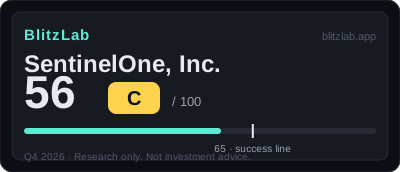
SentinelOne, Inc. — Blitz Index 56 (C)
SentinelOne scores 56 — the business turned a corner (emerging solutions are ~50% of ARR), but 9 of the points between it and the 65 line are demerits, not quality.
Last re-scored: October 21, 2026.
Confidence: Medium · Category: platforms
Score breakdown
| Section | Score | Detail |
|---|---|---|
| A · Speed | 16 / 25 | Revenue +47% → +32.2% → +21.9%, three straight years of deceleration; ARR +22% outruns revenue but NRR disclosure stopped at 110% |
| B · Moat | 36 / 60 | Emerging solutions (cloud · data · AI) hit ~50% of ARR in Q1 FY2027 — a platform turn, unverified by product-level disclosure (B1 · B2 capped at 8 · 9) |
| C · Creative destruction | 10 / 15 | From endpoint product to platform company — the displacement is real; the quality of expansion is not yet provable |
| D · BlitzFailing | −6 | SBC at 29.7% of revenue — worst in the security cluster (−4) — plus 20x dual-class shares with ~28% voting control (−2, sunsets 2028-06-29) |
Think we scored it wrong? Score it yourself →
Radar axes (0–100): Moat 60.0 · Speed 64 · Creative 66.7.
Watch item
Gates: G1 ✓ (ARR +22%) · G2 ✓ (borderline — bar ≈ $10.01B (FY2026 revenue × 10) vs Gartner global security spend $244B; CRWD holds half the bar — the real contest).
Strengths
- Revenue $1,001.3M ($1B crossed) · ARR $1,218M (+22%) — ARR outruns revenue (SEC)
- Emerging solutions (cloud · data · AI) ~50% of ARR (Q1 FY27) — numerical evidence of the platform turn (CEO statement)
- Non-GAAP operating margin −3% → +3% → +10% (Q2 FY27) · FCF margin +5% (first annual positive) — efficiency turnaround at speed (SEC)
- 0.00% converts $1,437.5M (2031 maturity) + pro forma cash + investments ≈ $2.2B — a capital structure with no interest burden (SEC)
- GAAP operating loss rate −60.9% → −32.1% improving (ITA tax charge $180.9M is one-off)
- International revenue 37% → 39% — room to expand
Concerns
- Three straight years of deceleration (47% → 32.2% → 21.9%) + FY2027 guide ≈ +20% — the next speed is in the judgment zone
- NRR disclosure stopped (132% → 110% → stopped) — retention unverifiable (strongly recorded as concern; D2 no-trigger)
- The 4.7x ARR gap to CRWD has stalled for a year — share recapture speed is the practical G2 question
- SBC/revenue 29.7% (FY2026) · weighted shares 330.1M (diluting ~5–7% a year) — dilution runs alongside growth
- Converts can dilute up to ~46.1M shares (≈ 14%) at conversion ($31.21)
- Quarterly GAAP GM fell to 72% (from 75%) + AI inference cost pressure on GM (company risk item)
Research notes
Thesis: a challenger whose second act is already half the business, but whose proof is getting thinner as the growth rate cools
SentinelOne, Inc., listed on the New York Stock Exchange under the ticker S, scores 56 out of 100 under the BlitzLab v1.0 model, grade C, made up of Speed 16 out of 25, Moat 36 out of 60, Creative Destruction 10 out of 15, and deductions of 6 points. The score is nine points below the 65-point threshold, and no FLAG applies, because total deductions of 6 fall below the 15-point FLAG trigger. This is a first scoring, with no blind assessment behind it, and it is scored as of 20 October 2026, on the basis of second-quarter fiscal 2027 results released on 27 August 2026. Third-quarter fiscal 2027 results, estimated for 3 December 2026, fall after the as-of date and are excluded from the score; they appear in this draft only as a future marker, not as an anticipated outcome. The confidence level recorded in the score file is medium, for three stated reasons: the net revenue retention figure has been discontinued as a published number from fiscal 2026, the company discloses no quantified total addressable market, and there was no official company notice of the next earnings date as of the scoring date. The underlying filings — the 10-K, 10-Q, 8-K releases, and DEF 14A proxy statement — were reviewed directly from SEC EDGAR, so the financial and customer figures in this draft are confirmed on that basis, while the labelled estimates and press-reported figures are identified as such wherever they appear. SentinelOne is classified as mature, on trailing-twelve-month revenue of approximately 1,099 million dollars, calculated in the score file as fiscal 2026 revenue of 1,001.3 million dollars, less first-half fiscal 2026 revenue of 471.2 million dollars, plus first-half fiscal 2027 revenue of 568.7 million dollars. Its fiscal year ends in January: fiscal 2026 ran from 1 February 2025 to 31 January 2026, and fiscal 2027 runs from 1 February 2026 to 31 January 2027.
The thesis of this draft can be stated in one sentence, and everything that follows is an attempt to test it against the filings. SentinelOne is a cybersecurity challenger that has already made the transition its score depends on — from a single endpoint product to a platform in which emerging solutions in cloud, data, and artificial intelligence account for about half of annual recurring revenue — but it is making that transition while its headline growth rate cools, its most important retention metric stops being published, and its largest competitor refuses to shrink in relative terms. That combination is what the score of 56 describes: a business score before deductions of 62 points, which would still fall short of 65 on operations alone, reduced by a further 6 points for dilution and governance. A reader who looks only at the platform story, or only at the growth deceleration, will therefore misunderstand the score in opposite directions. The platform story is real, and it is quantified; the deceleration is also real, and it is quantified; and the gap between the two is where the judgement lives.
Two features of the score deserve attention before any of the detail, because they explain the shape of the whole assessment. The first is that the gate verdicts both pass, but they pass in different evidentiary registers, and the difference matters. Gate G1, sustained growth or a second growth curve, passes on confirmed figures: revenue, annual recurring revenue, and large-customer counts growing together, plus a second curve in emerging solutions that is numerically visible. Gate G2, a ten-year ceiling in a new market at least ten times current revenue, passes on an estimate, and on a borderline one: the bar is approximately 10.01 billion dollars, derived from fiscal 2026 revenue of 1,001.3 million dollars multiplied by ten, and the company itself discloses no quantified market size, so the pass rests on a third-party market estimate reported in the press, together with a structural argument about category expansion. The second feature is that six of the nine points separating SentinelOne from the threshold are deductions, not operating shortfalls. The business, on its own terms, scores 62; the capital and control structures cost it 6. That is the score file's own framing, and it is repeated here because it determines what would have to change for the grade to change: either the business must improve by a full grade boundary on its own, or the deductions must narrow, or some combination of the two must close a nine-point gap that is, arithmetically, mostly structural.
Speed: growth that is still above 20 percent, but decelerating for a third consecutive year
The speed section, 16 out of 25, converts to 64.0 on a 100-point scale. Its shape is a controlled deceleration rather than a collapse, and the score file treats that distinction as the central question of the section: whether a growth rate settling in the low 20 percent range is the natural normalisation of a business now operating above 1 billion dollars of annual revenue, or the first sign of a share contest that SentinelOne is not winning.
Growth, scored 7 out of 10, rests on a three-year sequence that is confirmed in the filings. Revenue rose from 621.2 million dollars in fiscal 2024, at a growth rate in the high 40 percent range, to 821.5 million dollars in fiscal 2025, up 32.2 percent, and then to 1,001.3 million dollars in fiscal 2026, up 21.9 percent — the first year above 1 billion dollars, but the third consecutive year of deceleration. The quarterly path tells the same story in finer grain: year-on-year growth eased from 39.7 percent in the first quarter of fiscal 2025 to 20.6 percent in the second quarter of fiscal 2027, settling in the low 20 percent range rather than falling through it. Annual recurring revenue, the recurring-revenue measure that matters most for a subscription business, grew slightly faster than revenue: from 724.4 million dollars to 920.1 million dollars, then to 1,119.1 million dollars in fiscal 2026, up 22 percent, and then to 1,218 million dollars at 31 July 2026, also up 22 percent. Customers with more than 100,000 dollars of annual recurring revenue numbered 1,133, then 1,411, then 1,667 in fiscal 2026, up 18 percent, and then 1,715 at 31 July 2026, with the growth rate of that count easing to 13 percent on the score file's labelling. Fiscal 2027 guidance points to revenue of 1.202 to 1.207 billion dollars, approximately 20 percent growth year on year, which, if delivered, would confirm that the deceleration continues into a fourth year rather than reversing.
The reason the growth subscore stops at 7, rather than rising to 8, is a combination of that trajectory and a verification gap that the score file records as a discounting factor. The verification gap is the discontinuation of the net revenue retention figure. Net revenue retention was 132 percent, then 114 percent, then 110 percent, and from fiscal 2026 the company publishes only the qualitative statement that retention remains in expansionary territory, with no number attached. A falling retention series that then stops being published is, on its face, the least verifiable moment in the company's disclosure history, and the score file treats it as such: not as a deduction in itself, which is a question for the revenue-quality item discussed below, but as a discount on the growth score, because the quality of the growth — how much of it comes from existing customers expanding, as opposed to new customers landing — can no longer be measured from the company's own disclosures. The score file places SentinelOne alongside Rubrik at 8, on 48.5 percent growth, Zscaler at 8, on 25.4 percent growth with a demonstrated re-acceleration, and CrowdStrike at 6, on 25.8 percent growth in a thinner datapack scored conservatively, and the comparison is instructive: SentinelOne is smaller than CrowdStrike but growing at essentially the same rate, and its deceleration path is more pronounced than Zscaler's, which is why it sits one point below both Rubrik and Zscaler on this item despite a growth rate that, in isolation, looks respectable.
Capital velocity, scored 3 out of 5, is a story of demonstrated access on a large scale, in a single event, with a dilution cost attached. On 16 October 2026, four days before the as-of date and therefore included in the score, SentinelOne completed the issuance of 0.00 percent convertible notes due 2031, with total principal of 1,437.5 million dollars, comprising a base amount of 1.25 billion dollars plus the full exercise of the greenshoe, for net proceeds of approximately 1,408 million dollars. Pro forma cash plus investments stood at approximately 2.2 billion dollars, calculated as 813 million dollars at 31 July 2026 plus the net proceeds. Operating cash flow was positive 76.6 million dollars in fiscal 2026, a margin of 8 percent, and the free cash flow margin was positive 5 percent, the first positive annual figure. Share repurchases of 200.0 million dollars in fiscal 2026, plus a concurrent purchase of 150.0 million dollars, show a company returning capital as well as raising it. The limitations are twofold, and both are stated in the score file. First, the financing is a single large event, not a repeated pattern of capital deployment, and the repurchase programme does not exceed the stock-based compensation issuance of 297.6 million dollars in fiscal 2026, so the net share count continues to rise, a point that returns in the deductions section. Second, conversion of the notes at the base conversion rate could add up to approximately 46.1 million shares, at a conversion price of 31.21 dollars against a closing price of 24.01 dollars on 13 October 2026, a premium of 30 percent, so the zero coupon is paid for, if at all, in equity rather than in interest. The score file places SentinelOne in the same band as Rubrik and Zscaler, each at 3, on the grounds that access to capital at this scale is top-tier while the pattern is episodic and the dilution overhang is real.
Hiring and productivity, scored 3 out of 5, rests on a thinner evidence base than the revenue figures, and the score file says so. Headcount was more than 2,900 employees worldwide at 31 January 2026, against more than 2,800 a year earlier, and revenue per employee in fiscal 2026 was approximately 345,000 dollars on the score file's calculation, placing SentinelOne in the same productivity band as Zscaler at approximately 385,000 dollars and Rubrik at approximately 347,000 dollars, each scored 3. What is missing, and what holds the subscore at 3 rather than 4, is the year-on-year growth rate of headcount itself, which is not disclosed, so the speed of hiring — as opposed to the productivity of the people already hired — cannot be verified. Two watch items are also recorded: restructuring plans approved in March 2025 and July 2025, with restructuring costs of 12.8 million dollars in fiscal 2026, and a chief financial officer transition from Larson to Padgett on an interim basis and then to Parekh. Neither item is scored as a deduction in itself, but together they describe a company that was reshaping its cost base and its finance leadership in the same period in which its growth rate was decelerating, and that context belongs in any reading of the productivity figure.
Share-of-market momentum, scored 3 out of 5, is where speed meets position, and it is the weakest of the four speed items in the sense that it is the one most directly constrained by a competitor's scale. CrowdStrike's fiscal 2026 revenue was 4.81 billion dollars and its annual recurring revenue was 5.25 billion dollars — 4.8 times SentinelOne's revenue and 4.7 times its annual recurring revenue, on a press-reported basis for CrowdStrike's figures — and because CrowdStrike grew at approximately 22 percent, essentially the same rate as SentinelOne's 21.9 percent, the gap is not narrowing. That is the score file's central observation for this item, and it is worth stating plainly, because it reframes the whole growth story: a company growing at 22 percent is not losing ground in absolute terms, but it is not gaining ground either, if its largest competitor grows at the same rate from a base nearly five times larger. The large-customer count, up 18 percent and then 13 percent on the score file's labelling, reinforces the point, because the rate at which SentinelOne adds its largest customers is slowing even as the absolute count rises. The company discloses no quantified market share figure, and its competitive set is named in the 10-K as including CrowdStrike, Microsoft, Palo Alto Networks, and Wiz, among others. Overseas revenue rose from 37 percent of revenue in fiscal 2025 to 39 percent in fiscal 2026, which is genuine geographic expansion, but it is expansion within the same share contest rather than a separate one. The score file places SentinelOne one step below Rubrik at 4, whose large-customer growth of 23 percent is faster, and level with CrowdStrike at 3, on the grounds that a quantified market share is unconfirmed and the gap is static. The fifth point, and the fourth, are therefore withheld not because SentinelOne is shrinking, but because it is not demonstrably taking share.
Moat: a platform claim with half the revenue behind it, and a retention number missing from the proof
The moat section, 36 out of 60, converts to 60.0 on a 100-point scale. Its character is best described as a platform in formation: the strategic claim is that SentinelOne is no longer an endpoint company, the revenue evidence supports that claim up to a point, and the evidence stops exactly where a sceptic would most want it to continue — at the product-level breakdown and the retention rate that would show whether the platform is sticky or merely broad.
Network effects, scored 8 out of 18, are explicitly recorded as absent in the classical sense, and the score file is careful about the distinction. There is no true customer-to-customer network effect of the kind that would make each additional customer directly more valuable to every other customer. What the company claims instead is a data flywheel: the Singularity Data Lake collects and correlates telemetry at petabyte scale and feeds it back through Purple AI, its artificial intelligence product, so that more data improves the product. That claim is recorded as a company assertion in the 10-K, not as a measured fact, because the quantitative indicators that would verify it — data volumes, model performance — are not disclosed. The platform land-and-expand mechanism is the second leg of the moat claim: a customer lands on the endpoint product and then expands into cloud, data, and artificial intelligence modules, and the sole numerical evidence for that expansion is the emerging-solutions share of annual recurring revenue, approximately 50 percent in the first quarter of fiscal 2027, stated by the chief executive in an earnings release. The subscore sits at the top of the 5-to-9 anchor band for data and ecosystem effects, level with Rubrik, Zscaler, and Datadog at 8, and one point below CrowdStrike at 9, whose Threat Graph is treated as a genuine customer-to-customer network, because threat intelligence circulates between customers. That one-point gap is a precise statement of the difference: CrowdStrike's customers make each other safer; SentinelOne's customers, on the disclosed evidence, make SentinelOne's product better in a way that is asserted but not measured, and make themselves harder to move only to the extent that the platform expansion is real. The discounting factors are stated plainly: the retention figure that would verify expansion quality has fallen from 132 percent to 110 percent and then stopped being published, and the product-level breakdown of platform revenue and annual recurring revenue is not disclosed, so the switching costs of the platform transition cannot be measured. A reader should therefore treat the network-effects score as a judgement about a claimed mechanism with partial revenue evidence, not as a measurement of a network.
Distribution scalability, scored 9 out of 18, describes a go-to-market model that is enterprise-grade and deliberately high-touch. The model combines enterprise direct sales with channel partners, as confirmed in the 10-K, and the repeated-expansion evidence is the same set of figures that runs through the speed section: large customers rising from 1,133 to 1,715, and emerging solutions reaching approximately 50 percent of annual recurring revenue in the first quarter of fiscal 2027. An upmarket move is described in the fourth-quarter earnings release as upmarket success, but the average deal size in monetary terms is not disclosed, so the scale of that move cannot be quantified. The discounting factor is the cost of the motion: sales and marketing expense in the high 30 percent range as a share of revenue, including stock-based compensation, on the 10-K functional line items, which is high for a mature software-as-a-service business and indicates a continued dependence on high-touch selling. There is no viral or self-serve element. The subscore sits at the top of the 5-to-9 anchor band for paid-sales-dependent but repeatedly expandable distribution, level with CrowdStrike and Rubrik at 9. What blocks entry to the 10-to-14 band is stated numerically and comparatively: Zscaler at 10 has hard evidence of a flagship motion's customer explosion with total contract value to match, and SentinelOne has no equivalent hard evidence. The distribution score is therefore strong but bounded: the company can repeatedly expand within customers it has already won, at a high cost of selling, but it has not demonstrated a distribution motion that scales without a proportional increase in sales effort.
Market size, scored 10 out of 12, is the item where the evidence hierarchy does the most work, and it deserves a careful reading because it is also the item that most directly depends on a press-reported figure. The gate verdict is a borderline pass on an estimate: the bar is approximately 10.01 billion dollars, and the third-party market estimate is Gartner's forecast of 244 billion dollars of worldwide information-security end-user spending in 2026, cited via press reporting, which is approximately 24 times the bar. On that broad-market basis, the headroom is ample. The score file is explicit, however, that the endpoint market alone cannot reach the bar, and that the pass is premised on category expansion into cloud, SIEM, data, and artificial intelligence security — the same expansion whose revenue evidence is the emerging-solutions share of approximately 50 percent, without a product-level breakdown. The market capitalisation of approximately 7.51 billion dollars, on a press-reported basis, is approximately 75 percent of the bar, implying a price-to-sales multiple of approximately 7.5 times on the score file's calculation. The discounting factors are the absence of a company-disclosed quantified market size, the endpoint-only insufficiency, and the fact that CrowdStrike already holds annual recurring revenue of 5.25 billion dollars, approximately half the bar, which makes the share contest, rather than the size of the ceiling, the practical constraint. The score file places SentinelOne above Zscaler at 9, whose third-party market estimate is 1.3 times its bar plus adjacent markets, and level with Datadog and NET, each at 10, which have quantified market sizes backing their scores, and one point below CrowdStrike at 11, which rests on qualitative assertion in a thinner datapack and is explicitly recorded as not available as a ceiling for SentinelOne on the evidence hierarchy. The rule that emerges is worth stating generally: a large third-party market estimate can support a high market-size score, but it cannot by itself answer the question of how much of that market SentinelOne can capture, and the score file keeps those two questions separate.
Gross margin, scored 9 out of 12, is the moat item that most directly validates the efficiency side of the story, and its trajectory contains a cautionary detail that is easy to miss. Generally accepted accounting principles gross margin was 71.1 percent, then 74.3 percent, then 74.1 percent in fiscal 2026, on gross profit of 742.1 million dollars, while the non-generally accepted accounting principles gross margin was 79 percent in both fiscal 2025 and fiscal 2026. Profitability has turned on the non-generally accepted basis: the generally accepted operating margin improved from negative 60.9 percent to negative 40.1 percent to negative 32.1 percent, while the non-generally accepted operating margin moved from negative 3 percent in fiscal 2025 to positive 3 percent in fiscal 2026, the first positive annual figure, and then to positive 10 percent in the second quarter of fiscal 2027. The free cash flow margin of positive 5 percent in fiscal 2026, also the first positive annual figure, corroborates the turn from the cash side. The caution is quarterly and specific: in the second quarter of fiscal 2027, the generally accepted gross margin fell to 72 percent, against 75 percent a year earlier, and the non-generally accepted figure fell from 79 percent to 77 percent, and the company itself names artificial intelligence inference costs, including for Purple AI, as a margin pressure factor in its risk disclosures. The free cash flow margin of 5 percent is also thin by comparison with Zscaler at 23 percent and Rubrik at 18 percent. The score file therefore places SentinelOne below Zscaler, Rubrik, and Datadog, each at 10, on margin stability and cash-generation strength, and above CrowdStrike at 8, which was scored conservatively on unconfirmed figures. A note on the fiscal 2026 loss figure belongs here, because it is easy to misread: the generally accepted net loss of 450.7 million dollars in fiscal 2026 includes a one-off tax cost of 180.9 million dollars related to an ITA tax settlement, so the operating trajectory is better read from the operating loss and the non-generally accepted indicators quoted above than from the net loss alone.
Creative destruction: replacing signature antivirus with autonomous response, from a challenger's position
The creative destruction section, 10 out of 15, converts to 66.7 on a 100-point scale, and its three items describe different stages of the same substitution: a category redefinition that is clearly articulated and backed by acquisitions, a behaviour change that is underway but not yet proven at accelerating scale, and a cost-structure change that is real as a vendor-consolidation story but not yet demonstrated in unit economics.
The order being replaced, scored 4 out of 5, is the clearest of the three. The old order is signature-based antivirus plus reactive, post-incident endpoint detection and response. SentinelOne defines its replacement as artificial-intelligence-native, autonomous response, through ActiveEDR and the Storyline behavioural artificial intelligence product, as stated in the company's own framing. The legacy vendors named as the displaced order in the 10-K competitive disclosure are Trellix and Symantec, and the point-solution order — separate products for separate security problems — is the further target, replaced by a single agent and a single data layer spanning endpoint, cloud, data, and artificial intelligence security. The acquisitions of Prompt, in artificial intelligence runtime security, and Observo, in data pipelines, are recorded as physical evidence of that redefinition, because they are purchases of capabilities in the new order rather than statements about it. The fifth point is withheld for a reason the score file states directly: the leader of this replacement wave is CrowdStrike, at 4.7 times SentinelOne's annual recurring revenue scale, and SentinelOne is a challenger within the same wave rather than its leader. The score file places SentinelOne level with CrowdStrike, Zscaler, and Rubrik at 4, which is the right way to read the item: the order being replaced is large and clearly identified, and SentinelOne's claim to be replacing it is credible, but the claim is shared with a larger competitor that is advancing at the same speed.
Irreversible behaviour change, scored 3 out of 5, is the item where the evidence is structural rather than cultural. The behaviour change itself is concrete: security operations move from signature-based antivirus to artificial-intelligence-native autonomous response, and a customer that has rebuilt its security operations around that model has structurally little incentive to return to on-premises antivirus. The emerging-solutions share of approximately 50 percent of annual recurring revenue is the adoption evidence for the platform side of that change. What is missing, and what holds the item at the anchor for behaviour change in progress, is hard evidence of accelerating adoption at the scale that supports Zscaler's 4, where a flagship motion's customer count exploded from 350 to more than 950, and the fact that the large-customer growth rate is slowing rather than accelerating. The score file places SentinelOne level with CrowdStrike and Rubrik at 3, and the judgement is best read as a statement about timing: the old behaviour has been abandoned in the sense that the operating model has changed, but the new behaviour has not yet been demonstrated at the scale and speed that would justify a higher score.
Cost-structure change, scored 3 out of 5, follows a similar pattern of real but incompletely measured change. The structural change is genuine: a single-agent, multi-module platform replacing a sprawl of point solutions offers customers vendor consolidation and the cost saving that consolidation implies. What is not disclosed, and what holds the item at the standard security software-as-a-service band of 3, level with CrowdStrike, Zscaler, Cloudflare, and Rubrik, is any company-published measurement of collapsing unit security cost — for example, cost per endpoint or cost per unit of data — that would demonstrate the kind of unit-cost disruption the higher anchor requires. The watch item is directional and important: artificial intelligence inference costs are moving against the cost-structure assumption, in step with the quarterly gross-margin decline discussed above, so the question for future filings is whether the cost-structure change moves in the direction the creative-destruction thesis assumes, or whether inference costs erode it. Across all three creative-destruction items, the pattern is consistent: the direction of substitution is clearly defined and partly backed by acquisitions, the contractual and operational lock-in is forming, and the quantitative proof of a cost revolution is the least developed part of the case.
Deductions and risks: six points, and two bills
Total deductions are 6 points, from debt at negative 4, revenue quality at 0, governance at negative 2, and regulatory and social cost at 0. Each deduction, and each zero, deserves separate treatment, because they are not the same kind of risk, and because the two non-zero items together explain the entire gap between the business score of 62 and the final score of 56.
Debt, scored negative 4 out of a possible negative 10, is dominated not by financial debt but by dilution. The financial debt itself, taken alone, looks manageable: the 0.00 percent convertible notes of 1,437.5 million dollars principal, maturing in 2031, carry no coupon, are spread to a distant maturity, and are partly offset by a capped call costing 151.4 million dollars with a cap of 48.02 dollars, while pro forma cash plus investments of approximately 2.2 billion dollars cover the note principal comfortably. The deduction comes from stock-based compensation. Compensation was 216.9 million dollars, then 267.5 million dollars, then 297.6 million dollars in fiscal 2026, equal to 34.9 percent, then 32.6 percent, then 29.7 percent of revenue. The ratio is falling, which is favourable, but the level remains the worst in the security cluster on the score file's comparison: Zscaler at 24.5 percent scores negative 3, Rubrik at 25.0 percent scores negative 3, and Roblox at 19 to 23 percent scores negative 2, so SentinelOne at 29.7 percent sits one step heavier, at negative 4, on the anchor-line consistency the score file applies. The share count tells the same story in units: the weighted average share count rose from 294.9 million to 314.8 million to 330.1 million, an increase of approximately 5 to 7 percent per year, and repurchases of 200.0 million dollars in fiscal 2026 did not exceed the compensation issuance. Two further balance-sheet items are recorded in this section rather than elsewhere. Acquisition spending was 123.8 million dollars in net cash in fiscal 2025 and 249.0 million dollars in fiscal 2026, plus 71.6 million dollars of stock consideration, with goodwill rising from 629.6 million dollars to 912.7 million dollars, a sharp increase that reflects the platform acquisitions discussed above. And the ITA settlement obligation, totalling approximately 184.8 million dollars at 7.0 percent interest, payable in instalments through fiscal 2031, with an acceleration clause to 255.1 million dollars on a change of control, is recorded here as a debt-context item: it is a burden relative to annual operating cash flow of 76.6 million dollars, but its payment schedule is spread, so it is a weight rather than a wall. The resulting picture is a company whose growth has been substantially funded in equity, and whose shareholders' per-share claim has therefore grown more slowly than its revenue — the same structural pattern the score file identifies in Rubrik, where the business is not what holds the company below the line, but the capital structure is.
Revenue quality, scored 0, is a clean sheet with a strongly recorded concern, and the distinction between the two is important. There is no revenue restatement, no auditor change, and no audit-opinion issue in the disclosure history, so no revenue-quality trigger is present. The concern is the discontinuation of the net revenue retention figure, from 132 percent to 114 percent to 110 percent and then to a qualitative statement only, which arrives in step with a falling retention trend and therefore reads as a reduction in disclosure at exactly the moment when verification matters most. The score file follows the Zscaler precedent in handling this: Zscaler's discontinuation of its dollar-based net retention rate and calculated billings disclosures was recorded as a concern without a revenue-quality deduction, because a disclosure reduction is not an accounting irregularity, and the same hierarchy is applied here. The verification gap is therefore charged where it belongs — as a discount on the growth and network-effects scores, where the missing number would have done its work — and not double-counted here. A reader who treats the discontinuation as a red flag for accounting quality would be misreading the score file's hierarchy; a reader who ignores it entirely would be missing the single largest verification gap in the file. Both errors are avoided by keeping the concern in its proper place: strongly recorded, zero-scored, and already reflected in the operating items.
Governance, scored negative 2 out of a possible negative 5, is the lighter of the two deductions, and it is lighter for a specific structural reason. The dual-class structure gives Class B shares 20 votes each against 1 vote for each Class A share, a multiple twice that of the 10-vote structures at Datadog and Cloudflare. But the concentration behind that multiple is lower than at the peers: Class B holders together hold approximately 28 percent of voting power at 31 January 2026, on 6,300,444 Class B shares equal to approximately 1.9 percent of issued shares, against 46.2 percent for the officer and director group at Rubrik and 52.4 percent for the founder group at Cloudflare. The structure also carries a sunset clause: Class B shares convert automatically on 29 June 2028, so the dual-class arrangement is temporary rather than permanent, and that temporariness is recorded as an offsetting factor. Founder Tomer Weingarten's combined chief executive and chair roles are recorded as a minor factor. The score file places SentinelOne level with Datadog at negative 2, whose 10-vote structure and 32.8 percent founder-group voting power produce the same deduction through a different combination of multiple and concentration, and the comparison is the point: a higher multiple with lower concentration and a sunset can equal a lower multiple with higher concentration and no such offset. No single-shareholder majority control and no conflict-of-interest trigger is recorded. The governance deduction is therefore not a claim of misconduct; it is a claim about the durability of control, and about who decides, if the interests of the controlling group and the wider shareholder base ever diverge, with a dated end to the arrangement that bounds the claim in time.
Regulatory and social cost, scored 0, records the absence of a trigger rather than the absence of risk. There is no material litigation or regulatory sanction with a quantified provision disclosed in the 10-K, so no deduction is triggered, level with CrowdStrike and Rubrik. The risks that a reader might be tempted to place here — privacy and artificial intelligence regulation, including the regulatory and accuracy risks the company itself names for generative artificial intelligence products such as Purple AI, government contracting and export controls, and liability in the event of a security incident — are recorded in the score file as standing risk disclosures and watch items, not as scored costs, because no trigger event has occurred. That discipline matters: it keeps the deductions section honest about what kind of risk each item measures, and it prevents a general sense of regulatory exposure, which is real for every cybersecurity company, from inflating a regulatory score that has no regulatory facts behind it.
What to watch: the gap, the retention number, the margin, and the dilution bill
What to watch for SentinelOne reduces to a small number of observable tests, each of which can be checked against a filing rather than a press release, and each of which maps to a specific subscore that would move if the test resolved in one direction or the other.
The first test is the character of the deceleration and the gap. Fiscal 2027 guidance implies revenue growth of approximately 20 percent, against 21.9 percent in fiscal 2026 and 32.2 percent in fiscal 2025, and the third-quarter fiscal 2027 results, estimated for 3 December 2026, are the first post-as-of-date checkpoint. They should be read for three things: whether reported growth tracks the guided rate or departs from it, whether annual recurring revenue growth remains at or above the 22 percent recent prints, and whether the large-customer growth rate stabilises or continues to ease from 18 percent toward 13 percent on the score file's labelling. Alongside those figures, the CrowdStrike comparison should be recomputed on the same basis: as long as both companies grow at approximately the same rate, the 4.7-times annual recurring revenue gap will not narrow, and the score file's framing of the G2 question — that the practical issue is not the size of the ceiling but the speed of share recapture — will remain the correct lens. If SentinelOne's growth rate re-accelerates above CrowdStrike's, the share-of-market item has a path upward; if it continues to decelerate while CrowdStrike holds its rate, the gap becomes structural rather than cyclical, and the growth score has further to fall.
The second test is whether the retention number returns, in any form. The discontinuation of the net revenue retention figure is the single largest verification gap in the file, and its resolution would change more than one subscore: it would bear on growth, where it is currently a discounting factor, and on network effects, where it is the missing verification of the expansion claim. The observable questions are whether a future filing restores a numerical retention figure, publishes an alternative expansion metric with a disclosed calculation, or continues with qualitative language only, and, if a number returns, whether it stabilises, recovers, or continues the 132 percent to 114 percent to 110 percent decline. Until such a number exists, the platform claim should be quoted with its evidence limit attached, as this draft has done: emerging solutions at approximately 50 percent of annual recurring revenue is a revenue-mix fact stated by the chief executive, not a retention fact, and the two are not substitutes for one another. The score file proposes, for the model's next version, a formal rule for exactly this situation, reallocating weight to annual recurring revenue, large-customer counts, and remaining performance obligations where a retention figure is discontinued, and readers should expect future scorings to apply that rule explicitly if the gap persists.
The third test is the margin, and specifically whether artificial intelligence inference costs are a quarterly fluctuation or a structural pressure. The second-quarter fiscal 2027 prints — generally accepted gross margin at 72 percent against 75 percent a year earlier, non-generally accepted gross margin at 77 percent against 79 percent — are the first quarterly evidence of the pressure the company's own risk disclosures name, and the next filings should be read for whether those margins stabilise, recover, or continue to decline as Purple AI and other artificial intelligence products grow as a share of revenue. The non-generally accepted operating margin, at positive 10 percent in the second quarter of fiscal 2027 after positive 3 percent for fiscal 2026 as a whole, and the free cash flow margin of positive 5 percent, are the counterweights: if operating leverage continues to expand while gross margin compresses, the efficiency story survives; if both compress together, the gross-margin item has further to fall, and the cost-structure item with it. The score file's proposed model rule for artificial intelligence inference costs, reflecting them in the gross-margin item where a company names them as a pressure factor, means that this test is already built into the scoring framework rather than being an ad hoc concern.
The fourth test is dilution against cash generation. Stock-based compensation was 29.7 percent of revenue in fiscal 2026, down from 34.9 percent two years earlier, and the direction is favourable, but the level remains the worst in the security cluster and the anchor case for the model's next version at the 25-percent-plus band. The relevant observations for future filings are whether the compensation ratio continues to fall toward the levels that would narrow the debt deduction — Zscaler at 24.5 percent and Rubrik at 25.0 percent each score negative 3 — whether the weighted average share count, at 330.1 million, begins to grow more slowly than revenue, whether repurchases begin to exceed compensation issuance, and whether the convertible notes' conversion overhang, up to approximately 46.1 million shares at 31.21 dollars, moves closer to or further from the market price. The ITA obligation, at approximately 184.8 million dollars through fiscal 2031 with a 255.1 million dollar acceleration clause, should be tracked alongside operating cash flow, at 76.6 million dollars in fiscal 2026, as a measure of how much of the company's cash generation is already committed. The convertible notes do not mature until 2031 and carry no coupon, so there is no near-term refinancing test; the test is instead whether growth can be funded increasingly from cash flow rather than from equity, and whether per-share claims begin to grow at something closer to the rate of revenue growth.
The fifth test is governance durability and the platform proof together, because they share a date. The Class B sunset of 29 June 2028 bounds the dual-class deduction in time, and the question for future proxy statements is whether the voting concentration of approximately 28 percent narrows further as Class B converts or is sold, and whether the combined chief executive and chair roles remain combined. In parallel, the platform proof should be tracked through disclosures rather than announcements: whether future filings begin to disclose a product-level breakdown of revenue or annual recurring revenue for the emerging solutions, a customer count or retention figure for the cloud, data, and artificial intelligence modules, or a quantified market size from the company itself that would allow the borderline gate verdict and the market-size score to be re-evaluated on confirmed rather than press-reported evidence. The proposed model rules for the next version — on stock-based compensation bands, on retention-disclosure gaps, on dual-class sunsets, on inference costs, and on the distinction between market ceiling and share recapture — all have SentinelOne as an anchor case, which means that future scorings of this company will be, in part, tests of rules that this scoring helped to write.
SentinelOne at 56/C is, on this evidence, a company that has already made its most important transition and has not yet proved that the transition wins share. The revenue has crossed 1 billion dollars, annual recurring revenue is growing slightly faster than revenue at 22 percent, emerging solutions are half the recurring-revenue base, the non-generally accepted operating margin has turned positive and reached 10 percent in a quarter, and a 1,437.5 million dollar zero-coupon financing has put approximately 2.2 billion dollars of pro forma cash and investments on the balance sheet. The deceleration to the low 20 percent range, the missing retention number, the static 4.7-times gap to CrowdStrike, the 29.7 percent compensation ratio, and the 20-vote dual-class structure with its 2028 sunset are the reasons the score stops nine points short of the threshold, and they are also the reasons the next chapters are checkable rather than speculative. If growth re-accelerates above the competitor's rate, if a retention number returns and stabilises, if margins hold against inference costs, and if dilution narrows toward the cluster norm, the path toward 65 is visible in the arithmetic itself: the business score needs three more points, and the deductions need to narrow by six, or some combination that sums to nine. If, instead, deceleration continues, retention stays unpublished, the gap stays static, and dilution persists near 30 percent of revenue, the score will have described the ceiling accurately. Either way, the filings to watch are named, the dates are known, and the figures that would change the judgement are specified in advance — which is, for a research score, the most useful thing a draft can offer.
More Platforms companies
Other Platforms names on the Blitz Index, highest score first: Alphabet (83/A), Meta (78/B), Airbnb (76/B).
Next earnings
Q4 2026 · Expected
Coverage
SentinelOne, Inc. · Q3 FY2027 earnings ~Dec 2026 (unconfirmed) · Score 56 · Grade C
Embed this score
Copy the HTML below to show this score on your site. The badge links back to this page and updates automatically when the score changes.
Preview:
BlitzLab scores businesses against a scholar’s standard — not investment advice. No price targets, no buy/sell recommendations. Figures are from SEC filings (XBRL) as labeled in the source scorecard.