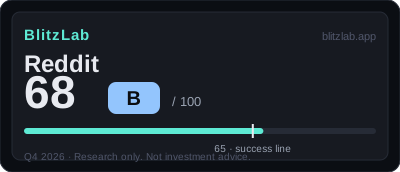
Reddit — Blitz Index 68 (B)
FY2025 revenue +69% ($2.2B), 8 straight profitable quarters, and Google and OpenAI pay for the data — yet 60% of DAUq is non-logged Google organic.
Last re-scored: October 29, 2026.
Confidence: High · S&P 500 · Category: platforms
Score breakdown
| Section | Score | Detail |
|---|---|---|
| A · Speed | 20 / 25 | FY2025 revenue +69% ($2.2B) → TTM ~$2.8B; Q2 2026 +61%; 14 straight quarters of DAUq growth |
| B · Moat | 43 / 60 | 91.3% gross margin; Google and OpenAI Data API contracts; 60% of DAUq is non-logged search organic |
| C · Creative destruction | 12 / 15 | The human conversation archive repriced as AI training fuel — free crawling replaced by paid Data API |
| D · BlitzFailing | −7 | Huffman 76.1% vote via irrevocable proxy; 2025-06 securities class action; Dutch DPA probe + EU VLOP |
Think we scored it wrong? Score it yourself →
Radar axes (0–100): Moat 71.7 · Speed 80 · Creative 80.
Watch item
Gates: G1 ✓ · G2 ✓. 5 points above the threshold — first score. Profit and 60%+ growth at $2.8B scale against borrowed distribution.
Strengths
- 14 straight quarters of DAUq growth (60.3M → 130.3M) — international drives ~2/3 of it
- 13 straight revenue quarters + 8 profitable quarters — growth and profitability proven together
- 91.3% gross margin + $684M FCF — software-like operating leverage
- Data licensing RPO $92.1M — the second revenue leg is contractually real
Concerns
- 60% of DAUq is non-logged Google organic — AI Overviews can cannibalize the traffic feeding ads (94% of revenue)
- 2025-06 securities class action (early stage) — disclosure claims on Search/AI impact
- Licensing contract value concentrated in 2 partners — renewal failure hits the second leg
- Huffman 76.1% voting control via proxy + Advance governance contract — delegated, not direct, control
Research notes
Score
Reddit, Inc. (NYSE: RDDT) scores 68/100, Grade B, on the Blitz Index under BlitzLab v1.0 (frozen). Speed (A) 20/25, Moat (B) 43/60, Creative destruction (C) 12/15, Demerits (D) −7. Total: 20 + 43 + 12 − 7 = 68. The score sits three points above the 65-point line, with no FLAG, since total demerits of 7 fall below the 15-point FLAG threshold. On the radar axes, converted to a 100-point scale, Moat is 71.7, Speed is 80.0, and Creative destruction is 80.0. The assessment date, T, is 2026-10-17, and the latest results included are for the second quarter of 2026, reported on 2026-07-31. Results for the third quarter of 2026, due after the market close on 2026-10-29, fall after T and are therefore excluded from this score. This draft is a scholar's assessment, not investment advice, and it does not consider price as a scoring input.
1. Current position: a profitable platform still growing at blitz pace
Reddit enters this assessment as a first-time score, and the first fact the score file establishes is that the company has already crossed the line that separates a fast-growing platform from a fast-growing platform that also makes money. Revenue reached $2,202.5 million in fiscal 2025, up 69% year on year on a Securities and Exchange Commission (SEC) confirmed basis, and trailing twelve-month revenue to the second quarter of 2026 was approximately $2,778.8 million, built from $584.9 million in the third quarter of 2025, $725.6 million in the fourth quarter, $663.4 million in the first quarter of 2026, and $804.9 million in the second quarter. Quarterly growth remained in the 60% range even as the base expanded, with the first quarter of 2026 up 69% year on year and the second quarter up 61%. That combination — a base approaching $2.8 billion still growing at more than 60% — is the central reason Speed scores 20 out of 25, and it is also the reason the full 10 points for growth (A1) are withheld: the score file reserves the top mark until the third and fourth quarters of 2026 provide further evidence that this pace can be sustained at still larger scale.
Profitability arrived alongside that growth rather than after it, which is what makes Reddit's position unusual in blitzscaling terms. The company recorded eight consecutive quarters of net income from the third quarter of 2024 onward, as stated in its annual report, and fiscal 2025 operating income turned positive at $442 million. The fiscal 2025 operating margin was 20.1%, the adjusted EBITDA margin was 38.4%, and free cash flow was $684.2 million. In other words, the familiar trade-off between growth and efficiency, which many blitzscaling companies resolve only by slowing down, has so far been resolved here by keeping both. The score file's own summary calls this a platform that maintains growth in the 60% range while already profitable, and it contrasts that trajectory with a company whose bookings growth has slowed. The contrast matters because it clarifies what this score is rewarding: not growth purchased at any cost, but growth that has already survived the transition to operating profit.
Scale, in audience terms, tells the same story from a different angle. Daily active uniques averaged 130.3 million in the second quarter of 2026, up 18% year on year, and weekly active uniques reached 514.6 million. That audience did not appear suddenly. Daily active uniques grew for fourteen consecutive quarters, from 60.3 million in the first quarter of 2023 to 130.3 million in the second quarter of 2026, and revenue grew year on year for thirteen consecutive quarters. The duration of those streaks matters more than any single quarter, because blitzscaling is a claim about sustained velocity, not a single strong period. A fourteen-quarter audience streak and a thirteen-quarter revenue streak, both confirmed in SEC filings, give the growth score a foundation that a single quarter could not.
The second structural fact is geographic. Growth is now led from outside the United States. International daily active uniques rose from 53.7 million in the fourth quarter of 2024 to 77.1 million in the second quarter of 2026, an increase of about 44%, accounting for roughly two-thirds of total audience growth. That shift is not incidental to the moat or to the distribution story that follows; it is the engine of both. If the next wave of Reddit's growth is international, then the company's ability to serve users in many languages, and to monetise them at rising rates, becomes the decisive question for the next several quarters. Average revenue per user already points in that direction: global average revenue per user was $6.18 in the second quarter of 2026, up 36% year on year, while United States average revenue per user was $11.85. The gap between those two figures is itself a statement about where future monetisation headroom lies, and about how much of the international audience remains to be converted into revenue at anything approaching domestic rates.
Reddit is classified in the score file as GROWTH, with trailing twelve-month revenue of approximately $2.78 billion and a market capitalisation of approximately $30 billion on a press-reported basis. It listed on the New York Stock Exchange on 2024-03-21, with net initial public offering proceeds of $600.0 million confirmed by the SEC, and its inclusion in the S&P 500 took effect on 2026-08-18, on a company-announced, press-reported basis. Neither fact enters the score directly, but together they mark the transition this assessment is really about: a company that went public about two and a half years before T, and that has already moved from proving that people will gather on its platform to proving that advertisers and, increasingly, artificial intelligence companies will pay for access to what those people have said.
2. Speed: capital, people, and share velocity behind the headline growth
Growth (A1, 9 out of 10) is only one of four Speed components, and the other three explain why the headline is credible rather than merely large. Capital velocity (A2, 4 out of 5) rests on a balance sheet that is, in substance, unlevered. Cash and marketable securities totalled $2.8 billion at 2026-06-30, against total debt of $310.1 million, and a $500 million revolving facility remained undrawn except for $5.3 million in letters of credit. Share repurchases in the first half of 2026 totalled $239.6 million. The score file is candid about the double edge here: having no need to raise capital is evidence of capital velocity, but it is also its limit, since a company that does not need financing cannot demonstrate speed through financing. The point is not that Reddit could raise money quickly, but that it does not have to — the growth described above is being funded from the business itself, from the free cash flow and the cash balance already on hand.
Productivity (A3, 4 out of 5) reinforces that reading. Headcount was 2,555 employees at 2025-12-31, up 14.4% year on year on an SEC-confirmed basis, while revenue grew far faster. Revenue per employee was approximately $1.09 million on a trailing twelve-month estimated basis divided by that headcount, which the score file places among the highest for platform companies. The arithmetic is simple and important: when headcount grows more slowly than revenue, each additional employee is associated with more revenue than the last, and the platform is scaling through software and community rather than through linear hiring. That is the operating leverage that a 91% gross margin, discussed below, makes possible, and it is why the score file treats headcount discipline as a speed signal rather than as a cost-cutting footnote.
Share velocity (A4, 3 out of 5) is scored on audience momentum rather than on a directly measured share of the advertising market, and the score file is explicit about that limitation. Daily active uniques of 130.3 million, up 18% year on year, and weekly active uniques of 514.6 million describe a platform still adding users at scale, with international users driving about two-thirds of the growth. The fifth point is withheld precisely because a quantified share of the digital advertising market, relative to competitors, is unconfirmed. That restraint is worth noting, because it shows where this score refuses to go beyond its evidence. Reddit is clearly gaining audience share within its own history, and it is clearly monetising that audience faster, with global average revenue per user up 36%. Whether that amounts to taking share from larger advertising platforms in measurable terms is a different claim, and the score file does not make it.
Taken together, the Speed section describes a company whose velocity is broad-based: revenue, audience, monetisation per user, and productivity are all moving in the same direction, and the balance sheet does not constrain that movement. The withheld points — the top growth point pending further quarters, the top share point pending a quantified advertising share — define the next test. Speed at 21 out of 25 is high, but it is not a claim that every question about durability has been answered.
3. Moat: a network built on conversation, distributed partly on borrowed ground
Moat (B) at 43 out of 60 is the largest section of the score, and it is also where Reddit's strengths and its most serious structural weakness sit side by side. Network effects (B1, 10 out of 18) are scored in the 10 to 14 anchor range for two-sided marketplace liquidity, comparable to the anchors used for ride-hailing and home-sharing platforms. The logic is that communities and accumulated content attract users and traffic, which in turn attract advertisers and demand for artificial intelligence data, creating a cross-side structure in which each side reinforces the others. Third-party validation for that structure is concrete: Google signed a Data API agreement in February 2024 and OpenAI signed one in May 2024, both on a company-announced, press-reported basis. Those agreements matter because they show that parties other than advertisers are willing to pay for access to Reddit's corpus, which is the strongest external evidence that the network produces something scarce rather than merely something popular.
The discount applied to that network effect is equally concrete, and it is the single most important qualification in the entire assessment. About half of distribution comes from Google search organic traffic, and non-logged-in daily active uniques account for 60% of the total. In other words, a large share of the audience arrives through a channel Reddit does not control, and the network effect therefore stands, in the score file's phrase, on borrowed distribution. The top of the anchor range, 14 points, is reserved for evidence that this search dependence is being resolved. Until then, the network is real but partially rented, and any change in how search surfaces Reddit content would affect audience, advertising, and data value together rather than in isolation.
Distribution scalability (B2, 12 out of 18) follows the same logic. Customer acquisition cost approaches zero, because discovery is driven by recommendation, virality, and search organic traffic, as described in the company's own risk factors. Machine translation has expanded multilingual accessibility, and international daily active uniques now drive about two-thirds of growth, which means distribution is scaling geographically without a proportional increase in acquisition spending. Data licensing adds a second distribution axis, through medium-term contracts with multiple partners, but the score file discounts it for concentration: substantially all of the contract value is concentrated in two partners, so renewal risk falls heavily on a small number of decisions. Distribution is therefore scalable and cheap, but not yet diversified in its newest form.
Market size (B3, 10 out of 12) is the clearest pass in the moat section. The global digital advertising market is estimated at $859 billion in 2025, rising to $973 billion in 2026 and $1.48 trillion in 2029, according to ResearchAndMarkets estimates cited in press reporting. Against the gate bar of approximately $27.8 billion — ten times current revenue — that market is more than thirty times larger, which is why the second gate, G2, passes on advertising alone. The full 12 points are withheld until quantified expansion of advertising share, relative to larger competitors, is demonstrated, and the data licensing market is recorded only as an upside option because no quantified total addressable market has been secured for it. The discipline here mirrors the share-velocity section: a very large market is not the same as a demonstrated share of it, and the score rewards the former while reserving judgment on the latter.
Gross margin (B4, 11 out of 12) is the moat's strongest single item, and it explains much of the operating leverage described earlier. Gross margin was 91.3% in the second quarter of 2026 and 91.2% for fiscal 2025, on an SEC basis, reflecting a software-like cost structure in which hosting is the principal cost and unit hosting costs are trending down. Combined with a fiscal 2025 operating margin of 20.1%, an adjusted EBITDA margin of 38.4%, and free cash flow of $684.2 million, the margin structure shows a business whose incremental user costs almost nothing to serve. Stock-based compensation of $343.2 million, or 15.6% of revenue, is noted as normalising from the $801.6 million initial public offering one-off in fiscal 2024, with share repurchases partly offsetting dilution. The near-maximum score here is not a reward for a single quarter's margin, but for a cost structure that has now been demonstrated across a full fiscal year and into the following quarters.
4. Creative destruction: when the archive itself becomes the product
Creative destruction (C) at 12 out of 15 is the section that gives this assessment its distinctive thesis, and the score file names it plainly: Reddit is an archive blitz, in which conversations from the past become fuel for the artificial intelligence era. The order being replaced (C1, 4 out of 5) is the practice of free crawling of human conversation. Reddit converted that practice into paid access, first through the monetisation of its Data API in 2023 and then through the Google and OpenAI agreements in 2024. Advertising remains the dominant revenue source, but the company has expanded from a single revenue stream into a second one based on controlling access to conversation itself. The discount is quantitative: licensing sits within Other revenue of $140.0 million in fiscal 2025, or 6.4% of total revenue, and although that amount is growing in absolute terms, advertising grew faster, at 74%, so licensing's share actually shrank. The full 5 points are reserved for evidence that licensing exceeds 10% of revenue. That threshold is a useful discipline, because it prevents a compelling narrative from outrunning a still-small revenue line.
Irreversible behaviour change (C2, 4 out of 5) looks at whether the new behaviour is likely to persist. Weekly active uniques of 514.6 million convert to daily active uniques at a rate of about 25%, and the structure in which search and artificial intelligence summary tools learn from and cite Reddit content is difficult to reverse once established. The score file notes a paradox that runs through the whole assessment: the company itself identifies as a risk that artificial intelligence tools could substitute for visiting Reddit, while simultaneously selling data to those same tools. That dual structure — threatened by artificial intelligence on the audience side, paid by artificial intelligence on the data side — is both a hedge and a vulnerability, as discussed in the risks section below. Logged-in daily active uniques were 52.6 million, or about 40% of the total, and expanding that logged-in conversion is the stated condition for the full 5 points. The logic is straightforward: a logged-in user is a user Reddit can serve, retain, and monetise directly, rather than a visitor arriving through search and leaving through search.
Cost-structure change (C3, 4 out of 5) closes the section with the economics that make the other two items matter. Marginal cost per user is approximately zero, and rising average revenue per user — $11.85 in the United States — flows directly into operating leverage, as demonstrated by the fiscal 2025 operating margin of 20.1% and a gross margin above 91%. The discount is evidential rather than conceptual: a company-disclosed measured figure for cost per daily active unique collapsing has not been published, so the score file records that component as unconfirmed. The pattern is consistent across this assessment. Where the economics are demonstrated in the financial statements, the score is high; where the claim would require a figure the company has not disclosed, the point is withheld.
The gate verdicts frame all three sections. Gate G1, sustained growth or a second growth curve, passes on a confirmed basis: fourteen consecutive quarters of audience growth, thirteen consecutive quarters of revenue growth, eight consecutive quarters of net income, a return to operating profit, and a second revenue source demonstrated by contract in data licensing. Gate G2, a ten-year ceiling for a new market at least ten times current revenue, passes on an estimated basis, because the digital advertising market alone exceeds the approximately $27.8 billion bar by more than thirty times. Data licensing is an adjacent market for which no quantified total addressable market has been secured, so it is not needed for the gate to pass, and it is not counted as if it were.
5. Deductions and risks: two concentrated risks, and a clean balance sheet
Demerits (D) total −7, which is why there is no FLAG. The composition of that total matters more than its size, because it is concentrated in governance and in legal and regulatory exposure, while the financial and accounting items score zero. Debt (D1, 0) reflects a balance sheet with no borrowings in substance: total debt of $310.1 million at 2025-12-31, confirmed by the SEC, consists principally of working-capital-type liabilities, against cash and securities of $2.8 billion, a ratio of total debt to trailing twelve-month revenue of about 0.11 times. Non-cancellable cloud purchase obligations of $372.2 million for 2026 to 2028, disclosed in Note 11 of the annual report, are explicitly recorded as not a deduction item. Revenue quality (D2, 0) reflects the absence of restatements, auditor changes, or audit opinion issues. The auditor is KPMG, in place since 2019, with an unqualified opinion for fiscal 2025 and an effective opinion on internal control, both SEC-confirmed. The aggregation of advertising exposure is designated as a critical audit matter, with information technology specialists involved in verification, which the score file records as audit strengthening rather than as evidence of accounting irregularity. In short, the financial foundations of this score are not the source of its deductions.
Governance (D3, −4 out of a possible −5) is the largest single deduction, and it is structural rather than episodic. Reddit has a triple-class share structure: Class A shares carry one vote, Class B shares carry ten votes, and Class C shares carry no votes. Steve Huffman controls 76.1% of total voting power through an irrevocable proxy over the stakes held by Advance and Tencent, on the basis of the definitive proxy statement at 2026-03-31, filed on 2026-04-23 and confirmed by the SEC. The score file aligns this with the anchor line used for a comparable founder-controlled company at a similar level of voting concentration, hence −4. The additional risk is contractual: Advance holds a governance agreement entitling it to nominate two directors and to pre-approve charter changes and change-of-control transactions. The vulnerability is therefore not simply that one person controls a large majority of votes, but that the control rests on a proxy arrangement whose alignment with the proxy grantors could, in principle, break. The score file records a candidate refinement for a future model version that would distinguish delegated control of this kind from directly held founder control, precisely because the two structures fail in different ways.
Regulatory and social cost (D4, −3 out of a possible −5) has two components. The first, scored at −2, is a securities class action filed in June 2025 in the Northern District of California, naming the company and certain officers and directors, alleging false or misleading statements about the impact of Google Search and AI Overviews. At T, that litigation was at an early stage. The second, scored at −1, covers an investigation and information order by the Dutch Data Protection Authority concerning licensing, which the company is contesting, together with designation as a very large online platform in the European Union in September 2026 on a press-reported basis, and the associated costs of compliance with the Digital Services Act and Section 230. Neither component is scored as an existential threat, but together they show that the two central assets of the thesis — search distribution and data licensing — are also the two areas where legal and regulatory exposure is accumulating.
Beyond the scored deductions, the score file lists a set of concerns that any reader should keep alongside the headline score. Search dependence is first, for reasons already given: 60% of daily active uniques are non-logged-in, and about half of distribution is Google organic traffic, so absorption of search traffic by AI Overviews would strike audience, advertising, and data value in sequence. Licensing concentration is second: substantially all contract value sits with two partners, so a renewal failure would damage the second revenue stream disproportionately. Governance concentration is third, as above. Regulatory investigation and platform designation are fourth. And the absence of any history of providing earnings guidance is fifth, because it limits visibility for the growth score: without guidance, each quarter's result must speak for itself, and the top growth point remains withheld until further quarters are reported. None of these concerns overturns the gate verdicts, but they define the conditions under which the score could fall, and they are the reason the assessment reads as a high B rather than as an unqualified endorsement.
A valuation note, not reflected in the score, is recorded in the score file for completeness: market capitalisation of approximately $30.0 billion, based on a closing price of $156.14 on 2026-10-16 on a press-reported basis, implying a price-to-sales multiple of approximately 10.8 times trailing twelve-month revenue of $2.78 billion, with a 52-week range of $119.27 to $263.50. Consistent with the lesson drawn from earlier testing that a business score does not look at price, none of those figures affects the 70 points. No analyst estimates of that kind are cited in the score file and none are cited here. The note is included only so that a reader does not mistake the business assessment for a market assessment; the two use different rulers, and this draft uses only the first.
6. What to watch: the tests that would move this score
The score file's structure makes the forward tests unusually clear, because almost every withheld point names its own condition. On growth, the test is whether the third and fourth quarters of 2026 confirm that 60% range growth can be sustained as the revenue base moves beyond $2.8 billion, which would unlock the tenth growth point. The third-quarter results due on 2026-10-29, after T, are the first such test, but the score file deliberately excludes them, so the next rescore will be the first to judge them. On share velocity, the test is a quantified advertising market share that can be compared with larger platforms; until such a figure is confirmed, the fifth share point stays withheld, and audience growth alone will not earn it. On the network effect, the test is evidence that search dependence is being resolved — whether through a rising share of logged-in users, now about 40%, through direct and app-based traffic, or through another durable channel that reduces reliance on a single search engine's organic results. The top of the network anchor range, 14 points, waits for that evidence.
On distribution, the test is renewal and diversification of data licensing: whether the medium-term contracts concentrated in two partners are renewed, whether additional partners of comparable scale are added, and whether remaining performance obligations of $92.1 million convert into recognised revenue at a pace that supports the second revenue stream's growth. On market size, the test is the same quantified share expansion that governs the share-velocity point, with data licensing's total addressable market remaining an open question rather than a scored assumption. On creative destruction, the test is whether licensing rises above 10% of revenue, which would convert a compelling second-act narrative into a demonstrated second revenue pillar, and whether logged-in conversion rises enough to earn the fifth point for irreversible behaviour change. On cost structure, the test is disclosure: a company-published measured figure for cost per daily active unique would close the one evidential gap in an otherwise fully demonstrated margin story.
On the risk side, the watch items are equally specific. The securities class action's progression from its early stage at T, and any development in the Dutch regulator's licensing investigation or in very large online platform obligations, will determine whether the −3 regulatory deduction deepens or stabilises. The governance structure will be tested not by routine quarters but by any moment when the interests of the proxy grantors and the proxy holder diverge, or when Advance's nomination and pre-approval rights come into play on a charter or control transaction. And the search question will be tested continuously, quarter by quarter, in the relationship between total daily active uniques, the logged-in share, and international growth: if international audience growth continues to drive about two-thirds of total growth, and if monetisation per user continues to rise, then the borrowed-distribution risk is being managed even if it is not yet eliminated.
The score file's own synthesis names this phase as the late first blitz, a period of harvest and expansion at once, in which a $2.8 billion revenue business growing at more than 60% while profitable, with international audience as the fuel for the next wave, waits for licensing to cross 10% before the second act can be called demonstrated. That framing is the right way to read the 68/B. It is three points above the 65 line, with Speed and Creative destruction tied at 80.0, and Moat the relative constraint at 71.7 — a profile of a company whose growth and whose disruption thesis are ahead of the defensibility of its distribution. Whether the next rescore moves toward the top of Grade B or back toward the line will depend less on any single quarter's revenue, and more on whether the audience that arrives through search becomes an audience that arrives directly, and whether the archive that artificial intelligence companies pay to read becomes a revenue stream large enough to stand beside advertising on its own.
More Platforms companies
Other Platforms names on the Blitz Index, highest score first: Alphabet (83/A), Meta (78/B), Airbnb (76/B).
Next earnings
Q4 2026 · Expected
Coverage
Reddit, Inc. · Q3 2026 due Oct 29, 2026 (AMC, confirmed) · Score 68 · Grade B
Embed this score
Copy the HTML below to show this score on your site. The badge links back to this page and updates automatically when the score changes.
Preview:
BlitzLab scores businesses against a scholar’s standard — not investment advice. No price targets, no buy/sell recommendations. Figures are from SEC filings (XBRL) as labeled in the source scorecard.