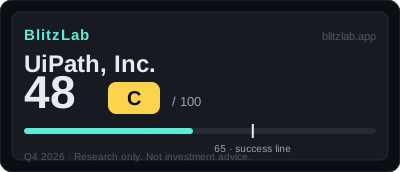
UiPath, Inc. — Blitz Index 48 (C)
UiPath scores 48 — profitability achieved, speed not restarted: every point above 48 hangs on whether agentic AI starts showing up in revenue.
Last re-scored: October 21, 2026.
Confidence: High · Category: platforms
Score breakdown
| Section | Score | Detail |
|---|---|---|
| A · Speed | 14 / 25 | Revenue +12.7% with DBNRR rebounding to 109% — no TTD-style failure signature, but net new ARR of $37M/quarter will not re-accelerate |
| B · Moat | 34 / 60 | BOAT customers show 120% DBNRR (press-reported) yet agentic revenue is undisclosed — the platform story is half-built |
| C · Creative destruction | 9 / 15 | From RPA to agentic automation — the displacement thesis exists only as qualitative signals in top deals |
| D · BlitzFailing | −9 | Dines controls ~84% of votes via 35x Class B (−4) — a structural, permanent fixture; plus normalizing SBC and customer concentration |
Think we scored it wrong? Score it yourself →
Radar axes (0–100): Moat 56.7 · Speed 56 · Creative 60.
Watch item
Gates: G1 ✓ (narrow — growth alone, agentic excluded) · G2 ✓ (borderline — bar ≈ $16.1B (FY2026 revenue × 10) requires the BOAT/agentic category expansion to hold; agentic disclosure in the next 2–3 quarters is the re-review trigger for both gates).
Strengths
- First annual GAAP operating profit (+$56.8M) → four straight profitable quarters, non-GAAP operating margin 21.7% (Q2 FY27) — the profitability turn is confirmed (SEC)
- SBC 28.4% → ~11% quarterly, WASO shrinking via buybacks — the dilution structure's direction is clearly improving (SEC)
- DBNRR 107% → 109% rebound, $1M+ customers +21% YoY — existing cohorts are still expanding (SEC)
- FY2027 guide: revenue ~+11% · ARR ~+11.5% — double-digit positive growth guided (SEC)
- Debt-free · net cash ($1,689.9M → $1,405M), capex ~1.2% of revenue — a growth-risk company, not a balance-sheet-risk company (SEC)
- AI in 18 of the top 20 deals, BOAT customers at 120% DBNRR (press-reported) — qualitative signals of the agentic turn exist
Concerns
- No disclosed agentic revenue · ARR split (confirmed non-disclosure) — the second curve's monetization cannot be externally verified
- Net new ARR $37M/quarter (~2% of ARR) — weak linkage to total ARR, at odds with agentic qualitative signals
- Quarterly GM down to 80% (85.0% → 83.2% → 80% in quarter) — professional-services and hosting mix pressure persists
- RPA core market saturation risk vs bar $16.1B — if category expansion fails, the ceiling closes
- Bundle pricing pressure from platform giants (Power Automate · M365 · Copilot bundles) — a structural ceiling the 10-K names
- Dines ~84% of votes + CEO·Chairman in one — minority holders structurally cannot correct the course
Research notes
UiPath, Inc. (NYSE: PATH) scores 48/C under BlitzLab v1.0: Speed (A) 14 out of 25, Moat (B) 34 out of 60, Creative Destruction (C) 9 out of 15, and Demerits (D) minus 9, for 14 + 34 + 9 − 9 = 48. The grade band for C is 40 to 59, and the score sits 17 points below the 65-point threshold. There is no FLAG designation, because total demerits of 9 fall short of the 15-point FLAG line, although the margin to that line is only 6 points, and 4 of those points come from a governance structure that does not change with quarterly results. The item scores are: A1 Growth 5, A2 Capital Speed 3, A3 Hiring and Productivity 3, A4 Share Speed 3; B1 Network Effects 8, B2 Distribution Scalability 9, B3 Market Size 8, B4 Gross Margin 9; C1 Order Displaced 4, C2 Irreversible Behaviour Change 3, C3 Cost-Structure Change 2; D1 Debt minus 2, D2 Revenue Quality minus 2, D3 Governance minus 4, and D4 Regulatory and Social Cost minus 1. The data cutoff, T, is 2026-10-20, and the scoring date recorded in the score file is 2026-10-21. UiPath is classified as mature: fiscal 2026 revenue of $1,610.6 million clears the $1 billion mature-company line, and the company was founded in 2005 and listed in 2021. That classification matters, because the two gates are then judged differently from the way they would be judged for a young company still proving that a market exists at all. For a mature company, the question is whether growth continues or a second growth curve exists, and whether the remaining market headroom is at least ten times current revenue.
The most useful way to read the 48 is as a composite of two different stories that have not yet resolved into one. The first story is complete and documented: a company that pioneered robotic process automation, built annual recurring revenue (ARR) to $1,937.7 million, turned to GAAP operating profitability, and accumulated a large cash position while carrying no borrowings. The second story is asserted but not yet documented in revenue terms: a company that says its future lies in agentic automation, in which software agents, robots, people, and models are orchestrated together, and that positions itself as the definer of a category it calls Business Orchestration and Automation Technologies (BOAT). The score file is unusually explicit about the boundary between those two stories. It credits the first and withholds credit for the second, not because the second story is implausible, but because no filing, quarterly report, or earnings release available at T discloses revenue or ARR for Maestro, Agent Builder, or Autopilot, the products that would carry it. Everything that follows in this draft respects that boundary. Where the score file reports a figure as press-based, estimated, calculated, or unconfirmed, this draft keeps that label attached to the figure.
Thesis: the mirror image of a failure, and the limits of that distinction
Both gates pass, and both passes are recorded as borderline. That double-borderline character is itself the thesis of this company at T, and it deserves to be stated plainly before any discussion of individual items, because it frames every number that follows.
Gate G1 asks whether growth continues or a second growth curve exists. The score file answers yes, but only through the first of those two legs. Growth has not stopped. Revenue rose from $1,058.6 million in fiscal 2023 to $1,308.1 million in fiscal 2024, an increase of 23.6 percent, then to $1,429.7 million in fiscal 2025, an increase of 9.3 percent, and then to $1,610.6 million in fiscal 2026, an increase of 12.7 percent. The quarterly sequence after that fiscal year-end continues the same pattern rather than breaking it: first-quarter fiscal 2027 revenue of $418.4 million, up 17.3 percent, and second-quarter fiscal 2027 revenue of $410.3 million, up 13.4 percent, or 16 percent excluding foreign-exchange headwinds as the company described it. ARR moved from $1,606.6 million to $1,937.7 million, with year-on-year growth recovering from 11.2 percent at the end of fiscal 2026 to 12.4 percent in the second quarter of fiscal 2027. Fiscal 2027 guidance, given on 2026-09-03, points to revenue of $1,789 to $1,794 million, roughly 11 percent growth, and year-end ARR of $2,065 to $2,070 million, roughly 11.5 percent growth. None of that is blitz speed. All of it is, in the gate's own wording, evidence that growth continues.
The score file reaches that conclusion by explicit contrast with a company that failed the same gate, and the contrast is instructive. Trade Desk (TTD) failed G1 after guiding to a 12 percent year-on-year revenue decline for a quarter, disclosing a decrease in gross spend from existing clients, and offering no adoption disclosure for its second curve. UiPath guides to roughly 11 percent growth rather than a decline, and its existing-customer cohort is still expanding in net terms: dollar-based net retention (DBNRR) recovered from 107 percent at the end of fiscal 2026 to 109 percent in the second quarter of fiscal 2027, and gross retention was reported at approximately 97 percent in the second quarter of fiscal 2027 on a call-reporting basis. The number of customers with more than $1 million in ARR rose from 357 to 387, an increase of 21 percent year on year. That is the decisive difference between the two cases: one company's existing customers were spending less, and the other company's existing customers were, in aggregate, spending more. The score file is careful to add that the intensity of the slowdown belongs to the speed section rather than to the gate. Net new ARR of $37 million in a quarter, about 2 percent of ARR, is thin, and there is no disclosed evidence of re-acceleration. But a gate that asks for continuation does not demand explosion, and six consecutive quarters of net ARR increase together with positive guidance satisfy the continuation test as written.
The second leg of G1, the second curve, is where the score file refuses to follow the company's own narrative, and that refusal is the most consequential judgement in the entire scoring. The agentic products exist as products, and the qualitative signals around them are visible: 18 of the top 20 deals in the second quarter of fiscal 2027 included artificial intelligence, on a call-reporting basis, and BOAT customers showed DBNRR of 120 percent against 109 percent for the company as a whole, on a press-based report of an Investor Day held on 2026-09-23. Agentic product pricing, moving from transaction-based toward outcome-based charging, is described as experimental, again on a call-reporting basis. But none of those signals is a revenue figure. No 10-K, 10-Q, or earnings release available at T separates Maestro, Agent Builder, or Autopilot revenue or ARR from the rest of the business. The score file therefore does not count the second curve as G1 evidence at all. It notes the precedents that support that strictness: Dropbox (DBX) passed on quantified usage for its Dash product, and Docusign (DOCS) passed on a quantified 31 percent increase in activity, while a company whose second curve had no adoption disclosure failed. An "AI-included deal" is a sales narrative, the score file argues, not revenue. By the same standard, the comparison with Salesforce's Agentforce, which was credited on disclosed ARR of $1.5 billion growing 240 percent, shows what a qualifying disclosure would look like, and UiPath does not have one at T.
Gate G2 asks whether the ten-year ceiling of the new market is at least ten times current revenue. With fiscal 2026 revenue of $1,610.6 million, the bar is approximately $16.1 billion. The pass here is also borderline, and it is explicitly recorded as an estimate rather than a confirmed judgement. The reason is straightforward: the company's 10-K discloses no quantitative total addressable market (TAM) figure. The robotic process automation (RPA) core market alone, on third-party estimates described in the score file as ranging from hundreds of millions to several billions of dollars, cannot reach the bar, and current ARR of $1.94 billion may already represent a substantial part of that core market. The pass depends entirely on accepting a broader definition of the addressable market that includes BOAT and agentic automation. On that definition, a single external estimate cited in the score file, on a press-reporting basis, puts the enterprise agentic AI market at $3.67 billion in 2025 rising to $24.5 billion in 2030, which arithmetically clears the bar. Equally important for the logic of the pass is what is absent: unlike the cases of companies that failed G2 because their own targets were nearly exhausted or because measured penetration of a defined pool reached 70 to 84 percent, there is no quantitative evidence that closes the ceiling from below for UiPath, in part because third-party RPA market-share percentages are themselves unconfirmed, so a Roku-style proximity measurement cannot even be constructed. The score file therefore records G2 as a borderline pass on an estimate, with the premise, the scaling of the agentic category into revenue, left as an explicit condition for re-examination. If, after two or three more quarters, there is still no agentic revenue disclosure and the RPA core is confirmed to be the whole business, that premise lapses.
Put together, the two gates describe a company whose scored upside is entirely conditional. The growth leg of G1 and the category-expansion premise of G2 both point at the same unresolved question: does agentic automation become a revenue line, or does it remain a feature set that helps defend RPA deals? The next two or three quarters of disclosure, or its continued absence, would pull both gate triggers at once. That is why the thesis of this page is not "a mature automation company with a new product line" but something narrower and more precise: a completed first act whose second act has been announced, staffed, and sold into deals, but not yet priced, separated, or proven in the filings.
Speed: profitable, disciplined, and no longer fast
Speed scores 14 out of 25, and the composition of that score tells the story of a company that has traded velocity for durability. A1 Growth, at 5 out of 10, reflects the trajectory already described: double-digit growth that has settled into an 11 to 12 percent range, with guidance in the same range and no disclosed evidence of re-acceleration. The score file places UiPath in the same band as Okta (OKTA), which also scored 5 on growth of 11.8 percent with stronger leading indicators, and it states the conditions for a higher score plainly: a quarterly guidance re-acceleration, or a DBNRR rebound to 110 percent or above. The thinness of net new ARR, $37 million in a quarter against ARR of nearly $1.94 billion, is the single most important speed fact in the file, because it shows that the impressive-sounding cohort metrics, DBNRR of 109 percent and 21 percent growth in $1 million-plus customers, are describing depth within existing large customers rather than breadth across new ones. Growth is deepening, not widening, and the score reflects that shape.
A2 Capital Speed, at 3 out of 5, is a study in what self-generated cash can and cannot do. Operating cash flow was $371.2 million in fiscal 2026, and free cash flow was approximately $352 million on a calculated basis, a margin of about 22 percent, with capital expenditure at only about 1.2 percent of revenue. The company carries no borrowings. Cash plus securities moved from $1,689.9 million to $1,405 million, a decline that reflects the use of cash rather than any distress, and the weighted-average share count fell from 559.9 million to 544.9 million and then to 523.0 million as buybacks more than offset dilution. All of that is genuine capital strength, and it is why the company's risk profile in this scoring is a growth risk rather than a financial risk. But the score file withholds a higher mark for a precise reason: capital is being used for return and dilution defence, not as fuel for growth. Apart from the Peak AI acquisition at $40.1 million, there is little disclosed evidence of growth capital deployment, and the amount paid for WorkFusion is unconfirmed. Okta, Docusign, and Monday.com (MNDY) received the same 3 in the same return-phase situation. A company that generates its own cash but does not deploy it into a new growth engine is fast in the sense of being self-sustaining, and slow in the sense that matters to a blitzscaling score.
A3 Hiring and Productivity, at 3 out of 5, is the thinnest-evidenced of the speed items, and the score file is honest about that thinness. Headcount was 3,981 at 2026-01-31, but the prior-year figure is unconfirmed in the datapack, so no hiring trajectory can be evidenced from disclosure. Revenue per employee was approximately $405,000 in fiscal 2026 on a calculated basis, which the score file describes as mid-range for software-as-a-service companies. What can be documented is a restructuring approved in July 2024, repositioning go-to-market and AI research and development, which was completed in the second quarter of fiscal 2026. The character of that period is therefore efficiency after reduction, not a hiring blitz, and it is linked in the score file to the return of founder Daniel Dines in June 2024 and the subsequent turn to profitability. Productivity is credited; speed, in the sense of a workforce expanding to chase a widening market, is not evidenced. Monday.com and Docusign received the same 3 on the same reasoning.
A4 Share Speed, at 3 out of 5, captures a similar tension between position and proof. UiPath's category position is documented: a traditional leader in RPA that now positions itself in its 10-K as a definer of the BOAT category. But third-party quantitative RPA market-share percentages are unconfirmed, so how much share remains to be taken cannot be verified from outside the company. The 10-K itself names the structural ceiling: platform companies including Microsoft, with Power Automate bundled into Microsoft 365 and Copilot, as well as ServiceNow and Salesforce, exert bundle pricing pressure. Against that ceiling, the score file sets the genuine offsetting evidence of penetration within large customers: $1 million-plus customers up 21 percent year on year to 387, and $100,000-plus customers up 10 percent. Monday.com received the same 3 for the same pattern, upmarket penetration that is fast without quantified category share to prove it. The speed section as a whole, then, describes a company whose motion is real but whose acceleration is missing, and whose capital and workforce are configured for defence and efficiency rather than for a new surge.
Moat: an ecosystem lock that is deep, not wide
Moat scores 34 out of 60, the largest section in absolute terms and the section where UiPath's first act is most visible. B1 Network Effects, at 8 out of 18, is placed in the 5 to 9 band for data and ecosystem effects, explicitly below the 10 to 14 band for two-sided liquidity and well below the 15 to 18 band for platform lock-in. The reasoning is structural: direct network effects are weak as a matter of the company's disclosed structure. What exists instead is a developer and partner ecosystem, including a marketplace, training, and certification, together with switching costs embedded in reusable automation assets, process maps, and governance controls. Maestro's vendor-neutral orchestration claim, the idea that UiPath can govern other vendors' agents as well as its own, is identified as the core of the network position, but it carries no revenue evidence. The press-based BOAT-customer DBNRR figure of 120 percent, against 109 percent overall, is cited as company-side evidence that expansion is stronger where the platform is adopted, and it is kept labelled as press-based because it comes from Investor Day reporting rather than a filing. The score file awards one point more than Monday.com's 7, on the depth of automation-asset lock-in, and it caps the score below 10 for a reason stated by the 10-K itself: differentiation against platform-company bundles is weakening. A moat that the company's own risk disclosures describe as under bundle pressure cannot be scored as if that pressure did not exist.
B2 Distribution Scalability, at 9 out of 18, sits at the top of the 5 to 9 band for paid-sales-dependent but repeatably expandable distribution, and explicitly below the 10 to 14 band for strong viral distribution with customer acquisition cost approaching zero. The structure is enterprise direct sales plus global systems-integrator and channel partners plus hyperscaler marketplaces, including Microsoft, Google, Amazon Web Services, and Oracle. The reason the score stops at 9 is arithmetic: sales and marketing expense was $683.3 million in fiscal 2026, or 42.4 percent of revenue, down from $738.5 million in the prior year after restructuring, but still the signature of a distribution model that paid selling sustains. Repeatability is nevertheless evidenced quantitatively, by the same land-and-expand figures that appear throughout this scoring: $1 million-plus customers up 21 percent and DBNRR of 109 percent, together with the global coverage of the partner channel. Monday.com, with sales and marketing at 51.2 percent of revenue and a funnel limitation, received the same 9. UiPath's distribution is therefore best described as expensive but repeatable: it works, it scales within large customers, and it does not compound on its own.
B3 Market Size, at 8 out of 12, restates the G2 judgement in item form. The bar is $16.1 billion, the addressable market is the sum of RPA, BOAT, and agentic automation rather than RPA alone, and the absolute scale of that sum could clear the bar, but the company's quantitative TAM is undisclosed and the effective market depends on the agentic category scaling into revenue, which is currently undisclosed. Monday.com and Docusign received the same 8 in the same situation, undisclosed quantitative TAM with early penetration or dependence on a new category. The score file states the condition for a full mark directly: quantitative TAM disclosure plus agentic revenue evidence. Until both arrive, the market-size score is a statement about possibility under a stated premise, not about a measured market.
B4 Gross Margin, at 9 out of 12, is the moat item where direction matters as much as level. Gross margin was 85.0 percent in fiscal 2024, 82.7 percent in fiscal 2025, and 83.2 percent in fiscal 2026: a high software level with a downward direction. The quarterly picture is weaker still, with second-quarter fiscal 2027 GAAP gross margin at 80 percent and non-GAAP gross margin at 82 percent, as professional services and hosting mix press on the total. The underlying software economics remain top-tier, with software gross margin, covering licences and subscriptions, at approximately 90 percent on a call-reporting basis. Docusign and Monday.com, with gross margins in the 89 percent range and stable, scored 11, two points above UiPath, because UiPath's absolute level is a tier below theirs and its trajectory is clearly downward. The score file states the condition for 10 or above directly: evidence that the quarterly gross-margin decline has stopped. The moat section as a whole thus describes a company with a real but narrowing economic advantage: high software margins, a deep installed automation base, and a distribution machine that works, all of which are being pressed simultaneously by mix shift and by platform bundles.
Creative destruction: the disruptor becoming the disrupted
Creative Destruction scores 9 out of 15, and it is the section where UiPath's history is most dramatic, because the company occupies both sides of the disruption it describes. C1 Order Displaced, at 4 out of 5, credits a completed first disruption: manual back-office work and legacy screen manipulation replaced by software robots, a replacement that UiPath pioneered and whose scale is evidenced by $1.6 billion of revenue. But the score file immediately records the reversal: that very order is now itself under displacement pressure from generative AI and agents, a position confirmed by the structure of the 10-K. The attempted second disruption is therefore self-cannibalising by design: rule-based bots giving way to agentic automation, with Maestro orchestrating AI agents, robots, people, and models, as an explicit strategy since the founder's return. The fifth point is withheld for the same reason that recurs throughout this scoring: the scale of the second disruption is not yet evidenced. Docusign received the same 4 on the same yardstick, displacement evidenced at scale but penetration below a majority. UiPath has displaced an order and is now attempting to displace its own displacement, and only the second half of that sentence remains unproven.
C2 Irreversible Behaviour Change, at 3 out of 5, places UiPath in the "behaviour change in progress" anchor band, alongside Docusign and Monday.com. The evidence is that automation is deeply embedded in customer operations: DBNRR of 109 percent shows the existing cohort expanding in net terms, gross retention of approximately 97 percent is reported on a call-reporting basis, and $1 million-plus customers grew 21 percent year on year. Tearing automation out carries a real cost in that structure. The fourth point is withheld for a precise reason: the agent of the behaviour change is still deterministic automation, not the agentic layer. Quantitative measurement of agentic behaviour change, such as retention by tool or agent ARR, is undisclosed, and net new ARR of $37 million per quarter shows that the speed of change is not fast. The behaviour change is real, it is embedded, and it has not yet been shown to have crossed into the agentic era.
C3 Cost-Structure Change, at 2 out of 5, is the lowest creative-destruction item, and the score file explains why without overstating the case. The first disruption's cost substitution, human marginal cost replaced by the spreading of robot fixed cost, is a historical fact, not evidence of a current cost-structure change. No unit-cost measurement for the agentic layer is disclosed; that figure is unconfirmed. Agentic product pricing, from transaction-based toward outcome-based, is experimental on a call-reporting basis. The company's own cost structure remains that of a traditional software-as-a-service business, with sales and marketing at 42.4 percent of revenue. Monday.com and Docusign received the same 2 on the same yardstick: direction exists, but there is no evidence of a cost structure having been broken. The creative-destruction section therefore totals 9 because the first disruption is complete and the second is announced, while the behavioural and cost evidence for the second disruption has not yet been disclosed in measurable form.
Deductions and risks: a clean balance sheet, a fixed governance cost
Demerits total minus 9, and the composition matters more than the total, because the four deductions are of different kinds and only some of them can move. D1 Debt, at minus 2 out of a possible minus 10, is not about debt at all in the conventional sense. There are no financing borrowings, the company is in a net cash position, and capital expenditure is only about 1.2 percent of revenue, so financial-distress risk is effectively absent. The minus 2 comes from dilution and earnings quality. Stock-based compensation was $372.0 million in one fiscal year, or 28.4 percent of revenue, then $358.2 million, or 25.1 percent, then $290.7 million, or 18.0 percent, and then approximately $45 million in the second quarter of fiscal 2027, or about 11 percent on a calculated basis. That is a rapid normalisation from a top-tier software-as-a-service level, but stock-based compensation still exceeds five times GAAP operating profit of $56.8 million, and it remains the substance of shareholder dilution. The precedents cited in the score file support the mark: Okta, at 18.6 percent and improving, received minus 2, and Iot (IOT), at 19.5 percent and falling, also received minus 2, while Zscaler (ZS), at 24.5 percent, received minus 3. UiPath sits below Zscaler in absolute level and is improving across every interval, which fits the Okta yardstick at minus 2. Buybacks reducing the weighted-average share count from 559.9 million to 544.9 million and then to 523.0 million are recorded as an offsetting factor. The deduction is therefore best read as a charge for a dilution structure that is improving quickly but has not yet finished improving.
D2 Revenue Quality, at minus 2, combines three distinct charges, and the score file keeps them distinct. First, concentration: the 10-K risk disclosures state that the top 10 percent of customers account for a substantial part of revenue and ARR, that the 387 customers with more than $1 million in ARR account for approximately 50 percent of revenue, and that dependence on channel partners and hyperscalers creates direct exposure to partner policy changes and bundle competition. Second, licence revenue recognition timing can distort quarterly revenue, a volatility the company itself discloses as a risk. Third, fiscal 2026 net income of $282.3 million includes a tax benefit of minus $181.7 million, which is to say a tax inflow, so any interpretation based on net income multiples requires caution about earnings quality. The offsetting factors are that there is no revenue restatement and no audit-opinion issue. Docusign received minus 3, one point heavier, because it combined a concentration figure of 125 customers at 83 percent with a claim-stage litigation matter; UiPath has no litigation issue confirmed in the file, and its concentration in absolute terms is lower. The deduction is therefore a concentration and earnings-quality charge, not a charge for accounting failure.
D3 Governance, at minus 4 out of a possible minus 5, is the deduction that most constrains the score, because it is structural rather than operational. The company has a dual-class structure in which Class B shares carry 35 votes each against 1 vote for Class A, and founder Daniel Dines holds all of the Class B shares, giving him approximately 84 percent of voting power as of 2026-01-31, as stated in the 10-K. Dines is both chief executive officer and chairman, so the practical check on that voting power is, in the score file's words, effectively absent. The quantitative anchor line established from Okta's file places voting power in the 30 percent range at minus 2, the 50 percent range at minus 3, and the 70 percent range at minus 4, with Duolingo at approximately 76 percent, Coupang at 74.1 percent, and Docusign at 79 percent all receiving minus 4. UiPath at 84 percent sits at the top of that band, but the score file keeps it at minus 4 to preserve the band distinction, reserving minus 5 for an effectively complete-control range. The practical consequence is stated plainly in the score file's key drivers: no quarterly result lowers this deduction. It is a fixed cost of the score, and it accounts for 4 of the 6 points between the current demerit total of 9 and the FLAG line of 15.
D4 Regulatory and Social Cost, at minus 1 out of a possible minus 5, is limited to structural exposure because no realised cost is disclosed. There is no quantitative disclosure of a material litigation provision; that figure is unconfirmed, and there is no disclosed fine or data-breach incident. The deduction covers exposure that the 10-K enumerates: data privacy regulation including the General Data Protection Regulation and the California Consumer Privacy Act, AI regulation, and a Romanian tax-authority (ANAF) risk, together with a macroeconomic statement in the 10-K that government-efficiency measures of the DOGE type affect customer budgets. Docusign, Cart (CART), and MQ received the same minus 1 on the same yardstick, exposure stage rather than incident stage. The demerit section as a whole thus describes a company with a clean balance sheet and no accounting failure, carrying a heavy but bounded governance charge and a concentration charge, with regulatory exposure that has not yet materialised into a disclosed cost.
What to watch: two triggers, one question
The score file names two re-examination triggers, and they are worth restating exactly, because they define what would change this assessment. The first trigger belongs to G1: if fiscal 2027 guidance turns negative, or if DBNRR falls below 100 percent, the premise of the growth-continuation leg disappears, and G1 would have to be re-judged on agentic revenue disclosure, failing if that disclosure does not exist. The second trigger belongs to G2: if, after two or three more quarters, there is still no agentic revenue disclosure and the RPA core is confirmed to be the whole business, the category-expansion premise lapses. Those two triggers converge on a single question, which the score file's blitzscaling analysis states as its maximum risk: that agentic automation hardens into an extension of the first act rather than a second act, a sales narrative that defends RPA deals without becoming a product customers pay more for. The observable form of that outcome would be the continued coexistence of the two figures that currently sit in tension in the file: AI included in 18 of the top 20 deals on a call-reporting basis, and net new ARR of only $37 million per quarter. If that coexistence persists for two or three more quarters, the interpretation the score file anticipates is that agentic capability is a defensive feature rather than a separately monetised product, and the remaining picture would be a bundle contest with Microsoft and a governance structure that minority shareholders cannot correct.
Against that risk, the score file also records what has already been proven, and the watch list should keep both sides in view. Profitability conversion is confirmed: the first annual GAAP operating profit of $56.8 million, followed by four consecutive profitable quarters, with non-GAAP operating margin of 21.7 percent in the second quarter of fiscal 2027. Stock-based compensation normalisation is confirmed across every interval, from 28.4 percent to approximately 11 percent on a quarterly calculated basis, with the share count falling. Cohort expansion is confirmed: DBNRR recovering from 107 percent to 109 percent, and $1 million-plus customers up 21 percent. Guidance remains positive at roughly 11 percent for revenue and roughly 11.5 percent for ARR. The gross-margin trajectory is the item to watch within the proven side, because quarterly GAAP gross margin at 80 percent, down from a fiscal-year level of 83.2 percent, shows that efficiency in operating terms is coexisting with erosion in gross-margin terms, driven by professional-services and hosting mix. The conditions for higher item scores are also stated in the file and can be used as a checklist without adding any new judgement: quarterly guidance re-acceleration or DBNRR at 110 percent or above for A1; evidence that the quarterly gross-margin decline has stopped for B4 at 10 or above; quantitative TAM disclosure plus agentic revenue evidence for B3 at the full mark; and quantified agentic usage or revenue disclosure for any G1 credit to the second curve.
Two calendar markers, both post-T and therefore recorded here without anticipated outcomes, complete the picture. Fiscal 2027 third-quarter results were expected in early December, after T, and are excluded from this scoring. That release is the next point at which the triggers above can be tested against new disclosure, and the next point at which the distinction between a sales narrative and a revenue line can narrow. Until then, the assessment stands as scored: a company that completed one blitz, converted it to profitability and cash generation, and now faces a second act whose existence as a business, as opposed to a strategy, has not yet been filed. The 48/C score is the arithmetic of that position: 14 for speed that has slowed, 34 for a moat that is deep but pressed, 9 for a creative destruction that is half complete, and minus 9 for deductions dominated by a governance structure that will not change. Seventeen points below the threshold is not a narrow miss caused by one item, and closing it would require the one thing this draft has deliberately not assumed: disclosed, separately measurable revenue from the agentic second curve.
More Platforms companies
Other Platforms names on the Blitz Index, highest score first: Alphabet (83/A), Meta (78/B), Airbnb (76/B).
Next earnings
Q4 2026 · Expected
Coverage
UiPath, Inc. · Q3 FY2027 earnings ~Dec 2026 (unconfirmed) · Score 48 · Grade C
Embed this score
Copy the HTML below to show this score on your site. The badge links back to this page and updates automatically when the score changes.
Preview:
BlitzLab scores businesses against a scholar’s standard — not investment advice. No price targets, no buy/sell recommendations. Figures are from SEC filings (XBRL) as labeled in the source scorecard.