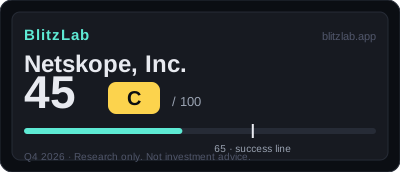
Netskope, Inc. — Blitz Index 45 (C)
Netskope scores 45 — a ~30% grower whose moat is consolidation, funded by stock compensation at 72.8% of revenue.
Last re-scored: October 25, 2026.
Confidence: Medium · Category: platforms
Score breakdown
| Section | Score | Detail |
|---|---|---|
| A · Speed | 15 / 25 | FY2026 $709.0M (+31.7%) → TTM $802.6M (+30.4%), Q2 FY2027 +29.2% — solid ~30% growth, but ARR growth slowed +29% → +27% and NRR fell 118% → 114% |
| B · Moat | 32 / 60 | Consolidation moat, not a network effect: Netskope One, one Zero Trust Engine, NewEdge in 80 regions — against a ~3.8x larger Zscaler; GAAP gross margin 68.1% → 73.9% in Q2 FY2027 |
| C · Creative destruction | 10 / 15 | Single cloud-native SASE/SSE platform replacing fragmented VPN, SWG/CASB/ZTNA and hardware firewall stacks — a contested replacement, not a one-sided one |
| D · BlitzFailing | −12 | SBC $516.2M (72.8% of FY2026 revenue; 32.9% in H1 FY2027) + ~30% dilution overhang + PIK-toggle converts (2028/2029) + Class B 20 votes per share |
Think we scored it wrong? Score it yourself →
Radar axes (0–100): Moat 53.3 · Speed 60 · Creative 66.7.
Watch item
Gates: G1 ✓ (confirmed) · G2 ✓ (estimate — narrow SASE definitions give only 1.3–2.1x the bar ≈ $8.0B). 20 points below the threshold — first score.
Strengths
- Revenue +31.7% in FY2026 and +29.2% in Q2 FY2027 — a ~30% compounder
- GAAP gross margin 59.8% → 68.1% → 73.9% (Q2 FY2027), non-GAAP 77%
- RPO $1.2B → $1.4B (Jan → Jul 2026) with ARR growth +27–29%
- NewEdge private network: 80 regions, 200+ localisation zones
- Gartner SASE Leader three years running, SSE Leader five years running (company-reported)
Concerns
- SBC 72.8% of FY2026 revenue, 32.9% in H1 FY2027 — dilution funds the blitz
- Dilution overhang ~30% of shares (options, RSUs, converts) plus PIK-toggle notes due 2028/2029
- NRR 118% → 114% and ARR growth +29% → +27% — both expansion gauges decelerating
- Non-GAAP operating margin still −9% with FY2027 FCF margin guided at ~2%
- Class B shares carry 20 votes each; CEO key-person dependence and a CFO succession unconfirmed at scoring
Research notes
Thesis: a consolidation blitz, fuelled by equity
Netskope, Inc. (NASDAQ: NTSK) earns a BlitzLab v1.0 score of 45 out of 100, grade C, twenty points below the 65-point threshold. The shape of the score matters more than the total: speed 15 of 25, moat 32 of 60, creative destruction 10 of 15, and deductions of 12 points. Converted to the radar's hundred-point axes, that reads as moat 53.3, speed 60.0, and creative destruction 66.7. Both gates pass — G1, sustained growth or a second growth curve, on confirmed evidence, and G2, a ten-year market ceiling at least ten times current revenue, on an estimate whose dispersion is stated openly rather than hidden. No FLAG applies, because deductions of 12 fall short of the 15-point FLAG line. The story the score tells is consistent from every angle: a company growing at roughly thirty percent a year, improving its gross margin steadily, and consolidating enterprise security spending onto one platform — while paying for that blitz largely in stock, and while disclosing so little, so recently, that several of the most important questions about its business cannot yet be answered from public filings at all.
That disclosure thinness is structural, not incidental. Netskope is classified as a recent IPO: it listed in September 2025, and as of the scoring date, 25 October 2026, it had one 10-K on file and roughly thirteen months of disclosure history. The score file rates confidence as medium-high for SEC figures and medium for market and competitive structure, and that split runs through everything that follows. Where the file is silent, this article is silent too. Figures that the score file marks as reported, estimated, or unconfirmed keep those labels here, and items the file excludes as post-T appear only as future markers, with no anticipated outcome attached.
Netskope's fiscal calendar needs a note before any number is read, because it is easy to misread. Its fiscal year ends on 31 January: fiscal 2026 is the year ended 31 January 2026, and the second quarter of fiscal 2027 is the quarter ended 31 July 2026. Calendar-year language and fiscal-year language describe different periods here, and the score file warns against confusing them.
Speed: growth that holds its pace without accelerating
Growth, item A1, scores 7 of 10. The revenue line is a study in persistence: 406.9 million dollars in fiscal 2024, 538.3 million in fiscal 2025, up 32.3 percent, and 709.0 million in fiscal 2026, up 31.7 percent. The trailing twelve months reached 802.6 million dollars, up 30.4 percent, and the second quarter of fiscal 2027 delivered 220.5 million dollars, up 29.2 percent. Three consecutive years in the thirty-percent range is a robust trajectory, and it is the backbone of the G1 pass. But the score file is careful about what the trajectory is not: it is not acceleration. Annualised recurring revenue growth eased from 29 percent in the first quarter of fiscal 2027 to 27 percent in the second, and fiscal 2027 revenue guidance of 888 to 892 million dollars implies only 25 to 26 percent growth over fiscal 2026. The file's own ladder is explicit — ten points would require demonstrated acceleration, and eight or nine would require the thirty-percent range to be sustained together with a demonstrated re-acceleration of recurring revenue. Neither condition is met at T. What exists is durable, decelerating-at-the-margin growth, and the score reflects exactly that.
Capital velocity, item A2, scores 3 of 5. The September 2025 IPO raised net proceeds of approximately 992.2 million dollars, and that cash underwrites the first half of fiscal 2027. Cash plus securities stood at 1,067.4 million dollars against convertible notes carried at 698.1 million dollars, leaving net cash of approximately 369 million dollars by the file's calculation. Access to capital, in other words, is not the constraint. The pace of cash generation is. Fiscal 2026 produced operating cash flow of positive 38.1 million dollars, the first annual positive figure in three years — and then the first half of fiscal 2027 slipped back into negative territory, with operating cash flow of negative 70.5 million dollars and free cash flow of negative 87.0 million dollars. Fiscal 2027 guidance implies a free cash flow margin of only about 2 percent. A company can have a strong balance sheet and still be slow at turning its own operations into cash, and Netskope at T is that company.
Hiring and productivity, item A3, scores 2 of 5, and the low score is as much about evidence as about performance. Headcount is confirmed at 3,281 employees as of 31 January 2026, but neither the first- nor second-quarter fiscal 2027 10-Q updates that figure, so the denominator is stale. Revenue per employee works out to roughly 0.22 million dollars for fiscal 2026 and roughly 0.24 million dollars on a trailing-twelve-month basis, with the stale-denominator caution attached, and that level is low. Fiscal 2026 cost growth — sales and marketing up 40 percent, research and development up 100 percent, general and administrative up 239 percent — cannot be used to judge productivity at all, because it is contaminated by IPO stock-based compensation. With hiring pace and productivity both undemonstrated, the score file awards 2, and this article does not dress that up as something else.
Share velocity, item A4, scores 3 of 5. The enterprise footprint is real: 1,531 customers with more than 100,000 dollars of annualised recurring revenue as of 31 January 2026, up 22 percent year on year and accounting for 86 percent of total recurring revenue, with roughly a third of the Fortune 100 and roughly 19 percent of the Forbes Global 2000 as customers. But the second quarter of fiscal 2027 brings no customer-count update, so extrapolation is prohibited, the number of customers above one million dollars is unconfirmed, and gross retention is unconfirmed. Net revenue retention of 114 percent evidences continued expansion, yet it fell four percentage points from 118 percent a year earlier. The competitive frame sharpens the picture: against Zscaler's recurring revenue of approximately 3.4 billion dollars on a reported basis, Netskope sits roughly 3.8 times smaller. Share is expanding, but from a challenger's position inside the same leadership quadrant, not from the front.
Moat: consolidation, not network effects
The moat section is where Netskope's strategic identity becomes clearest, and where the score file draws its sharpest distinction. Network effects, item B1, score only 6 of 18, because the file finds no genuine user-to-user network effect. The moat is consolidation instead. Netskope One, a single Zero Trust Engine, a single client and console, and the private NewEdge network — 80 regions and more than 200 localisation zones, confirmed in the 10-K — reduce the number of vendors and policies an enterprise must manage. That is a real source of value, and it is a real switching cost in the form of embedded policy. But the file marks its structural limit plainly: module by module, Netskope must compete against incumbents with larger installed bases. Consolidation is a moat of integration, not of compounding user interaction, and 6 points prices it as such.
Distribution scalability, item B2, is the strongest moat item at 10 of 18. The motion combines direct sales with approximately 1,600 channel partners on a reported basis, plus an expanded Deloitte managed SASE arrangement confirmed in the first quarter of fiscal 2027. External validation is strong: Gartner named Netskope a SASE Leader for three consecutive years with the highest execution rating, and an SSE Leader for five consecutive years, both on company announcements. The discounts are equally plain. The enterprise and channel motion is expensive — sales and marketing grew 40 percent in fiscal 2026 — productivity measures such as the magic number are undisclosed, and the roughly 3.8-times scale gap to Zscaler persists. Distribution is validated and expanding, but it is not cheap distribution, and the score does not pretend otherwise.
Market size, item B3, scores 7 of 12, and the reasoning here doubles as the G2 gate verdict. G2 passes, but only as an estimate with its dispersion stated. The bar is approximately 8.0 billion dollars: trailing-twelve-month revenue of 802.6 million dollars times ten gives approximately 8.03 billion. No single third-party market estimate is adopted, because the estimates themselves disagree by a factor of two to five for the current market. On the narrow SASE definition, Grand View puts the market at 6.8 billion dollars in 2026 estimates rising to 17.2 billion in 2030 estimates, while The Business Research Company puts it at 3.79 billion dollars in 2026 rising to 10.14 billion in 2030. Even on the narrow definition, the 2030 estimates of 10 to 17 billion dollars already clear the bar, and extrapolation to the ten-year horizon around 2036 reaches several multiples of it. On the broader definition — Netskope One's actual span across SSE, SASE, SD-WAN, data security, and AI security, with IDC's directional figure of 377 billion dollars in global security spending in 2028 cited for direction — the headroom is far larger. The pass is therefore real, but thin on the narrow definition, where 2030 headroom is only 1.3 to 2.1 times the bar, and the conclusion would wobble if the market definition changed. The file also withholds full marks for a specific reason: there is no confirmed segment revenue split demonstrating that the broad definition equals Netskope's own serviceable market, and until segment-level market evidence exists, 12 points are not available.
Gross margin, item B4, scores 9 of 12, and it is the cleanest success in the whole score. GAAP gross margin improved steadily: 59.8 percent in fiscal 2024, 64.6 percent in fiscal 2025, 68.1 percent in fiscal 2026, and 73.9 percent in the second quarter of fiscal 2027, against 72 percent a year earlier, with non-GAAP gross margin at 77 percent in the quarter and guidance around 77 percent. The margin level itself is excellent. What it has not done is convert into operating leverage: GAAP operating margin for fiscal 2026 was negative 92.0 percent on the file's calculation, and non-GAAP operating margin was negative 9 percent in the quarter with fiscal 2027 guidance around negative 9 percent. Because B4 is a gross-margin item, it earns 9; the failure of that margin to reach the operating line is charged where it belongs, in the deductions section.
Creative destruction: a clear incumbent stack, an uncounted disruption
Creative destruction totals 10 of 15, and its three items trace a gradient from clarity to evidence. The order being displaced, item C1, scores 4 of 5. The stack being displaced is unusually well defined: on-premises VPN concentrators, point products for secure web gateway, cloud access security broker, and zero-trust network access, hardware firewalls, and separate SD-WAN — a fragmented stack — and, in the AI era, uncontrolled use of public AI tools, a framing the chief executive gave in the first-quarter earnings materials. A single cloud-native SASE and SSE platform on the NewEdge network is a structurally coherent bid for that stack's place. The point withheld is for the contested nature of the market: Gartner names Zscaler, Palo Alto Networks, Cloudflare, and Cato Networks as Leaders or Visionaries too, so this is not a one-sided displacement.
Irreversible behaviour change, item C2, scores 3 of 5. The evidence for customers committing and expanding exists: remaining performance obligations rose from 1.2 billion dollars in January 2026 to 1.4 billion in July 2026, recurring revenue grew 27 to 29 percent, and net revenue retention ran at 114 to 116 percent — though the direction is mixed, with second-quarter retention falling. Product launches across the first two quarters — AI Command Center, One DataSec Command Center, NewEdge AI Fast Path, and participation in the NVIDIA Open Secure AI Alliance — evidence platform extension. What is missing is counted proof of disruption itself: win rates against incumbents, counts of legacy replacements, and an AI revenue split are all unconfirmed. Commitments plus launches earn 3; they do not earn a disruption claim.
Cost-structure change, item C3, also scores 3 of 5. A cloud-native platform structurally removes customers' appliance and VPN hardware costs, but no measured per-unit cost decline is disclosed. The NewEdge AI Fast Path claim of up to 90 percent latency reduction to AI destinations is a company claim, reported in character, not a measured customer saving. And a third-party Gartner summary, on a reported basis, flags above-average pricing and a weaker financial profile against large incumbents as drawbacks. The honest reading is premium consolidation rather than cost collapse, and 3 points say so.
Deductions and risks: the bill for the blitz arrives in stock
Deductions total negative 12, and their composition is the most instructive part of the score. Debt, item D1, takes negative 7, and the file is explicit that this is closer to dilution than to conventional debt. Net cash is positive, but the cushion is thin and the dilution is large. Convertible notes are carried at 698.1 million dollars: the 2028 Notes carry 401 million dollars of principal at 3.75 percent with a payment-in-kind toggle, and the 2029 Notes carry 75 million dollars of principal at 3.00 percent with a payment-in-kind toggle, so that accretion has already pushed the carrying value above the 476-million-dollar principal sum, with maturities in 2028 and 2029. Stock-based compensation was 516.2 million dollars in fiscal 2026 — 72.8 percent of revenue on the file's calculation, including approximately 402 million dollars of third-quarter fiscal 2026 IPO vesting — and it remained high in the first half of fiscal 2027 at 139.0 million dollars, or 32.9 percent of half-year revenue. The dilution overhang is 122.7 million shares on the file's statement, comprising options of 47.0 million, restricted stock units of 53.0 million, and convertible notes of 22.5 million, equal to approximately 30 percent of 408.6 million shares outstanding. Add an accumulated deficit of 2.6 billion dollars, first-half free cash flow of negative 87.0 million dollars, and fiscal 2027 guidance for a free cash flow margin of only about 2 percent, and the conclusion follows: cash generation is not yet at a level that repays the maturities on its own. Net cash of approximately 369 million dollars is better read as time until maturity than as comfort.
Revenue quality, item D2, takes only negative 1. There are no restatements and no auditor issues on the basis of the disclosures reviewed. The caution is structural rather than accusatory: the fiscal 2026 GAAP operating loss of 652.6 million dollars, or negative 92.0 percent, and non-GAAP fiscal 2027 guidance of around negative 9 percent are two very different stories, bridged essentially by IPO stock-based compensation. That is not improper accounting, but GAAP and non-GAAP results describing different realities is a quality point worth noting, and the fact that fiscal 2027 guidance itself is a non-GAAP loss means profitability remains guidance rather than demonstration.
Governance, item D3, takes negative 3. The structure concentrates voting power: Class B shares carry 20 votes each, and the 10-K's risk factors state that this concentration limits or excludes Class A holders' influence. Founder preferred shares dating to 2012, held by two founders, add a further layer. The file also records disclosed dependence on chief executive Sanjay Beri as a key person, and the chief financial officer Del Matto's stated intention to retire with a successor unconfirmed at T. Governance risk here is not speculative; it is stated in the company's own disclosure language, and the deduction reflects that.
Regulatory and social cost, item D4, takes negative 1. No material litigation or fines were confirmed on the basis of the disclosures reviewed. AI security and data-sovereignty demand are a tailwind and simultaneously a compliance surface — Sovereign SASE ranks as the top use case in Gartner Critical Capabilities on a company announcement — and competition with large incumbents and hyperscaler-native security continues. Insider activity after the IPO lock-up expiry is unconfirmed in the datapack, with Form 4 and Form 144 filings not tallied, and the score file correctly refuses to use an unconfirmed figure as deduction evidence. The light deduction rests only on the confirmed competitive and compliance surface.
What to watch: four questions for the next quarter
The score file's own framing of Netskope is "consolidation blitz, dilution fuel": the pace of bundled platform growth exists, but the fuel is equity dilution, and the moment dilution dries up — through share-price or hiring competitiveness — is the blitz's speed limit. The single largest risk, in the file's blitzscaling analysis, is stated as a sentence: if stock-based compensation stops, the blitz stops. Paying a third of labour cost in stock in the first half of fiscal 2027 means cutting that compensation would improve near-term margin while shaking hiring and retention competitiveness, while maintaining it dilutes per-share value, with the convertible notes' approximately 22.5 million shares on conversion adding to the race between how fast the company grows and how fast the share count grows.
Four watch items will decide the next scoring, and they are all visible in the file's own logic. First, the direction of net revenue retention and recurring-revenue growth: two expansion indicators decelerated together, and the next quarter will show whether that is noise or trend. Second, whether the first-half cash-flow deficit recovers toward the fiscal 2027 guidance free cash flow margin of about 2 percent. Third, whether the stock-based compensation ratio falls from its first-half level of 32.9 percent of revenue. Fourth, whether a chief financial officer successor is announced. Alongside those, the disclosure gaps themselves are watch items: updated customer counts, gross retention, a segment revenue split, and an AI revenue split would each raise the ceiling that thin disclosure currently places on the score.
One calendar marker belongs here, and only as a marker. The third quarter of fiscal 2027 is the quarter ended 31 October 2026, and its results fall after T; they are excluded from this score. A December timing pattern exists, but the reporting date is unconfirmed — it is not a company-confirmed date and must not be presented as one — and no outcome is anticipated here. The company's fiscal 2027 revenue guidance was raised during the year, from 879 to 883 million dollars to 888 to 892 million dollars, which the file counts among the positives, alongside the first annual operating cash flow positive in fiscal 2026 and the absence of any immediate cash wall. That is the balance of the record at T: a real enterprise footprint, a genuinely improving gross margin, a coherent consolidation strategy, and a bill for the blitz that is still being paid in shares. The score of 45 does not say the strategy is failing. It says the strategy has not yet demonstrated that it can pay for itself in cash.
More Platforms companies
Other Platforms names on the Blitz Index, highest score first: Alphabet (83/A), Meta (78/B), Airbnb (76/B).
Next earnings
Dec 2, 2026 · After close · Confirmed
Coverage
Netskope, Inc. · Q3 FY2027 due early Dec 2026 (expected, unconfirmed) · Score 45 · Grade C
Embed this score
Copy the HTML below to show this score on your site. The badge links back to this page and updates automatically when the score changes.
Preview:
BlitzLab scores businesses against a scholar’s standard — not investment advice. No price targets, no buy/sell recommendations. Figures are from SEC filings (XBRL) as labeled in the source scorecard.