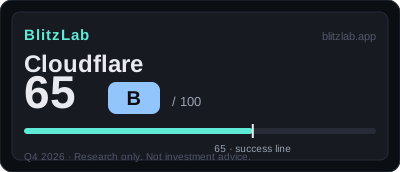
Cloudflare — Blitz Index 65 (B)
22 straight quarters of growth — the reason it is 3 points short is all in the demerits.
Last re-scored: November 5, 2026.
Confidence: High · Category: platforms
Score breakdown
| Section | Score | Detail |
|---|---|---|
| A · Speed | 19 / 25 | 22 straight quarters of growth; Q2 +35.9% YoY; FY2026 guidance +32% |
| B · Moat | 39 / 60 | DBNRR 120% + RPO $2.73B (+35%); 4,698 $100k+ customers (+26.5%) |
| C · Creative destruction | 11 / 15 | Workers + Workers AI — the Agentic Internet second curve |
| D · BlitzFailing | −4 | Founder duo 52.4% vote; SBC 20.8%; $5.8B 0% convertibles |
Think we scored it wrong? Score it yourself →
Radar axes (0–100): Moat 65 · Speed 76 · Creative 73.
Watch item
Gates: G1 ✓ · G2 ✓. 3 points below the threshold — first score. The DDOG pattern without the re-acceleration price: every missing point is in D.
Strengths
- DBNRR 120% (4 straight quarters at 118%+)
- RPO $2.73B (+35% YoY, SEC)
- FY2026 revenue guidance +32% (SEC 8-K)
- Workers AI — the second-curve candidate
Concerns
- Founders' combined 52.4% voting power (DEF 14A)
- SBC 20.8% of revenue — persistent dilution
- Gross margin 78% drifting to low-70s — cost-structure shift
- 2026 notes ($1.29B) maturity handling undisclosed
Research notes
1. Current Position: A Clean Business Carrying a Heavy Bill
Cloudflare, Inc. enters this scoring period as a mature software-as-a-service company whose operating record is, on the evidence in the score file, unusually clean — and whose score is nevertheless held at the 65-point line by deductions alone. That tension is the whole story of this assessment, and it is worth stating plainly at the outset because it shapes everything that follows. Add the three positive axes together and Cloudflare reaches 69 points: speed 19 out of 25, moat 39 out of 60, and creative destruction 11 out of 15. Subtract the four demerit points and the total falls to 65, exactly on the threshold BlitzLab treats as success. No flag applies, since demerits of 4 sit well below the 15-point flag threshold, but the shortfall is real, and its cause is narrow: the business, as scored, clears the bar, while the claims attached to that business — in debt structure and, above all, in governance — pull it back to it.
The company behind the score was founded on July 26, 2009, in Delaware, and listed on September 13, 2019, at $15 per share on a press-reported basis. By the scoring date of October 16, 2026, it is classified in the score file as a mature SaaS company, with trailing-twelve-month revenue of approximately $2.51 billion and a market capitalization of approximately $112.6 billion on a press-reported basis as of October 15, 2026. The latest results available at T are for the second quarter of 2026, filed on August 6, 2026; third-quarter 2026 results, due after the market close on November 5, 2026, fall after T and are therefore excluded from this assessment. The confidence level recorded in the score file is high, resting on direct review of the full texts of the fiscal 2025 Form 10-K, the second-quarter 2026 Form 10-Q, Form 8-K filings, and the definitive proxy statement on SEC EDGAR, together with XBRL company facts checked directly, and with the company's CIK number, 1477333, confirmed by direct lookup in the SEC's company tickers file rather than by guesswork. This is the company's first scoring in the BlitzLab system, with no blind process attached, and the assessment that follows is built only on what those filings and the cited reporting support.
Both gates of the BlitzLab model pass, and the manner of their passing already previews the company's character. Gate 1, which asks whether growth continues or a second growth curve exists, passes on confirmed figures. Revenue rose from $138.1 million in the first quarter of 2021 to $696.1 million in the second quarter of 2026, twenty-two consecutive quarters of quarter-on-quarter increase confirmed in SEC XBRL data, without a single quarter in the sequence breaking the run. Second-quarter 2026 revenue grew 35.9 percent year on year, and full-year 2026 guidance of $2,864 million to $2,870 million, implying growth of 32 percent year on year, is confirmed in a Form 8-K. Dollar-based net retention of 120 percent, sustained for four consecutive quarters at 118 percent or above, customers paying more than $100,000 a year numbering 4,698 and up 26.5 percent year on year, and remaining performance obligations of $2,732 million, with current remaining performance obligations up 35 percent year on year, are all confirmed in SEC filings. A candidate second curve is named — the Workers developer platform and Workers AI, described by the chief executive in the second-quarter earnings press release, on a confirmed basis, as the infrastructure, control, developer tools, and payment rails of what he called the Agentic Internet — but the score file is careful to record that the demonstration of that curve remains at a qualitative stage. Gate 1 passes on the first curve, not on a promise about the second.
Gate 2, which asks whether the ten-year ceiling of the new market is at least ten times current revenue, passes on an estimate. Ten times trailing-twelve-month revenue of approximately $2,512.4 million sets a bar of approximately $25.1 billion. Against that bar, the company-presented total addressable market of $196 billion for 2026, drawn from an investor presentation for the fourth quarter of 2025 hosted by Quartr and based on company analysis drawing on Gartner and IDC, is press-reported and company material, and stands at approximately 7.8 times the bar. An Investor Day update citing $238 billion for 2026 and more than $300 billion for 2028 rests on a single secondary source and is recorded in the score file for reference only. The gate therefore passes, but the quality of its evidence is openly weaker than Gate 1's, and that difference in evidence quality — confirmed operating facts on one side, company-presented market sizing on the other — runs through the entire score. Where the filings speak, this assessment can be firm. Where only the company or a single secondary source speaks, it says so.
2. Speed: Twenty-Two Quarters Without a Break, and Re-Acceleration at Scale
Speed scores 19 out of 25, and its composition describes a mature company that is not slowing down in the way mature companies are expected to. Growth itself earns 9 out of 10, the strongest single speed item. The long arc runs from fiscal 2021 revenue of $656.4 million to fiscal 2025 revenue of $2,167.9 million, up 30 percent year on year, and on to trailing-twelve-month revenue of $2,512.4 million at T. Within that arc, the recent shape matters more than the level: growth of 28.6 percent in 2024, then 30 percent in 2025, then approximately 34 percent in the first half of 2026, with second-quarter 2026 growth of 35.9 percent year on year, all confirmed. This is re-acceleration, not deceleration, and it is happening at a revenue scale above $2.5 billion, which is why the score file places it in the top tier for mature SaaS and rates it on a par with Datadog, which also scores 9 on this item. The one point withheld from the maximum record a simple boundary: this is not the triple-digit explosive growth that the top of the scale describes, and the model does not award the maximum for a growth rate in the thirties, however durable. The twenty-two-quarter unbroken sequence is the evidentiary anchor here. A single quarter of decline would have broken it; none did, across a period that includes the post-pandemic normalization, interest-rate tightening, and the artificial-intelligence investment cycle. Durability of that kind is rarer than a single spectacular quarter, and the score treats it as such, while still refusing to confuse durability with explosion.
Capital velocity earns 4 out of 5, and the reasoning turns on access to capital at terms that, for a company still reporting GAAP operating losses, are strikingly favorable. Market capitalization of approximately $112.6 billion as of October 15, 2026, on a press-reported basis, already signals capital access of the highest order. The decisive event is the August 13, 2026 issuance of $2.5 billion of 0 percent convertible notes maturing in 2031, confirmed in a Form 8-K, with a conversion price of $496.94 representing a premium of 60 percent over the August 10 closing price, also confirmed. A company able to raise two and a half billion dollars at zero coupon and at a 60 percent conversion premium is a company whose capital providers are pricing in substantial future equity value rather than demanding current yield. Active fundraising is further evidenced by the $2.0 billion of 2030 notes issued in June 2025, confirmed in a Form 8-K dated June 17, 2025. The point withheld from the maximum is not explained in the score file as a doubt about access; it is the ordinary reserve of a scale that stops one step short of the top, and the assessment preserves that reserve rather than rounding it away.
The two remaining speed items are more modest, and their modesty is informative. Hiring and productivity earn 3 out of 5. Headcount stood at 5,156 employees as of December 31, 2025, of whom 2,452 were outside the United States, confirmed in the Form 10-K. Revenue per employee, calculated as trailing-twelve-month revenue divided by that headcount, is approximately $0.49 million per person, which the score file describes as a standard level for SaaS. The limit on the item is a disclosure gap: second-quarter 2026 headcount was not disclosed, which the score file records as unconfirmed, so the productivity figure cannot be refreshed to T and the item is scored at the same level as Datadog. Share velocity also earns 3 out of 5, on a similar balance of confirmed strength and missing measurement. Customers paying more than $100,000 a year reached 4,698 in the second quarter of 2026, up 26.5 percent year on year on a confirmed basis, which is direct evidence that the customer base is moving upmarket rather than merely widening. The score file also cites press-reported claims, via ainvest and Business Insider, that more than 45 percent of the Fortune 500 are paying customers. But no quantified market share figure has been disclosed, which is recorded as unconfirmed, and the score file explicitly contrasts this with Datadog, which scores 4 on the item on the strength of a Gartner Magic Quadrant position held for six consecutive years confirmed in SEC filings. Cloudflare's large-customer growth is real and confirmed; its share of its market, as a number, is not public, and the score refuses to invent it. Speed, taken as a whole, is therefore the subscore of a company growing faster at $2.5 billion than it did at smaller scale, raising capital on equity-like terms, expanding into larger customers, and still leaving two ordinary measurement gaps — current headcount and quantified share — unfilled.
3. Moat: An Edge Network That Improves as It Grows, and Distribution That Expands Itself
Moat scores 39 out of 60, the largest subscore in absolute terms, and its internal pattern is the most instructive part of this assessment: distribution and market size are strong, while the classic network effect, though structurally present, cannot yet be quantified. Network effects earn 8 out of 18. The mechanism is described in the Form 10-K's business section on a confirmed basis: a global edge network exhibits scale economies in which, as points of presence multiply, performance and security improve for every customer, because threat intelligence circulates across the network. Every additional point of presence and every additional customer therefore has the potential to make the network more valuable to those already on it, which is the structural shape of a network effect even before any number is attached to it. Supporting evidence includes the Workers developer platform ecosystem, dollar-based net retention of 120 percent confirmed in SEC filings, and total paying customers of 332,466 as of the fourth quarter of 2025, confirmed in SEC filings. What keeps the item at 8 rather than higher is the absence of a disclosed quantitative network-effect figure, recorded as unconfirmed. The score file places the item at the top of the anchor band described as a data or ecosystem effect that exists but is weak, spanning 5 to 9 points, and rates it on a par with Datadog. The distinction matters. Cloudflare's network effect is not asserted as a slogan; its mechanism is documented in the company's own filed description of its business, and its correlates — retention, paying-customer count, developer platform — are confirmed. But a mechanism with correlates is not yet a measured effect, and the model scores the gap between those two things rather than collapsing them.
Distribution scalability earns 12 out of 18, the strongest moat item, and here the evidence is at its firmest. The go-to-market structure is land-and-expand, combining self-serve adoption with direct sales, confirmed in the Form 10-K. Dollar-based net retention of 120 percent, sustained for four consecutive quarters at 118 percent or above, confirmed in SEC filings, means that the existing customer base, on balance, spends more each period than it did before — expansion outweighing churn in net terms. Remaining performance obligations of $2,732 million, of which 64 percent is expected to be recognized within the next twelve months, confirmed in SEC filings, means that a large volume of future revenue is already contracted rather than merely hoped for. The score file describes developer adoption as the base of strong repeat expansion, and places the item at the bottom of the anchor band described as a strong viral mechanism or a large distribution partner, spanning 10 to 14 points, again on a par with Datadog. The logic of land-and-expand deserves emphasis because it is the engine that connects the moat to the speed score: a customer who arrives through self-serve or developer adoption and then expands spending by a fifth in a year is distribution that compounds without a proportional increase in selling effort. That is why a retention figure of 120 percent does double duty in this assessment, appearing as evidence for both the network-effect item and the distribution item. It is not double-counting in the loose sense; it is one confirmed fact bearing on two different questions, one about whether the product becomes more valuable as it spreads, and one about whether revenue spreads itself once a customer has landed.
Market size earns 10 out of 12, and gross margin earns 8 out of 12, and together they complete the moat picture with a characteristic split between a large claimed opportunity and a good but softening profit structure. The market-size mark follows directly from Gate 2: the company-presented total addressable market of $196 billion for 2026 stands at approximately 7.8 times the $25.1 billion bar, so the gate passes with room to spare. The two points withheld from the maximum record the provenance of the figure: it is the company's own claim, press-reported and company material, not an independently verified market measurement, and the model does not award full marks for a self-presented market size. The score file rates this item on a par with Datadog for the same reason. Gross margin tells a more dynamic story. The margin was approximately 78 percent in 2021, fell to a low of 71.2 percent in the first quarter of 2026, and recovered slightly to 71.8 percent in the second quarter of 2026, on SEC XBRL data with a confirmed and estimate mix, while fiscal 2025 gross margin was 74.5 percent. The level remains in a healthy band for a scaled infrastructure business, and the second-quarter uptick interrupts the decline, but the direction over five years is downward, and the company continues to report GAAP operating losses — a loss of $170 million in the second quarter of 2026, including $150.7 million of restructuring expense, on a confirmed basis, and a fiscal 2025 loss of $102.3 million — alongside a non-GAAP operating margin of 14 percent as cited in the score file and a fiscal 2025 free cash flow margin of 12.0 percent on a calculated basis. The score file therefore rates gross margin two points below Datadog's 10, at 8: the band is good, the trend is adverse, and GAAP losses persist, and the score holds all three facts at once rather than letting the level excuse the trend or the trend erase the level.
4. Creative Destruction: Displacing the Box, and Building for an Agent Web
Creative destruction scores 11 out of 15, and its three items trace a company in the middle of one substitution and at the threshold of another. The order being displaced earns 4 out of 5, the strongest creative-destruction item. The transition is architectural: from on-premises hardware boxes to what the company calls the Connectivity Cloud. The Form 10-K overview, on a confirmed basis, describes the old enterprise pattern — multiple on-premises boxes connected together — and argues that the move to the cloud has made that pattern unsustainable, with customers consolidating behind a single global cloud provider. That is a precise and falsifiable description of a displacement: not a single product being replaced, but an entire way of assembling enterprise infrastructure being retired in favor of a unified cloud layer. The score file records the substitution as in progress, broad in scope but not complete, and rates it one step above Datadog's 3. The withheld point is the completion reserve. A displacement that is underway across many customers is not yet a displacement that has finished, and the model keeps that distinction visible.
Irreversible behavior change earns 4 out of 5, again on a par with Datadog, and its evidence combines hard retention facts with a directional claim that is honestly labeled as early. Dollar-based net retention of 120 percent, confirmed in SEC filings, means expansion exceeds churn in net terms, which is behavior change measured in spending rather than asserted in prose. Remaining performance obligations of $2.73 billion, confirmed, mean customers have contracted future spending at scale. More than 45 percent of the Fortune 500 being paying customers, on a press-reported basis via ainvest and Business Insider, suggests the behavior has reached the largest enterprises rather than remaining confined to early adopters. Alongside those facts sits the forward-looking claim: that the web is shifting toward AI agents and answer engines, and that Cloudflare is building the infrastructure, control, developer tools, and payment rails for that shift, in the chief executive's words in the second-quarter earnings press release on a confirmed basis. The score file is explicit that the direction is certain while the measurement remains at a qualitative stage, and the mark of 4 reflects that split — strong evidence that customers have already changed how they purchase and expand, plus a clearly stated but not yet measured thesis about how the web itself will change next.
Cost structure change earns 3 out of 5. The mechanism is the edge network's scale economy, confirmed in the filings: the marginal cost of an additional customer is low, and the gross margin band of 71 to 78 percent is consistent with that structure. The score file rates this above Datadog's 2 because Cloudflare's own network economy is real rather than merely analogous to a peer's. What keeps the item at 3 is a measurement gap recorded as unconfirmed: no company-published measured figure for unit-cost collapse has been disclosed, so the magnitude of the cost-structure change, as distinct from its existence, cannot be verified. The pattern across all three creative-destruction items is therefore consistent. The displacement is documented in the company's filed description of its business. The behavior change is measured in retention and contracted revenue, with a forward thesis attached and labeled as such. The cost change is structurally real and directionally favorable, but unmeasured in unit terms. A score of 11 out of 15 describes a company well into its creative destruction, not one that has finished it, and the three withheld points across the items are, in each case, reserves for completion or measurement rather than doubts about direction.
5. Deductions and Risks: Where the Three Missing Points Went
Demerits total −5, and their composition is the key to the entire assessment, because every one of the three points by which Cloudflare falls short of 65 can be found here. Debt earns −2. Total debt stood at $4,854.1 million as of June 30, 2026, on a confirmed basis in SEC filings, equal to approximately 1.9 times trailing-twelve-month revenue. The book value of notes was $3,270.3 million, comprising $1,293.3 million of 2026 notes classified as current and $1,977.0 million of 2030 notes, and the August 13, 2026 issuance of $2,500 million of 2031 notes, confirmed in a Form 8-K, takes the pro forma total to approximately $5.8 billion on an estimated basis, or approximately 2.3 times trailing-twelve-month revenue. Against that leverage, the offsets are substantial and confirmed: the notes carry a 0 percent coupon, so quarterly interest expense was only $3.1 million against interest income of $39.9 million, and cash and equivalents of approximately $4.16 billion leave net debt of approximately $1.6 billion. The deduction is therefore mild, and the score file describes it as such — leverage exists, but a zero coupon and abundant liquidity make it light. The live question inside the item is recorded as unconfirmed: how the $1.29 billion of 2026 notes will be handled at maturity has not been disclosed. That single undisclosed refinancing decision is the kind of ordinary corporate-finance event that rarely makes headlines and frequently decides whether a mild deduction stays mild.
Revenue quality earns 0, and the zero is a positive finding rather than an absence of analysis. There has been no revenue restatement, no auditor change, and no audit-opinion issue, with KPMG as auditor, on a confirmed basis. The gross margin decline from approximately 78 percent to the low seventies is explicitly judged in the score file to be a structural change in costs rather than a quality problem, on an estimated basis, and no trigger for a deduction is present. This matters because a company reporting GAAP losses while growing rapidly is exactly the profile in which a reader might suspect that revenue quality is doing hidden work. The score file checks that suspicion against the filings and finds no support for it. The margin decline is visible, explained as cost structure, and not treated as evidence of misstatement. A zero here is the model saying, after looking, that there is nothing to deduct.
Governance earns −3, the largest single deduction, and it is where the assessment becomes most pointed. The share structure carries differential voting rights: Class A shares carry one vote each and Class B shares carry ten votes each, confirmed in the definitive proxy statement. The two founders together control 52.4 percent of the voting power — Prince at 39.0 percent and Zatlyn at 13.4 percent, confirmed in the definitive proxy statement dated June 9, 2026 — which is majority control. The officer and director group accounts for 99.0 percent of Class B shares, also confirmed. Stock-based compensation in fiscal 2025 was $451.5 million, equal to 20.8 percent of revenue, on a confirmed basis, and the level is structural rather than a one-year spike: 21.1 percent in 2023 and 20.3 percent in 2024. A further governance event is recorded with its uncertainty preserved: the creation of Class C non-voting shares was approved at the June 30, 2026 annual meeting, but the Form 8-K giving effect to that creation had not been filed by T, a confirmed and unconfirmed mix. The score file rates this item more severely than Datadog's −2, where founder voting control stands at 32.8 percent, precisely because Cloudflare's founders command an outright majority rather than a large minority. The difference between 32.8 percent and 52.4 percent is not a difference of degree in governance terms; it is the difference between influence that must still win a vote and control that decides one.
Regulation and social cost earn 0, again as a no-trigger finding, but with a concern recorded rather than buried. The second-quarter 2026 Form 10-Q contains no material litigation disclosure, on a confirmed basis. A shareholder lawsuit related to Class C shares is reported by a single weak secondary source, ainvest, on a press-reported basis described as weak, and the score file explicitly does not reflect it in the score, recording it only as a concern. The Form 10-K's Item 1A risk factors, on a confirmed basis, disclose a history of sustained net losses, with an accumulated deficit of $1,204.9 million, uncertainty over profitability, and debt repayment risk. No confirmed regulatory issue is present. The zero therefore means something specific: no confirmed regulatory or litigation cost currently warrants a deduction, while two disclosures — the accumulated deficit and the weak-sourced lawsuit report — remain on the record for a reader to weigh. The demerit total of −5 thus decomposes into a mild, well-offset debt item, a clean revenue-quality check, a majority-control governance item, and a clean regulatory check with a noted concern. Remove the governance item alone and the score would clear 65. That arithmetic is not an argument for removing it; it is a measurement of how much of this company's shortfall is about who controls it rather than how its business performs.
6. The Blitzscaling Fit: Distribution Plus Capital, With a Control Bill Attached
Stepping back from the item scores, the score file's blitzscaling analysis places Cloudflare in a recognizable type: a distribution-plus-capital blitzer, a variant of the same species as Datadog, expressed in networking and security rather than observability. The main lever is distribution, in two fused forms — the physical edge network of points of presence and the developer adoption that brings customers onto it — and the twenty-two-quarter growth sequence is the distribution network doing its work. The secondary lever is capital, in the distinctive form of zero-coupon convertible debt: money raised at no current interest cost, which buys time without burning the engine, since quarterly interest expense of $3.1 million is negligible against the scale of the business. The weak lever is the quantification of network effects. The threat-intelligence circulation mechanism is real and filed, but it has not been converted into a number, and the score file names that conversion as a task for a future version of the model. A blitzer whose main lever is distribution and whose fuel is nearly free capital is a coherent strategic shape, and the score's speed and distribution marks reflect that coherence.
The trade-off Cloudflare has made between speed and efficiency is equally distinctive, and it is best understood as a bargain struck on three sides at once. On the first side, zero-coupon financing buys time without interest cost: the classic price of blitzscaling, the interest bill, is not being paid. On the second side, GAAP losses are accepted while growth is pursued, with the gap between a non-GAAP operating margin of 14 percent and continuing GAAP operating losses explained in the score file by stock-based compensation of $451.5 million and restructuring expense — an accounting loss alongside cash generation, in the score file's own contrast. On the third side, the price is paid in governance rather than in interest or in cash: majority founder voting control of 52.4 percent plus the creation of non-voting Class C shares describes a structure in which public-market capital is raised while decision-making stays fixed with the founders. The score file's framing of the single largest risk follows directly from that bargain, and it is worth quoting in substance because it is the sharpest sentence in the assessment: the founders' company is larger than the shareholders' company. Capital is raised from the public market, control is not shared with it, and stock-based compensation at 20.8 percent of revenue is the ongoing maintenance cost of that structure. Blitzscaling doctrine includes a rule not to fear ownership dilution, but under founder majority control that rule operates one-sidedly: founders dilute outside holders while retaining control themselves, and on a day when the business falters, that control structure will slow a change of direction rather than accelerate one. That is not a prediction that the business will falter; it is an observation about what the governance structure would do if it did, and it is why a governance deduction belongs in a blitzscaling score at all, rather than being treated as a separate corporate-governance footnote.
The stage judgment in the score file places Cloudflare at a boundary that will resolve in the coming quarters: the late phase of a first blitz, at the edge between harvest and re-blitz. The first curve is still accelerating — 28.6 percent, then 30 percent, then approximately 34 percent — which is not the profile of a business settling into harvest. The second curve, Workers and Workers AI for an agent-driven web, is named, described by the chief executive in confirmed press-release language, and not yet demonstrated in measured results. If that second curve materializes in revenue, retention, and large-customer adoption at the scale the first curve has shown, the period will be recorded as a re-blitz. If it does not, the same period will be recorded as the harvest phase of a successful first blitz. The assessment does not prejudge that fork. It records the first curve as confirmed, the second as a candidate at a qualitative stage, and the fork itself as the central question for the next scoring period. That discipline — refusing to score a second curve before it has numbers — is part of why the score is credible at 62 rather than flattering at a higher figure.
7. What to Watch
Several observable markers will determine whether this 65/B rises, stays level, or falls, and each of them is already named in the score file's evidence. The first is the twenty-two-quarter sequence itself. Third-quarter 2026 results, due after the market close on November 5, 2026, fall after this assessment's as-of date and are therefore excluded here; they will be the first new evidence on whether the unbroken run extends to twenty-three quarters and whether the re-acceleration toward the mid-thirties holds. A break in the sequence, or a return toward the high twenties, would move the growth item before it moved anything else. The second is the handling of the $1.29 billion of 2026 notes at maturity, currently undisclosed and recorded as unconfirmed. Whether those notes are refinanced, converted, repaid from the approximately $4.16 billion cash position, or addressed by another instrument will show whether the mild debt deduction stays mild or acquires a harder edge, and the pro forma debt figure of approximately $5.8 billion should be recomputed against whatever actually happens rather than carried forward as an estimate.
The third marker is governance in action: whether the Form 8-K giving effect to Class C non-voting shares is filed, and what the weak-sourced report of Class C-related shareholder litigation becomes when tested against primary sources. The score file deliberately does not score that report, and a reader should follow the same discipline — treating a single weak secondary source as a prompt to look for a filing, not as a fact. If a primary filing appears, the regulatory item must be revisited; if none appears, the concern remains a concern and nothing more. The fourth marker is stock-based compensation as a share of revenue. At 20.8 percent in fiscal 2025, following 21.1 percent and 20.3 percent in the two prior years, the level is structural. A sustained move down would ease the governance deduction's supporting logic; a sustained move up would strengthen it. The fifth marker is gross margin direction. The second-quarter recovery to 71.8 percent from a first-quarter low of 71.2 percent interrupts a five-year decline from approximately 78 percent, but one quarter of recovery does not establish a reversal, and the margin item will turn on whether the low seventies become a floor or a staging post for a further decline.
Two further markers sit at the boundary between the scored business and the unscored future. One is the quantification of the network effect: any company-published measured figure for threat-intelligence circulation, developer-platform effects, or edge-network scale economies would convert the weakest moat item from a documented mechanism into a measured one, and could move the network-effect item out of the 5-to-9 band in which it currently sits at 8. The other is the Workers and Workers AI second curve: any disclosed revenue, customer, or retention evidence attached specifically to that platform, as distinct from the Connectivity Cloud as a whole, would move the second curve from a qualitative candidate to a scored reality, and with it the stage judgment from a boundary to a direction. Finally, the valuation note, which the model deliberately excludes from the score, records a market capitalization of approximately $112.6 billion on a press-reported basis as of October 15, 2026, and a price-to-sales ratio of approximately 44.8 times trailing-twelve-month revenue of $2.51 billion. The market capitalization stands at approximately 4.5 times the $25.1 billion Gate 2 bar and approximately 57 percent of the company-presented $196 billion total addressable market. The business score does not look at price, following the lesson of BlitzLab's earlier testing that a business score and a market price measure different things, but a reader who cares about the distance between a business ceiling and a price that already reflects a large multiple of current revenue will find those figures here, labeled as press-reported and calculated estimates and kept separate from the score.
Cloudflare at 65/B is, in the end, a portrait of a business performing at an elite level and a control structure charging a visible price for that performance. Twenty-two quarters without a break, growth re-accelerating into the mid-thirties at $2.5 billion of revenue, retention of 120 percent, contracted revenue of $2.73 billion, capital raised at zero coupon and a 60 percent conversion premium, and a displacement of the on-premises box that is broad and underway — that is the business, and it scores 67 before deductions. Majority founder voting control of 52.4 percent, stock-based compensation at a structural 20.8 percent of revenue, a non-voting share class approved with its effectiveness still unfiled at T, and pro forma debt of approximately $5.8 billion against a cash position of approximately $4.16 billion — that is the bill, and it costs five points. Three of those five points are the difference between this score and the 65-point line. Whether the next period closes that gap will depend less on whether the business keeps growing, which it has done for twenty-two consecutive quarters, than on whether the claims attached to the business — in control, in dilution, and in refinancing — stay as light as the current score judges them to be.
Head-to-head
Cloudflare vs Zscaler — side-by-side scorecard comparison.
More Platforms companies
Other Platforms names on the Blitz Index, highest score first: Alphabet (83/A), Meta (78/B), Airbnb (76/B).
Next earnings
Q4 2026 · Expected
Coverage
Cloudflare, Inc. · Q3 2026 due Nov 5, 2026 (AMC) · Score 65 · Grade B · 65+ Club member
Embed this score
Copy the HTML below to show this score on your site. The badge links back to this page and updates automatically when the score changes.
Preview:
BlitzLab scores businesses against a scholar’s standard — not investment advice. No price targets, no buy/sell recommendations. Figures are from SEC filings (XBRL) as labeled in the source scorecard.