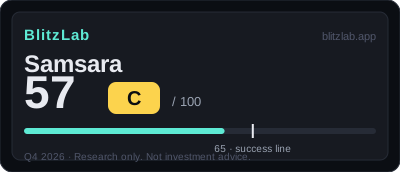
Samsara — Blitz Index 57 (C)
$2.1B ARR and GAAP profitability — but the market already priced the ceiling.
Last re-scored: October 18, 2026.
Confidence: High · Category: platforms
Score breakdown
| Section | Score | Detail |
|---|---|---|
| A · Speed | 18 / 25 | ARR $2.125B at +30% for 3 straight quarters — deceleration stabilized into re-acceleration |
| B · Moat | 34 / 60 | $100K+ customers 3,605; $1M+ ARR +50%; 25T+ data points/year feed AI products at 20%+ of net new ACV |
| C · Creative destruction | 11 / 15 | From SMB telematics to the enterprise fleet OS — AI features as the new wedge |
| D · BlitzFailing | −6 | Founder voting ~85% (Class B 10 votes); SBC 19.5% of revenue; company-claimed TAM ($117–200B) is top-down inflated |
Think we scored it wrong? Score it yourself →
Radar axes (0–100): Moat 56.7 · Speed 72 · Creative 73.3.
Watch item
Gates: G1 ✓ · G2 ✓. 8 points below the threshold — the business re-accelerated; the multiple got there first.
Strengths
- ARR $2.125B (+30%), 3 straight quarters — stable after deceleration
- 4 straight GAAP-profitable quarters + first operating profit — the turn is complete
- 76.8% gross margin (subscription 98.1%) — top-tier SaaS margins
- $100K+ customers 3,605, $1M+ at 210 — enterprise penetration accelerating
Concerns
- Founder voting ~85% via Class B — limited minority say
- SBC at 19.5% of revenue — trending down but large in absolute terms
- Claimed TAM ($117–200B) is top-down inflated — serviceable share unverified
- Fragmented market (top 5 ~25%) — a long share war
Research notes
Thesis: The Dashboard for the Physical World
Samsara sells a single idea to companies that run trucks, warehouses, construction sites, and field-service fleets: the physical operations of a business, long managed through a patchwork of disconnected tools, can be run from one platform. Dash cameras, GPS trackers, electronic logging devices, equipment sensors, and paper workflows each once lived in their own silo. Samsara's Connected Operations platform pulls them into one dashboard, and charges for the bundle as a subscription. The hardware that sits in a vehicle or on a piece of equipment is not sold as a standalone product; under the company's accounting, bundled devices are part of a single performance obligation combined with the subscription, which is why subscription revenue accounts for 98.1% of total revenue.
The company was founded by Sanjit Biswas and John Bicket, who had previously co-founded Meraki, and it listed on the New York Stock Exchange on December 15, 2021. As of the scoring date of October 18, 2026, Samsara is classified as a growth company, with trailing-twelve-month revenue of about $1.85 billion and a market capitalization of roughly $23.2 billion. Its most recent reported quarter at that date was the second quarter of fiscal 2027, reported on September 3, 2026. Fiscal 2026, in the company's own convention, is the year ended January 31, 2026. The third quarter of fiscal 2027 had not yet been reported as of the scoring date and is therefore excluded from this assessment; it stands only as a future marker.
Samsara's BlitzLab score is 57 out of 100, grade C. That total is built from 18 points for speed, 34 for moat, 11 for creative destruction, and minus 6 in deductions. The score sits 8 points below the 65-point threshold, which means the business, on this methodology, is not yet at the level the model associates with its highest tier. The shape of the score matters more than the headline. Speed and creative destruction are comparatively strong, at 18 of 25 and 11 of 15 respectively, while moat, at 34 of 60, is the constraint. The company's own score file phrases the tension bluntly: the business looks like a B-grade operation held to a C-grade total by its governance deduction and its stock-based compensation load. This draft follows that evidence, section by section, and keeps every figure tied to the score file's sources, which rest primarily on Samsara's filings with the U.S. Securities and Exchange Commission — its fiscal 2026 Form 10-K filed March 16, 2026, its second-quarter fiscal 2027 Form 10-Q filed September 8, 2026, and its earnings release furnished on Form 8-K on September 3, 2026 — supplemented by shareholder-letter material reported in the press and by market reports cited on a press-reported basis.
Speed: Deceleration, Then Three Quarters of Stability
Growth is the first thing to examine, because Samsara's recent history is a study in how a fast-growing software company matures without stalling. Annual revenue rose from $937.4 million in fiscal 2024, up 43.7%, to $1,249.2 million in fiscal 2025, up 33.3%, and then to $1,618.6 million in fiscal 2026, up 29.6%. Those are audited, SEC-confirmed figures, and the direction is unmistakable: growth decelerated from the low forties to just under thirty percent. What happened next is what earns the company's growth item a 7 out of 10 rather than something lower. Quarterly year-over-year growth traced a path from 37.4% down to 29.9%, and then annualized recurring revenue growth stabilized at 30% for three consecutive quarters. Annualized recurring revenue itself reached $2.125 billion, up 30% year over year, in the second quarter of fiscal 2027. The score file treats this as a re-acceleration pattern of the kind previously associated with Datadog: a mature software company whose growth rate stops falling, steadies, and holds. It is not explosive acceleration, and the score reflects that distinction — sustained high speed, but not a breakout.
The forward-looking markers point in the same direction. Fiscal 2027 guidance implies growth of about 26%, and it was revised upward. Quarterly net new annualized recurring revenue reached $134.1 million, and fiscal 2026 net new annualized recurring revenue of $432 million grew 21% on a constant-currency basis, an acceleration from the prior year. The two gates that precede any scoring both pass. The first gate, sustained growth or a second growth curve, passes on confirmed evidence: the $2.125 billion recurring revenue base growing at 30%, four consecutive quarters of GAAP net income beginning in the third quarter of fiscal 2026, and a first quarter of GAAP operating profit in the first quarter of fiscal 2027. The second gate, a ten-year revenue ceiling at least ten times current revenue, passes on an estimate. The bar is approximately $20.5 billion, defined as ten times the midpoint of fiscal 2027 guidance revenue of roughly $2.045 billion. The company's claimed total addressable market of $117 billion to $200 billion for the digitization of physical operations, with a claimed compound annual growth rate of 22%, is a top-down figure that the score file explicitly discounts as generous; even so, the bar amounts to only 10 to 17.5% of that claimed market, so the gate passes on arithmetic rather than on the edge of the estimate. That discount is worth keeping in mind throughout: the market-size case is sufficient, but it is not proven by bottom-up evidence.
Capital velocity, scored 3 out of 5, tells a quieter story. Since its initial public offering, Samsara has not raised large amounts of new equity capital; it has funded growth from operating cash flow. That self-reliance is unusual among blitz-scaling companies, which typically consume external capital to buy speed, and it is a genuine strength. The other side of the ledger is that the company has little recent demonstrated record of raising capital at scale, so the unused capacity is unproven rather than proven. Two October 2026 events sit in the background of this item and must be reported with their labels intact. On October 15, a founder stock sale under a pre-arranged 10b5-1 trading plan was disclosed, and on October 16 the share price fell 7.1%, as reported by MarketBeat. The score file records the timing overlap and explicitly notes that causation is unconfirmed. It is background, not a scored fact, and it should not be read as more than that.
Hiring and productivity, scored 4 out of 5, support the picture of a company growing efficiently rather than merely quickly. Headcount exceeds 4,100 employees, up 17% year over year, while revenue per employee stands at roughly $395,000 for fiscal 2026, a solid software-company productivity figure, and a healthy one given that the business also ships hardware. Share-of-market velocity, scored 4 out of 5, is where speed becomes most concrete. Customers with more than $100,000 in annualized recurring revenue grew from 1,964 to 3,605 over five years, reaching 3,605 with a quarterly record addition of 242 in the latest reported quarter. Customers above $1 million reached 210, also a quarterly record, with 20 added in the quarter. The point the score file stresses is not the share number itself but the direction of travel: the company is moving upmarket, and the speed of that enterprise migration is the evidence.
Moat: An Enterprise Migration, Not Yet a Network Effect
The moat section, at 34 of 60, is the weakest part of the score relative to its maximum, and each of its four items explains a different piece of that verdict. Start with the network effect item, scored 8 out of 18. Samsara processes more than 25 trillion data points per year, confirmed in its earnings release, and that data is the fuel for its artificial intelligence platform. Dollar-based net revenue retention stands at approximately 115% for the core business, on a shareholder-letter basis as reported in the press. Multi-product adoption is the strongest single lock-in statistic in the file: 96% of customers above $100,000 in annualized recurring revenue use two or more products, and 72% use three or more. Emerging artificial intelligence products account for more than 20% of net new annual contract value, and have done so for three consecutive quarters. That is real evidence of a data flywheel taking shape — more customers, more data, better AI products, more adoption.
But the score file is careful about what this is not. Because the product is bundled with hardware installed in vehicles and equipment, switching costs are high, yet that is a switching-cost lock-in rather than a classic network effect in which each additional user makes the product more valuable to every other user. The data flywheel hypothesis is real but incomplete, and its proof will ultimately run through net revenue retention rather than through the raw volume of data points. The item sits at the top of the score file's anchor range for data and ecosystem effects, which spans 5 to 9, and 8 reflects a moat that is forming rather than finished.
Distribution scalability, scored 9 out of 18, is the strongest moat item, and it rests on two channels pulling in the same direction. The first is direct sales, which dominates: sales and marketing spending of $683.8 million amounts to 42.2% of revenue, and the company continues to land large deals, with 131 new annual contract value deals above $1 million in the fourth quarter of fiscal 2026, a quarterly record. The second is embedded distribution through original equipment manufacturer partnerships — Hyundai Translead, Stellantis, Rivian, and Continental — under which Samsara's technology is installed at the point of manufacture, on a press-reported basis. A third channel is newer: the Element Fleet Management partnership, which is expected on a press-reported basis to reach $70 million in annualized recurring revenue on an annualized basis by 2027. International expansion adds a further leg, with 15% of net new annual contract value coming from outside the United States and European annualized recurring revenue accelerating for four consecutive quarters. The score file places this at the top of its anchor range for paid, sales-dependent distribution that can nevertheless expand repeatedly, and the breadth of channels — direct, embedded, partner, and international — is what justifies the upper end of that range.
Market size, scored 8 out of 12, follows from the second gate. The bar of roughly $20.5 billion is small relative to the company's claimed $117 billion to $200 billion market, even after discounting the top-down character of that claim. The item stops short of the maximum because the serviceable share of that market has not been demonstrated, and because further acceleration in large-customer penetration would be needed to earn full marks. Gross margin, scored 9 out of 12, is the most conventionally impressive moat item. Gross margin rose from 73.7% in fiscal 2024 to 76.1% in fiscal 2025 and then to 76.8% in fiscal 2026, a gentle but steady climb confirmed in SEC filings and cross-checked against inline XBRL data. Subscription revenue is 98.1% of the total, and device costs of $144.0 million, equal to 8.9% of revenue, remain embedded in the cost structure. A 76.8% blended gross margin for a business that ships physical devices is, in the score file's words, top-tier for software. It is also moving in the same direction as profitability: the margin expansion coincides with the turn to GAAP profitability, which suggests the business model is scaling rather than merely growing.
Creative Destruction: Replacing the Point Solution
The creative destruction section, at 11 of 15, is the strongest relative performer, and it captures what Samsara is actually displacing. The first item, the order being replaced, scores 4 out of 5. The incumbent order is the point solution: a dash camera from one vendor, a GPS tracker from another, an electronic logging device from a third, and paper workflows tying them together loosely or not at all. Samsara replaces that stack with a single Connected Operations platform that combines video-based safety, telematics, equipment monitoring, and workflows in one dashboard. The target being replaced is clear and large, which is why the item scores highly.
The second item, irreversible behavior change, also scores 4 out of 5. The evidence is the enterprise migration itself: annualized recurring revenue of $2.125 billion reached less than five years after listing, and the share of revenue from large customers rose from 59% to 63%, with large-customer annualized recurring revenue of $1.3 billion growing 38% and customers above $1 million growing their annualized recurring revenue by 50%. Multi-product adoption of 96% means customer workflows are now tied to the platform rather than to any single tool. One further piece of evidence is competitive rather than commercial: Samsara's $30 million arbitration victory over Motive, a rival, is recorded in the score file as demonstrated competitive defense. Behavior change, in this account, is under way rather than complete, and the score reflects that it is a process, not a finished fact.
The third item, cost-structure change, scores 3 out of 5. Artificial intelligence agents such as the AI Safety Coach automate workflows, and the score file adopts the company's "Age of Intelligence" framing for this shift. The structural argument is that a single platform costs less in total ownership than the several point solutions it replaces. The reason the item stops at 3 is evidentiary: unit-level cost measurements have not been publicly disclosed, so the cost advantage is a coherent structure rather than a measured result. Creative destruction, in other words, is directionally strong but not yet fully quantified.
Deductions and Risks: Governance Is the Single Largest Problem
Deductions total minus 6, well below the 15-point threshold that would trigger a flag, so Samsara carries no flag. But the composition of those six points matters more than their size, because they concentrate in exactly the place a long-term observer would worry about.
Debt, scored minus 2 out of a possible minus 10, is the mildest concern. Samsara carries zero long-term borrowings, confirmed in SEC filings, and holds liquidity of approximately $840 million. The deduction comes instead from stock-based compensation: $315.0 million in fiscal 2026, equal to 19.5% of revenue. That is lower than the comparable case of Zscaler, where 24.5% of revenue drew a deduction of minus 3, and it is falling, down from 25.3% of revenue. Dilution runs at a moderate 2.7% per year. The combination of no debt and a declining stock-compensation burden is why the deduction is only minus 2, but the absolute scale of stock-based compensation remains large, and it is a real cost borne by shareholders even when it does not pass through the cash flow statement.
Revenue quality, scored 0, is clean on the available evidence. The score file records that no material weakness in internal control over financial reporting was identified in the Form 10-K at the time of fact collection, and that there were no revenue restatements and no auditor changes. The label attached is "unconfirmed (no-trigger)," which is the honest way to put it: nothing adverse surfaced, rather than everything having been affirmatively verified.
Governance, scored minus 4 out of a possible minus 5, is the dominant deduction and the single largest risk in the entire assessment. Samsara has a dual-class share structure in which Class B shares carry 10 votes per share, and the founders and pre-IPO shareholders control a majority of voting power, confirmed in the risk factors section of the Form 10-K. The score file quantifies this against an emerging anchor line for differential voting rights: Datadog at 32.8% voting concentration drew minus 2, Toast at 51% and Roblox at 58.8% drew minus 3, and Duolingo at approximately 76% and Coupang at 74.1% drew minus 4. Samsara's Class B voting share sits at approximately 85%, calculated as 212.3 million Class B shares times 10 votes divided by 2,491 million total votes, placing it squarely in the Duolingo and Coupang band and earning the same minus 4. The consequence is structural: outside shareholders own most of the economics but control a small fraction of the votes. Blitzscaling theory justifies concentrated control as the price of speed, and Samsara's history shows that speed being used well. But at this stage of maturity, the absence of a check on that control is a different kind of risk from the ordinary execution risks of a growing company, and the score file names it as the company's single greatest risk: the gap between the quality of the business, with a moat score of 34, and the quality of its governance, with a deduction of minus 4.
Regulatory and social cost, scored 0, rounds out the section. No securities litigation or fines have been confirmed. The founder's 10b5-1 plan sale is recorded as background, with causation for the subsequent share price move unconfirmed, and valuation multiples — a price-to-sales ratio of approximately 12.5 times trailing revenue and a price-to-earnings ratio of approximately 247 — are explicitly excluded from the score, since the scoring model evaluates the business rather than its price.
Two further risks deserve emphasis because they shape how the score should be read. The first is the market-share fight. On a press-reported basis, Samsara holds approximately 6% of the global telematics market, against approximately 7% for Verizon and approximately 5% for Geotab, and ranks second in smart fleet at 11.8%. The top five players together hold only about 25% of the market, which means the market is fragmented and the contest for share is a long campaign, not a short war. Sales and marketing spending at 42.2% of revenue is the price of that campaign. The second is the valuation gap, which is not scored but is central to any reading of the company. The market capitalization of roughly $23.2 billion is approximately 1.1 times the $20.5 billion bar, which means the market has already priced in a substantial portion of the ten-year revenue ceiling that the second gate tests. The score of 57 measures the quality of the business; the price measures something else. The distance between those two measurements is, in the score file's phrasing, the core question for anyone studying the company.
What to Watch
Several markers will determine whether Samsara's score moves, and each is grounded in a specific gap or trend in the score file. The first is whether the 30% recurring revenue growth rate holds, accelerates, or resumes its earlier deceleration when the third quarter of fiscal 2027 is reported; three quarters of stability is a pattern, but a fourth would make it a track record, and a break would reopen the deceleration question. The second is the enterprise migration: whether customers above $1 million continue to add at a record pace, whether large-customer annualized recurring revenue keeps growing faster than the total, and whether the large-customer share pushes beyond 63%. The third is the artificial intelligence story: whether emerging AI products sustain their share above 20% of net new annual contract value beyond three consecutive quarters, and whether dollar-based net revenue retention holds near 115%, since retention is the score file's chosen proof of the data flywheel. The fourth is international expansion, where European acceleration and the 15% non-U.S. share of net new annual contract value will show whether the platform travels beyond its home market. The fifth is the Element Fleet Management channel, whose press-reported expectation of $70 million in annualized recurring revenue by 2027 will test whether partner distribution can become a material second engine alongside direct sales.
On the risk side, the markers are equally specific. Stock-based compensation should continue its decline from 25.3% toward and below 19.5% of revenue; a reversal would widen the debt deduction. The governance structure will not change on its own, so the relevant question is not whether the dual-class structure persists — it will — but whether its consequences remain theoretical or become practical, and whether the company's record of using concentrated control well continues. The Motive arbitration outcome shows the company can defend its position; the longer test is whether the fragmented telematics market consolidates around a small number of platforms, and whether Samsara is one of them. Finally, the calendar matters: the score file notes that the third quarter of fiscal 2027 had not been reported as of October 18, 2026, and that quarter's results, when they arrive, will be the first new evidence on every trend described here.
Samsara's story, as the evidence stands, is that of a self-reliant blitz-scaler: a company that grew from under $1 billion to more than $2 billion in recurring revenue without leaning on large equity raises, that turned profitable on a GAAP basis while holding growth at 30%, and that is converting a fragmented, hardware-heavy market into a subscription platform one enterprise customer at a time. Its constraints are equally clear: a moat that is forming rather than finished, a market-share fight that will be expensive and long, and a governance structure that leaves outside shareholders with little formal voice. The score of 57, grade C, 8 points below the threshold, captures that balance without flattering either side.
More Platforms companies
Other Platforms names on the Blitz Index, highest score first: Alphabet (83/A), Meta (78/B), Airbnb (76/B).
Next earnings
Dec 3, 2026 · Expected
Coverage
Samsara Inc. · Q3 FY2027 due Dec 3, 2026 (expected) · Score 57 · Grade C
Embed this score
Copy the HTML below to show this score on your site. The badge links back to this page and updates automatically when the score changes.
Preview:
BlitzLab scores businesses against a scholar’s standard — not investment advice. No price targets, no buy/sell recommendations. Figures are from SEC filings (XBRL) as labeled in the source scorecard.