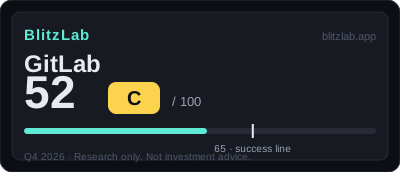
GitLab — Blitz Index 52 (C)
An elite-margin DevSecOps incumbent decelerating into GitHub's shadow, its AI second curve still unproven in revenue.
Last re-scored: October 20, 2026.
Confidence: High · Category: platforms
Score breakdown
| Section | Score | Detail |
|---|---|---|
| A · Speed | 15 / 25 | Growth +25.8% and slowing (guidance +18–19%); DBNRR down from 130% to 117% |
| B · Moat | 36 / 60 | Elite gross margin (84%) and self-hosting lock-in, but no quantified edge over GitHub is disclosed anywhere |
| C · Creative destruction | 8 / 15 | The single-platform DevSecOps shift is real; Duo AI consumption ($40M+ run rate) is still early |
| D · BlitzFailing | −7 | SBC at 22.5% of revenue, an AI-monetization securities lawsuit, founder voting control of 50.4% |
Think we scored it wrong? Score it yourself →
Radar axes (0–100): Moat 60 · Speed 60 · Creative 53.3.
Watch item
Gates: G1 ✓ · G2 ✓. Bar ≈ $11.3B (FY2027E revenue × 10); the market cap at 82% of the bar is a valuation note, kept out of the gate (BE precedent).
Strengths
- DevSecOps PMF is proven: ~$1.06B TTM revenue, DBNRR 117%, cRPO +20%+, 1,571 customers at $100K+
- Consumption signals: paid AI run rate $15M → $40M+ in one quarter; Flex drew 130+ customers in six weeks
- First Order +100% YoY (Q2 FY2027) — new-logo inflow re-accelerating
- Debt-free with ~$1.26B net cash and a $400M buyback executed; FY2027 guidance raised twice
Concerns
- Consistent deceleration: +30.9% → +25.8% → guidance +18–19%, approaching the sub-20% line
- Gross margin down three straight years (89.7% → 84%) on structural AI/SaaS hosting costs
- No disclosed win-rate or share data against GitHub — differentiation remains a qualitative claim
- Duo revenue is not broken out, so the second curve cannot be verified in numbers
Research notes
Thesis: Act One Is Finished, Act Two Is Unproven
GitLab is a company caught between two acts of its own story, and its score of 52 out of 100, grade C, is best read as a verdict on that in-between state rather than on either act alone. Act One — the consolidation of a fragmented DevSecOps toolchain into a single application — is complete. Revenue reached 955.2 million dollars in fiscal 2026, the dollar-based net retention rate held at 117 percent, and 1,571 customers each generated more than 100,000 dollars in annual recurring revenue. Act Two — the reinvention of that platform around AI agents that plan, write, secure, and ship code with growing autonomy — has begun but has not yet been proven in the numbers that matter most. The Duo Agent Platform reached general availability in January 2026, and its consumption run rate rose from 15 million dollars at the end of the first quarter of fiscal 2027 to more than 40 million dollars at the end of the second quarter, as reported in press coverage. That is a striking rate of change in a single quarter. It is not, however, a separately disclosed revenue line, and until it is, the second act remains a signal rather than a demonstrated growth curve.
That tension runs through every section of the score. The moat section, at 36 of 60, is the strongest part of the profile, carried by an elite gross margin and a large addressable market. The speed section, at 15 of 25, records a growth trajectory that is decelerating on every measure the score file tracks: annual revenue growth, quarterly revenue growth, guidance, and net retention. The creative destruction section, at 8 of 15, credits real displacement of point tools and real behavioral change around AI-assisted development, but withholds the higher marks that require irreversible, large-scale proof. Deductions of 7 points — for dilution, an unresolved securities lawsuit, and founder voting control — do not by themselves explain the result. The section arithmetic is A 15 + B 36 + C 8 - D 7 = 52. Even before deductions, the operating score of 59 falls short of the 65-point threshold, by 13 points on the final total. GitLab's problem, in the language of this model, is not that it is broken. It is that its first growth engine is cooling while its second has not yet replaced it.
The context matters. GitLab was founded in 2011 by co-founder Sytse Sijbrandij and listed on NASDAQ on October 14, 2021. William Staples became chief executive officer on December 5, 2024, with Sijbrandij moving to executive chair. The company's fiscal year ends in January, so all quarterly labels in this assessment follow the fiscal calendar. The as-of date, T, is October 20, 2026, and the latest confirmed quarter is the second quarter of fiscal 2027, covering May 1 through July 31, 2026 and reported on September 1, 2026. The third quarter of fiscal 2027, with press estimates pointing to either December 1 or December 7, 2026 and no official company announcement, falls after T and is excluded from this assessment except as a future marker at the end. Nothing in this body anticipates its outcome.
Two gates precede any scoring in this model, and GitLab passes both. Gate one, sustained growth or a second growth curve, passes on confirmed evidence: the core DevSecOps product-market fit is demonstrated, and the Duo Agent Platform stands as a credible second-curve candidate even though its proof is early. Gate two, a ten-year market ceiling at least ten times current revenue, passes on estimates. The bar is set at approximately 11.3 billion dollars, derived from the midpoint of fiscal 2027 guidance of about 1,131 million dollars. On a trailing-twelve-month revenue base of approximately 1,055 million dollars the bar would be about 10.6 billion dollars, and the conclusion is the same on either basis. External market estimates put the narrowly defined DevOps market at 10.2 billion dollars in 2025 rising to 40.0 billion dollars by 2035, and broader definitions higher still. The market ceiling clears the bar. What the market ceiling does not do is assure GitLab a share of it, and that distinction — between a market that is large and a company that can capture it against Microsoft's GitHub — is where several of the score's discounts live.
Speed: A Decelerating Mature Software Business
The speed score of 15 out of 25 is the arithmetic of deceleration. Revenue grew from 579.9 million dollars in fiscal 2024 to 759.2 million dollars in fiscal 2025, an increase of 30.9 percent, and then to 955.2 million dollars in fiscal 2026, an increase of 25.8 percent. The quarterly path continues the same direction: 264.2 million dollars in the first quarter of fiscal 2027, up 23 percent, followed by 286.3 million dollars in the second quarter, up 21.3 percent. Fiscal 2027 guidance of 1,129 to 1,133 million dollars implies growth of 18 to 19 percent over the prior year, a further step down. Guidance has been raised twice, from an earlier range of 1,099 to 1,118 million dollars, which is a genuine positive in the score file's account of the period. But a raised forecast that still implies deceleration is still a forecast of deceleration, and the score treats it accordingly, awarding 6 of 10 for growth.
The retention figures tell the same story from inside the existing customer base. Dollar-based net retention rate has fallen from 130 percent to 123 percent, then to 118 percent, and then to 117 percent in each of the first two quarters of fiscal 2027, where it has stabilized rather than recovered. Stabilization is better than continued decline, and the score file notes it as such. It is not re-acceleration. Two offsetting signals deserve attention. Remaining performance obligations reached 1.2 billion dollars, up 16 percent, with current remaining performance obligations up 20 percent, and the score file records three consecutive quarters of current remaining performance obligations growth of 20 to 24 percent year over year. First orders grew 100 percent year over year in the second quarter of fiscal 2027, a sign that new customer acquisition may be re-accelerating even as expansion within existing accounts cools. The tension between those two signals — new logos arriving faster, existing accounts expanding more slowly — is the central question for the next several quarters, and the score file leaves it open rather than resolving it in GitLab's favor.
Capital velocity scores 3 of 5. The balance sheet itself presents no bottleneck: the company carries no borrowings, and cash plus short-term investments stood at approximately 1,257 million dollars as of July 31, 2026. A 400 million dollar share repurchase authorization approved on March 3, 2026 was followed by actual repurchases of approximately 3.5 million shares in the second quarter of fiscal 2027, so the return-of-capital phase is not merely announced but executed. What is absent is new financing activity of the kind that marks a company still fueling expansion with outside capital. GitLab is, in this respect, a company managing a mature balance sheet rather than raising firepower for a new blitz, and the score reflects that posture.
Hiring and productivity also score 3 of 5. Headcount stood at approximately 2,580 employees across 60 countries as of January 31, 2026, and revenue per employee was approximately 370,000 dollars on fiscal 2026 revenue, a level the score file places alongside comparable peers and below the most productive names in the scored set. A discount applies for leadership transition: the chief executive change in December 2024 was followed by the departure and replacement of the chief technology officer in January 2026, leaving management continuity in a transitional phase at the moment the company is attempting its second act. That is a judgment about context, not about any individual's capability, but it matters for a model that treats execution continuity as part of speed.
Share-of-market velocity scores 3 of 5, and here the score file is unusually explicit about what is missing. Large customers continue to arrive: the count of customers above 100,000 dollars in annual recurring revenue rose from 955 to 1,229, an increase of 28.7 percent, then to 1,456, an increase of 18.4 percent, and then to 1,571 in the second quarter of fiscal 2027, an increase of 17 percent. The direction is consistent; the rate of increase is slowing. Customers above 5,000 dollars grew only 8 percent year over year. More importantly, GitLab discloses no market share or win-rate figures against GitHub, and the annual report describes Microsoft, which owns GitHub, as its principal competitor in qualitative terms only. No external validation of the Gartner leadership kind is cited in the score file either. The score therefore credits the large-customer penetration that is demonstrated and refuses to credit competitive superiority that is asserted but not quantified. That refusal is a recurring discipline in this assessment, and it is worth naming: where GitLab's claims are qualitative, the score stays at the middle band.
Moat: Elite Margins, a Real Platform, and a Rival That Owns the Category's Default
The moat section, at 36 of 60, is where GitLab's case is strongest and where its limits are most precisely drawn. Network effects score 7 of 18, within the anchor band for effects that exist but are weak. The positive side is real: more than 5,200 open-source contributors, more than 50 million registered users, and a customer base that the company states includes more than 50 percent of the Fortune 100. A single-platform standard creates switching costs once an organization has built its delivery pipeline around it. The discount is equally real. Most registered users sit in the free and open-source tier, which does not translate directly into paid lock-in, and the decline in net retention from 130 percent to 117 percent suggests that the grip on paying customers is loosening rather than tightening. GitLab's ecosystem is broad; the score judges its monetized lock-in as thinner than that of peers that have demonstrated higher multi-product adoption and retention.
Distribution scalability scores 11 of 18, the highest moat item after market size and gross margin. The open-core funnel — free users graduating to Premium and Ultimate tiers — is complemented by systems integrator and cloud partner channels and by a land-and-expand motion that the 117 percent retention rate evidences. Self-hosting flexibility is a genuine distribution weapon in regulated industries: public sector and enterprise customers together account for more than 70 percent of fiscal 2026 annual recurring revenue, and the ability to deploy inside a customer's own environment, with neutrality across large language model providers, is an advantage that a cloud-only rival cannot easily match. The discount, again, follows the retention trend and the pricing model: a seat-based model with consumption-based credits still in an experimental phase does not yet scale revenue with usage the way a fully consumption-based model can. The score places GitLab one point below peers with retention near 120 percent and level with peers near 107 percent, a placement that follows the retention numbers rather than the narrative.
Market size scores 9 of 12. Gate two is passed, and the estimates behind it are generous in the broad definitions: the narrow DevOps definition reaches 40.0 billion dollars by 2035, about 3.5 times the bar, while the broad definition reaches 108 billion dollars, and DevSecOps alone is estimated at 10.3 billion dollars rising to 37.3 billion dollars by 2035. The discounts are structural. Definitions vary so widely that the software-only revenue pool is smaller than the headline totals, which include services. And the market's dominant participant is Microsoft with GitHub, which means GitLab's accessible share of the ceiling is structurally lower than the ceiling itself. The score file is careful to separate the size of the market from the share GitLab can plausibly take, and the 9 reflects a pass above the bar with that ceiling on share kept in view.
Gross margin scores 9 of 12, and it is here that the assessment's most elegant tension appears: a level that is elite, and a direction that is adverse. GAAP gross margin fell from 89.7 percent in fiscal 2024 to 88.8 percent and then to 87.4 percent in fiscal 2026, on gross profit of 834.5 million dollars. The quarterly path extended the decline, from 86 percent in the first quarter of fiscal 2027 to 84 percent in the second, with non-GAAP margin falling from 89 percent to 86 percent over the same span. The annual report attributes the pressure to rising hosting costs as software-as-a-service and Duo Agent Platform usage grows. That is a structural explanation, not a one-time one: the very AI transition that constitutes GitLab's second act is, for now, consuming margin rather than expanding it. The score credits the level, which remains among the best in the scored set, and discounts the trend, landing one point below the band awarded to peers whose margins are lower in absolute terms but not falling. The score file's own framing is the right one: the moment consumption revenue grows large enough to halt the margin decline will be a rescoring inflection point, and that moment has not yet arrived.
Creative Destruction: Replacing Toolchains, Changing Workflows, but Not Yet Changing Cost Structures
Creative destruction scores 8 of 15, and each of its three items tells a different part of the story. Replacing the old order scores 3 of 5. The proposition is clear and genuinely in progress: a single DevSecOps platform displaces a fragmented toolchain of source control, continuous integration, and security point tools stitched together with manual handoffs. What keeps the score at the middle band is the identity of the displaced party. The contest is less the overthrow of an obsolete order than a share contest against a peer platform, GitHub, and platform consolidation is an industry-wide movement rather than a GitLab-specific revolution. The top band in this model is reserved for order-changing replacements of the kind associated with the highest-scoring companies, and GitLab's displacement, real as it is, does not reach that scale.
Irreversible behavioral change scores 3 of 5, mapping directly onto the model's anchor for AI coding assistants as a change in progress. The Duo Agent Platform, generally available since January 2026, introduces agent-based autonomous execution across planning, development, security, and deployment. Its consumption run rate rose from 15 million dollars to more than 40 million dollars within one quarter on a press-reported basis, a 2.7-fold increase that the score file treats as an early signal of behavioral adoption. Platform workflow lock-in is corroborated by the durability measures — current remaining performance obligations growth in the 20 percent range and large-customer growth of 64.5 percent over two and a half years — but agent-driven behavioral change itself is still at an early revenue stage. The score withholds the higher mark that requires demonstrated irreversibility, and that withholding is consistent with the treatment of Duo revenue throughout: promising, early, and not yet separately disclosed.
Cost structure change scores 2 of 5. The shift from seat-based pricing toward usage-based GitLab Credits running in parallel is a change in billing structure, but the score file records no measured collapse in unit costs, and it applies the same standard it applies elsewhere: a usage-based price is a billing change, not a cost collapse. A Forrester Total Economic Impact figure of 400 percent return on investment, cited by the company, is treated as vendor research cited by the company rather than as a measured outcome, and it is not relied on here. Meanwhile the hosting cost pressure documented in the gross margin section runs in the opposite direction, pushing costs up rather than down. The 2 is therefore not a dismissal of the pricing transition but a refusal to score a transition as a transformation before its economics are demonstrated.
Deductions and Risks: Three Bills for a Debt-Free Company
GitLab carries no borrowings, and yet deductions total 7 points. That apparent paradox is one of the most instructive features of the score, because it shows how a clean balance sheet can coexist with real claims on future value. Debt scores minus 2 of a possible minus 10. Total liabilities of 690.3 million dollars consist principally of deferred revenue, more than 545 million dollars of it current, plus payables, set against cash and short-term investments of 1,257 million dollars in a net cash structure. The substance of the deduction is dilution rather than leverage. Stock-based compensation reached 215.0 million dollars in fiscal 2026, equal to 22.5 percent of revenue and up from 163.0 million dollars in fiscal 2024 and 185.9 million dollars in fiscal 2025. Class A shares outstanding rose from 153.3 million to 166.2 million within six months, an increase of 8.4 percent, partly offset by the share repurchase program. The same section records an accumulated deficit of approximately 1.2 billion dollars, a fiscal 2026 net loss of 56.0 million dollars, a second-quarter fiscal 2027 net loss of 36.8 million dollars widened from 9.2 million dollars a year earlier, and second-quarter operating cash flow of negative 3.1 million dollars against positive 49.4 million dollars a year earlier. None of these individually threatens solvency in a company with no borrowings and more than a billion dollars in liquid resources. Together they describe a company whose equity base is expanding quickly and whose cash generation wobbled in the latest quarter, and the score charges 2 points for that combination.
Revenue quality scores minus 2. There are no restatements, auditor changes, or audit opinion issues to offset the charge, which is the favorable part of the picture. The charge itself arises from litigation: Dolly v. GitLab, a securities class action filed on September 4, 2024 in the Northern District of California, covering a class period of June 5, 2023 through June 3, 2024, disputes statements about AI features and AI monetization capability, with parallel shareholder derivative suits, and stands listed as a current matter in Item 3 of the annual report. The substance of the suit and any accounting question are unconfirmed, and the score does not treat allegations as findings. But the subject matter of the dispute is the truthfulness of the AI revenue narrative, and it overlaps with the absence of separate Duo revenue disclosure. While a legal process tests the company's AI monetization claims, the quality of the revenue story carries a verification overhang, and the score applies the same 2-point charge used for other unconfirmed litigation in the scored set.
Governance scores minus 3 of a possible minus 5, the largest single deduction. GitLab has a dual-class structure in which Class B shares carry 10 votes each, and founder Sijbrandij owns 93.76 percent of Class B, translating into 50.43 percent of total voting power as of the April 21, 2026 record date in the definitive proxy statement, with directors and officers together at 54.14 percent. The chief executive role has passed to a professional manager, but voting control has not passed with it. A related-party arrangement is also disclosed and audit-committee approved: a right-of-first-refusal agreement with Kilo, an entity coded as Code, Inc. and affiliated with Sijbrandij. The score places this in the same band as other founders holding just over half the votes. The governance question is not whether founder control is inherently harmful — the model does not presume that — but whether outside shareholders can constrain it when strategy must change. In a company whose second act requires a pricing transition, a margin sacrifice, and a contest with Microsoft, that constraint question is substantive rather than formal.
Regulatory and social costs score 0. No fines, sanctions, or licensing matters are current on the disclosure record. Federal budget and shutdown exposure affecting public sector revenue is noted in the annual report's risk factors as a source of revenue variability, but it is not a regulatory cost trigger. GitHub competition and disruption from AI coding tools are treated as business risks already reflected in the market-share and creative-destruction sections, and the score deliberately does not double-count them here. A zero in this section is therefore a clean result on its own terms, not an oversight.
What to Watch: The Markers That Would Change the Score
The score file's structure implies its own watch list, and the markers below follow it without adding forecasts. First, the consumption transition: whether Duo's press-reported run rate above 40 million dollars grows into separately disclosed revenue of a scale that can be weighed against total revenue, and whether the Flex offering's early reported traction — more than 130 customers and more than 20 million dollars in commitments within six weeks of launch, as recorded in the score file — develops into a disclosed, repeatable motion. The model has an open methodological question here, noted in the score file itself: at what threshold of revenue share should a consumption run rate begin to count toward growth scoring. Until that threshold and that disclosure exist, Duo remains a candidate second curve rather than a counted one.
Second, the margin direction: whether gross margin stabilizes after its three-year decline from 89.7 percent toward 84 percent, and whether hosting cost pressure from software-as-a-service and AI usage eases as consumption revenue scales. A halt in the decline would remove the discount embedded in the gross margin score; a continued decline would deepen the question of whether the AI transition is structurally more expensive than the seat-based business it replaces. The non-GAAP operating income guidance of 148 to 152 million dollars for fiscal 2027 frames the profitability path the company has set for itself, and the score file records it as guidance rather than as an outcome.
Third, the retention and large-customer path: whether dollar-based net retention rate recovers from its 117 percent plateau or resumes its decline, whether the 100 percent year-over-year growth in first orders persists beyond a single quarter, and whether large-customer growth re-accelerates from its current 17 percent pace. These three measures together will show whether the cooling expansion engine is stabilizing at a new level or continuing to slow toward the high-teens growth implied by guidance.
Fourth, the competitive evidence gap: whether GitLab begins to disclose market share, win rates, or other quantified measures against GitHub. The absence of such disclosure is itself scored, and its continuation would deepen the discounts in the market-share and network-effects items. Conversely, quantified evidence of competitive standing would be the most direct route to raising those items, because the current scores are explicitly limited by the absence of numbers rather than by adverse numbers.
Fifth, the governance and legal overhangs: the progress of the Dolly securities litigation and its parallel derivative suits, the trajectory of stock-based compensation as a share of revenue and of share count growth net of repurchases, and any change in the founder's voting position. None of these requires speculation about outcomes to be worth watching; the score file treats the litigation substance as unconfirmed, and this body does the same. What matters for rescoring is whether the overhangs shrink, persist, or grow, and by how much.
Finally, the calendar marker that falls after T: third-quarter fiscal 2027 results, for which press estimates have pointed to either December 1 or December 7, 2026 without an official company announcement. That event is recorded here only as a future marker. It is the next scheduled occasion on which the confirmed record will update, and the next rescoring will be able to weigh the markers above against new disclosed figures rather than against estimates. Until then, GitLab stands as the score describes it: a platform whose first act is complete, whose second act is genuinely underway, and whose 52 points measure the distance between a finished consolidation and an unproven reinvention.
More Platforms companies
Other Platforms names on the Blitz Index, highest score first: Alphabet (83/A), Meta (78/B), Airbnb (76/B).
Next earnings
Dec 1, 2026 · Expected
Coverage
GitLab Inc. · Q3 FY2027 due Dec 1, 2026 (expected) · Score 52 · Grade C
Embed this score
Copy the HTML below to show this score on your site. The badge links back to this page and updates automatically when the score changes.
Preview:
BlitzLab scores businesses against a scholar’s standard — not investment advice. No price targets, no buy/sell recommendations. Figures are from SEC filings (XBRL) as labeled in the source scorecard.