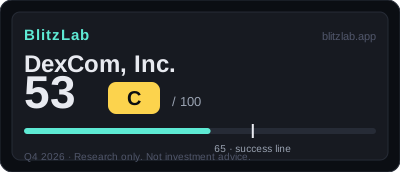
DexCom, Inc. — Blitz Index 53 (C)
Dexcom scores 53 — a measured recovery after the 2024 collapse, with margins expanding again, but Stelo's consumer bet is still unprovable in the filings.
Last re-scored: October 29, 2026.
Confidence: High · Category: platforms
Score breakdown
| Section | Score | Detail |
|---|---|---|
| A · Speed | 15 / 25 | Revenue $3,622M → $4,033M → $4,662M re-accelerated; customer adds 500–600K → 600–700K — but Stelo contributes zero provable revenue (undisclosed) |
| B · Moat | 33 / 60 | Payer formulary position + AID pump integrations + Clarity workflow lock-in — a moat, but the AID corridor is shared with Abbott (B1 capped at 7) |
| C · Creative destruction | 11 / 15 | Displacing fingersticks and expanding into Type 2 non-insulin — the clinical-regulatory case (CONNECT RCT, Smart Basal FDA) is building |
| D · BlitzFailing | −6 | FDA warning letter (2025-03) and ongoing G6/G7 class actions (−3) plus securities litigation around the 2024 guidance cut (−2) |
Think we scored it wrong? Score it yourself →
Radar axes (0–100): Moat 55 · Speed 60 · Creative 73.3.
Watch item
Gates: G1 ✓ (re-acceleration documented) · G2 ✓ (borderline — bar $46.62B (FY25 revenue × 10) vs derived ceiling ~$62–68B from 52M covered lives; thin at 1.3–1.5x, and the company's own trajectory lags far behind).
Strengths
- Consumables repeat revenue (~95%) + customer adds re-accelerating (500–600K → 600–700K) — PMF proven in physical metrics
- International revenue +16.1% (FY25) · +19–26% (2026 quarters) — the next growth engine is measured
- FCF $1,077.2M (margin 23.1%) + buybacks ($750M FY24 · $500M FY25 · $603.6M 1H26) — self-funding phase
- GM 60.1% → 63.4% + operating margin 19.6% → 22.9% (1H26) — recovery in growth and margin together
- Abbott patent dispute settled (2024 settlement · cross-license, no-sue through 2034-12-20) — legal risk on competition removed
- CONNECT RCT (Q2 2026) + Smart Basal FDA clearance (2025-12) — clinical and regulatory footing accumulating for Type 2 non-insulin adoption
Concerns
- FDA warning letter (2025-03, manufacturing · quality systems) + G6/G7 class actions — regulatory and legal risks are realized facts
- Securities class action over the 2024 guidance cut is proceeding — a credibility discount on forward statements
- Stelo revenue is undisclosed — the second curve (OTC · consumer) cannot be verified in current filings
- ASP pressure from rebate eligibility expansion and channel mix (10-K MD&A) — penetration growth may not convert to revenue
- New-patient share race with Abbott is tight (PCP survey 47/46 · endocrinology 53/44) — no hard-number share lead
- The 2024 sales-org overhaul shock may recur + CEO change (Leach, 2026) — execution continuity
Research notes
Thesis
DexCom is a mature company in the middle of a recovery that can be checked against public filings, and a second growth story that cannot yet be checked at all. That tension is the whole of its BlitzLab score: 53 out of 100, grade C, twelve points below the 65-point threshold, with no FLAG. The score is built from a first quarterly scoring dated 2026-10-21, with an as-of date, or T, of 2026-10-20. The latest results available at T were the second quarter of 2026, announced on 2026-07-30. The third quarter of 2026, due on 2026-10-29, falls after T and is therefore treated in this body only as a future marker, with no anticipated outcome attached to it.
The recovery is visible in three directions at once, and that simultaneity is what makes it credible. Revenue fell to a quarterly growth low of 2.0 percent in the third quarter of 2024, then returned to double digits: 21.6 percent in the third quarter of 2025, 13.1 percent in the fourth quarter, 15.0 percent in the first quarter of 2026, and 13.1 percent again in the second quarter of 2026, when revenue reached 1,308.4 million dollars (confirmed, from SEC filings). Annual revenue tells the same story on a longer arc: 3,622.3 million dollars in fiscal 2023, rising 11.3 percent to 4,033.0 million dollars in fiscal 2024, then rising 15.6 percent to 4,662.0 million dollars in fiscal 2025 (confirmed). Growth slowed, then re-accelerated. That is the language of the score file itself, and the filings support it.
The second direction is the customer count. Net customer additions, excluding Stelo, rose from roughly 500,000 to 600,000 in 2024 to roughly 600,000 to 700,000 in 2025 (confirmed). A revenue recovery alone could be explained away by price, mix, or timing. A recovery in net additions is harder to explain away, because it means more people are actually starting and staying on the system. The score file treats this as the physical evidence of the recovery, and it is right to do so: it is the one series in which the company's explanation for the 2024 slowdown can be tested against something other than the company's own revenue line.
The third direction is profitability. Operating profit in fiscal 2025 was 911.8 million dollars, a margin of 19.6 percent, and free cash flow was 1,077.2 million dollars, a margin of 23.1 percent (confirmed for operating profit; the free cash flow margin is a calculated, estimated figure in the score file). Gross margin, which had fallen to 60.1 percent in fiscal 2025, recovered to 62.9 percent in the first quarter of 2026 and 63.4 percent in the second quarter. The operating margin moved from 16.5 percent to 14.9 percent to 19.6 percent across fiscal 2023 to 2025, and reached 22.9 percent in the first half of 2026. Growth and margin are recovering together, which is a materially stronger statement than either one alone.
What caused the 2024 dip matters, because it determines whether the recovery should be trusted. The company identified the cause as a sales organization restructuring shock, specifying three factors (press-reported). The score file is explicit on one point that deserves emphasis: GLP-1 drugs are not the company's official explanation for the slowdown, and reporting that suggested otherwise has been corrected in the score file's account. The distinction matters because it changes the diagnosis. If the slowdown had been driven by a competing therapy shrinking the addressable population, the recovery would be suspect. If it was driven by the company's own reorganization, then the recovery of the organization should produce a recovery in the numbers, and that is what the 2025 and 2026 filings show. The score file's gate verdict reflects exactly that reasoning: Gate 1, sustained growth or a second growth curve, passes on confirmed evidence, with the growth rates and the net additions doing the work and Stelo expectations deliberately excluded.
Gate 2 is where the story becomes more difficult, and the score file marks it as a pass with a warning, on estimated grounds. The gate asks whether the ten-year ceiling of the new market is at least ten times current revenue. Using confirmed fiscal 2025 revenue of 4,662.0 million dollars, the bar is approximately 46.62 billion dollars. A trailing-twelve-month figure of 4,969.2 million dollars for the third quarter of 2025 through the second quarter of 2026 would imply a bar of about 49.69 billion dollars, but the score file follows the precedent set in the Insulet scoring and adopts the confirmed annual revenue figure as the authoritative base, so 46.62 billion dollars is the bar used here.
On that bar, the ceiling exists but the headroom is thin. The company has pointed, on a press-reported basis from its Investor Day, to a covered population in the United States plus ten major countries of roughly 23 million people rising to roughly 52 million by 2030. Dividing fiscal 2025 revenue by an estimated global active base of roughly 3.6 to 3.8 million people gives an implied revenue per patient per year of roughly 1.2 to 1.3 thousand dollars (estimated). Multiplying 52 million people by roughly 1.25 thousand dollars gives a ceiling of roughly 62 to 68 billion dollars, about 1.3 to 1.5 times the bar. The ceiling clears the bar, but not by much. And the company's own long-term trajectory points somewhere far below the ceiling: organic growth of more than 10 percent per year through 2030, also press-reported, would leave revenue in the vicinity of 12 billion dollars by 2030. Between a ceiling near 65 billion dollars and a trajectory near 12 billion dollars lies a very large gap, and the score file names the issue precisely. This is not a case of a market that is too small in absolute terms. The International Diabetes Federation figures cited by the company in its 10-K put the global diabetes population at 589 million people in 2024, rising to 853 million by 2050. The question is not whether the people exist. The question is how fast coverage converts into adoption, and that is a question about speed of penetration, not about the size of the map. The score file calls this a penetration-speed gate issue, the same type identified for Insulet, and it is the single most important conceptual frame in this entire scoring.
That frame also explains why Stelo, the company's over-the-counter product, is simultaneously the most interesting part of the story and the part that contributes nothing to the score. Stelo's revenue is not separately disclosed (unconfirmed), so its contribution cannot be verified from public filings, and the score file accordingly gives it no credit anywhere: not in Gate 1, not in growth, not in distribution, and not in market size. That discipline is worth stating plainly, because it is what separates this scoring from a narrative built on a product launch. A launch is an event. A revenue line is evidence. Until Stelo has the second, it cannot carry weight in the first sense that matters here.
A valuation note, kept strictly separate from the business score, records that the market capitalization was approximately 32.45 billion dollars on a press-reported basis, based on a closing price of 85.98 dollars on 2026-10-19, with a price-to-sales ratio of roughly 7.0 times fiscal 2025 revenue on a calculated basis, a price-to-earnings ratio of roughly 34 on a press-reported basis, and a 52-week range of 54.11 to 92.59 dollars. The market capitalization is roughly 70 percent of the Gate 2 bar of 46.62 billion dollars. The score file is explicit that the business score does not look at price, and this body follows that rule: the valuation figures are context, not an input to the 52.
Moat: A Prescription Ecosystem, Not a Network Effect
DexCom's moat score is 32 out of 60, the largest section in the model and the one where the company's position is both real and bounded. The four items are: network effect 7 out of 18, distribution scalability 9 out of 18, market size 8 out of 12, and gross margin 8 out of 12. Converted to the radar chart's 100-point scale, the moat axis reads 53.3. That is the lowest of the three radar axes, and it tells the reader something important before any detail: this is not a company whose moat, as the model defines it, dominates its story.
Start with what the moat is not. The score file is unusually clear on this point. The substance of the network-effect item is not a classical network effect at all, in which each additional user directly raises the value of the product for other users. What DexCom actually has is a combination of prescription and formulary status, integration with automated insulin delivery systems, and a consumable repeat-purchase stream. The score places this in the 5 to 9 band for data and ecosystem effects, awarding 7. The reasoning is worth walking through, because it shows the model's discipline at work.
First, the G7 system connects with automated insulin delivery pumps, including Insulet's Omnipod 5, as well as smart pens, Apple Watch, and Garmin devices. The company describes this as the world's largest connected continuous glucose monitoring ecosystem. That description is the company's claim, and the score file records it as such. But the crucial qualification follows immediately: Omnipod 5 integrates with both Dexcom's G6 and G7 and with Abbott's Libre 2 Plus. The integration ground is shared, not exclusive. Cross-checking against the Insulet scoring confirms the point. A moat that a direct rival also occupies is a weaker moat than one that only its owner occupies, and the score reflects that by stopping at 7 rather than reaching the 10 to 14 band.
Second, the Dexcom Clarity and Follow platforms are embedded in clinicians' workflows, which is a genuine switching cost: a clinician who monitors patients through Clarity is not starting from zero when a patient stays on Dexcom, and a patient whose data flows to family members through Follow has a social layer around the device. Third, a real-time application programming interface offers third-party applications and devices live data, but the scale of its use is not disclosed (unconfirmed), so it cannot be quantified and receives no additional weight. None of this is a network effect in the sense that one more user makes the sensor more accurate for the next user. It is an ecosystem and workflow effect, and the score's 7 is an honest price for that distinction.
Distribution, at 9 out of 18, is where the company's history and its future collide. In the United States, roughly 85 percent of revenue flows through distributors, via durable medical equipment and pharmacy channels (confirmed). Outside the United States, direct sales carry a larger share. That structure was shaken in 2024, when the durable medical equipment channel's share fell, with an annual impact of roughly 100 million dollars, and pharmacy channel expansion offset the decline. The score file's phrase for this phase is precise: the distribution structure is in transition. A company whose main channel is shrinking and being replaced is not a company with a settled distribution advantage, even if the replacement is working.
Stelo is the exception that could change the distribution story, and the reason it does not yet do so is the same disclosure gap that runs through this entire scoring. Launched in August 2024 as an over-the-counter product, Stelo reaches users directly, online and through retail, without a prescription, through a direct-to-consumer route that is entirely different from the prescription channel. If that route were verified at scale, it would be a genuine distribution innovation: a second channel that bypasses the gatekeepers of the first. But revenue, customer numbers, and unit prices for Stelo are not separately disclosed (unconfirmed), so the score file withholds any addition for it. The one-point gap to Insulet's 10 on this item is, in the score file's own comparison, exactly this difference: Insulet's pharmacy channel innovation has been demonstrated in results, while Dexcom's over-the-counter channel is a new route whose commercial substance is unverified. Demonstrated beats announced. That is a rule worth remembering across the whole BlitzLab model.
Market size, at 8 out of 12, is tied to Gate 2 and carries the same caution. The addressable scale is large: 589 million people with diabetes worldwide on the International Diabetes Federation figures cited by the company, and a covered population in the United States plus ten major countries of roughly 52 million by 2030 on a press-reported company outlook. The calculated ceiling of roughly 62 to 68 billion dollars clears the 46.62 billion dollar bar by a factor of roughly 1.3 to 1.5. But two discounts apply, and both are stated in the score file. The first is the conservative principle applied to estimated items: the key variable in the ceiling, adoption among people with Type 2 diabetes who do not use insulin and people with prediabetes, depends heavily on Stelo, whose revenue contribution is unconfirmed. The second is concentration of risk in a single variable: the realization of the ceiling depends on the conversion of coverage into adoption, one mechanism carrying the whole upside. Insulet also scores 8 here, and the score file notes that the two companies share the same penetration-speed issue type, with a difference in verifiability: Dexcom's per-patient revenue can be estimated, so its ceiling can be set against the bar in dollars, while Insulet's cannot. The fact that Dexcom's arithmetic is more checkable does not raise its score, because the arithmetic itself shows thin headroom and a wide gap to the company's own trajectory.
Gross margin, at 8 out of 12, completes the moat section with a story of damage and partial repair. Generally accepted accounting principles gross margin fell from 63.2 percent to 60.5 percent to 60.1 percent in fiscal 2025, and the 10-K's management discussion attributes the decline not to demand but to supply assurance inefficiencies and a production mix with lower yields. That attribution matters: a margin decline caused by weak demand would signal a pricing or competitive problem, while a decline caused by manufacturing execution is, in principle, fixable. The recovery to 62.9 percent in the first quarter of 2026 and 63.4 percent in the second quarter is consistent with the fixable interpretation, but it has not yet fully closed the gap to the earlier level. Gross profit in fiscal 2025 was 2,801.9 million dollars (confirmed). The company's 2030 targets, on a press-reported basis, are a non-GAAP gross margin of 67 to 69 percent and an operating margin of 29 to 30 percent, supported by expectations around the G7 15 Day conversion and a 10 percent cost reduction for the future G8 system. Those targets are expectations, not results, and the score stops at 8 for that reason. Insulet scores 10 here, with a 71.6 percent gross margin expanding alongside growth; Dexcom's margin history, with its 2024 to 2025 trough not yet fully recovered, does not yet support the same mark.
Speed: Double Digits Again, But the Guidance Points Lower
Speed scores 15 out of 25, or 60.0 on the radar scale. The four items are: growth 6 out of 10, capital velocity 3 out of 5, hiring and productivity 3 out of 5, and share velocity 3 out of 5. The pattern is even: no item collapses, and no item excels. That evenness is itself informative. This is a company moving at a solid pace in every dimension the model measures, without blitzing in any of them.
Growth, at 6, is the most heavily evidenced item in the section. Fiscal 2025 revenue of 4,662.0 million dollars, up 15.6 percent (confirmed), follows 11.3 percent growth in fiscal 2024. The quarterly path from the 2.0 percent trough in the third quarter of 2024 through 21.6 percent in the third quarter of 2025 to 13.1 percent in the second quarter of 2026 shows a recovery that has held for several quarters, not a single-quarter bounce. Customer net additions excluding Stelo, rising from roughly 500,000 to 600,000 in 2024 to roughly 600,000 to 700,000 in 2025, corroborate the revenue path with a physical count. The score file's comparisons are instructive: Insulet scores 7 with 30.7 percent growth and Shopify scores 7 with 33.7 percent growth, both a tier above DexCom's rate, so 6 is the consistent mark. Stelo's growth contribution is scored at zero within this item because its revenue is undisclosed (unconfirmed), not because it is assumed to be zero in reality. The distinction between a scored zero and a real zero is one the reader should keep in mind throughout this body: the model only credits what filings verify.
There is, however, a forward-looking tension inside the growth item that the score file does not hide. Fiscal 2026 guidance is 5.18 to 5.25 billion dollars, growth of 11 to 13 percent, with the midpoint raised at the second-quarter point. That guided range sits below the recent growth rate of roughly 13 to 15 percent. Guidance is a company statement about its own expectations, not a result, and it should not be read as a forecast by this body. But the direction is worth noting as a fact about the company's own framing: the company that just printed 13.1 percent quarterly growth is guiding to a full year below that pace. Whether that reflects caution, a tougher comparison base, or a genuine deceleration is not something the score file resolves, and this body does not resolve it either. It is recorded here as an open question, and it belongs on the watch list.
Capital velocity, at 3 out of 5, captures a company that has crossed from raising capital to returning it. Free cash flow in fiscal 2025 was 1,077.2 million dollars (estimated margin calculation), and share repurchases ran at 750.0 million dollars in fiscal 2024, 500.0 million dollars in fiscal 2025, and 603.6 million dollars in the first half of 2026, alongside a new 1.0 billion dollar program running to 2027-06-30 on a press-reported basis. Diluted share count fell from 425.5 million in fiscal 2023 to 405.5 million in fiscal 2025 and 390.1 million in the second quarter of 2026. Cash plus securities of 1.95 billion dollars exceeds convertible notes of 1.24 billion dollars. The score file applies the mature-company yardstick here, the same logic used for Insulet's 3: when a company is self-funding, the relevant question is no longer whether it can access capital, but what it does with the capital it generates, and returning it while shrinking the share count is a competent but not blitzing answer.
Hiring and productivity, also at 3, is the quietest item in the section, and its quietness is the point. Headcount was approximately 11,100 at 2025-12-31 (confirmed), split between 5,300 in the United States and 5,800 elsewhere, implying revenue per employee of approximately 420 thousand dollars on a calculated, estimated basis. SG&A expense moved from 1,185.4 million dollars to 1,285.8 million dollars to 1,291.0 million dollars, or 27.7 percent of revenue, flattening after the 2024 sales organization restructuring. There is no evidence of a hiring blitz, and productivity is described in the score file as unremarkable. Insulet also scores 3 here, despite 38 percent hiring growth, which shows that the model is not simply rewarding headcount growth: it is asking whether hiring is producing leverage, and for DexCom the answer is steady rather than spectacular.
Share velocity, at 3, is where the competitive reality is most honestly stated. Continuous glucose monitoring is a two-player structure, Dexcom versus Abbott, a point on which company disclosure and industry surveys agree (confirmed as a structure). A William Blair survey from autumn 2025, on a press-reported basis, found the expected allocation of new continuous glucose monitoring patients over the next three years to be closely contested: 47 percent versus 46 percent among primary-care physicians, and 53 percent versus 44 percent among endocrinologists. The score file does not present a hard number showing DexCom pulling away in share, because no such number is available, and this body does not invent one. Penetration in the United States is estimated in the high single digits to the low teens in percentage terms, but the company has given no absolute penetration figure, so that range is an estimate, not a company statement. The indirect evidence points the right way: overseas revenue grew 16.1 percent in fiscal 2025 and 19 to 26 percent across the quarters of 2026, and the covered population is expanding from roughly 23 million toward 52 million. But indirect evidence is not share evidence, and the score file applies the same yardstick it applied to Insulet's 3: without hard numbers showing share gains, 3 is the mark.
Creative Destruction: A Completed Replacement, and an Unfinished Expansion
Creative destruction scores 11 out of 15, or 73.3 on the radar scale, the strongest of the three axes. The items are: order being replaced 4 out of 5, irreversible behavior change 4 out of 5, and cost structure change 3 out of 5. This is the section where DexCom's story is most convincing, and also where its limits are most clearly defined.
The order being replaced, at 4, is unusually clear. The old order is single-point fingerstick blood measurement. The new order is continuous data at five-minute intervals, with alerts and trends, as the company defines the category in its 10-K. In the insulin-using population, continuous glucose monitoring is moving toward the standard, which means the replacement is close to complete rather than still dramatic. That completeness is both the strength and the ceiling of the item: a replacement that is nearly finished has less destruction left to do, and the score file withholds the fifth point for that reason. The new frontier is Stelo's expansion of the category from a diabetes management device into a metabolic health consumer product, addressing people with prediabetes and Type 2 diabetes who do not use insulin, outside the prescription and reimbursement system. That is a genuine category expansion in concept. But its revenue contribution is unconfirmed, so the expansion is scored as a concept with a regulatory and retail presence, not as a demonstrated second replacement. The parallel with Insulet's 4, for a category creation still in progress, is exact in structure even though the two companies' categories differ.
Irreversible behavior change, also at 4, is the most human item in the model, and DexCom's case is strong at the level of the individual adopter. A sensor worn around the clock, producing alerts and trend data woven into the daily rhythm, is not easily abandoned: returning to fingersticks after continuous data is, in the score file's words, a clinical and behavioral step backward. On the clinician side, the Clarity and Follow data platforms are embedded in prescribing and monitoring workflows, which creates an institutional stickiness beyond the individual device. The regulatory and clinical staircase reinforces the point: G7, then over-the-counter Stelo, then the G7 15 Day, then Smart Basal with United States Food and Drug Administration approval in December 2025, and the CONNECT randomized controlled trial in the second quarter of 2026 supplying clinical evidence for non-insulin Type 2 diabetes. Each step widens the population for whom continuous data is the default rather than the exception. The fifth point is withheld because the behavior change in the non-insulin and prediabetes population is still in its formative stage, and the absence of separately disclosed Stelo revenue is itself evidence that the formative stage has not yet produced a measurable installed base in the filings. A behavior change that cannot be counted in the filings cannot be scored as complete.
Cost structure change, at 3, is the most modest item in the section, and the score file's caution is well placed. The measurable layer is the G7 15 Day, approved by the Food and Drug Administration in April 2025 and launched late in 2025: a longer wear period means fewer sensors per patient per year, plus manufacturing efficiency. The company's 2030 targets of a 67 to 69 percent non-GAAP gross margin and a 10 percent cost reduction for the future G8 system, both press-reported, point in the same direction, as do production investments in Malaysia and Ireland aimed at scale economies. But unit cost figures in dollars are not disclosed, and the gross margin recovery from 60.1 percent to 63.4 percent looks more like normalization of yields after a manufacturing disruption than evidence of a cost structure being broken apart. Insulet also scores 3 here, for a similarly gradual manufacturing-layer change. The model is asking for a collapse in the cost of delivering the product, and DexCom offers an improvement. The difference between those two things is the difference between 3 and a higher mark.
Deductions and Risks: Small Numbers, Real Events
Deductions total minus 6, well below the minus 15 threshold that would trigger a FLAG, so no FLAG is attached to this scoring. The items are: debt minus 1 out of minus 10, revenue quality minus 2 out of minus 10, governance 0 out of minus 5, and regulatory and social cost minus 3 out of minus 5. The total is small, but the composition matters more than the total, because two of the four deductions arise from events that have actually happened, not from structural exposures.
Debt, at minus 1, is the lightest deduction and the easiest to explain. Convertible notes carrying a 0.375 percent coupon and maturing in 2028 stood at a book value of 1,240.9 million dollars at 2025-12-31 and 1,242.8 million dollars at 2026-06-30. A 200 million dollar revolving facility was unused. Cash plus securities of 1.95 billion dollars exceeds the convertible balance, leaving the company close to a net cash position. Capital expenditure of 363.5 million dollars, or 7.8 percent of revenue, reflects ongoing production capacity investment, and share-based compensation of 159.6 million dollars, or 3.4 percent of revenue, is restrained, with the share count falling under repurchases so no dilution deduction applies. Insulet scores minus 2 here, with net debt and a repayment loss; DexCom's lighter mark follows directly from its balance sheet. The one item to watch is the refinancing of the 2028 convertible maturity as it comes into view, which the score file names as the sole monitoring item in this category.
Revenue quality, at minus 2, is where trust, rather than arithmetic, is being priced. There are no restatements, no auditor changes, and no audit opinion issues, so the accounting quality triggers are absent. The deduction rests on three substantive points. The first is the securities class action around the fiscal 2024 guidance reduction of July 2024, filed between August and October 2024 and proceeding in consolidated form: when forward-looking statements become the subject of litigation, the market's discount on the next set of forward-looking statements is a real cost, even before any outcome. The second is persistent pressure on unit prices from expanded rebate eligibility and channel mix, which the 10-K's management discussion repeatedly flags as a headwind. The third is structural: roughly 85 percent of revenue passes through distributors, so visibility into final demand depends in part on intermediary inventory. Insulet scores minus 1 here, for a guidance reduction plus executive change cluster; DexCom scores one point more severely because a securities lawsuit is a step stronger as a trust event than a guidance reduction alone. That judgment is debatable in either direction, but it is stated and reasoned in the score file, which is what matters.
Governance, at 0, is the cleanest item in the section. The company has a single class of shares, with no differential voting rights. Investors above 5 percent, on the basis of Schedule 13G filings cited in the 2026 definitive proxy statement, are Vanguard at 12.8 percent and BlackRock at 8.4 percent. There is no founder control. The chief executive transition from Kevin Sayer to Jake Leach in early 2026, and chief financial officer Jereme Sylvain's assumption of the president and chief operating officer roles in September 2026, disclosed in a filing dated 2026-09-14, are treated as a management reorganization relevant to execution confidence, not as a structural governance trigger. Insulet scores 0 on the same yardstick. Nothing in the governance structure itself deducts from the score.
Regulatory and social cost, at minus 3, is the heaviest deduction and the one that most deserves the reader's attention. In March 2025, the Food and Drug Administration issued a warning letter following inspections of the San Diego and Mesa facilities, citing manufacturing process and quality management system deficiencies, disclosed in the 10-K's risk section. Corrective action is in progress, and the possibility of delayed new approvals or product restrictions remains as a stated risk. Separately, product class actions and a derivative action relating to the G6 and G7 systems are listed in the quarterly filing, with the company stating that the outcome cannot reasonably be estimated. Press reporting has also raised a Class I recall in connection with the products, but the company has given no quantified disclosure on that point, so this body records it as press-reported and unquantified rather than as a company figure. Insulet scores minus 2 here for structural exposure alone; DexCom scores more severely because a warning letter and ongoing litigation are events, not exposures. The fifth point of deduction is withheld because, as of T, there is no confirmed fine, product restriction, or sanction. The distinction between an event and a sanction is the whole of the judgment, and it cuts in both directions: the risk is real enough to deduct for, and not yet realized enough to deduct the maximum for.
Beyond the four deduction items, the score file's risk list adds two structural exposures that belong in any honest account. The first is the interaction between price and share that the blitzscaling-fit analysis names as the maximum risk: if rebate expansion continues to reduce unit prices while new-patient allocation remains closely contested with Abbott, then expanding penetration may not translate into expanding revenue. The covered population doubling from roughly 23 million to roughly 52 million would be consumed, in that scenario, by the combination of lower unit prices and a split allocation. The gap between the roughly 65 billion dollar ceiling and the roughly 12 billion dollar trajectory is the numerical form of that risk. The second is execution continuity: the 2024 sales organization restructuring shock, and the 2026 chief executive transition, together raise the question of whether the organization that recovered can keep recovering without another self-inflicted disruption. Neither risk is scored separately, but both are visible in the items that are scored, and a reader who understands the deduction section will already understand them.
One further piece of the competitive picture belongs here because it removes a risk rather than adding one. The patent dispute with Abbott was settled in 2024 through a settlement and cross-license, with a covenant not to sue running to 2034-12-20. Legal risk in the rivalry is therefore not an open front in the way it was before the settlement. That does not make Abbott less of a commercial rival; the survey numbers show a contest that is very much alive. But it does mean the rivalry will be fought on products, channels, and coverage rather than in patent court, which is a cleaner contest to analyze.
What to Watch
The watch list for DexCom is unusually crisp, because the score file's open questions are specific and the triggers for revisiting the gates are stated. They fall into five groups.
First, the third quarter of 2026 results, due on 2026-10-29, are the next data point after T. This body records that date only as a future marker. What matters for the scoring is not any single quarter in isolation but whether the pattern established through the second quarter of 2026 persists: double-digit growth, continued net additions excluding Stelo, and a gross margin at or above the 63.4 percent level of the second quarter. A break in any of those three series would reopen the question that Gate 1 answered, namely whether the 2024 dip was truly a one-time event.
Second, Stelo disclosure is the single most informative thing the company could publish. The score file's review trigger is explicit: continued non-disclosure of Stelo revenue is itself a signal. If the company begins to disclose Stelo revenue, customer numbers, or unit prices separately, three items would need to be revisited at once: growth, distribution, and market size, all of which currently withhold credit for the over-the-counter channel. If disclosure continues to be absent while the product remains prominent in the company's strategy discussion, the gap between the strategic emphasis and the filed evidence will itself become a finding. Either way, the next disclosure decision on Stelo is more informative than the next product announcement about it.
Third, the penetration-speed variables named in Gate 2 deserve tracking as a set, not one by one. The covered population path from roughly 23 million toward 52 million by 2030, the conversion of coverage into adoption among people with Type 2 diabetes who do not use insulin and people with prediabetes, the allocation of new patients between DexCom and Abbott, and the offset between rebate-driven price declines and volume growth together determine whether the ceiling near 65 billion dollars or the trajectory near 12 billion dollars is the better guide to 2030. The score file's review triggers name the failure modes precisely: further deceleration in United States growth, stagnation in coverage expansion, and continued non-disclosure of Stelo revenue. Any one of those would justify reopening Gate 2, even though it currently passes.
Fourth, the regulatory and legal docket should be followed as events, not as background. The March 2025 warning letter's corrective action, any development in the G6 and G7 product litigation, and any movement in the securities class action around the July 2024 guidance reduction each have the capacity to move the deductions section independently. The warning letter in particular should be tracked to resolution: a closed warning letter and an open one are different risk states, and the score file's minus 3 assumes the open state. A confirmed fine, product restriction, or sanction, none of which exists as of T, would push the deduction toward the maximum; a clean closure would argue for relief. The 2028 convertible refinancing belongs on the same calendar, as a known future financing event rather than a surprise.
Fifth, the product staircase should be tracked for commercial translation, not for regulatory milestones alone. The G7 15 Day, the future G8 system's expected 10 percent cost reduction, and the Smart Basal approval of December 2025 are all real steps, and the CONNECT trial in the second quarter of 2026 supplies clinical evidence for the non-insulin Type 2 population. But the score file's discipline applies here too: a regulatory approval is not a revenue line, and a trial result is not an adoption rate. The question for each step is whether it appears in the next filings as net additions, as overseas growth, as gross margin, or as a separately disclosed Stelo line. Until it does, it belongs in the narrative and not in the score.
DexCom at 52 is, in the end, a precise portrait rather than a vague one. It is a company that has proved it can recover, that has not yet proved it can open its second curve, and whose moat is a prescription ecosystem shared at its most valuable junction with its principal rival. The recovery is measured in filings. The second curve is still waiting for its first filed number. When that number arrives, or when its continued absence becomes itself a conclusion, this scoring will have something new to say. Until then, 52 with no FLAG is the honest mark: a mature company, growing at double digits again, profitable, close to net cash, carrying real but bounded regulatory and legal deductions, and thirteen points short of the threshold because the future it describes is larger than the future it has yet demonstrated.
More Platforms companies
Other Platforms names on the Blitz Index, highest score first: Alphabet (83/A), Meta (78/B), Airbnb (76/B).
Next earnings
Q4 2026 · Expected
Coverage
DexCom, Inc. · Q3 2026 earnings Oct 29, 2026 (AMC, confirmed) · Score 53 · Grade C
Embed this score
Copy the HTML below to show this score on your site. The badge links back to this page and updates automatically when the score changes.
Preview:
BlitzLab scores businesses against a scholar’s standard — not investment advice. No price targets, no buy/sell recommendations. Figures are from SEC filings (XBRL) as labeled in the source scorecard.