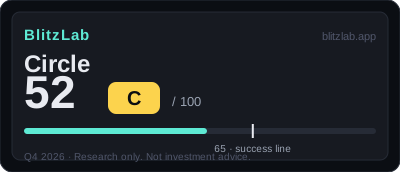
Circle — Blitz Index 52 (C)
USDC circulation +67% in 18 months — but 96% of reported revenue is interest on reserves.
Last re-scored: October 18, 2026.
Confidence: High · Category: platforms
Score breakdown
| Section | Score | Detail |
|---|---|---|
| A · Speed | 17 / 25 | USDC circulation +67% in 18 months (SEC); on-chain quarterly volume $14.8T (+151% YoY); 60%+ share of dollars in use |
| B · Moat | 33 / 60 | MiCA license · federal bank charter · GENIUS regime — a 3-layer regulatory moat; Arc L1 mainnet + 100+ builders |
| C · Creative destruction | 11 / 15 | The regulated digital dollar displacing SWIFT and card settlement — thin G2 margin (1.4–1.6x optimistic) |
| D · BlitzFailing | −9 | 95%+ of revenue is rate-dependent (−$442M on −90bp, SEC); distribution costs 60.6% of revenue; USDT 60.6% vs USDC 24.2% |
Think we scored it wrong? Score it yourself →
Radar axes (0–100): Moat 55 · Speed 68 · Creative 73.3.
Watch item
Gates: G1 ✓ · G2 ✓ (thin). 13 points below the threshold — the circulation blitzes; the economics leak.
Strengths
- USDC circulation +67% in 18 months (SEC) — the stablecoin blitz is real
- On-chain quarterly volume $14.8T (+151% YoY) — 60%+ share of dollars in use
- Arc L1 mainnet + 100+ builders — the second curve has substance
- RLDC margin 41.2% improving + GAAP profit ($48.2M/quarter) — profitability secured
Concerns
- 95%+ of revenue depends on rates — −90bp costs −$442M (SEC quantified)
- Distribution costs at 60.6% of revenue — over half the growth shared with partners
- USDT 60.6% vs USDC 24.2% — market-cap share stalled
- GENIUS §4(a)(11) yield-ban scope on partner rewards still unresolved
Research notes
Thesis: the blitz is in circulation, not in reported revenue
Circle Internet Group is the first company in this scorecard series for which the headline revenue line is the wrong place to look for the blitz. The company behind USDC, the regulated dollar stablecoin, scores 52 out of 100, grade C, thirteen points below the 65-point line — and the shape of that score tells the story more honestly than the total alone. Speed is 17 out of 25, moat is 33 out of 60, creative destruction is 11 out of 15, and deductions total minus 9. Converted to the radar axes used across the scorecard, that is 68.0 for speed, 55.0 for moat, and 73.3 for creative destruction. The strongest section is the destructive ambition; the weakest, relative to its ceiling, is the moat. And the central tension of the whole case is a single arithmetic fact, stated plainly in the score file: more than 95% of Circle's revenue is reserve interest income, which is to say, circulation multiplied by a yield. When the yield falls, reported revenue can stall even while the underlying business accelerates. That is exactly what happened in the first half of 2026, and any reading of Circle that starts from the revenue line will misread the company.
The numbers that describe the real blitz are the circulation numbers. USDC in circulation at period end rose from $43.9 billion in the fourth quarter of 2024 to $73.3 billion in the second quarter of 2026, an increase of 67% over eighteen months, confirmed in SEC filings. On-chain transaction volume in a quarter reached $14.8 trillion, up 151% year over year, also confirmed in SEC filings. Transaction volume grew at roughly eight times the rate of circulation growth, which is the score file's evidence that USDC is not merely being parked but being used. Reported revenue, by contrast, grew 63.8% in fiscal 2025, from $1,676 million in fiscal 2024 to $2,747 million, and then flattened in the first half of 2026: $694.1 million in the first quarter of 2026 to $701.3 million in the second quarter, growth of just 1.0% quarter over quarter. The score file attributes that flattening directly to the reserve yield, which fell from 4.2% to 3.5%, a decline the company's annual report quantifies: a 90-basis-point fall in the average yield reduced revenue by $442.1 million. The yield fell faster than circulation grew, and the product of the two — which is, in substance, the revenue line — stood still.
This is why the score file's first key driver is phrased as a correction to the reader's instincts: the business is circulation, not revenue. The first half of 2026 was not, on the evidence of the filings, a slowdown in the underlying adoption of USDC. It was a macroeconomic variable moving against a revenue formula that is almost entirely exposed to that variable. The scoring model, in its frozen version 1.0, reads growth through reported revenue, and so the speed item for growth scores 7 out of 10 rather than higher: the file is explicit that if growth is read through circulation rather than through reported revenue, the picture is a blitz, but on the reported-revenue basis the deceleration is real and must be scored. That distinction — between the thing being measured and the thing doing the measuring — runs through the entire Circle case, and it is the reason the company is simultaneously one of the most genuinely blitzing businesses in the scorecard and a company thirteen points short of the threshold.
Both gates pass, and the second passes only at the borderline. Gate 1, which asks whether growth continues or a second growth curve exists, passes on confirmed evidence: the circulation blitz itself, the transaction volume, the fiscal 2025 revenue growth, and two concrete second curves — the Arc layer-1 blockchain, whose public mainnet launched on September 16, 2026 with more than 100 ecosystem builders, confirmed in an 8-K filing, and the acquisition of Tazapay for $400 million, reported in the press, which is said to open access to more than 100 emerging markets. Gate 2, which asks whether the ten-year ceiling of the new market is at least ten times current revenue, passes as an estimate, and the file is careful to show its working rather than merely assert the result. The bar is approximately $28 to $29 billion, ten times an annualised fiscal 2026 revenue estimate of roughly $2.8 to $2.9 billion. Because almost all revenue is reserve interest income, that bar is equivalent, on the assumption of a constant yield and a constant distribution cost rate, to circulation of roughly $730 to $780 billion, about ten times the current $73.3 billion. The optimistic scenario reaches it: a stablecoin market of $3 trillion over ten years — a tenfold expansion, matching the trajectory from 2020 to 2026 — multiplied by a Circle share of 35% to 40%, gives circulation of $1.05 to $1.2 trillion and revenue of roughly $41 to $46 billion, or 1.4 to 1.6 times the bar. The conservative scenario does not: a $1.5 trillion market at a 30% share gives $450 billion of circulation and roughly $17 billion of revenue, about 0.6 times the bar. The pass therefore rests on the optimistic scenario, and the file names the fragility precisely — if half of the optimistic case breaks, the gate fails — and names the key sensitivity, which is the interest-rate headwind: if the reserve yield keeps falling from 3.5%, still more circulation is needed to clear the same bar. That is a pass, but it is a pass with thin margin, and the draft that follows keeps that thinness in view rather than rounding it away.
Speed: a distribution blitz measured through the wrong meter
Speed scores 17 out of 25, built from four items: growth 7 out of 10, capital velocity 4 out of 5, hiring and productivity 3 out of 5, and share velocity 3 out of 5. The growth item has already been described, and its score of 7 is the product of the tension between two growth rates that point in opposite directions. Fiscal 2025 revenue growth of 63.8% is, on its own, a blitzing rate. Trailing-twelve-month revenue of approximately $2,905 million confirms the scale that rate produced. But the first half of 2026 shows the deceleration plainly: quarter-over-quarter growth of 1.0%, caused, as the filings quantify, by the yield decline overwhelming circulation growth. The score file resolves this by scoring the reported-revenue deceleration while recording, in the same breath, that the substance of growth — circulation up 67% over eighteen months and on-chain volume up 151% year over year — is blitzing. A reader who wants the honest version of Circle's speed should carry both sentences at once. The company is growing fast in the quantity it controls and standing still in the quantity the market's interest-rate cycle controls.
Capital velocity scores 4 out of 5, and the evidence is a balance sheet that can fund a blitz from its own resources rather than from repeated trips to the capital markets. The initial public offering, on June 5, 2025, at $31.00 per share for 34 million shares, raised net proceeds of $572.6 million, confirmed in SEC filings. Cash stood at $1.73 billion at June 30, 2026, also confirmed in filings. Operating cash flow for the first six months of 2026 was positive $538.5 million, again confirmed. That combination — a large IPO raise, a large cash balance, and strongly positive operating cash flow within a year of listing — is the substance of the score. The file notes the other side of the capital story, on a press-reported basis: the share price of $82.22 at October 16, 2026, while well above the $31.00 offering price, stood 44% below the 52-week high of $147.44, and the stock's beta of 1.82 marks it as a security that moves sharply with both interest-rate and crypto cycles. The valuation note in the score file records, also on a press-reported basis, a market capitalisation of approximately $20.9 billion and a price-to-sales ratio of approximately 7.2 times trailing-twelve-month revenue, with a 52-week range of $49.90 to $147.44. The business score itself does not look at price, and this draft does not either, except to record that the capital position supporting the blitz is strong while the market's pricing of that blitz has been volatile. The structure the score rewards is self-funding: a company generating more than half a billion dollars of operating cash flow in six months does not need to ask permission to keep distributing.
Hiring and productivity scores 3 out of 5, and the score is deliberately conservative because the underlying headcount figure is not confirmed. The company's filings do not disclose employee numbers, so the figure used — approximately 900 people, on a press-reported basis — cannot be treated as a filing fact. Divided into trailing revenue, it implies revenue per employee of approximately $3.2 million, a very high productivity figure, but because the headcount itself is press-reported, the score file refuses to reward it fully and holds the item at 3. That restraint is worth noting because it is characteristic of the score file's method: where the evidence is press-reported rather than filing-confirmed, the score is shaded down, and the draft follows the same discipline. What can be said on confirmed evidence is that a business distributing $73.3 billion of a digital dollar, processing $14.8 trillion of quarterly on-chain volume, and generating $2,747 million of fiscal 2025 revenue is doing so with an organisation that is, by any plausible reading of the press-reported headcount, lean relative to its scale. The score of 3 records both halves: the productivity is evidently high, and the evidence for it is not strong enough to score higher.
Share velocity scores 3 out of 5, and here the file draws a distinction that is central to understanding Circle's competitive position. By market capitalisation, USDC holds 24.2% of a total stablecoin market of $303.6 billion on a press-reported basis, against 60.6% for Tether's USDT. By transaction volume, the picture inverts: Circle's adjusted transaction volume share rose from approximately 40% in 2025 to more than 60% in 2026, according to Bernstein on a press-reported basis, making USDC the most used dollar in on-chain transactions even while it remains the second-largest by stock of coins outstanding. The score file's phrase for this is "the dollar that is used," and the distinction matters. A stablecoin that sits in wallets is a store of value; a stablecoin that moves is a medium of exchange, and the medium-of-exchange position is the one that compounds into infrastructure. But the file also records the counter-evidence honestly: thirty-day momentum, on a press-reported basis, favoured USDT, up 0.09% against a 1.43% decline for USDC, and market-capitalisation share was flat rather than rising. The regulatory asymmetry is scored as upside rather than as present fact: MiCA authorisation in Europe, a federal bank licence reported in July 2026, and the GENIUS Act framework together give Circle a regulated status that its largest competitor, operating offshore, does not hold in the same form. The score of 3 therefore balances a genuine lead in usage against a flat position in the stock of coins and a competitor more than twice its size by capitalisation.
Moat: trust as the product, distribution as the cost
Moat scores 33 out of 60, the weakest section relative to its ceiling, and its four items explain why a company with a genuine usage lead does not score higher on defensibility: network effects 8 out of 18, distribution scalability 10 out of 18, market size 8 out of 12, and gross margin 7 out of 12. The moat, in the score file's analysis, is not a technology advantage. Running a reserve is, in the file's phrase, undifferentiated: any competent issuer can hold short-dated government securities and cash. What is differentiated is trust — the belief, held by exchanges, payment companies, and end users, that a USDC will be redeemable at par, that its reserves are what the issuer says they are, and that a regulator stands behind the claim. That trust is the moat, and it is a real one, but it is a thinner and more contingent moat than a network effect or a proprietary technology, and the scores reflect that.
Network effects score 8 out of 18. The distribution partner network — Coinbase and Binance among others — and the Arc ecosystem of more than 100 builders, confirmed in an 8-K filing, give USDC reach that a new issuer cannot replicate overnight. The "regulated dollar" trust premium is the mechanism: partners distribute USDC rather than a rival coin in part because its regulatory standing lowers their own risk. But the file is explicit about the limit of this effect. The classical network effect, in which each additional user makes the product more valuable to every other user, is weak here. A person who receives USDC does not make USDC more useful to another person who receives USDC in the way that a new participant on a communications network makes the network more useful to everyone on it. What Circle has is closer to a distribution-network effect: the more venues accept USDC, the more useful it is to keep USDC, and the more useful it is to keep USDC, the more venues accept it. That loop is real, and it is why the score is 8 rather than lower, but it is not the self-reinforcing flywheel of a social network or a marketplace, and the score stops well short of the top of the band for that reason.
Distribution scalability scores 10 out of 18, and it is the item where Circle's greatest strength and its greatest structural weakness sit side by side. The strength is proven: circulation growth of 67% over eighteen months, confirmed in filings, is the demonstration that distribution scales. The Tazapay acquisition, reported in the press at $400 million, extends that distribution into more than 100 emerging markets, and the Arc mainnet, confirmed in an 8-K, gives Circle its own chain on which USDC is the native settlement asset. The weakness is the price of that distribution, and the file states it without softening: distribution and transaction costs were $1,661.5 million in fiscal 2025, or 60.6% of revenue, confirmed in SEC filings. Growth, for Circle, means paying more to the partners who carry the coin. Coinbase takes 50% of the residual under the arrangement described in the company's S-1 filing, and the quarterly report's own language, quoted in the score file, is that Circle's results are linked to partner policies that it does "not control or supervise." Distribution scales, in other words, but the economics of distribution do not improve with scale in the way a software company's economics do. Every additional dollar of circulation brings additional distribution cost with it, by contract, and that contractual structure is a ceiling on the moat score that no amount of circulation growth can lift on its own.
Market size scores 8 out of 12, and the score follows directly from the Gate 2 analysis. The stablecoin market is $303 to $309 billion on a press-reported basis, with the expansion of on-chain dollar settlement unquantified beyond that figure. The gate bar of $28 to $29 billion is cleared in the optimistic scenario at 1.4 to 1.6 times, but not in the conservative scenario, and the interest-rate headwind and the share structure — USDT at 60.6% against USDC at 24.2% — eat into the margin. A market-size score of 8 records a market that is large and plausibly much larger, but whose capture by Circle specifically is constrained by a dominant competitor and by a revenue formula that depends on a variable Circle does not control. The file's treatment is consistent: the market is big enough to matter enormously, and Circle's share of it is not yet big enough to score higher.
Gross margin scores 7 out of 12, and the item is measured through the company's own preferred profitability lens. RLDC — revenue less distribution costs — was $288.8 million in the second quarter of 2026, a margin of 41.2%, improved from 38.1% in the second quarter of 2025, confirmed in SEC filings. Adjusted EBITDA was $143.5 million, or 50% of RLDC, and GAAP net income was $48.2 million for the quarter, both confirmed. Profitability, in other words, is established: this is a company making real money, not a company buying growth with losses. But the ceiling is structural, and the file names it precisely: distribution costs run at 61.5% of reserve interest income, so the margin on the revenue that matters is capped by contract before any operating expense is considered. The improvement from 38.1% to 41.2% shows the margin moving in the right direction, and the GAAP profit shows the business model working, but the score of 7 records that the margin cannot expand the way a software margin can, because the largest cost line grows with the revenue line by design. That is the second of the score file's three key drivers, phrased as a paradox: the more Circle grows, the more it shares.
Creative destruction: replacing the settlement rails
Creative destruction scores 11 out of 15, the strongest section relative to its ceiling, built from three items: the order being replaced 4 out of 5, irreversible behaviour change 4 out of 5, and cost-structure change 3 out of 5. This is the section where Circle's ambition is clearest, and where the score file is most willing to credit the company's story — while still marking the boundary between what is proven and what is asserted.
The order being replaced scores 4 out of 5. The GENIUS Act framework, on a press-reported basis, creates a legal category of the "lawful digital dollar," and Circle's Arc blockchain plus USDC together present an infrastructure for moving that dollar on-chain in place of bank wires, the SWIFT messaging network, and card settlement rails. The targets of replacement are named concretely in the score file: holding dollars in bank accounts, sending money across borders, USDT itself as the incumbent offshore dollar, and the settlement infrastructure that sits between financial institutions. The regulatory competition is also a standards competition: Circle publishes monthly independent attestations of its reserves, against Tether's quarterly cadence, on a press-reported basis, and the file treats that cadence as part of the contest for which dollar the regulated world will trust. Machine-to-machine payments by AI agents, also press-reported, are named as a further frontier — a form of payment for which the existing card and wire rails were never designed, and for which a programmable dollar is the native instrument. The score of 4, rather than 5, reflects that the replacement is under way rather than complete: the old rails still carry the overwhelming majority of dollar payments, and the new rails have so far captured a particular slice — crypto-native and cross-border flows — rather than the whole.
Irreversible behaviour change scores 4 out of 5, and the evidence is the transaction volume. Quarterly on-chain volume of $14.8 trillion, up 151% year over year, growing at eight times the rate of circulation, is the file's proof that behaviour is changing structurally rather than speculatively. People and institutions are not merely acquiring USDC; they are transacting in it, and the transaction-volume share of more than 60%, on Bernstein's press-reported figures, shows that in the market for moving dollars on-chain, USDC has overtaken its larger rival. Fiscal 2025 revenue growth of 63.8% is cited in support, though the file is careful elsewhere to separate revenue from usage, and the behaviour-change case rests primarily on the volume figures rather than on the revenue line. The score of 4 records a change that looks structural — volume growing far faster than the stock of coins is consistent with a medium of exchange finding its use, not with a speculative asset finding buyers — while stopping short of the top score because the change is concentrated in on-chain activity rather than yet visible across the whole dollar payment system.
Cost-structure change scores 3 out of 5, and the file draws a distinction that cuts against Circle's own interest. On-chain settlement is structurally cheaper than SWIFT transfers and correspondent banking for the user: the cost structure of moving money collapses for the person sending it. But Circle's own cost structure does not collapse with it. Distribution costs above 60% of revenue mean that the company capturing the settlement flow bears a heavy cost of capturing it, and the beneficiary of the cost collapse is the user rather than Circle. The score of 3 therefore records a genuine destruction of the old cost structure in the market, paired with a cost structure inside Circle that is itself heavy and contractual. It is the same paradox as the moat section, seen from the other side: Circle is destroying the economics of the old rails while operating on economics that are themselves far from software-like.
Deductions and risks: one concentrated bet, priced by the central bank
Deductions total minus 9, well below the minus 15 threshold that would trigger a FLAG, and no FLAG applies. The four items are: debt minus 1 out of a possible minus 10, revenue quality minus 4 out of minus 10, governance minus 2 out of minus 5, and regulatory and social cost minus 2 out of minus 5. The small total is itself informative: Circle is not a company carrying the kinds of balance-sheet or governance pathologies that sink scores. Its risks are concentrated rather than diffuse, and the largest single deduction names the concentration exactly.
Debt scores minus 1, the lightest deduction on the card. Interest-bearing debt is effectively absent, with a debt-to-equity ratio of 0.00 on a press-reported basis. The stablecoin reserves themselves are a liability in the accounting sense — Circle owes USDC users the dollars backing their coins — but the file is explicit that this is not leverage risk, because the liability is matched by reserves held as the business itself. Stock-based compensation was $105.4 million in the first six months of 2026, after one-off IPO effects fell away, a level the file describes as modest at approximately 7% of revenue, and the share count rose only gently, from 252.7 million to approximately 255 million. A deduction of 1, rather than zero, records the modest dilution and compensation cost without treating a matched reserve liability as debt. For a company whose entire business is a liability matched by assets, that distinction is the whole point, and the file draws it carefully.
Revenue quality scores minus 4, the largest deduction, and it is the risk that dominates the entire Circle case. More than 95% of revenue is reserve interest income: a single revenue source, dependent on interest rates. The annual report's quantification is the sharpest sentence in the score file — a 90-basis-point fall in the average yield reduced revenue by $442.1 million — and the yield was still falling at the scoring date, from 4.2% to 3.5%. The structural character of the risk is that it is not a company variable at all. Circle does not set the federal funds rate, and it cannot offset a rate cut by improving its product in the quarter in which the cut happens; it can only grow circulation faster than the yield falls, which is what it failed to do in the first half of 2026. Layered on top of the rate exposure is the partner-policy exposure already described: results linked to distribution partners' policies that Circle does, in its own filing language, "not control or supervise." A revenue line that depends on a central bank's decisions and on partners' policies is a revenue line of lower quality than a diversified, company-controlled one, and the deduction of 4 records that without overstating it — the revenue is real, recurring, and cash-backed, which is why the deduction is 4 rather than higher, but it is concentrated in a way that no other company in the scorecard is.
Governance scores minus 2. The share structure is dual-class, but Class B's total voting power is capped at 30%, confirmed in filings, so the structure is not one of absolute founder control. The company is led by chief executive Allaire — the file names him as the centre of the company, and the draft records that without adding biography the file does not supply. The specific governance risk the file identifies is contractual rather than personal: the Coinbase agreement contains an intellectual-property transfer clause, described in the S-1 filing, that would operate if payments stopped and a restructuring failed. The clause is conditional, and the file marks it as such, but its existence is evidence of structural dependence on a single partner: the company whose distribution Circle most needs also holds, in the contract, a claim on the company's intellectual property in a failure scenario. A deduction of 2 records a real but conditional dependence, not a present governance failure.
Regulatory and social cost scores minus 2, and the item turns on a date and a clause. The GENIUS Act takes effect on January 18, 2027, establishing a permitted-issuer regime and prohibiting issuers from paying interest or yield to the people who keep their tokens, under section 4(a)(11) of the Act. Circle itself makes no such direct payments, so the prohibition does not strike at its own practice on the file's reading. But the scope of the prohibition as applied to distribution-partner rewards — Coinbase's reward rate is reported in the press at 3.60% — is unconfirmed, with implementing rules still being written at the scoring date. If partner rewards were caught by the prohibition or narrowed by the rules, a meaningful channel of USDC distribution would be affected, and the file therefore holds the deduction at 2 rather than lower. The competitive structure is the other half of the item: the annual report itself names Tether as the primary competitor, and the 60.6% to 24.2% capitalisation gap is the standing fact against which the regulatory story must be measured. Regulation is, for Circle, simultaneously the moat and the risk: the same legislative framework that creates the "lawful digital dollar" category in which Circle leads also writes rules whose interpretation is not yet settled.
The score file's own summary of the risk side names six concerns, and they are worth carrying together because they interact: revenue more than 95% dependent on interest rates, with $442 million of quantified sensitivity to a 90-basis-point move; distribution costs at 60.6% of revenue, sharing more than half the growth with partners; the USDT capitalisation lead and its thirty-day momentum advantage; the unconfirmed scope of the GENIUS Act's interest prohibition as applied to partner rewards; the conditional intellectual-property transfer clause in the Coinbase agreement; and a beta of 1.82, marking exposure to both interest-rate and crypto cycles at once. None of these is a balance-sheet crisis. Together they describe a company whose fate is unusually tied to variables outside its own building — a central bank, a legislature's rule-writers, and a dominant competitor's next move.
What to watch: the three triggers that will rewrite this score
The score file's blitzscaling-fit analysis places Circle in the late first act of its blitz: the circulation blitz is under way, the revenue blitz is waiting on the interest-rate cycle. The second act has two named triggers, and the watch list that follows is organised around them, plus the standing sensitivity that could change the story in either direction. Each item below is a future marker only. No outcome is anticipated, and no figure is projected, because the score file projects none and this draft invents none.
The first trigger is the GENIUS Act taking effect on January 18, 2027. The permitted-issuer regime, the implementing rules, and in particular the settled interpretation of the interest and yield prohibition as applied to partner rewards will define the regulatory ground on which Circle operates. A settled interpretation that leaves partner rewards untouched preserves a distribution channel; a settled interpretation that narrows them changes the distribution economics that already consume 60.6% of revenue. The score file also lists, as a model question for a future version rather than as a present scoring change, the rule for when a regulation with a fixed effective date should be reflected in the regulatory deduction — from a year before effectiveness, or only at effectiveness itself. That open question is itself a reason to watch the date: the scoring treatment of regulation is not yet settled, and the event is close enough that the treatment will matter soon.
The second trigger is Arc monetisation. The Arc mainnet launched on September 16, 2026, with more than 100 ecosystem builders, and the score file treats Arc as the substance of the second growth curve alongside the Tazapay acquisition. What the filings at the scoring date do not yet show is a revenue line from Arc itself: the chain is infrastructure whose monetisation, if it comes, would diversify a revenue base that is currently more than 95% reserve interest income. The Tazapay acquisition, reported in the press at $400 million, is the parallel second-curve item to watch: access to more than 100 emerging markets is a distribution claim whose conversion into circulation, and then into revenue, will be visible in future circulation figures before it is visible anywhere else. For both Arc and Tazapay, the score file's own discipline applies: circulation first, revenue second, and any future rescoring should ask whether the second curve is producing the first of those before it claims the second.
The third item is not a trigger but a standing sensitivity, and it is the one the score file names as the single largest risk: the interest rate. The reserve yield fell from 4.2% to 3.5% during the period covered by the filings, and the quantified sensitivity — $442.1 million of revenue per 90 basis points — gives any future reader a ruler. If the yield stabilises or reverses, the arithmetic that flattened the first half of 2026 reverses with it, and reported revenue can resume growing without any change in the underlying circulation blitz. If the yield falls further — the file names a further 100-basis-point fall as the kind of move that would flip the Gate 2 verdict — circulation would need to grow by roughly 30% merely to stand still in revenue terms, on the file's own illustration. Watching Circle, therefore, means watching two series at once and refusing to confuse them: the circulation series, which Circle controls through distribution, and the yield series, which it does not control at all. The company's score will move when either moves, and the most informative future filings will be the ones that show whether the first is outrunning the second.
Two further markers belong on the watch list because the score file dates them. The third-quarter 2026 results, due November 4, 2026, fall after the scoring date of October 18, 2026, and are therefore excluded from this score; they will be the first filing to show whether the circulation and yield arithmetic of the first half of the year persisted into the second half. And the thirty-day share momentum and the capitalisation gap against USDT, both press-reported at the scoring date, are the standing competitive markers: a narrowing of the 60.6% to 24.2% gap, or a reversal of the short-term momentum, would be evidence about the distribution contest that no single quarter's revenue line could supply on its own.
Circle's final shape, as scored, is a paradox stated as plainly as the file states it. The company has built the most used dollar on-chain, with circulation up 67% in eighteen months and quarterly transaction volume of $14.8 trillion, and it has done so inside a regulatory frame — MiCA authorisation, a federal bank licence reported in July 2026, and the GENIUS Act regime — that its largest competitor does not share. It is profitable, with a 41.2% RLDC margin and $48.2 million of GAAP net income in the second quarter of 2026, and it funds itself, with $1.73 billion of cash and $538.5 million of six-month operating cash flow. And yet it scores 52 out of 100, because the moat it has built is trust rather than technology, because it pays away 60.6% of its revenue to the partners who distribute its product, and because more than 95% of what remains depends on an interest rate set by someone else. The blitz is real, and it is visible in the circulation figures. Whether it becomes a score above the 65-point line depends on whether the second act — Arc, emerging-market distribution, and a settled regulatory regime — can convert a used dollar into a diversified business before the interest-rate cycle asks the circulation blitz to do more work than circulation alone can do.
More Platforms companies
Other Platforms names on the Blitz Index, highest score first: Alphabet (83/A), Meta (78/B), Airbnb (76/B).
Next earnings
Q4 2026 · Expected
Coverage
Circle Internet Group, Inc. · Q3 2026 due Nov 4, 2026 (confirmed) · Score 52 · Grade C
Embed this score
Copy the HTML below to show this score on your site. The badge links back to this page and updates automatically when the score changes.
Preview:
BlitzLab scores businesses against a scholar’s standard — not investment advice. No price targets, no buy/sell recommendations. Figures are from SEC filings (XBRL) as labeled in the source scorecard.