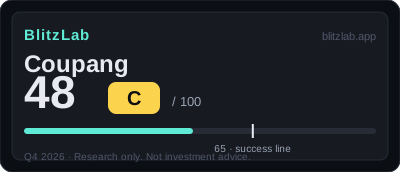
Coupang — Blitz Index 48 (C)
Product Commerce +11% with $2,485M adjusted EBITDA; Developing Offerings +38% with −$995M. The breach tax: 33M accounts, a $410M provision, $1.2B in vouchers.
Last re-scored: November 3, 2026.
Confidence: High · Category: platforms
Score breakdown
| Section | Score | Detail |
|---|---|---|
| A · Speed | 13 / 25 | FY2025 +14% slowed to +~6% in H1 2026 after the incident; the second curve is +38% but losing money |
| B · Moat | 36 / 60 | WOW bundle lock-in + Rocket Delivery infrastructure; G2 only clears with adjacent-market summation |
| C · Creative destruction | 10 / 15 | Redefined Korean delivery with dawn delivery; Product Commerce is 85.7% of revenue |
| D · BlitzFailing | −11 | 33M-account breach; PIPC $410M provision; Bom Kim holds 74.1% voting power |
Think we scored it wrong? Score it yourself →
Radar axes (0–100): Moat 60.0 · Speed 52 · Creative 66.7.
Watch item
Gates: G1 ✓ · G2 ✓ (borderline). 17 points below the threshold — first score. Act one's harvest is funding act two's burn, with the breach still in the numbers.
Strengths
- Product Commerce $29,592M (+11%), adjusted EBITDA $2,485M at an 8.4% margin — the cash engine
- Developing Offerings $4,942M (+38%) — Eats, Taiwan and Farfetch as the second curve
- Net other revenue $8,222M (+28%) — the 3P, advertising and WOW high-margin mix
- WOW bundle + Rocket Delivery infrastructure holding 24.7M active customers
Concerns
- Growth decelerated from +14% to +~6% — the 10-Q names the incident as the cause
- Developing Offerings losses widened from −$631M to −$995M — the second curve's fuel burn
- TTM FCF $105M, down 87% — the cash-generation collapse
- Bom Kim 74.1% voting power + CEO-chair — no check on the direction
Research notes
Thesis: a finished blitz in its home market, paying for its second act
Coupang, Inc. scores 48 out of 100, grade C, under BlitzLab v1.0, and the total is best read as two stories held in a single number. The business sections add up to 59: speed 13 out of 25, moat 36 out of 60, and creative destruction 10 out of 15. Deductions of 11 points then pull the total to 48, seventeen points below the 65-point threshold. The arithmetic is exact: 13 plus 36 plus 10 minus 11 equals 48, and every item subscore sums exactly to its section total. There is no FLAG marker on this score, because the deduction total of 11 sits below the 15-point FLAG threshold. That absence matters for how the score should be read. Coupang is not flagged as a blitz-failing watch case. It is, in the score file's terms, a mature company whose first blitz is finished and whose second blitz is still loss-making, with a large realised trust cost layered on top of both.
This is a first scoring, not a rescore, and the scoring date, or T, is October 17, 2026. The latest results available at T were the second quarter of 2026, reported in the Form 10-Q filed on August 4, 2026. Third-quarter 2026 results, due on November 3, 2026 on a press-reported basis, are excluded from the score because they fall after T, and they appear in this body only as a future marker, with no anticipated outcome attached. The company is classified as mature in the score file, on trailing-twelve-month revenue of approximately $35.5 billion and a market capitalisation of approximately $25.7 billion. It is a United States-listed company, incorporated in Delaware and headquartered in Seattle, whose operating body is in Korea. That geographic split is not a footnote to the Coupang story. It is the story: a Korean commerce, delivery, advertising, food-delivery, entertainment, fintech, and luxury business, scored through United States filings.
The two-sided structure runs through every section. On one side stands Product Commerce, the home-market business, with revenue of $29,592 million in fiscal 2025, up 11% year over year, and adjusted EBITDA of $2,485 million, a margin of 8.4% on the score file's calculation. That is a cash-generating core at very large scale. On the other side stands Developing Offerings, the second growth curve, with revenue of $4,942 million in fiscal 2025, up 38% year over year and equal to 14.3% of total revenue, but with an adjusted EBITDA loss of $995 million, widened from a loss of $631 million in the prior year. The second curve is growing faster than the core and losing more money as it grows. The score file names that tension directly in its first key driver: the fuel for the second curve is the core's cash, and the core's cash is being consumed by the second curve. Gate 1, which asks whether growth continues or a second growth curve exists, passes on confirmed evidence, because total revenue grew from $24,383 million in 2023 to $30,268 million in 2024, up 24%, and then to $34,534 million in 2025, up 14%, a two-year increase of 41.6%, all confirmed from SEC filings, and because Developing Offerings provides a second curve in fact, not merely in plan. Product Commerce active customers rose from 21.5 million in the first quarter of 2024 to 24.7 million in the second quarter of 2026, also confirmed from SEC filings. Gate 2, which asks whether the ten-year ceiling of the new market is at least ten times current revenue, passes only as an estimate and only on a borderline basis, a distinction this body preserves throughout, because the borderline character of Gate 2 is central to the score.
The third element in the thesis, and the one that most distinguishes this scoring from a routine mature-company scoring, is trust. A data breach in November 2025 affected up to 33 million customer accounts, according to the score file's account of the Form 8-K disclosure under Item 1.05. The account details are limited to what the score file states: names, telephone numbers, delivery addresses, and email addresses were involved, the act is estimated in the file to have been by a former employee, and payment information was not leaked. The score file does not add breach details beyond that account, and neither does this body. What the score file does record, in unusual explicitness, is the cost chain that followed: a provision of $410 million for a Personal Information Protection Commission fine, a customer compensation programme of $1.2 billion in vouchers, and a direct statement in the second-quarter 2026 Form 10-Q that the incident was the main cause of the slowdown in first-half 2026 growth. A data breach that a filing itself names as the cause of a growth slowdown is a different kind of event from a breach recorded only as a contingent liability. It is scored here in three places at once, and the reader who wants to understand the total of 48 should keep all three in view: a deduction of 4 points in the regulatory and social-cost item, a one-point discount in the irreversible-behaviour-change item, and a placement at the lower end of the network-effect anchor band. Trust, in this scoring, is both the fuel of the blitz and, once broken, one of its most expensive deductions.
Speed: growth that is decelerating from a very large base
Speed scores 13 out of 25, or 52.0 on the radar conversion, and its four items are growth 6 out of 10, capital velocity 2 out of 5, hiring and productivity 2 out of 5, and share velocity 3 out of 5. The shape of the section is deceleration, not collapse. Growth is still present at every level the score file measures, but it is slowing, and the score file is explicit that the slowdown is both visible in the numbers and attributed in the filings to the November 2025 incident.
The growth item, at 6 out of 10, rests on a confirmed revenue path that is strong in level and weakening in rate. Fiscal 2025 revenue of $34,534 million, up 14% year over year, follows fiscal 2024 revenue of $30,268 million, up 24%, and fiscal 2023 revenue of $24,383 million. The two-year increase of 41.6% is confirmed from SEC filings. The first half of 2026 then grew by approximately 6%, comprising growth of 7.5% in the first quarter and 3.9% in the second quarter, both confirmed from the Form 10-Q, which states that growth slowed in the aftermath of the incident. The score file's reasoning for withholding four points is stated plainly: from a base of approximately $35 billion, the step down from 14% to approximately 6% is a clear deceleration trend, and the incident shock is still in progress. The second growth curve tempers that reading without reversing it. Developing Offerings revenue of $4,942 million, up 38% year over year and equal to 14.3% of total revenue, confirmed from SEC filings, shows that new growth axes exist in Eats, Taiwan, and Farfetch. But those axes are expanding their losses at the same time, with Developing Offerings adjusted EBITDA at negative $995 million, and the growth item therefore describes a company whose headline growth is slowing even as its newest growth is accelerating. Both halves of that sentence are confirmed, and both are needed.
Capital velocity scores 2 out of 5, and the evidence is a mixture of access retained and fuel supply weakened. Market capitalisation was approximately $25.65 billion on October 16, 2026, on a press-reported basis, down 56% from the 52-week high of $32.35. Short-term borrowings were $1,985 million, confirmed from SEC filings, double the $960 million recorded at the end of 2025. Against those negatives stand confirmed offsets: cash of $6,110 million, a $1 billion share repurchase programme of which $243 million was executed in 2025, and a five-year revolving facility, described in the score file in connection with a Farfetch refinancing at a reduced interest rate. The score of 2 therefore describes capital access that is maintained but a blitz fuel supply that is slowing, because a share price roughly halved from its 52-week high and a doubling of short-term borrowings are, in the score file's judgement, the conditions under which the speed of refuelling declines. The business score does not look at price as a value judgement, and this body does not use the market capitalisation figure that way. It is recorded here only as the score file uses it: as evidence about capital velocity.
Hiring and productivity score 2 out of 5, and the underlying figure is scale of a particular kind. Employees numbered approximately 108,000 at December 31, 2025, confirmed from SEC filings, mostly on the Korean logistics front line under a direct-employment model. Revenue per employee is approximately $328,000, an estimated figure calculated in the score file as trailing-twelve-month revenue divided by headcount. The score file's reasoning is structural rather than critical of effort: a logistics-intensive business is structurally low on this measure, and the scale of hiring itself is consistent with a company in the middle of a blitz, but the productivity indicator, on the score file's conservative reading, supports only 2 points. The score file also records Coupang Care, a health-promotion programme for logistics workers confirmed in the Form 10-K, as an internalisation of social cost. That programme is not scored as a productivity gain. It is recorded as evidence that the labour model carries costs the company has chosen to absorb directly, which is part of why a headcount of approximately 108,000 should not be read as a pure speed asset.
Share velocity scores 3 out of 5, and here the score file is candid about the limits of its evidence. Coupang is described as the dominant operator in Korean business-to-consumer e-commerce, on a press-reported basis from ResearchAndMarkets in January 2026, but a quantitative market share is not disclosed by the company and is therefore marked unconfirmed in the score file. This body preserves that label exactly: dominance is asserted in a press-reported source, not demonstrated in a disclosed number. What is confirmed is geographic extension: the launch of Rocket Overseas in Taiwan and retail operations in Taiwan, confirmed in the Form 10-K, and the incorporation of Farfetch globally from January 30, 2024. The score of 3, in the same band the score file notes for another company scored at 3 on a company-asserted share figure, reflects a dominant position claimed but not numerically proven, with real extension into new markets alongside it. A reader should not convert the word dominant into a percentage, because the score file deliberately does not.
Moat: a logistics and membership lock-in, priced against a borderline ceiling
The moat section scores 37 out of 60, or 61.7 on the radar conversion, and it is the largest section in the model, so its shape drives the total more than any other section. Its four items are network effects 11 out of 18, distribution scalability 12 out of 18, market size 8 out of 12, and gross margin 6 out of 12. The section describes a genuine moat, built on infrastructure and membership, whose ceiling is only just large enough and whose cash conversion has weakened sharply.
Network effects score 11 out of 18, placed at the lower end of the 10 to 14 anchor band. The score file notes that the anchor example for that band lists the Coupang marketplace directly, as a two-sided market with liquidity, and the evidence for the placement is confirmed in the filings. The WOW membership bundles Rocket delivery with over-the-top content and fintech services into a paid lock-in. The marketplace itself is two-sided, connecting third-party sellers with 24.7 million active customers. Rocket delivery infrastructure is named in the Form 10-K as a core competitive advantage, confirmed from SEC filings. Those three elements together, a paid bundle, a two-sided marketplace, and a proprietary delivery network, are the substance of the network-effect claim. Two discounts pull the score to the lower end of its band, and the score file names both. First, quantitative measures such as cross-elasticity and churn rates are not disclosed, and are therefore marked unconfirmed. The network effect is demonstrated in structure and scale, not measured in the elasticities a stricter test would want. Second, the November 2025 data breach damaged trust, and the Form 10-Q names it as the main cause of the first-half growth slowdown, confirmed from SEC filings. A network whose value depends on customers trusting it with their addresses, telephone numbers, and payment relationships is a network whose trust damage is a moat damage, and the score of 11 records that connection rather than treating the breach as an unrelated incident.
Distribution scalability scores 12 out of 18, the strongest moat item, and the evidence is a demonstrated engine of category replication. The path runs from direct-purchase retail to the marketplace, then to Rocket Fresh, then to advertising, and then to Eats, Play, fintech, Taiwan, and Farfetch, with the segment definitions confirmed in the Form 10-K. The score file treats that sequence as repeated proof of a category-expansion engine: the same logistics, customer base, and membership infrastructure is reused to enter adjacent categories, and each entry is an observed expansion rather than a planned one. Net other revenue of $8,222 million in fiscal 2025, up 28% year over year and confirmed from SEC filings, is the financial trace of that engine, combining third-party fees, advertising, WOW membership, Eats, and fintech. The score stops at 12 rather than higher because the score file records no viral or platform-boarding mechanism of the kind that would carry distribution without further effort. Coupang's distribution scales by replication, category by category, market by market, and that replication is proven, but it is work each time. The distinction matters for the second growth curve: Eats, Taiwan, and Farfetch are distribution extensions, and their losses are the cost of extending distribution before the new categories pay for themselves.
Market size scores 8 out of 12, and the reasoning behind it is the most methodologically explicit passage in the score file, so this body reports it in full. The gate bar is trailing-twelve-month revenue of approximately $35,462 million multiplied by ten, approximately $355 billion. On a strict judgement, Korean business-to-consumer e-commerce alone does not reach that bar: the market is $268.8 billion in 2025, rising to a forecast of $349.8 billion in 2029, on a press-reported basis from ResearchAndMarkets via GlobeNewswire in January 2026, equal to 0.98 times the bar, a miss. On a combined judgement, adjacent markets are added: Korea at approximately $350 billion, Taiwan e-commerce at approximately $40 billion, food delivery at approximately $20 billion, retail media and advertising at approximately $5 billion, fintech at approximately $10 billion, and global luxury online at approximately $80 billion, totalling approximately $505 billion, or approximately 1.4 times the bar, a borderline pass. The score file justifies the combination on a specific ground, and this body preserves that ground exactly: every combined component corresponds to an actual business segment of Coupang, as defined in the Form 10-K, where Developing Offerings comprises Eats, Play, fintech, Taiwan, and Farfetch, and advertising sits inside Product Commerce, all confirmed from SEC filings, so the combination is not an arbitrary extension. The score file also states the condition that keeps the pass borderline rather than comfortable: realising the combined ceiling would require extreme share capture in each adjacent market. The score of 8, two points below companies scored at 10 on ceilings two to three times their bars, records that condition. Gate 2 therefore passes, but it passes in the same manner the score file notes for another company scored in the same quarter, where a single-market ceiling at 97% of its bar was combined with adjacent markets into a borderline pass. If a reader believes the adjacent-market combination is excessive, the score file itself invites reconsideration, and this body records that invitation rather than resolving it.
Gross margin scores 6 out of 12, and the item is where the two-sided story becomes a cash story. The gross margin rate is 29.4% in fiscal 2025, confirmed from SEC filings, with Product Commerce at 32.0% and Developing Offerings at 13.7% on the score file's calculation. The core's margin is solid. Against it stand three confirmed facts that pull the score down. The adjusted EBITDA margin is 4.3% in fiscal 2025. Developing Offerings adjusted EBITDA is negative $995 million, widened from negative $631 million in the prior year, confirmed from SEC filings. Free cash flow on a trailing-twelve-month basis is $105 million, down 87% year over year, confirmed from SEC filings. The score file's summary is that the quality of margin exists but cash generation has collapsed, and the score of 6 is the numerical form of that sentence. A reader who cites the 29.4% gross margin without the $105 million free cash flow figure, or who cites the free cash flow collapse without the Product Commerce margin of 32.0%, would be telling half the story. The moat section as a whole has the same structure: a distribution and membership advantage that is real, a market ceiling that is only just sufficient, and a cash conversion that has weakened at the moment the second growth curve most needs cash.
Creative destruction: a delivery standard that redefined a market, discounted by trust
Creative destruction scores 10 out of 15, or 66.7 on the radar conversion, and its three items are replacing the existing order 4 out of 5, irreversible behaviour change 4 out of 5, and cost-structure change 2 out of 5. The section describes a displacement that is substantial in its home market and incomplete in its cost logic, with trust acting as a discount on the behaviour change it created.
Replacing the existing order scores 4 out of 5. The order being replaced is Korean offline and traditional distribution, and the mechanism is Rocket delivery, which redefined the standard for delivery speed, confirmed in the Form 10-K's business and risk-factor sections. Product Commerce accounts for 85.7% of connected revenue in fiscal 2025, confirmed from SEC filings, which means the displacement has its home base in the core business rather than in a peripheral experiment. Competition with companies such as Naver and SSG coexists with the displacement, as the score file notes, but the scale and clarity of the replacement are sufficient for 4 points. The score stops short of the top mark because the displacement, while large, is not described in the score file as complete, and because the competitive coexistence is real. What is being replaced is the expectation of how quickly and reliably an online order arrives, and that expectation, once reset by dawn-delivery standards, is difficult for traditional distribution to meet without rebuilding its own logistics. That is the sense in which Coupang's creative destruction is infrastructural rather than merely commercial.
Irreversible behaviour change scores 4 out of 5, and the anchor for the item is unusually direct. The score file notes that the anchor example for the top mark lists dawn delivery, with the parenthetical that Coupang created the standard, directly in the anchor. The behaviour is the expectation of overnight delivery as a default, reinforced by the WOW bundle's subscription lock-in and by revenue per active customer maintained in the $300 range, confirmed from SEC filings. The discount from the top mark is the trust cost, and the score file states it precisely: the November 2025 data breach damaged trust, and the $1.2 billion voucher compensation programme, confirmed in the Form 10-K and running from January 2026 as a deduction from revenue, is the price of preventing churn. A behaviour change whose retention must be paid for in vouchers is weaker, in the score file's judgement, than a behaviour change that retains customers without payment, and the score of 4 records that weakening without denying the underlying change. Customers still expect dawn delivery. The question the discount raises is whether they expect it from Coupang with the same confidence they did before the breach, and the score file leaves that as a one-point discount rather than a reversal.
Cost-structure change scores 2 out of 5, the weakest item in the creative destruction section, and the reason is the status of the evidence. The Form 10-K asserts economies of scale from the company's own logistics network, under its key factors, and Product Commerce adjusted EBITDA margin is 8.4%, calculated in the score file as $2,485 million divided by $29,592 million. But a company-announced measured figure for the collapse in per-unit logistics cost is not disclosed, and is therefore marked unconfirmed in the score file. This body preserves that label exactly and does not supply a per-unit cost figure the score file does not contain. The score of 2 therefore describes a cost-structure claim at the assertion stage: the network exists, the core margin is real, but the measured unit-cost transformation that would prove a structural cost change has not been published. That is a disciplined withholding, and it is consistent with the score file's treatment of other unconfirmed quantities. A logistics network that has not published its per-unit cost decline cannot be scored as if it had.
Deductions and risks: governance and trust carry almost the whole weight
Deductions total 11 points: debt negative 2 out of a possible negative 10, revenue quality negative 1 out of a possible negative 10, governance negative 4 out of a possible negative 5, and regulatory and social costs negative 4 out of a possible negative 5. The distribution of those deductions is the most informative single fact in the deductions section. Financial leverage is light. Revenue quality is nearly clean. The weight sits almost entirely in two items, governance and regulatory and social costs, each one point short of the maximum deduction, and each grounded in confirmed filings. A reader who summarises Coupang's deductions as a debt problem would be misreading the score.
Debt, at negative 2, is the lightest deduction in proportion to its possible range, and the figures explain why. Financial debt, defined in the score file as short-term borrowings plus long-term debt, is $2,603 million, confirmed from SEC filings, equal to 0.07 times trailing-twelve-month revenue. Cash of $6,110 million covers financial debt by 2.3 times on the score file's estimated calculation. The score file pairs quarterly interest of $25 million against adjusted EBITDA of $163 million, confirmed from SEC filings, as an affordability indication. Against those comfortable ratios stand two structural items, and the score file names both as the reason for the deduction rather than a clean zero. Lease liabilities are $3,030 million, confirmed from SEC filings, and described as structural given the logistics character of the business. A provision of $410 million for a Personal Information Protection Commission fine is recorded, with the score file noting that the provision is not final in the sense that the formal disposition has not been issued and the amount may change, while the existence of the provision is confirmed in the Form 10-Q. Financial leverage, on the score file's reading, is modest, but the lease stack plus the fine provision are sufficient for a deduction of 2. That is a measured judgement, and it should not be inflated into a leverage crisis the filings do not support.
Revenue quality, at negative 1, is the smallest deduction, and it is small because the clean facts dominate. There is no revenue restatement and no audit-opinion issue, confirmed from SEC filings. A material weakness in internal control related to the Farfetch acquisition is treated as resolved in 2025, confirmed in Item 9A of the Form 10-K. The single discount is a one-off item the score file records with precision: of a $175 million insurance receipt for a fire at a fulfilment centre in 2024, $116 million was deducted from cost of sales, as stated in the Form 10-K, producing a one-off profit effect. The deduction of 1 is the score file's way of marking that one-off without suggesting a broader quality problem. A reader who wants to test revenue quality further will find little else in the score file to test it with, and that scarcity is itself the point: on the evidence in the filings, revenue quality is not where Coupang's risk sits.
Governance, at negative 4 out of a possible negative 5, is one of the two heavy deductions, and it deserves its full weight in this body because the score file gives it the weight of a structural fact rather than a judgement call. Class B shares carry 29 votes per share, confirmed by direct quotation in the score file from the Form 10-K original text, twenty-nine votes. Bom Kim holds all of the Class B shares, giving him 74.1% of the voting power at December 31, 2025, confirmed from SEC filings. He serves as both chief executive officer and chairman, confirmed in the definitive proxy statement DEF 14A filed on April 27, 2026. The score file places this in a band with precedent: another company at approximately 76% voting concentration is scored at negative 4, and another at 58.8% at negative 3, so 74.1% falls in the negative 4 band. The meaning of that placement should not be softened. When one person controls nearly three-quarters of the vote and holds both the chief executive and chairman roles, the checks that ordinarily constrain a chief executive are structurally absent, whatever the quality of that chief executive's decisions. The score file records no finding of wrongdoing in this item, and neither does this body. The deduction is structural: it describes where power sits, not how it has been used. But structure is what a scoring system is for, and on structure, Coupang's governance is one point short of the maximum deduction.
Regulatory and social costs, at negative 4 out of a possible negative 5, is the other heavy deduction, and it is where the breach, the fine, the compensation, and the wider regulatory history converge. The breach itself is dated November 18, 2025 in the score file's account of the Form 8-K under Item 1.05, confirmed from SEC filings, affecting up to 33 million customer accounts, with names, telephone numbers, delivery addresses, and email addresses involved, estimated in the file to have been the act of a former employee, and with payment information not leaked. The score file does not add legal outcomes or remediation claims beyond the filings, and this body follows that restraint. The fine provision is $278 million plus $132 million, totalling $410 million, recorded in the second quarter of 2026, with the formal disposition not yet issued so that the amount may change and an appeal planned, confirmed from SEC filings. The customer compensation programme is $1.2 billion in vouchers, running from January 2026 and deducted from revenue, confirmed in the Form 10-K. Alongside the breach sit two further confirmed items: a Korea Fair Trade Commission fine of $121 million from June 2024, confirmed from SEC filings, and an initial-public-offering securities class action that is in progress. The score file's reasoning for withholding the fifth point is stated explicitly: the formal disposition is not final, and payment information was not leaked, so the maximum deduction is reserved. The reasoning for the four points that are given is equally explicit: a realised large-scale breach, plus a fine provision, plus a compensation programme, is a triple impact. That triple impact is the score file's phrase, and it is the right phrase for this body, because it captures why a single incident is scored in three places. The breach is not only a regulatory event. It is a trust event that slowed growth, a cost event that consumes revenue through vouchers, and a governance-adjacent event in that it tests whether a concentrated leadership can restore confidence. The deduction of 4, one point short of the maximum, records all three without claiming the worst case.
Two further items from the score file's list of concerns are worth recording because they complete the risk picture without changing the score's structure. Short-term borrowings doubled from $960 million to $1,985 million, and equity fell from $4,623 million to $2,987 million, as listed in the score file's concerns. The score file does not attach a separate deduction to those movements beyond the items already scored, and this body does not add one. They are recorded here as context for the capital-velocity and debt items: a balance sheet that is becoming more borrowed and less equity-funded at the same time as its second growth curve is loss-making and its free cash flow has fallen 87%. That combination is the financial backdrop against which the governance and trust deductions should be read.
What to watch: whether the second act starts paying, and whether trust recovers
The score file's own framing of the path forward is unusually clear, and this body follows it. The distance to the 65-point threshold is sixteen points, and the score file states what that distance depends on: whether the second act starts making money. That is not a prediction about any single quarter. It is a structural statement about the score's composition. Product Commerce already generates cash, with adjusted EBITDA of $2,485 million at a margin of 8.4%. Developing Offerings already grows, at 38% year over year to $4,942 million. What has not yet happened, on the evidence at T, is the combination of those two facts in the same segment: growth that generates cash rather than consuming it. The markers for that combination are in future filings, and the score file names the most immediate one. Third-quarter 2026 results, due on November 3, 2026 on a press-reported basis and excluded from this score, are the first judgement point on the active-customer trend, which the score file identifies as the maximum watch point for the trust question. This body attaches no anticipated outcome to that marker. It records only that the marker exists, and why it matters: if the active-customer count, at 24.7 million in the second quarter of 2026, holds or grows in the next filing, the trust discount in the network-effect and behaviour-change items will have one piece of evidence against it, and if it does not, the discount will have one piece of evidence for it. Either way, the judgement will come from the filing, not from an expectation formed in advance.
The second watch item is the free cash flow line. Trailing-twelve-month free cash flow of $105 million, down 87% year over year, is the single most dramatic deterioration in the score file, and it sits alongside a gross margin rate that has not collapsed and a core adjusted EBITDA that remains positive. That combination, margin maintained but cash conversion collapsed, is the pattern the score file flags for a future methodology question, and it is the pattern a reader should watch in future filings. If free cash flow recovers while Developing Offerings losses narrow, the gross-margin item's discount will have a reason to narrow. If free cash flow stays near $105 million while the second curve continues to expand its losses, the question becomes how long the core's $2,485 million of adjusted EBITDA can fund both the second curve and the trust costs of vouchers and fines. The score file does not answer that question, and this body does not answer it either. It is recorded as the central financial tension of the score.
The third watch item is the regulatory finality that the score file deliberately leaves open. The Personal Information Protection Commission disposition has not been formally issued, the $410 million provision may change, and an appeal is planned, all confirmed in the score file's account of the filings. The initial-public-offering securities class action is in progress, with no outcome stated in the score file. Those open items are why the regulatory deduction stops at 4 rather than 5, and they are also why it could move in either direction in a future scoring. A formal disposition at or below the provision, an appeal outcome, or a resolution of the class action would each be a filing event that a future scoring would need to record. Until those filings arrive, the honest summary is the score itself: a company that completed its first blitz in Korea, built a delivery standard and a membership lock-in that competitors must reckon with, extended that engine into food delivery, Taiwan, advertising, fintech, and global luxury, and now faces the two costs that the score file scores most heavily, concentrated governance and broken trust, while its second growth curve consumes the cash its first growth curve generates. The total of 48, grade C, seventeen points below the threshold, is BlitzLab's way of holding that combination in a single number: a finished blitz, an unpaid second act, and a trust bill that is still being paid.
More Platforms companies
Other Platforms names on the Blitz Index, highest score first: Alphabet (83/A), Meta (78/B), Airbnb (76/B).
Next earnings
Q4 2026 · Expected
Coverage
Coupang, Inc. · Q3 2026 due Nov 3, 2026 (AMC, confirmed) · Score 48 · Grade C
Embed this score
Copy the HTML below to show this score on your site. The badge links back to this page and updates automatically when the score changes.
Preview:
BlitzLab scores businesses against a scholar’s standard — not investment advice. No price targets, no buy/sell recommendations. Figures are from SEC filings (XBRL) as labeled in the source scorecard.